Buyer Fit Snapshot
| Best fit | Retail Packaging Supplier projects where brand print, material claims, artwork control, MOQ, and repeat-order consistency need to be specified before quoting. |
|---|---|
| Quote inputs | Share finished size, material target, print colors, finish, packing count, annual reorder estimate, ship-to region, and any compliance wording. |
| Proofing check | Approve dieline scale, logo placement, barcode or warning zones, color tolerance, closure strength, and carton packing before bulk production. |
| Main risk | Vague material claims, crowded artwork, missing packing details, or unclear freight terms can make a low unit price expensive after revisions. |
Fast answer: Retail Packaging Supplier: Quote Scope should be specified like a repeatable production item. The safest quote records material, print method, finish, artwork proof, packing count, and reorder notes in one written spec.
Production checks before approval
Compare the actual filled-product size with the drawing, then confirm tolerance on folds, seals, hang holes, label areas, and retail display edges. Reserve space for logos, QR codes, warning copy, and material claims before decorative graphics fill the panel.
Quote comparison points
Review material grade, print process, finish, sampling route, tooling charges, carton quantity, and freight assumptions side by side. A quote is only useful when the supplier can repeat the same color, closure quality, and packing count on the next order.
A serious retail packaging supplier guide matters even when a product already has traction. I have seen a polished sleeve design glide through internal approval on a Monday, then come back on Friday with a production bill that had nearly doubled because UV varnish, corrugate grade, and urgent freight were never captured in the first quote. That kind of miss does not look dramatic on paper. It just eats margin quietly, line by line, until somebody notices the launch is suddenly a lot less profitable than expected.
From a buyer’s perspective, a supplier is not just a sales contact with a clean template and a few cheerful promises. The partner you trust is sourcing stock, managing printing and finishing, controlling tooling, running quality checks, and often coordinating freight so cartons land at the right dock before the clock runs out. A practical retail packaging supplier guide should help you evaluate that whole chain, not only the first person who answers the email.
Team roles matter just as much as machine specs. Sourcing watches cost and contracts. Production planning tracks dates, capacity, and changeovers. Operations translates design intent into instructions that can actually be built. Quality checks the final pack against the approved spec. If those lanes blur, the conversation gets messy fast, and your retail packaging supplier guide turns into a blame map by the time the first shipment stalls.
Retail Packaging Supplier Guide: Why One Wrong Quote Can Sink a Launch
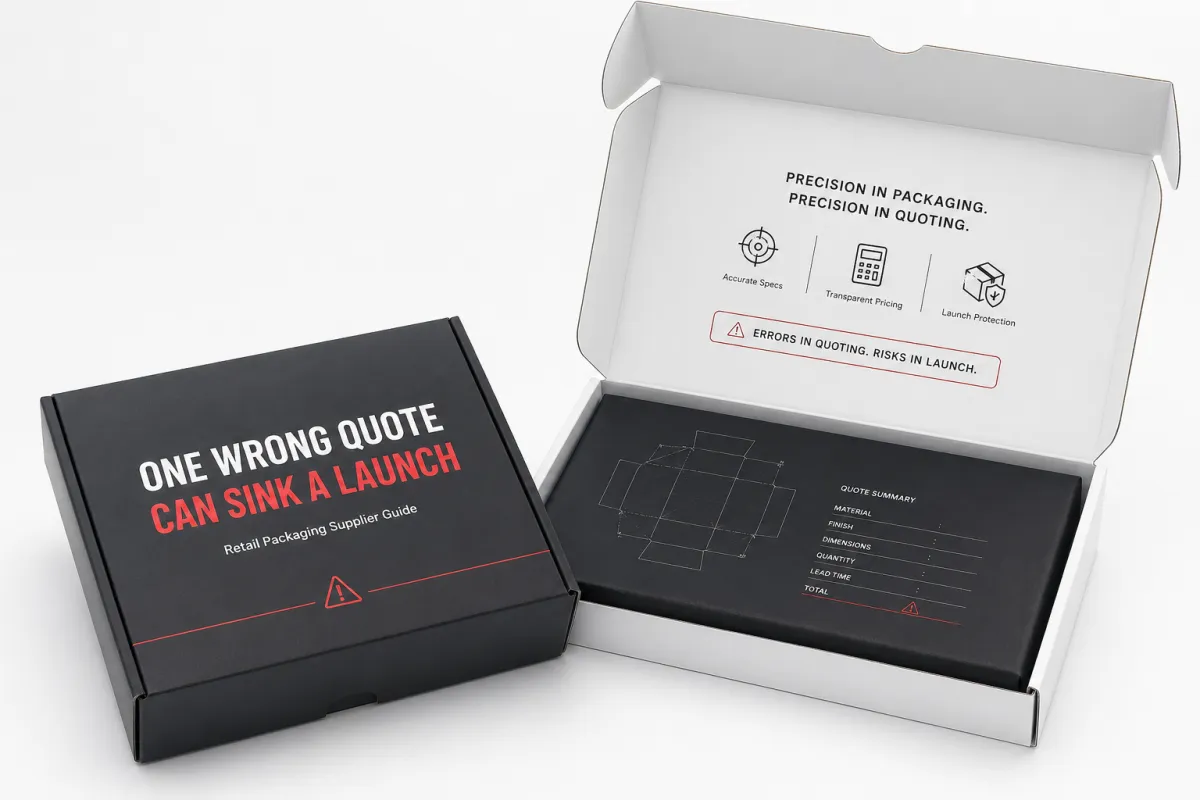
The big trap is pretending every supplier is interchangeable. A converter turns board, film, or paper into finished packs. A printer may own the press but hand off finishing to someone else. A fulfillment partner can pick, pack, and ship while still relying on a separate print workflow. Brand-owned production sits at the other end of the spectrum, shifting more control and more risk inside the organization. A clear retail packaging supplier guide exposes those boundaries before a low quote creates expensive surprises.
Retail packaging fails in practical ways, not theoretical ones. If a sleeve is off by a millimeter, the carton jams on automation. If varnish details are missing, the finish scratches during handling and transport. If board grade is too light, pallets sag before the distribution center gets the load off the truck. A useful retail packaging supplier guide asks more than "can they print it?" It asks whether they can print, finish, inspect, and deliver without burying extra charges in the fine print.
Supplier conversations should map ownership, not enthusiasm. Ask who takes the brief, who checks dielines, who signs off on samples, who authorizes changes in production, and who owns a defect claim if a run misses spec. In a competent retail packaging supplier guide, that responsibility map is written down early, because assumptions get expensive when they are wrong.
A second failure pattern shows up when people treat printer, tooling house, finishing contractor, and freight as one single chain of command. Sometimes that line does exist, but not often. When accountability is split and unmanaged, delays hide in the gaps and everyone sounds cooperative while the launch schedule still cracks. Responsibility clarity beats charm every time, and that is exactly why a retail packaging supplier guide earns its keep.
Get expectations down before the first proof. This is not a catalog of attractive boxes with smiling promises. It is a map for choosing a supplier that can handle promos, stockouts, design changes, and seasonal spikes without forcing you to rebuild the job from scratch. If a candidate cannot show that they have lived through those realities, they are probably just a temporary line on a PO, not a retail partner you can count on.
"A low quote is not automatically a better quote. It is often a quote with missing lines. That is usually where the trouble starts."
How Does a Retail Packaging Supplier Work From Artwork to Shelf?
A practical retail packaging supplier guide should show the full process from brief to store shelf. Intake comes first: dimensions, structure, SKU count, and launch dates need to be fixed before design talks drift into wishful thinking. Then comes a technical review, where bleed, dielines, barcode placement, color profiles, and tolerances are checked against real production constraints. After that, a sample or prototype is built, reviewed, corrected if needed, and approved before production is scheduled. The sequence sounds obvious, but it is exactly where many teams start cutting corners.
Most breakdowns follow a familiar pattern. A tolerance check gets skipped because everyone assumes CAD is enough, and then the carton is technically correct but operationally useless. A dieline is treated like an art reference instead of a mechanical boundary. Color is approved in the wrong profile and turns into a surprise during press-up. A strict retail packaging supplier guide turns those checks into hard gates instead of optional niceties.
Capacity pressure shows up once production is booked. If your launch lands beside a seasonal campaign or a big reorder, You Need to Know exactly where your job sits in the queue. A disciplined supplier gives you revision logs, a sample feedback trail, and escalation rules when tolerances drift. Without that visibility, your launch calendar starts behaving like a rumor.
Store reality can be harsher than lab testing. A sleeve that looks great on a light box may fail after repeated handling. A carton that passes visual approval can still fail compression, palletization, or barcode scans. For ecommerce, shipping stress matters as much as shelf aesthetics. If your packaging has to survive parcel lanes, transport durability references from ISTA help separate marketing confidence from physical reality.
Some suppliers add warehousing, kitting, and fulfillment to the chain. That structure can reduce handoffs and file losses. It can also erode margin when storage, pick-pack labor, and overtime rules are fuzzy. A reliable retail packaging supplier guide asks for explicit pricing language around those service layers before they become silent tax lines. Nobody likes opening an invoice and discovering the "small extras" have turned into the real bill.
For programs using Custom Printed Boxes or intricate branded packaging, a pre-production sample and a pilot lot usually reveal much more than an email exchange ever will. The sample confirms appearance; the pilot lot confirms repeatability. If a supplier refuses that middle proof step and jumps straight to full production, the answer usually reveals the weakness. For shelf-ready packaging and point-of-sale display work, that middle step matters even more because display behavior matters as much as print quality.
Key Factors Before You Approve a Retail Packaging Supplier
Technical competence is the first gate. If a supplier cannot run your required print method, the conversation should stop there. Ask what is managed in-house versus outsourced. Flexo, digital, and offset each behave differently, and so do minimum board weights, film gauges, lamination choices, and finishes such as embossing, spot UV, and hot foil. A solid retail packaging supplier guide treats those factors as non-negotiable, not decoration.
Paper-based programs bring sustainability claims into play, and claims without evidence create risk. Ask for documentation, not buzzwords. If recycled content or responsible sourcing is part of the pitch, request proof and traceability. The FSC system can be a useful reference, but your contract still needs line-level proof for the exact stock you buy. A thorough retail packaging supplier guide does not let environmental language float free from audited data.
Reliability should be scored with measurable behavior. Track sample lead-time consistency, on-time shipment performance, defect rate, and response speed during rework. A partner that replies quickly during the easy part and disappears during revision cycles is sending a message, and it is not subtle. A good retail packaging supplier guide rewards steady execution, not polished promises.
Data sharing is not administrative overhead; it is how you prove process control. Ask for COA, COF, proof logs, versioned change history, and test reports. Ask how artwork and tooling changes are recorded between proof and run. If the response is "we can send later," you are not seeing a process, just goodwill. In this retail packaging supplier guide, documentation quality belongs in the core acceptance criteria.
Service details can make a flawless spec look messy in execution. Time-zone overlap, language support, bilingual artwork handling, replacement policy, and warehouse destination flexibility determine whether execution bends under pressure. When your team runs across multiple regions, the supplier should sync to your calendar rather than force your teams to absorb their operating rhythm. Another reason the retail packaging supplier guide cannot stop at unit price.
Use a weighted scorecard from the start. Price matters, but so do quality, reliability, timing discipline, service, and risk controls. If you need a baseline, weight these at 25%, 20%, 20%, 20%, 15%, and 10%. Set hard fail points for launch risks: compliance misses, weak sample discipline, vague change control, and delivery ambiguity. A retail packaging supplier guide without numeric weights becomes a wish list with a logo.
| Supplier Model | Best Fit | Typical Strength | Common Risk | What to Ask First |
|---|---|---|---|---|
| Local converter | Short runs, fast reorders, custom packaging with tighter oversight | Quick communication and easier sample handling | Limited capacity during peak demand | On-time rate, backup capacity, changeover limits |
| Large print house | High-volume retail packaging and multi-SKU rollouts | Lower unit cost at scale | Slower revisions and more process layers | Revision policy, proof timing, escalation path |
| Fulfillment partner | Kitting, assembly, and store-ready packs | Fewer handoffs for packaging and distribution | Weaker print controls if sourced externally | Who owns inspection, warehouse fees, rework terms |
| Integrated supplier | Brands needing one owner for printing, finishing, and logistics | Single accountability across the chain | Contract scope can hide add-on charges | Line-item pricing, tooling ownership, freight terms |
That table captures the decision friction that should happen long before launch. Teams that delay this check usually end up rebuilding it under fire when a problem report lands in someone’s inbox. A reliable retail packaging supplier guide belongs inside the sourcing workflow, not in an archive folder opened only after an emergency.
Step-by-Step Guide: A Practical Timeline to Select the Right Partner
A fuzzy timeline produces a fuzzy supplier choice. This section of the retail packaging supplier guide is meant to be executable, not inspirational. Start with a one-page spec covering SKU count, dimensions, substrate, finish, unit volume, milestones, barcode rules, and legal text. A single clear page works better than a polished deck full of contradictions.
Step 1: define the spec and forecast. Specify what must stay fixed and what can change later. If a seasonal campaign creates pressure, record that constraint in the same document. A supplier needs context for whether they are supporting a one-time launch or a recurring program; that interpretation directly changes quoting quality.
Step 2: shortlist four to six suppliers whose capabilities overlap with the job. Before pricing, require a non-negotiables checklist: print method, finishing, sample schedule, approval authority, freight assumptions, and production slot status. Any team that cannot answer those basics should not move into deeper commercial discussion. That part is simple, but teams still skip it and then act surprised when the deal gets clumsy.
Step 3: run a focused sample sprint using the same design brief and identical approval criteria for every contender. Compare color control, die accuracy, fold behavior, surface durability, and handling behavior under repeated movement. The test is not a beauty review; it is a process test. The right retail packaging supplier guide checks repeatability before scale.
Step 4: build a cost model that separates every recurring and non-recurring cost. Include production, setup, tooling, shipping, inspection, returns, expected waste, and rework assumptions. If the quote packs everything into one line, split it yourself. A supplier list is useful only when it shows the real structure.
Step 5: map milestones with dates and decision gates. Start with T+0 brief handoff, T+3 mock sample, T+7 approvals, T+14 production lock, T+21 pilot lot, then move to full scale. Simpler sleeves may move faster, while multi-language or regulated packs need longer windows. Forcing both through one rhythm creates delay and blame, which is a dumb way to spend a launch budget.
Step 6: encode ambiguity control in the contract. Define defect cure periods, sample replacement triggers, priority slot rights during peak windows, and a right-to-audit clause if quality drifts. Tooling ownership, artwork revision ownership, and change fees should be explicit. A practical retail packaging supplier guide reduces ambiguity rather than documenting arguments after the fact.
Teams that want simple operations can use one tab for specifications, one for quotes, one for sample notes, and one for risks. Version discipline is crucial; three people comparing three files creates three versions of reality. That is the kind of confusion that turns retail packaging into expensive firefighting.
Retail Packaging Supplier Guide: Packaging Costs, Pricing Models, and Hidden Fees
Cost is where romance usually ends, which is often the healthy moment. A good retail packaging supplier guide separates all major components so no one mistakes a low unit price for a clean deal. Raw material, setup, waste, press time, color changes, finishes, inserts, hardware, QC, and transport all need explicit treatment. Missing any of these terms usually means a future argument, not a clean quotation.
Every pricing model carries trade-offs. Per-unit can look neat while burying setup and revision behavior. Per-kilogram can reward material efficiency until waste spikes and makes true costs hard to read. Tiered contracts can unlock scale economics, but only if actual volume matches the committed path. A useful retail packaging supplier guide shows where each model stays honest and where it quietly shifts risk.
Use this formula as a starting point:
Unit cost = (tooling + setup + materials + labor + QC + transport + expected waste) / units + contingency.
Contingency is not paranoia; it is practical risk budgeting. Boards warp, freight premiums arrive, and revisions always take more time than spreadsheets predict. A disciplined retail packaging supplier guide includes that buffer so margin is built on reality, not hope. If you leave it out, somebody is gonna pay for it later anyway.
Hidden fees are the real skill test for supplier discipline. Common extras include artwork cleanup, prepress checks, additional approvals, die-cut changes, freight spikes, express handling, storage charges, and replacement-run fees. If a quote looks too clean, some variable is likely being carried off-page. A supplier that avoids line-item detail is not being simple; they are leaving ambiguity visible on purpose.
| Pricing Model | Looks Cheap When | Hidden Risk | Best Use | Buyer Check |
|---|---|---|---|---|
| Per-unit | Volume is high and specs are stable | Setup, revisions, and freight may sit outside the number | Repeat retail packaging runs | Ask for revision and rush scenarios |
| Per-kilogram | Material use appears efficient | Waste, finishing, and spoilage can swing the real cost | Films and heavier board programs | Check expected scrap percentages |
| Tiered volume | Commitment is large enough to unlock lower rates | Forecast misses can erase the savings | Seasonal and multi-drop programs | Review minimums and exit terms |
| Blanket contract | Procurement likes predictable billing | Scope creep and surcharge creep become hard to spot | Multi-SKU retail packaging programs | Demand line-item transparency |
Negotiate in layers. Request a base quote, revised quote, and rush quote. Ask for a full breakdown for each line and a clear explanation when assumptions change. Confirm scrap tolerance bands so waste can be discussed as a rule, not a surprise. Clarify which condition triggers reprint charges and which triggers a courtesy remake. A quote that cannot survive that conversation probably was not built for real operations in the first place.
Sustainability claims deserve verification too. If recycled content is quoted, verify the materials and percentages against actual stock data. EPA recycling resources can support neutral reference points for waste and recovery language, but buyer-side diligence decides whether those claims survive commercial reality. Trust is fine; documentation is better.
If you are still sorting format and style options, review the supplier’s packaging range before pricing deepens. Our branded packaging options page can make early decisions about structure and finish faster, which reduces quote churn and keeps this retail packaging supplier guide tied to reality instead of hypotheticals.
Common Mistakes Retail Teams Make in Retail Packaging Supplier Selection
The first error is predictable and still very common: choosing on quote alone. Initial savings look attractive, then finishing corrections and reprints erase that gain. A useful retail packaging supplier guide forces total-cost comparison before any final signature. A cheap quote is only a good quote when execution works.
Confusing design skill with manufacturing readiness creates a recurring pattern. Beautiful visuals help, but they are only part of production readiness. If artwork-to-production handoff is weak, someone inside your team must become the missing operator for every issue. That role belongs to no one intentionally and usually ends with delayed timelines.
Ignoring real-world handling is another costly pattern. A carton can look perfect under studio light and fail in store replenishment, warehouse stacking, or sorter handling. If durability fails, the brand absorbs the impact and ownership often drifts toward "branding issue" by default. Packaging failures are usually process failures wearing a visual costume.
Treating sustainability claims as already audit-ready creates another blind spot. Require evidence for any environmental statement, including the standard used and what exactly the claim covers. If a supplier says it applies, ask whether it covers the full pack or only one component. Vague answers on this point signal risk, not differentiation.
Underestimating revision cycles causes late chaos. Multilingual labeling, regulation updates, and barcode changes look small in planning rooms and become schedule-heavy in execution. Teams often discover this only when proofs return too late and production windows compress. A practical retail packaging supplier guide reserves room for revision cycles up front, because the calendar does not care about optimism.
Signing long contracts without replacement timing can leave buyers trapped when demand shifts. One campaign peak can reverse the value equation: the low annual rate becomes less useful than dependable flexibility. Good supplier selection asks not just who charges less, but who remains functional through change.
Use this control matrix as a live reference:
- Price-only decision: owner is procurement; control action is a total-cost review including setup, freight, and reprint charges.
- Design-to-production gap: owner is brand operations; control action is preflight technical review before final artwork approval.
- Weak handling performance: owner is quality; control action is sample stress testing and transit validation.
- Unsupported sustainability claim: owner is compliance; control action is proof verification before launch.
- Revision cycle miss: owner is project management; control action is milestone windows with buffer time.
- No exit terms: owner is legal or sourcing; control action is contractual replacement and termination timing.
When that control list is visible and updated, the retail packaging supplier guide becomes a daily planning asset instead of a decorative document.
Retail Packaging Supplier Guide: Expert Actions and Your Next 30 Days
The quickest way to make progress is to start with one flagship SKU. A full reset of an entire packaging portfolio can break teams that are already running flat schedules. A focused retail packaging supplier guide becomes manageable when one real product, one real launch, and one real acceptance chain are under the microscope. Pick the SKU with the strongest margin risk or the highest customer visibility and test the framework there.
Use a simple review rhythm through the next month. Days 1 to 3: supplier outreach and pack brief. Days 4 to 10: technical discovery and non-negotiables. Days 11 to 15: sample review. Days 16 to 22: negotiation and scope cleanup. Days 23 to 30: final approvals, kickoff, and production lock. The structure keeps this retail packaging supplier guide active in the calendar rather than parked as deferred work.
Keep scoring criteria fixed once launched. Price at 25%. Quality at 20%. Reliability at 20%. Timeline discipline at 20%. Service at 15%. Risk controls at 10%. A supplier winning on unit cost but failing on quality and risk should not pass the gate. This framework protects the project from being won by headline price while losing on execution.
Before a PO is issued, harden service terms in writing: lead-time bands, response SLA, correction policy, change ownership, and quality hold steps. If those terms cannot be confirmed, the relationship drifts toward "flexible interpretation," and that is exactly what causes avoidable conflict during launch. Contracts are supposed to remove guesswork, not create a fresh pile of it.
Packaging format decisions can still impact execution quality. A small structural adjustment can reduce handling damage, lower freight costs, and simplify production more than a long-term contract negotiation. That is why a practical retail packaging supplier guide should sit next to packaging design and sourcing from day one.
Use a narrower comparison set: two suppliers is often enough for confidence if testing is strict. Run one sample sprint, score the same spec, and document every assumption clearly. If your team is evaluating options across custom printed boxes or retail-ready formats, reviewing the Custom Packaging Products page early helps set realistic technical and budget baselines before pricing intensifies.
The takeaway is straightforward: a retail packaging supplier guide protects margin, shortens approvals, and lowers launch risk from hidden fees, weak QA, or vague commitments. Put it to work on one live SKU, document the rules, and use the same scorecard on every repeat order so the next launch does not turn into the same expensive lesson wearing a different label.
What is a retail packaging supplier guide and why should my team use one?
It is a repeatable framework for evaluating suppliers under pressure without drifting into subjective decision-making. A good retail packaging supplier guide puts requirements, milestones, acceptance rules, and proof obligations into plain language before quotes become irreversible commitments.
How long should the process be in a retail packaging supplier guide before first full production?
For standard jobs, a practical window is about three to five weeks from spec handoff to launch-ready approval in steady conditions. One-color sleeves or simple corrugated work can move faster. Multilingual copy, special die cuts, coatings, and regulated labeling need longer planning and more checkpoint time. A retail packaging supplier guide should always include at least one revision cycle.
What should I include in a retail packaging supplier pricing checklist?
Track tooling, setup, substrate, print colors, finishing, die operations, QC, freight, sample approvals, and waste assumptions. Ask for quotes on baseline, lower-volume, and seasonal peak scenarios, because pricing often changes when urgency rises. A serious retail packaging supplier guide validates reprint rules, rush charges, and replacement fees before signing.
How can I catch unreliable suppliers early in a retail packaging supplier guide process?
Test response quality during sampling, not after contract execution. Ask for actual defect rates and on-time shipment data from recent projects, and verify references with similar retail profiles. A supplier that struggles with comparable runs is unlikely to perform flawlessly when your forecast volume increases. Operational proof is what this retail packaging supplier guide is built to demand.
How many samples are enough to trust a retail packaging supplier?
Use at least one pre-production sample and one pilot or short-run sample for the exact SKU structure and pack build. The first sample should confirm look and structure; the second should test process consistency, scan reliability, and handling behavior. A retail packaging supplier guide should allow scale only when both samples meet the same checklist used by receiving.
Use this retail packaging supplier guide as a standing sourcing practice, and the next launch becomes easier to control, cheaper to correct, and much less likely to turn into a familiar "small miss, big bill" story.

