For cosmetics woven label beanies Bulk Order Planning, the cuff is doing more work than most buyers expect. The shell can be warm and well knit, but if the label lands too high, curls at the fold, or fights the cuff depth, the product stops looking retail-ready. That kind of problem shows up fast in a gift set, a seasonal bundle, or a display carton. No one wants to explain why the promo item looks cheaper than the serum next to it.
Cosmetics brands use beanies as gift-with-purchase pieces, staff merchandise, launch freebies, and bundled seasonal accessories. A woven label gives the beanie a cleaner, more permanent brand mark than a temporary print. It also survives folding, bagging, transit compression, and warehouse handling better than a soft ink treatment on knit surface. That matters when the beanie has to arrive looking composed, not tired.
The strongest programs start with the surface the label will live on. Not the mockup. Not the quote. The cuff. Get that dimension right, and most of the rest becomes easier to control. Get it wrong, and the order spends the next three weeks trying to recover from a bad decision made too early.
Why cosmetics woven label beanies bulk order planning starts with the cuff
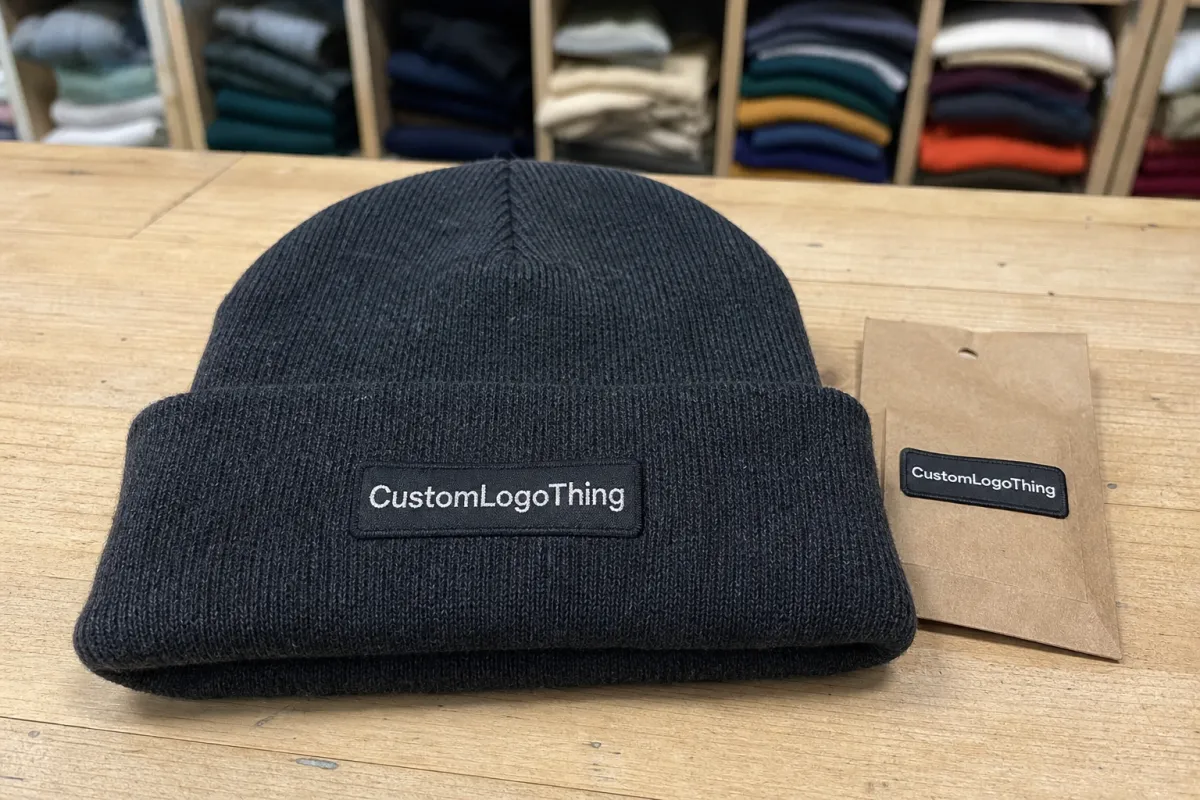
The cuff sets the visual balance, the sewing zone, and the visible branding area. A 1.5-inch woven label can look sharp on a tall cuff and awkward on a shallow one. If the fold is too short, the label gets crowded by the edge. If the cuff is too soft, it can curl after packing and make the logo read crooked even when the sewing was technically correct.
That is why the best planning starts with measurements, not artwork. A buyer can love the logo placement on a flat art board and still dislike it once the beanie is folded, bagged, and placed inside a kit. The actual product is what matters. A sample photo is useful, but a physical folded sample tells the truth faster.
Woven labels usually read as more premium than printed marks because the texture gives the logo more presence. Cosmetics buyers lean toward that finish for holiday sets, display-ready merch, and retail programs where the beanie needs to feel like part of the brand system instead of a throw-in. The label also handles repeated touch better. That matters in stores, in distribution, and in boxes that get opened and repacked more than once.
The common mistake is treating the beanie like a blank item and the label like a late-stage add-on. That can work for a tiny sample batch. It falls apart in bulk. Once the order is tied to a launch date, carton count, and packing workflow, small changes get expensive. A cuff depth change of even half an inch can force a label resize, a sewing revision, or a new fold method.
If the cuff height changes, the label balance changes too. That is usually where the order starts drifting.
Packaging also shapes the final result. A beanie packed with skincare kits or holiday gift sets needs to stay readable after compression. A woven label sewn onto a stable cuff is less likely to disappear into the knit texture. That protects the presentation at the point where the customer actually sees it: after transit, after stacking, after someone else has handled the box.
Beanie styles, yarns, and woven label constructions that sell through
Cuffed beanies usually give the cleanest label zone. The fold creates a natural panel for branding, and the label has a predictable surface to sit on. Slouchy styles can look modern, but they are less forgiving. The branding area moves more, and the label can float visually instead of sitting square. Rib-knit silhouettes are a practical middle ground. They keep enough structure at the cuff while still feeling soft enough for cosmetics gifting.
From a wholesale buyer's point of view, the best silhouette is the one that folds predictably and stacks well. A cuffed beanie is easier to bag, easier to photograph, and easier to merch on shelf or in a gift tray. Consistency matters. A product that looks neat in a sample tray should not turn into a different shape when packed in cartons for replenishment.
The label itself deserves more attention than it usually gets. A damask label is the usual choice for small logos and tight detail because the weave is fine enough to keep lines legible. If the design has thin type or a small icon, damask gives the sharpest result. A satin backer or folded edge can make the label feel smoother against the cuff and reduce scratch complaints from customers who notice these things immediately.
Body yarn changes the visual read more than many buyers expect. Acrylic is cost-friendly, color-rich, and easy to run in bulk. Wool blends add warmth and a more elevated hand feel, but the texture can soften the label contrast. Recycled yarns are common now, though they can carry slight shade variation from run to run. Cotton blends feel more natural, but they do not always recover as cleanly after folding. None of that is a deal-breaker. It just means the label and body need to be judged together, not separately on a screen.
Placement affects both style and production complexity. Most buyers compare the same few options:
- Center cuff for the clearest brand read.
- Side seam for a quieter, more fashion-led look.
- Back cuff when the front has to stay minimal.
- Woven patch for a more tactile stitched-on finish.
- Mixed placement when one mark is visual and another is informational.
Packaging choices still matter more than some teams admit. A beanie that ships with the right hangtag, clean polybag, accurate size sticker, and readable carton label is easier to count and easier to place into a retail workflow. If the product is meant for shelf display, ask for a fold method that keeps the cuff facing outward and the woven label visible through the bag. That one instruction saves time at receiving and store level. Small efficiencies become real money when the order scales.
For paper components, FSC-certified stock is a sensible ask for hangtags and outer printed inserts if the cosmetics brand is trying to keep its sustainability language consistent. For carton testing and shipping expectations, many teams use ISTA guidance as a practical baseline for distribution handling. It is not fancy. It is just a better way to find weak packaging before the customer does.
Spec sheet decisions that lock fit, color, and decoration before sampling
A good spec sheet removes guesswork before sampling starts. At minimum, it should list body fiber content, gauge, cuff depth, hat circumference, color target, label size, label construction, and exact sewing position. If the buyer sends only a logo file and a quantity, the first quote may look close enough, but the revision cycle can spiral once the real dimensions show up.
Measurements matter because a label that looks balanced on a 2.5-inch cuff can sit awkwardly on a 2-inch cuff once the beanie is folded for packing. The cuff is not just decoration. It is the working surface for the brand mark. Freeze that dimension first, then approve the label size against the actual folded garment. That sequence saves time and prevents a lot of avoidable back-and-forth.
Color approval needs a practical mindset too. Pantone is useful for woven labels, but knit bodies are not printed boards. Heather yarn, melange effects, and wool blends all carry visible variation. The right expectation is a controlled range, not perfect print-style uniformity. If the body is black, ivory, camel, or dark green, the label contrast should be checked against an actual yarn swatch, not a screen mockup that looks cleaner than the product will ever be.
There are a few finishing details that prevent headaches later:
- Fiber content labeling for retail and compliance.
- Care instructions that match the yarn blend.
- Loose-thread trimming before packing.
- Fold direction that protects the label face.
- Label stitch allowance so the patch stays flat on the cuff.
If you also need matching trims such as care labels, size tabs, or neck labels, align them before production starts so the sewing plan stays consistent. Reworking trim details after the sample stage is usually slower and more expensive than buyers expect. It also creates more room for the supplier to make assumptions, which is exactly what you do not want on a branded program.
Be specific about any retailer requirements or destination-market labeling rules. A supplier that sees the full spec early can price more accurately and avoid a second sampling round just to correct a missing instruction. That is especially useful in cosmetics programs, where the beanie may be packed with gift items, fragrance minis, or seasonal kits that all have to launch together and look like one collection.
Pricing, MOQ, and unit cost drivers to compare before you quote
Unit cost is shaped by a lot more than the woven label. Knit complexity, yarn blend, number of colors, label size, sewing time, and packaging all move the price. A simple acrylic beanie with one woven label and a basic polybag will usually land far below a wool-blend style with a custom patch, special hangtag, and printed insert.
MOQ logic follows the same pattern. The label adds artwork setup and sewing labor, but the minimum is usually driven more by knitting capacity, color runs, and body style than by the label alone. If the order uses multiple beanie colors, each split acts like a separate run and can raise the effective minimum. Buyers should ask how the supplier handles color breaks before they lock the forecast, not after.
| Run Size | Typical Use | Approx. Unit Cost | Notes |
|---|---|---|---|
| 300-500 pcs | Sampling, small promo test, local launch | $4.80-$7.20 | Higher setup share; fewer options keep pricing stable. |
| 1,000-1,500 pcs | Regional retail, gift-with-purchase, seasonal bundle | $3.10-$4.90 | Good balance of cost and control for cosmetics programs. |
| 3,000-5,000 pcs | National rollout, wholesale refill, multi-store order | $2.35-$3.70 | Better unit economics if artwork and color are locked early. |
| 8,000+ pcs | Broader retail distribution or annual program | $1.95-$3.10 | Lowest per-piece range, but packaging and labor must be planned tightly. |
These ranges are directional. The final number depends on yarn type, label coverage, packaging format, and whether the order needs special folding or carton splits. Ask for landed unit cost, not just factory price. Freight, inland handling, and pack-out can move the real budget enough to matter, especially for a cosmetics set that must arrive ready for shelf, kit assembly, or warehouse distribution.
Hidden costs deserve a direct question. Sampling, strike-offs, relabeling, carton splits, rush fees, and special packaging can appear later if they are not named up front. A clean quote for cosmetics woven label beanies Bulk Order Planning should say what is included, what is optional, and what changes if the buyer adjusts quantity after approval. Vague quotes look cheap until they are not.
Process and timeline: from artwork approval to carton release
A bulk order usually moves through a predictable sequence: brief review, artwork check, sample approval, yarn match, bulk knitting, label sewing, final inspection, and packing. Each step protects the next one. Skip the sample stage and a small label shift can turn into a costly problem once cartons are already moving.
Here is the flow a serious supplier should follow:
- Artwork review to confirm logo size, stitch detail, and fold position.
- Spec confirmation with measurements, color target, and packing method.
- Sample production for fit, shade, and label placement approval.
- Bulk knitting once yarn and format are locked.
- Label sewing and finishing with trim checks and thread cleanup.
- Final inspection on dimensions, count, and carton readiness.
- Carton release with labels and packing list aligned to the PO.
Sampling often takes 7-14 business days, depending on yarn availability and how quickly the label proof is approved. Bulk production commonly lands in the 15-25 business day range after approval, though seasonal demand, special yarn sourcing, and retail packaging can stretch that window. If the order is tied to a holiday program or launch calendar, build slack into the timeline instead of assuming the earliest ship date will hold.
The quickest jobs are usually the simplest ones. Final artwork, fixed label size, standard fold, and uncomplicated pack-out reduce friction. Rush orders can still happen, but the tradeoff is fewer variables. Speed comes from discipline. It does not come from hoping the factory can ignore physics.
For outbound pallet and carton handling, many teams think in ISTA terms so the package can survive stacking, vibration, and repeated touch points without the label shifting or the fold opening up. That is a practical way to reduce rework on receipt. If the order includes printed inserts or hangtags, FSC-certified paper keeps the presentation aligned with the cosmetics brand's sustainability messaging without adding drama.
A realistic timeline is better than a hopeful one. Buyers remember the supplier who named the constraints early and still delivered on schedule.
What a reliable bulk beanie supplier should prove before production
Do not rely on broad claims. Look for proof. A dependable supplier should show clear spec control, responsive quoting, stable label sewing, and carton packing that stays consistent from sample to bulk. If the sample looks good but the bulk photos show loose threads, crooked labels, or a different fold depth, that is a warning sign. The order may still ship, but the consistency problem will not fix itself.
The supplier should also document what was approved. Good records include sample photos, measured dimensions, shade references, sewing position notes, and any packing instruction tied to the purchase order. Those records matter during reorder season because they let the next run match the first one without rehashing every small detail. Reorders should feel boring. That is a compliment.
For cosmetics brands, communication is a quality metric. Seasonal drops move fast, and a product that ships in one quarter may need a repeat order in the next with the same brand feel and a different quantity. The best partners keep the trim package steady, which makes continuity easier and protects the shelf story across multiple launches. A supplier that changes details without warning is not helping. They are creating another round of cleanup for someone else's team.
There are a few factory checks that should never be skipped:
- Stitch security so the label does not lift in transit.
- Label alignment so the mark reads square on the cuff.
- Snag inspection before packing.
- Measurement tolerance for cuff depth and body length.
- Final pack count matched to the purchase order.
A reliable supplier also tells the truth about limits. If the label is too wide for the cuff, the right answer is to resize it, not to promise that sewing will hide the issue later. That kind of honesty matters in cosmetics programs, where the beanie sits next to premium jars, tubes, and boxes. “Good enough” is a weak standard when the rest of the bundle is doing real branding work.
Next steps: what to send for a faster quote and cleaner reorder
If you want a fast, accurate quote, send the complete pack of information the first time. Include the logo file, quantity tier, beanie style, color target, label dimensions, placement, packaging type, and target delivery date. If the product will sit inside a gift set or cosmetic bundle, say that clearly. The use case changes the pricing and the finishing instructions.
It helps to ask for two quote options: one optimized for lower unit cost and one optimized for retail presentation. That makes the tradeoffs visible. In many cases, the lower-cost version uses a standard fold, simple polybag, and one label placement, while the retail version includes a cleaner fold, hangtag, and more deliberate carton labeling. Seeing both side by side makes the decision easier and cuts down on guesswork.
For a first run, one preproduction sample is usually worth the time if the brand is testing a new fabric blend, label finish, or packing format. Once the body yarn, label contrast, and stitch placement are proven, the reorder path gets much smoother. The spec stays stable, the price conversation gets shorter, and the next production window is less likely to drift.
Also confirm what can change after the PO is released. Color splits, carton counts, insert copy, and delivery windows all carry cost. If those rules are clear from the start, the schedule stays realistic and the buyer avoids revisions that should have been solved in the brief. That is the difference between an order that feels managed and one that eats time.
Strong cosmetics Woven Label Beanies Bulk Order Planning is mostly about clarity: a correct cuff, a label that fits the knit surface, a quote that includes the real costs, and a timeline that leaves room for inspection. Get those four pieces right and the product has a much better chance of landing the way it was intended.
How many woven-label beanies should I order for a first cosmetics run?
Start with the supplier's MOQ and add a small buffer for photos, samples, and replacement pieces. If the order is going into skincare kits or holiday bundles, match the run to the confirmed retail quantity instead of guessing high. Keeping the first order to one body color and one label placement usually makes pricing cleaner and lowers risk.
What woven label size works best on cuffed beanies?
Most buyers choose a label size that reads clearly without overpowering the cuff. The cuff depth matters as much as the label width because the placement needs enough flat surface to sew cleanly. A mockup on the actual beanie style is the safest way to confirm the look before production.
Does adding a woven label change the MOQ for bulk beanies?
Usually the MOQ is driven more by knitting setup, yarn color count, and body style than by the label alone. A custom woven label does add artwork and sewing setup, so very small orders can carry a higher unit cost. If you need multiple colorways, each split can raise the effective minimum.
How long do sampling and bulk production usually take?
Sampling often takes longer than buyers expect because the label proof, yarn match, and placement approval have to line up before bulk begins. Bulk lead time depends on season, order size, and whether packaging is simple or retail-ready. The fastest schedules usually come from complete artwork, approved measurements, and quick sample sign-off.
What should I send for an accurate bulk quote?
Send the logo file, target quantity, beanie style, color target, label size, placement, and packaging format. Include your delivery window and whether the order is for retail, gifting, or a cosmetics bundle so the pricing reflects the real use case. If you have compliance or labeling needs, share those up front so the quote covers the full spec.
Strong planning is mostly about fewer surprises. Clean measurements, realistic timelines, and clear packing instructions will do more for the final result than any flashy mockup ever will.


