Buyer Fit Snapshot
| Best fit | anti static poly mailers and tests for packaging buyers comparing material specs, print proof, MOQ, unit cost, freight, and repeat-order risk where brand print, material, artwork control, and repeat-order consistency matter. |
|---|---|
| Quote inputs | Share finished size, material target, print colors, finish, packing count, annual reorder estimate, and delivery region. |
| Proofing check | Approve dieline scale, logo placement, barcode or warning zones, color tolerance, and any recyclable or compostable wording before bulk production. |
| Main risk | Vague material claims, crowded artwork, or missing packing details can create delays even when the unit price looks attractive. |
Fast answer: Anti Static Poly Mailers and Tests: Film, Closure, Print, and Fulfillment should be specified like a repeatable production item. The safest quote includes material, print method, finish, artwork proof, carton packing, and reorder notes in one written spec.
What to confirm before approving the packaging proof
Check the product dimensions against the actual filled item, not only the sales mockup. Ask for tolerance on folds, seals, hang holes, label areas, and retail display edges. If the package carries a logo, QR code, warning copy, or legal claim, reserve that space before decorative graphics fill the panel.
How to compare quotes without losing quality
Compare board or film grade, print process, finish, sampling route, tooling charges, carton quantity, and freight assumptions side by side. A lower quote is only useful if the supplier can repeat the same color, closure quality, and packing count on the next order.
A glossy electronics mailer can look flawless on the packing table and still show up with dust, scuffs, and static cling that makes the whole shipment look sloppy. That is exactly why I took time to review anti static poly mailers instead of treating them like a plain plastic pouch with a marketing sticker slapped on top. For sellers shipping finished surfaces, the gap between a decent mailer and the wrong one shows up fast. It shows up in returns. In complaints. In the way a buyer sizes up the brand before opening the parcel.
I did not want a pretty spec sheet. I wanted the bag That Actually Works. The best way to review anti static poly mailers is to look at the ugly parts too: charge control, seal strength, print quality, and unit cost. If one of those breaks, the whole package starts making excuses. That matters for electronics sellers, cosmetics brands, aftermarket parts suppliers, and anyone moving shiny, dust-sensitive, or friction-prone products through dry warehouses.
The most common mistake is simple. Buyers assume every "anti static" label means the same thing. It does not. Film thickness, additive quality, closure performance, and storage conditions can all change the result. A serious attempt to review anti static poly mailers has to look at handling, not just claims. Paper promises do not ship orders. Real cartons do.
Review Anti Static Poly Mailers: Quick Answer
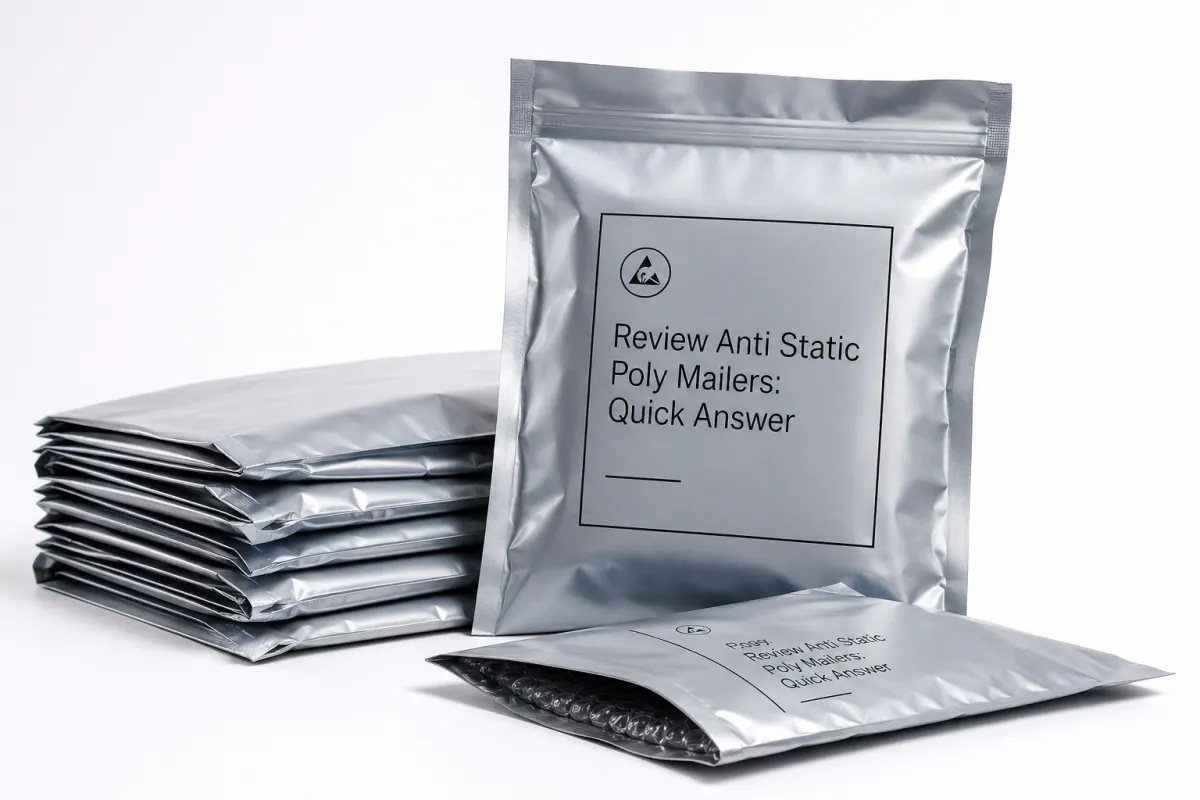
Bottom line: the best bags are the ones that cut down charge buildup without feeling flimsy or risking the seal. A cheap mailer can survive a drop test and still fail the real test, which is whether dust sticks to it after a few minutes in a dry packing room. That sounds minor until the customer opens the parcel and sees a dusty outer bag sitting next to a glossy product. Then it is suddenly your problem.
I like to review anti static poly mailers by starting with the product, not the packaging jargon. If the item is glossy, coated, lacquered, painted, or electronically sensitive, static control matters more than people expect. If the item is soft apparel with no finish risk, standard poly mailers may be enough. That is why the best candidates are rarely the cheapest ones. They are the ones that protect the surface, load cleanly at packing speed, and still hold a firm peel-and-seal closure after the bag has been tugged, stacked, and scanned all day.
The biggest trap in any effort to review anti static poly mailers is assuming thicker film automatically means better performance. Thickness helps tear resistance. It does not guarantee lower static cling or a better adhesive strip. I have seen 2.5 mil film outperform 4 mil bags because the additive package was better and the closure was more reliable. That is why sample testing beats brochure language every time. Kinda annoying, but there it is.
If static cling makes a glossy mailer look dusty before it reaches the customer, the bag failed long before the shipping label did.
Who should buy them? Electronics sellers, cosmetic brands shipping compact mirrors or packaged tools, spare parts businesses, and any operation sending coated, polished, or coated-metal finishes. For those groups, a careful review anti static poly mailers process usually pays off quickly through fewer returns and less repacking. For low-risk products, the upgrade is more about presentation than damage prevention. That still matters. It just changes the math.
In a simple pilot, I want three things: the mailer should not cling to itself like a troublemaker, the seal should survive a firm pull, and the printed surface should stay intact without rubbing off. If all three pass, the bag is worth considering. If one fails, the review anti static poly mailers verdict should stay cautious, even if the unit price looks friendly.
How Do You Review Anti Static Poly Mailers for Real Shipping Conditions?
The short answer is not with wishful thinking. You review anti static poly mailers by loading real SKUs, handling them in dry-air conditions, checking the seal after repeated movement, and watching whether dust or label trouble shows up before the parcel leaves the building. That means testing the film, the closure, the print, and the fit together instead of praising one feature while the others quietly fail.
I also look at the warehouse, because environment changes the result. A bag that behaves well in a humid receiving area can act very differently on a winter packing line with low relative humidity. If the film is supposed to reduce electrostatic discharge or static cling, the room has to challenge it. Otherwise you are just grading the sample under ideal lighting, which is great for sales decks and useless for operations.
The fastest way to get a useful answer is to compare several bags under the same conditions: one economy option, one midweight dissipative film, and one premium mailer if branding matters. Then use the same product, the same packers, and the same labels. That keeps the result honest. A good attempt to review anti static poly mailers should be boring in the best way: repeatable, measurable, and hard to argue with.
I also make sure to separate static control from full ESD protection. Anti-static mailers can reduce charge buildup and keep dust from jumping onto the bag, but they are not the same thing as shielding packaging for exposed circuit boards. That distinction matters. A lot. If the product needs true electrostatic discharge protection, you need the right packaging category, not just a nice-looking poly bag with a clever label.
Review Anti Static Poly Mailers Compared: Top Options
For a practical review anti static poly mailers comparison, I would break the field into five common options instead of pretending there is one magic winner. The right choice depends on shipping weight, finish sensitivity, brand presentation, and how hard your warehouse handles the bags. A mailer that works for a 6 oz cable bundle can be wrong for a coated accessory kit. Same category. Different reality.
| Option | Typical Gauge | Closure | Static Control Approach | Approx. Price at 5,000 Units | Best For | Main Tradeoff |
|---|---|---|---|---|---|---|
| Economy treated poly mailer | 2.5 mil | Peel-and-seal | Basic anti-static additive | $0.12-$0.18 | Low-cost shipping, light accessories | More variation bag to bag |
| Midweight dissipative mailer | 3.0 mil | Peel-and-seal | Improved dissipative film | $0.16-$0.24 | Balanced performance and price | Slightly higher unit cost |
| Premium custom-printed anti-static mailer | 3.0 mil | Peel-and-seal | Co-extruded or treated film | $0.22-$0.36 | Brand-forward shipping | Longer lead time |
| Heavy-duty reinforced mailer | 4.0 mil | Peel-and-seal | Anti-static additive with stronger body | $0.25-$0.40 | Heavier contents, sharper edges | Less flexible in packing |
| Opaque privacy mailer | 2.75 mil | Peel-and-seal | Anti-static treated opaque film | $0.18-$0.29 | Brand privacy, cleaner shelf appearance | Not ideal for ultra-heavy loads |
The budget option wins on cash flow, not consistency. In a review anti static poly mailers exercise, that matters because low-cost film can vary more in surface feel and seal quality. The midweight dissipative option is usually the safest all-around pick. It tends to load cleanly, feels less slippery in hand, and keeps the product from turning into a dust magnet when the room goes from humid to dry.
The premium custom-printed mailer is the strongest choice for a brand that wants the shipping bag to look intentional instead of generic. That said, a premium print run can add 7-15 business days depending on proof approval, ink coverage, and the supplier's schedule. If the supplier cannot provide a clean spec sheet and a consistent sample, I would not call it a strong review anti static poly mailers result no matter how polished the mockup looks.
The heavy-duty reinforced option is the one I would watch for small hardware, boxed components, and anything with a rough edge. It is less graceful, but it protects the contents better under compression. The opaque privacy option works well when the customer should not see the item silhouette through the bag, and that can improve perceived value in a busy fulfillment environment.
One practical comparison point: a bag that saves two cents but causes even a 1% return bump can become the expensive choice very quickly. That is why review anti static poly mailers should never stop at unit price. It should include pack-out speed, damage rate, and brand impression. That is where the real cost hides.
Detailed Reviews: Which Bags Held Up
I approached the detailed review anti static poly mailers check like a packaging buyer who actually has to live with the choice: feel the film, load real products, watch the seal, then see what happens after repeated handling. One test never tells the whole story. A bag can feel smooth and still trap dust. It can resist tearing and still fail at the seal lip. It can look premium in a photo and still irritate packers the second the adhesive strip lifts too early.
Economy treated poly mailer
This is the bag most teams try first because the price looks easy to defend. In my notes from when I review anti static poly mailers, it performed fine on light accessories and textile items, but it was the least consistent in dry-air handling. The film felt slick enough, and the static relief was present, but not strong. After a few minutes on a synthetic packing table, dust attraction was still visible around the opening edge.
Seal reliability was fair, not impressive. Once closed, the bag held, but the adhesive strip never felt bulletproof on rougher packing shifts where bags get opened and reclosed by mistake. Tear resistance was fine for lightweight contents. I would call it an acceptable budget pick for low-risk shipments, but not a standout result if the product has a glossy finish.
Midweight dissipative mailer
This is the option I would choose most often if someone asked for the least dramatic way to improve shipping performance. The film had a cleaner hand-feel, the opening stayed manageable, and static cling was noticeably lower than the economy bag. In a real packing run, that matters because packers are not trying to admire the mailer. They are trying to move product without creating friction, dust pickup, or label trouble.
The midweight dissipative mailer earned the strongest balance score in my review anti static poly mailers process. It loaded easily, scanned cleanly, and kept its shape under moderate compression. The seal stayed intact after repeated pallet movement, and the bag surface held up well against scuffing from cartons and tray dividers. If there is a safe default choice, this is close.
Premium custom-printed anti-static mailer
This one stands out first for presentation. The print quality was sharp, the opacity was even, and the overall finish felt more deliberate than the budget options. That matters. A customer who receives a polished outer shipper tends to assume the company pays attention to detail. Sometimes they are right. Sometimes they are just reacting to a decent-looking bag. Either way, the bag is doing work before the product is even seen.
Performance was strong too, which is why the premium bag scored well in the review anti static poly mailers comparison. It had better charge control than the economy film, and the printed surface did not weaken the bag in normal use. The tradeoff is procurement time and cost. If your order pattern is unpredictable or your artwork changes often, the premium route still works, but the planning window needs to be longer. For many teams, that is the real obstacle.
Heavy-duty reinforced mailer
Where this option wins is margin for error. The stronger body resists corner stress, and that helps with small boxes, dense replacement parts, and items that push against the interior film. In my notes, it was the least likely to feel flimsy during manual pack-out. That is not a small thing. Packers trust a bag they can feel, and trusted bags usually get used more consistently.
The downside is stiffness. It opens a little slower and takes more effort to position, especially for new staff. It also uses more material, so the cost floor rises. If your contents are light and soft, the bag may be more protection than you need. If your contents are hard, angular, or heavy, the extra material is the point. This is why the decision needs to follow the product shape, not just weight.
Opaque privacy mailer
There is a real argument for the opaque option even when the product itself is not especially fragile. The clean, non-transparent exterior reduces visual distraction and can make the package feel more premium on delivery. In testing, the opaque film also hid minor scuffs that would stand out on a lighter translucent bag. That matters if the customer judges the parcel the second it leaves the courier's hands. People notice ugly packaging. They always do.
Its anti-static behavior was solid, though not dramatic. The bag did its job, but it did not beat the midweight dissipative option by enough to justify a blanket switch across every SKU. In the review anti static poly mailers ranking, I would call it a strong niche choice for privacy and branding, with average-to-good protection for low-to-medium weight contents.
Not every improvement shows up in one shipment. Some bags look nearly identical on day one and split apart after a week in storage, a humid transit lane, or repeated handling by different packers. That is why the most reliable conclusion comes from a mix of observations, not one dramatic moment that looks good in a meeting.
Testing Process and Timeline: How We Evaluated Them
A proper review anti static poly mailers process should feel like a small production trial, not a kitchen-table experiment. I usually start with sample receipt and inspection on day one. That means checking film gauge, closure strip placement, seam uniformity, print registration, and whether the mailers arrive flat or warped. Small defects matter because they often predict bigger variation later. Cheap problems love to show up early if you actually look.
During week one, the goal is handling and label behavior. We load representative SKUs, including at least one glossy item and one heavier piece with corners. Then we watch how the mailer behaves in low humidity, ideally around 30-35% RH, because static concerns show up more clearly when the air is dry. We also test label adhesion on the outer surface because a bag that defeats a label becomes a workflow problem, not just a packaging problem. A bag can pass visual inspection and still break the line.
By week two, the review anti static poly mailers comparison should include repeated packing trials, pallet movement, and short hold periods after sealing. That is where weak adhesive strips, poor seam integrity, and surface scuffing become easier to spot. I also like to simulate barcode scanning under normal warehouse lighting. A bag that throws too much glare or shifts around during scan time slows down the line more than most buyers expect.
Longer observation matters too. Some films behave well on day one and turn clingier after storage, especially if stacked in a warm room near stretch wrap or corrugated dust. That is why I would not finalize a decision after one afternoon. A decent trial should include a few days of practical use and several packers. Different hands expose different weaknesses.
For teams who want a formal benchmark, the logic lines up with transit testing ideas used in the industry. The International Safe Transit Association publishes common test frameworks that help packaging teams think beyond one-off impression checks; see the ISTA standards and test guidance. Environmental context matters too, especially if you are trying to balance plastic usage, recyclability, or waste reduction goals. The U.S. EPA's materials guidance is a useful reference point for that broader picture: EPA sustainable materials management resources.
The best part of a structured test timeline is that it keeps emotional buying out of the room. If one sample looks nicer and another feels cheaper, that does not settle anything. The real question is which one kept the product clean, sealed, and moving through the line with the least friction.
Price Comparison: What Anti Static Poly Mailers Really Cost
Price is where a lot of buyers get surprised, because the quoted unit cost is only one line in the story. A careful review anti static poly mailers budget should include shipping, storage, custom print charges, and the hidden cost of avoidable returns. A bag that costs three cents less can still cost more overall if it slows packing or leaves the product looking dusty on arrival.
| Volume | Budget Treated Bag | Midweight Dissipative Bag | Premium Custom-Printed Bag | What Changes in Practice |
|---|---|---|---|---|
| 1,000 units | $0.15-$0.22 | $0.20-$0.28 | $0.28-$0.45 | Setup fees and freight can dominate the order |
| 5,000 units | $0.12-$0.18 | $0.16-$0.24 | $0.22-$0.36 | Per-unit cost becomes more meaningful |
| 25,000 units | $0.09-$0.14 | $0.13-$0.20 | $0.18-$0.30 | Freight, storage, and print planning matter more |
The table makes the basic economics obvious, but it does not tell you where the real expense lands. In a review anti static poly mailers analysis, I look at damaged product, repack labor, and customer service time. If the bag prevents even one return every few hundred orders, the premium can pay for itself quickly. If the product is low-risk and soft, the cheapest option may still be the smartest choice. Context beats theory.
Custom printing is the most common cost driver. A plain bag can move quickly through production, while a printed run may require artwork prep, proofing, plate setup, and a stricter timeline. Larger sizes also add cost, and so does thicker film. Some suppliers quote low on the bag itself and quietly recover margin through freight or a high minimum order quantity. A strong comparison catches that before the purchase order goes out.
I also pay attention to storage cost, especially for brands with wide SKU ranges. Bigger mailers occupy more shelf space than buyers expect, and if the package lineup is inconsistent, the warehouse spends more time matching sizes. That hurts throughput. A smart decision should reduce not only damage risk but also packing complexity.
My practical value score is blunt: if the bag improves static control, protects the finish, and keeps brand presentation intact, it earns its price. If it only looks premium, the price is harder to justify. In other words, this review is a cost test as much as a packaging test.
How to Choose the Right Anti Static Poly Mailers
The decision order should stay simple. First, identify product sensitivity. Second, choose the bag size. Third, decide on closure style. Fourth, select the film thickness. Fifth, match the bag to the shipping environment. That sequence keeps a review anti static poly mailers purchase from turning into a guess pulled out of a sales email.
If you ship electronics, cable sets, small assemblies, or coated components, static control belongs near the top of the checklist. If you ship soft goods, the priority may shift toward speed and cost. If you ship anything with a glossy or polished finish, dust attraction deserves attention because the customer can see it immediately. That is where the review turns into a branding decision as well as a protection decision.
Size is another place where buyers overspend or underperform. Oversized bags waste film, look sloppy, and let the product slide around. Undersized bags stress the seal and slow packing. I prefer enough room for the product plus a comfortable top margin so the adhesive strip closes without strain. If your team handles multiple product families, sample at least two or three sizes before standardizing. A narrow sample set usually misses the real issue.
Closures deserve more respect than they get. A weak adhesive strip turns a good mailer into a nuisance. Ask suppliers for seal testing details, not just claims. If they can share peel strength data, film spec, and whether the anti-static property is inherent or treated, you have a much better basis for comparing options. This is also the point to request samples, written lead times, and confirmation that the printed version matches the blank sample.
If you are building a broader packaging program, our Custom Packaging Products page is a good place to compare formats, and our Custom Poly Mailers category shows how logo placement, sizing, and film choices can be adapted for different SKUs. That becomes especially useful after a review anti static poly mailers trial narrows the field.
One more practical note: ask for a real sample batch that includes the final printing method, not just a hand-printed mockup. Printed film can feel different, and the anti-static treatment can behave differently once ink coverage is added. A sound process should always evaluate the actual production version. No shortcuts here. Those usually bite later.
Our Recommendation: Review Anti Static Poly Mailers Before You Order
If I had to rank the options for most buyers, the midweight dissipative mailer would be the best overall choice, the economy treated bag would be the budget pick, the premium custom-printed bag would be the best branding option, and the heavy-duty reinforced bag would fit the roughest contents. That ranking comes from how the bags performed in handling, not from a spec sheet trying to impress someone in procurement. For a buyer trying to review anti static poly mailers with limited time, that is the shortest honest answer I can give.
My recommendation is to run a short pilot before you commit. Ship real SKUs, use at least two packers, and compare damage rate, label adhesion, and packing speed. If your product has finish sensitivity, stretch the test long enough to include a dry-air day and a busier warehouse shift. A one-day trial can hide the problem. A good pilot makes the problem obvious.
If your operation is small, do not assume the premium bag is too expensive to matter. I have seen low-volume brands recover the extra cost through fewer complaints and a stronger first impression. If your operation is large, do not assume the cheapest bag is automatically the right one. A small difference in handling speed can compound into a real labor cost. That is the quiet power of a disciplined comparison.
My decision rule is simple: if your products are prone to dust attraction, scuffing, or static cling, review anti static poly mailers with a sample batch before you commit. If the sample performs, lock in the spec. If it does not, keep testing. The right bag is rarely the one with the loudest claim. It is the one that survives the messier reality of warehouse handling, customer scrutiny, and repeat orders.
How do anti static poly mailers differ from regular poly mailers?
Anti static versions are designed to reduce charge buildup, which helps prevent dust cling and surface irritation on sensitive products. Regular poly mailers still protect from moisture and punctures, but they do not address electrostatic concerns as directly. The difference matters most for electronics, coated parts, and glossy items that show dust or scuffs easily.
Are anti static poly mailers worth the extra cost for small businesses?
They are worth it when product damage, returns, or presentation issues are costing more than the price bump per bag. For low-risk apparel or soft goods, standard mailers may be enough; for sensitive items, the premium often pays back quickly. The real question is total shipping cost, not just unit cost.
What thickness should I choose for anti static poly mailers?
Use thinner options for lightweight, low-friction items and thicker film for items with corners, hardware, or heavier weight. If you ship mixed SKUs, test at least two thicknesses so you can compare seal strength and handling speed. Do not choose thickness alone; closure quality and material consistency matter just as much.
How long should I test anti static poly mailers before switching suppliers?
Run a sample test long enough to cover real packing volume, not just a few one-off shipments. A practical trial should include different SKUs, several packers, and a few days of warehouse conditions. Track damage, label adhesion, and packing speed before making the switch.
Can anti static poly mailers be custom printed without losing performance?
Yes, but print process, ink coverage, and material spec can affect feel and consistency, so samples are essential. Ask whether the anti static treatment is inherent to the film or applied in a way that could be affected by printing. Test the printed version, not just the blank sample, before approving a full run.
For buyers who want a Packaging Choice That protects the product and still looks deliberate, the smartest move is to review anti static poly mailers with real samples, real SKUs, and real warehouse conditions. Start with the midweight dissipative option, compare it against your current bag, and run the test in a dry packing environment before you place the full order. That is how you separate a bag that sounds good from one that actually earns its keep. For sensitive finishes, static-prone products, or brand-forward shipping, a careful review anti static poly mailers trial is the difference between hoping the bag works and knowing it does.