Buyer Fit Snapshot
| Best fit | of high tensile poly mailers buyer review for packaging buyers comparing material specs, print proof, MOQ, unit cost, freight, and repeat-order risk where brand print, material, artwork control, and repeat-order consistency matter. |
|---|---|
| Quote inputs | Share finished size, material target, print colors, finish, packing count, annual reorder estimate, and delivery region. |
| Proofing check | Approve dieline scale, logo placement, barcode or warning zones, color tolerance, and any recyclable or compostable wording before bulk production. |
| Main risk | Vague material claims, crowded artwork, or missing packing details can create delays even when the unit price looks attractive. |
Fast answer: Of High Tensile Poly Mailers Buyer Review: Film, Closure, Print, and Fulfillment should be specified like a repeatable production item. The safest quote includes material, print method, finish, artwork proof, carton packing, and reorder notes in one written spec.
What to confirm before approving the packaging proof
Check the product dimensions against the actual filled item, not only the sales mockup. Ask for tolerance on folds, seals, hang holes, label areas, and retail display edges. If the package carries a logo, QR code, warning copy, or legal claim, reserve that space before decorative graphics fill the panel.
How to compare quotes without losing quality
Compare board or film grade, print process, finish, sampling route, tooling charges, carton quantity, and freight assumptions side by side. A lower quote is only useful if the supplier can repeat the same color, closure quality, and packing count on the next order.
Review of High Tensile Poly Mailers: Top Picks Compared
If a mailer feels thick and still splits at the seam, it is bluffing. That is the first lesson in an honest review of high tensile poly mailers: thickness helps, sure, but the bag earns its keep by surviving corners, conveyor bends, label scuffing, and the occasional overstuffed order without turning into a customer complaint. A lighter bag with better stretch recovery and a cleaner weld can beat a heavier one that only looks tough in the sample room. That is why this review of high tensile poly mailers focuses on shipping behavior, not showroom drama.
From a buyer's seat, the real question is not “which mailer looks strongest on the counter?” It is “which one still looks fine after the third handoff, a tote squeeze, and a drop onto a sorting belt?” A useful review of high tensile poly mailers should answer that in plain language. You should know where the money goes: better film blend, better seam weld, cleaner adhesive strip, sharper print, or just more plastic. That is the lens here. I am also going to be blunt about where premium pricing earns its place and where it is just expensive wallpaper. If you need custom packaging beyond mailers, browse Custom Packaging Products or compare formats inside Custom Poly Mailers.
Quick rule: a good high tensile mailer proves itself at the weak points, not by feeling stiff in your hand.
Quick Answer: Review of High Tensile Poly Mailers
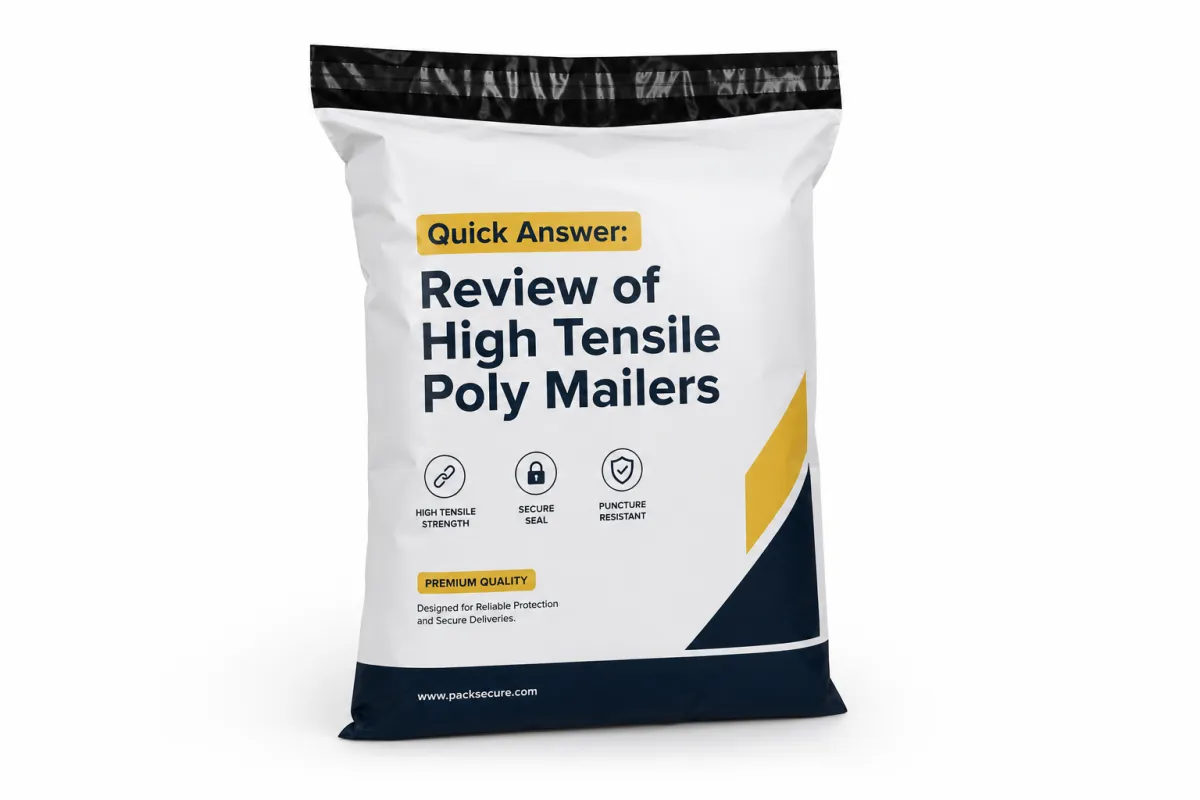
The short version of this review of high tensile poly mailers is simple: the best options survive abuse instead of just feeling dense. A mailer with a lower thickness reading can still outperform a thicker competitor if the film stretches well, the side seams are even, and the closure strip actually grips after the first press. That combination keeps corners from punching through and seals from creeping open during transit. For apparel brands, subscription boxes, and soft goods sellers, that matters more than an extra point on a spec sheet.
There is one detail people miss all the time: “high tensile” is not always a formal spec on a supplier sheet. Sometimes it means the film has better tear resistance, sometimes it means better elongation before failure, and sometimes it is just marketing doing its little dance. A serious review of high tensile poly mailers should separate those ideas instead of pretending they are identical.
Here is the practical bottom line from this review of high tensile poly mailers:
- Best value is usually a 2.5-3.0 mil coextruded mailer with solid side welds and a dependable peel-and-seal strip.
- Best durability is usually a mailer with a tougher outer skin, stronger tear propagation resistance, and a closure that tolerates a little overfill.
- Best presentation is usually a matte or satin finish with clean print contrast and an opening experience that does not feel cheap.
The most common buyer mistake is thinking thickness solves everything. It does not. I have seen a 4 mil bag fail because the seal was sloppy and the edges were cut too sharply, while a 2.75 mil bag kept shipping safely because the structure flexed instead of splitting. That is the pattern this review of high tensile poly mailers keeps circling back to: material behavior beats marketing copy. If you want a mailer that feels premium and protects the shipment, look for balanced construction, not a bigger number on the sample card.
There is also a standards angle worth paying attention to. Packaging buyers who want something better than guesswork often talk about tensile and elongation through ASTM methods such as ASTM D882, while shipping performance can be evaluated with distribution-style testing frameworks from ISTA. For broader packaging language and material context, packaging.org is a useful industry reference. A serious review of high tensile poly mailers belongs in that testing mindset, because “strong” means very little unless the bag survives handling.
Top High Tensile Poly Mailers Compared
This part of the review of high tensile poly mailers compares buyer profiles instead of pretending every mailer serves the same job. A slim garment order does not need the same build as a heavier soft-goods bundle, and a brand chasing a premium unboxing feel may care more about print clarity than raw puncture resistance. The comparison below focuses on tear resistance, seal quality, finish, and approximate cost per mailer in bulk. Those are the variables that usually decide whether a mailer becomes a staple or stays in the sample pile.
| Mailer Type | Tear Resistance | Seal Quality | Exterior Finish | Best Use Case | Typical Bulk Cost |
|---|---|---|---|---|---|
| Value Pick, 2.5-3.0 mil coextruded | High for apparel and soft goods | Very good if adhesive is clean | Gloss or satin | Daily shipping, repeat replenishment | $0.10-$0.16 each |
| Durability Pick, reinforced seam build | Very high under corner stress | Excellent, less prone to peel-up | Matte or low-gloss | Heavier garments, multi-item packs | $0.14-$0.22 each |
| Premium Print Pick, custom printed outer layer | Moderate to high | Good, depends on closure type | High-impact branded finish | Subscription boxes, retail-ready shipping | $0.18-$0.32 each |
| Budget Pick, lighter film with basic seal | Moderate | Acceptable for low-risk parcels | Standard glossy | Very light contents, short lanes | $0.07-$0.11 each |
For most apparel brands, the value pick wins because it sits in the middle of the curve. It is light enough to keep postage under control, yet tough enough to avoid obvious tears when the parcel gets treated like a football. That is why the phrase review of high tensile poly mailers matters in real buying decisions: the best option is not always the most expensive one. The durability pick earns its place when the pack shape is awkward, the shipment volume is high, or the return cost is uglier than the mailer itself. The premium print pick is the one I would choose if brand perception is part of the shipping equation and the mailer is not disappearing into a plain outer carton anyway.
If you are narrowing options, this review of high tensile poly mailers usually points to one of three directions: strongest structure, best print, or lowest landed cost. That is a useful way to think about it, because the “best” mailer changes with the lane. A company shipping folded tees across one region may not need the same abuse tolerance as a brand moving mixed soft goods nationally. The table is a starting point, not a verdict delivered from a lab bench with dramatic lighting.
Detailed Review of High Tensile Poly Mailers
The real value of a review of high tensile poly mailers sits in the failure points. Most mailers do not fail in the middle of a flat panel. They fail at the seam, the fold, the corner, or the seal strip after the pack has been squeezed, dropped, and stacked a few times. That is why film thickness by itself can mislead buyers. A good film with a weak weld becomes a bad product. A slightly lighter film with better stretch recovery can perform far better in transit.
Construction details that matter
Three construction elements deserve attention: film gauge, seam geometry, and closure performance. Film gauge is the easiest number to compare, but not always the best predictor. In a useful review of high tensile poly mailers, I look at whether the film has enough elongation to absorb stress without ripping into a long tear line. I also check whether the side seams are broad and even. Narrow or inconsistent welds tend to peel or split more easily under load. A clean adhesive strip should close with firm pressure, stay shut after the first few minutes, and resist dust or static cling messing with it.
On the film side, plenty of buyers like the feel of a thicker bag, but feel is not the same as performance. A mailer that flexes and recovers is often more useful than one that feels stiff and brittle. That is one reason this review of high tensile poly mailers does not treat thickness as the holy grail. A 3 mil coextruded mailer can be the smarter buy if the polymer blend is tuned well and the welds are consistent. If you are comparing custom packaging formats, the same logic applies across Custom Poly Mailers, outer cartons, and protective inserts.
One practical thing I always check: how the bag behaves when it is half-full. A mailer that looks excellent with a flat tee can suddenly act cranky around a folded sweatshirt or a mixed apparel bundle. That extra tension near the top seal is where the failures start. Kind of annoying, but packaging is rarely polite.
Real-world failure points
The first failure point is the corner. Boxes and hard inserts poke from the inside, and sharp edges attack the film from the outside. The second failure point is repeated flexing. Conveyor movement, bagging, and parcel sorting all add micro-stress that a sample held in your hand will never show. The third failure point is water and abrasion. A wet label or a rough tote wall can turn a decent mailer into a scratched, scuffed, or partly opened one. Any honest review of high tensile poly mailers should mention that the outer finish matters here. Matte surfaces usually hide scuffing better, while glossier finishes can show wear sooner even when the underlying film stays intact.
Here is the inconvenient truth: overfilling ruins a lot of otherwise decent mailers. If the product bulges hard against the closure, even a high tensile build can fail at the seal. That is not a defect in the material so much as a mismatch between package size and content geometry. This is where a review of high tensile poly mailers helps buyers avoid false savings. Saving a cent per bag means little if the return rate climbs because the outer pack could not handle the shape inside it.
Practical note: a mailer that survives a squeeze test in the office still needs to survive a conveyor turn, a drop edge, and a wet label in the real shipping lane.
Verdict by use case
- Apparel: Strong fit. This is where a good review of high tensile poly mailers usually lands, because shirts, leggings, and light knitwear benefit from low weight and better tear resistance.
- Accessories: Strong fit if the contents are soft or rounded. Hard edges need inner protection.
- Subscription boxes: Good if the inner pack is compact. Premium print helps more here than raw thickness.
- Heavy soft goods: Use a reinforced build and check seam width carefully.
If you want the safest interpretation of this review of high tensile poly mailers, sample at least one value option and one reinforced option. The first usually tells you whether your items actually need extra film, while the second shows how much protection you get for the extra spend. That side-by-side test is far more useful than staring at a spec sheet and hoping for a miracle.
Price Comparison: What High Tensile Poly Mailers Actually Cost
Price is where a lot of buyers misread the market, so this review of high tensile poly mailers needs to separate sticker price from landed cost. A cheaper mailer that causes damage, resealing issues, or customer complaints can end up more expensive than a slightly premium one that ships cleanly the first time. In bulk, standard Custom Poly Mailers often land around $0.07-$0.16 per unit depending on size, film build, and order volume, while custom printed, reinforced, or higher-finish options can move into the $0.18-$0.32 range. Those are working numbers, not promises. Artwork complexity, print coverage, and closure style can move the quote noticeably.
A useful review of high tensile poly mailers also needs to consider MOQ thresholds. Many suppliers price more aggressively once orders move past 1,000 or 5,000 pieces. A plain white or gray mailer at 5,000 units may land near the low end of the range, while full-coverage custom printing, dark films, or specialty finishes can add 15-35% to the price. Reinforced adhesive strips or thicker outer layers often add another small premium. None of that is shocking. What matters is whether the added cost reduces damage, supports the brand, or both.
Use this kind of cost logic:
- Base cost: film, closure strip, printing, and packaging.
- Operational cost: packing speed, seal reliability, and labor saved on rework.
- Damage cost: replacements, reships, and customer service time.
- Brand cost: presentation, repeat purchase confidence, and review impact.
That is why the phrase review of high tensile poly mailers matters for finance, not just procurement. A mailer that cuts damage by even a little can pay for itself quickly in high-volume apparel fulfillment. If you ship 10,000 parcels a month and only 1% fewer packages fail in transit, the avoided replacement and support costs can outrun a modest unit price increase. The premium gets easier to justify if the package is part of the customer experience instead of a hidden utility item.
One more detail: shipping economics often improve when the mailer is light but tough. You want enough structure to prevent tearing without adding unnecessary grams that push postage upward. That balance sits at the center of a thoughtful review of high tensile poly mailers. More material does not always mean better economics. Better engineering often does.
Ordering Process and Timeline: Samples, MOQ, and Delivery
Sampling should happen before any serious commitment, and a careful review of high tensile poly mailers treats that step as non-negotiable. The sample stage tells you whether the film feels flexible or brittle, whether the seal strip closes cleanly, and whether the print looks crisp enough to represent your brand. It also exposes practical issues that spec sheets hide, like static cling, awkward opening force, or a seam that looks fine until the bag is folded around a real product. For buyer teams, that means testing the actual item, not a blank bag on a desk.
The usual workflow looks like this:
- Sample request: ask for size matches, film options, and closure style.
- In-house test: pack actual SKUs, fold them, drop them, and inspect the edges.
- Artwork proof: confirm logo placement, color match, and barcode visibility.
- Production: approve the final proof and move into manufacturing.
- Inbound check: inspect a carton from the first run before full use.
Lead times vary, but a realistic baseline for custom orders is often 12-15 business days after proof approval, with faster or slower timelines depending on volume and print complexity. Sampling can take just a few days, though larger or more customized projects may take longer. If the order includes multiple ink colors, specialty finishes, or larger volumes, build in extra time. That is a lesson I keep repeating in every review of high tensile poly mailers: your deadline is usually tighter than the brochure suggests.
Minimum order quantity is another variable buyers should not ignore. Plain stock-style mailers can be relatively flexible, while custom-printed or specialty mailers may require 1,000, 3,000, or 5,000 pieces to be priced well. If you are testing a new design, place a small first run. If you are shifting an established SKU into a better outer layer, it can be worth ordering more once the sample proves the fit. The smart version of a review of high tensile poly mailers does not just judge quality; it judges how easily the product fits into your ordering rhythm.
For replenishment planning, a simple rule helps: reorder when you have 6-8 weeks of stock left, not when you are down to the last carton. Delays happen because of proof revisions, freight handoff, or production queue shifts. That is especially true for custom work. Any buyer reading a review of high tensile poly mailers should treat lead time as part of the total cost of ownership.
How to Choose High Tensile Poly Mailers for Your Orders
A buyer checklist works better than instinct. This part of the review of high tensile poly mailers is about matching the bag to the shipment, not just picking the prettiest sample. Start with product weight, but do not stop there. A 250-gram item with sharp corners can be harder on a mailer than a 500-gram soft item that sits flat. Shape, edge profile, and packing style matter as much as grams on a scale.
Use these questions as a filter:
- Does the item have hard corners or rough edges?
- Will the parcel move through a rough shipping lane or a short local route?
- Is the mailer doing all the protection, or is there an inner sleeve or carton?
- Do you need premium print for customer-facing unboxing?
- Will the package be handled often in fulfillment before it leaves the building?
For high-volume apparel fulfillment, seal strength and packing speed usually matter most. For accessories with sharper profiles, puncture resistance moves up the list. For premium retail programs, exterior finish and print clarity can matter almost as much as durability. That is why a good review of high tensile poly mailers should not hand out one universal winner. Different brands need different tradeoffs, and pretending otherwise leads to expensive reorders.
There are also common mistakes worth calling out. The first is paying extra for thickness when the seam is the real weak point. The second is buying the cheapest option for heavier replenishment runs and hoping the product “will probably be fine.” The third is ignoring size fit, which creates stress at the closure and corner points. In a serious review of high tensile poly mailers, fit is not a side note; it is the difference between a tidy pack and a stressed one.
Environmental and sourcing questions also come up. Some buyers ask for recycled content, compostability, or FSC-aligned messaging for printed inserts and related packaging. Those decisions depend on the broader package design, local recycling access, and brand claims. If sustainability language is part of the brief, make sure it is accurate and not just decorative. A grounded review of high tensile poly mailers should be honest here: a recyclable claim only helps if the local collection system and material stream support it.
For teams building out a wider packaging system, this is where a better supplier conversation starts. Do you need mailers only, or do you need a coordinated outer pack, labels, and protective components too? Sometimes the stronger answer is not a thicker bag but a smarter full package. That is why the internal link to Custom Packaging Products can matter as much as the mailer itself.
Our Recommendation: Best High Tensile Poly Mailers to Test First
If I had to simplify the whole review of high tensile poly mailers into a testing order, I would start with three samples: a value pick, a reinforced durability pick, and a premium print version if branding matters. That gives you a clean read on where the money is going. The value pick tells you whether the baseline already works. The reinforced version shows how much more abuse resistance you gain. The premium printed version shows whether the packaging experience improves enough to justify the upgrade.
My practical recommendation is this:
- Start with the value option if your goods are soft, flat, and low-risk.
- Compare against the reinforced option if the product has corners, seams, or heavier textile weight.
- Test the premium print option only if branding is part of the shipping experience and not just a nice extra.
The strongest recommendation from this review of high tensile poly mailers is not “buy the thickest one.” It is “buy the one that survives the route you actually use.” That may sound obvious, but a lot of packaging budgets get wasted by overspecifying one feature while ignoring another. Better seam integrity can be more valuable than another half-mil of thickness. Better print consistency can matter more than a slightly heavier film if the bag already performs well.
Honestly, the safest first purchase is usually the middle tier. It gives you enough structure for real shipping abuse without locking you into premium pricing before you know whether the upgrade matters. Then, if the test pack proves the brand experience improves, move up. If it does not, stay with the middle tier and put the savings into better inserts or better cartonization. That is the most efficient reading of a review of high tensile poly mailers.
Before placing the larger order, do a side-by-side pack test with the same product, the same fill level, and the same shipping label placement. Compare tear behavior, seal confidence, and final appearance after handling. Then calculate cost per order, not just cost per unit. If you need a refined branded outer pack, explore Custom Poly Mailers alongside the rest of the range in Custom Packaging Products. That combination usually gives buyers a clearer picture than spec sheets ever do.
My final take on this review of high tensile poly mailers is straightforward: choose the lightest bag that still protects the product, the seal that stays shut under pressure, and the finish that matches your brand promise. Do that, and the mailer stops being a commodity line item and starts doing real work. The actionable move is simple: test one value option and one reinforced option against your actual SKU, then pick the one that survives your real shipping lane with the least waste. That is how this review of high tensile poly mailers should end, and frankly, how the buying decision should begin too.
Are high tensile poly mailers better than standard poly mailers?
Yes, when the route is rough, the product has corners, or the parcel gets handled often. In a practical review of high tensile poly mailers, the advantage usually comes from better film behavior and stronger seams, not just a thicker feel. If the contents are ultra-light and low-risk, standard poly mailers can still be enough.
What thickness should I look for in a review of high tensile poly mailers?
Thickness helps, but it should never be judged alone. A thinner mailer with better adhesive and welding can outperform a cheaper thick one. In any serious review of high tensile poly mailers, the right thickness depends on product shape, not just weight.
Can high tensile poly mailers handle apparel and soft goods safely?
Yes, they are a strong fit for apparel, accessories, and other flexible products that do not need rigid protection. That is one reason the review of high tensile poly mailers often favors them for fashion fulfillment. For sharp hardware, rigid edges, or fragile inserts, add internal protection.
How long does it usually take to get custom high tensile poly mailers?
Sampling is usually the fastest step and should be used to confirm feel, seal quality, and print look before you commit. Custom production adds proofing and manufacturing time, especially for larger runs. A good review of high tensile poly mailers always advises buffer time for launches and seasonal resets.
Are premium printed high tensile poly mailers worth the extra cost?
They are worth it when the mailer is part of the customer experience and branding affects repeat purchase behavior. If the outer package is hidden or purely functional, the premium may not return much value. The honest answer in a review of high tensile poly mailers is that it depends on whether the mailer is a shipping tool only or a brand touchpoint.

