Planning a Ribbon Handle Paper Bags small batch custom order is mainly about controlling risk. A launch can change after the first packing test, a seasonal program may move faster than expected, and a pop-up may need a premium look without a large inventory commitment. A smaller run gives you room to confirm size, print quality, handle strength, and packing fit before you scale.
That matters because packaging has to do two things at once: support the brand and stay practical to buy, store, and ship. Small-batch ordering helps buyers make one careful decision set instead of gambling on volume too early. It is often the better fit for boutiques, gifting, beauty launches, and limited retail runs.
For buyers comparing Custom Packaging Products or broader Wholesale Programs, the same rule applies: confirm the structure first, then choose the quantity that matches actual demand. If the spec is wrong, a bigger order only magnifies the mistake.
Why Small Runs Reduce Packaging Risk
A small run is often the more disciplined purchase. It lets a buyer test demand without tying up cash in cartons that may sit in storage. That is useful for first releases, product refreshes, event kits, regional programs, and short seasonal windows where the packaging still needs to look polished from day one.
The cash-flow tradeoff is easy to overlook. Larger orders usually reduce unit price, but that savings can disappear if the bags sit too long, need discounting, or force extra storage costs. A 2,000-piece run may cost more per bag than a 10,000-piece run, but it can still be the better commercial choice if it protects working capital and gives the team time to learn from the first sell-through.
The best-fit use cases are predictable:
- Launches that need branded packaging without overcommitting.
- Pop-up shops that need a finished retail look quickly.
- Gift programs where the bag contributes to perceived value.
- Boutique retail where packaging supports price positioning.
- Event packs where the load is light but presentation still matters.
Small custom packaging is not just a scaled-down version of a larger buy. It is a different buying problem. If the bag is part of a test, the order should behave like a test. If demand is already stable, quantity becomes the primary discussion. Those are different decisions even when the artwork is the same.
The best small-batch bag is the one that still looks right after handling, packing, transport, and shelf display.
For buyers who care about transit risk as much as shelf appearance, standards from organizations such as ISTA can help frame the right questions about stack strength, vibration, and compression.
Bag Construction That Protects Print Quality and Carry Strength
Most of the premium feel comes from structure. Start with the paper grade. Ribbon-handle bags are commonly built with kraft paper, coated art paper, or board stock with lamination. For lighter boutique packaging, paper weight often sits around 170gsm to 250gsm. Heavier builds make sense when the bag needs firmer walls, better standing strength, or a more substantial retail feel.
Reinforcement matters more than first-time buyers expect. A reinforced top edge helps the bag keep its shape when the ribbon is pulled repeatedly. A base board improves stability and reduces bottom stress if the bag will be packed, carried, set down, and carried again. Glue coverage, fold accuracy, and handle anchoring all affect whether the bag holds up in use, not just whether it looks good in a proof.
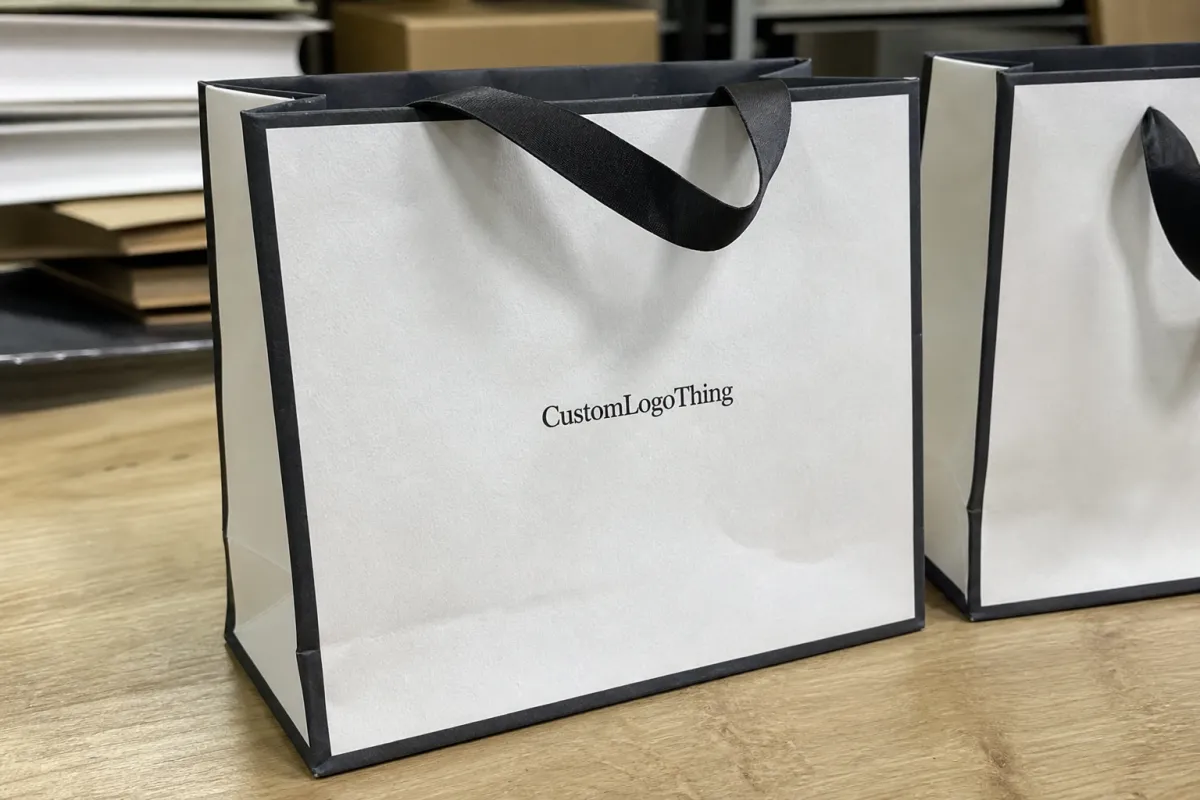
Ribbon handles create a softer, more gift-like presentation than rope or die-cut handles. They are often chosen for beauty, confectionery, boutique retail, and other categories where the bag is part of the customer experience. The format can look refined without requiring a complex structure.
Print method should match the artwork. Clean logos and broad color fields can work well with offset or flexographic printing, depending on quantity and material. Dense graphics, metallic accents, and fine registration need more control. If the design uses full coverage on coated stock, the supplier should explain how ink, varnish, and lamination will behave together. A quote is only useful if the artwork can be reproduced cleanly without banding, cracking, or color shift.
For buyers who think about shipping as well as shelf appearance, it helps to consider how the bags will travel inside cartons or on pallets. A good-looking paper bag can still fail if the outer pack or handling cycle is ignored.
Sizes, Paper Stocks, Handles, and Finish Options to Specify
The clearest quotes come from the clearest specs. Before asking for pricing, lock down the width, gusset, and height. Then confirm the paper weight, handle color, whether the gusset is printed or plain, and whether the bottom needs extra reinforcement. If any of those points are left open, the quote can shift later and comparison becomes harder.
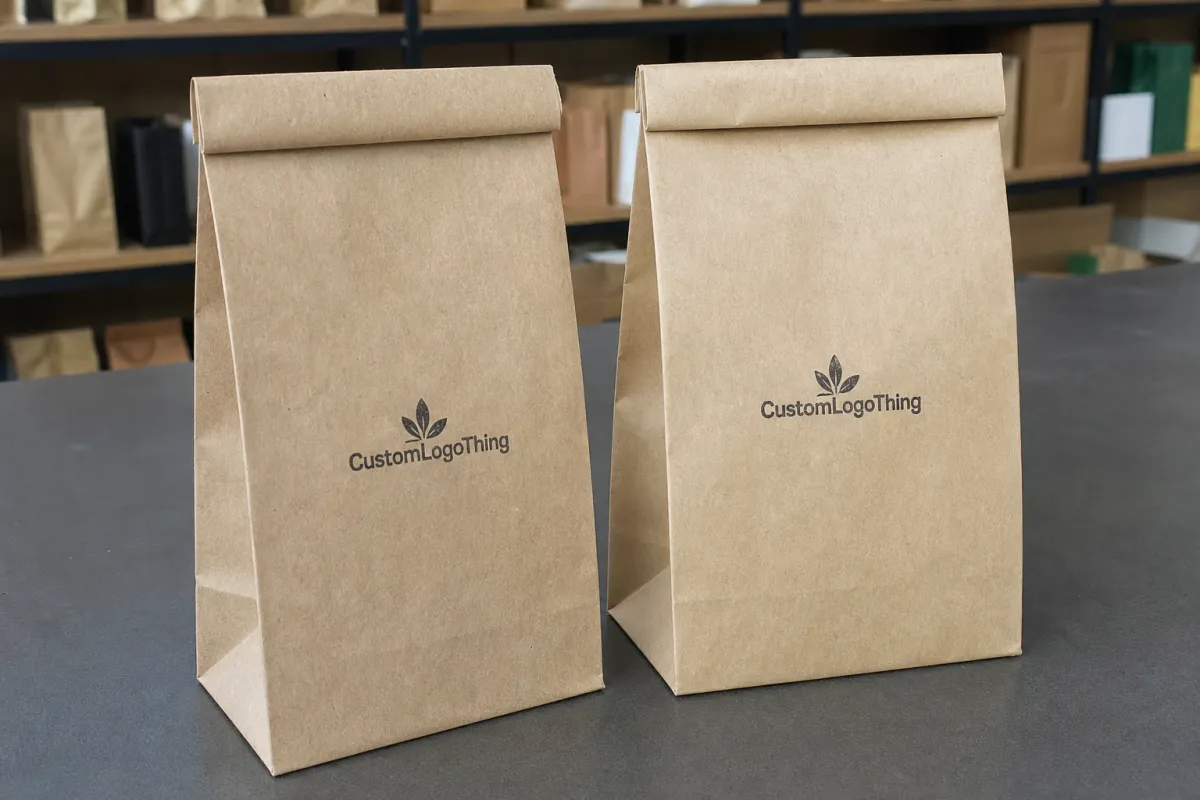
Paper stock changes the feel of the bag more than many buyers expect. Natural kraft gives the product a warmer, more tactile character and usually suits brands that want an earthy look. Coated stocks are better when the logo needs sharp edges, smooth solids, or stronger contrast. Uncoated premium board sits in the middle: matte, restrained, and a good match for minimal branding.
Here is a practical way to compare common choices:
| Option | Best For | Typical Look | Tradeoff |
|---|---|---|---|
| Natural kraft stock | Eco-style retail packaging, artisanal brands, lighter print coverage | Warm, textured, natural | Fine artwork prints less sharply |
| Coated art paper | Premium logos, solid color fields, bright branding | Smooth, crisp, polished | Needs finish protection for scuff resistance |
| Uncoated premium board | Minimal branding, boutique gift packaging, understated presentation | Matte, tactile, refined | Not ideal for heavy ink coverage |
| Laminated stock | Seasonal promotions, high-touch retail, longer wear | Matte or gloss, durable | Raises cost and usually adds setup time |
Finish changes the feeling quickly. Matte lamination gives the bag a quieter surface. Gloss brings up color and makes the package read brighter under store lighting. Spot UV can isolate a logo or pattern, and foil adds a stronger premium cue. These effects may seem small on a spec sheet, but they are obvious in hand.
The right choice depends on what the bag needs to say. A cosmetics bag may benefit from matte lamination and a precise foil mark. A confectionery bag may work better with a natural stock and lower ink coverage. Good product packaging does not need to do everything; it needs to do the right thing clearly.
For brands with sustainability requirements, material conversations should also include coating choices, print coverage, and end-of-life behavior. FSC-certified paper may matter in those programs, and the FSC framework can help support sourcing discussions when paper origin is part of the brand story.
Pricing, MOQ, and What Changes the Unit Cost
Pricing is rarely driven by one item. It usually comes from the combination of bag size, paper weight, handle type, print colors, finish, and how much of the surface is covered. In a Ribbon Handle Paper Bags small batch custom order, quantity matters too because setup time gets spread across fewer units. That is why the unit price can feel steep at 1,000 pieces and more reasonable at 5,000 or 10,000 pieces.
MOQ should be treated as spec-dependent, not universal. A standard size with simple artwork may have a lower minimum. A custom structure, premium finish, or tight registration usually pushes the minimum upward. The better question is not “What is your MOQ?” but “What is the MOQ for this exact size, stock, handle, and finish combination?” A ribbon color change or heavier board can shift the minimum even when the bag looks nearly the same.
For small-batch work, pricing often follows this pattern:
| Order Profile | Typical Unit Price Pressure | Why It Moves | Best Use |
|---|---|---|---|
| 1,000-2,000 pcs | Highest | Setup cost is spread across fewer bags | Launch tests, events, narrow seasonal runs |
| 3,000-5,000 pcs | Moderate | More efficient spread of proofing and tooling cost | Small retail programs, repeatable gifting |
| 10,000+ pcs | Lowest | Material buying and production efficiency improve | Established programs with predictable demand |
Small custom paper bags can vary widely in price. A simple printed bag may stay in a modest range, while heavier board, ribbon handles, lamination, foil, or multi-pass print quickly raise cost. That is not just decoration inflation. Each added element affects sourcing, setup, inspection, and packing. If a quote includes tight registration, custom ribbon color, and surface treatment, the price should reflect the added complexity.
Comparisons only work when the spec sheet is matched line by line. One quote may use lighter stock, shorter handles, or fewer print steps. Another may include freight while the first does not. Hidden costs also matter: setup, plate charges, proof revisions, carton packing, and multi-site delivery can all change the final spend. For procurement teams, clarity usually saves more money than the lowest headline number.
Process, Proofing, and Production Turnaround
The workflow should feel predictable: quote request, spec confirmation, artwork review, proof approval, production, inspection, packing, and shipment. If a supplier skips one of those steps, the buyer usually pays for it later. That matters even more on a small-batch order because there is less inventory to absorb a mistake.
Most delays start with artwork. Files without bleed, low-resolution logos, missing dieline dimensions, or unresolved color values slow proofing. Another common problem is spec drift: the buyer approves one size and then changes handle style or finish after the proof is already built. That can mean revised tooling, a fresh material order, or a new production slot.
Turnaround can be fast, but only when the details are stable. Standard materials and simple print can move quickly after approval. Special finishes, imported components, and peak-season demand usually extend lead time. A real timeline should be measured from proof approval, not from the first inquiry.
These habits help the job move without friction:
- Assign one person to approve artwork and dimensional changes.
- Send the final size and quantity before the quote is confirmed.
- Provide vector artwork or high-resolution files early.
- Confirm delivery address, receiving hours, and dock details before production starts.
- Review color, handle placement, and bleed before approving the proof.
For programs with stricter shipping conditions, packaging testing standards can help frame the conversation. Surface quality matters, but pallet pattern, carton strength, and handling cycle matter too.
Why Buyers Reorder From a Custom Packaging Partner
Repeat orders depend on reliability more than presentation. Buyers reorder when color stays consistent, handle placement does not drift, cartons are packed the same way each time, and questions get answered before they become delays. For a brand using ribbon-handle bags across related campaigns, consistency is part of the product experience.
There is also a practical difference between a direct manufacturing partner and a marketplace seller. A direct partner can review the spec more carefully, spot prepress issues earlier, and give more concrete feedback on where cost can be reduced without changing the look too much. A marketplace listing may be easier to browse, but it usually offers less control over construction, print method, or reorder history.
Order history helps more than most teams expect. When the previous spec is already on file, the next run becomes simpler. Handle color, board thickness, print position, and finish can be matched against the earlier job instead of being rebuilt from memory. That reduces back-and-forth and lowers the chance of drift between campaigns.
Good partners also suggest changes that protect the budget without flattening the design. They may recommend a slightly different ribbon width, a lighter interior print, or a stock that keeps the bag premium without pushing the cost too far. That kind of advice is especially useful for small-batch programs that may repeat later.
Next Steps to Lock the Right Spec Sheet
If the goal is a clean quote, send a complete spec sheet from the start. Include the bag dimensions, paper stock, handle color, print method, quantity, target ship date, and delivery ZIP code. Incomplete requests slow everything down and make pricing less trustworthy.
Add a reference image if one is available. A past sample, a competitor reference, or a simple mood board can help clarify finish level and color intensity. That matters most when the design includes metallic ink, large solid areas, or exact color matching. If possible, ask for a digital proof and, for tighter programs, a physical sample so the ribbon, surface, and logo placement can be checked in hand.
Before approval, check five points:
- Dimensions match the product and the planned fill weight.
- Artwork includes bleed, correct scaling, and legible small type.
- Finish fits the brand level and the budget.
- Timeline still works after proof review.
- Delivery details are confirmed for the receiving site.
That last check saves more trouble than people expect. The wrong address, a missed dock appointment, or a short receiving window can cause more delay than the print itself. Once the proof, timing, and budget all line up, the order can move with less risk.
For brands building a larger packaging program, a careful small batch can be the best first step. It protects cash, protects the schedule, and protects the brand image at the same time. If the first run works, scaling becomes easier. If the first run exposes a problem, the correction costs less.
What is the usual MOQ for ribbon handle paper bags in a small batch custom order?
MOQ depends on bag size, print complexity, and finish, but small-batch runs are usually lower than full commercial packaging orders. Ask for the minimum on the exact spec you plan to approve, because a different paper stock or handle style can change the threshold.
Which paper stock works best for ribbon handle paper bags with logo printing?
Smoother coated stocks usually deliver sharper logos and cleaner solids. Natural kraft or uncoated stock works well when the brand wants a softer, tactile look and a more restrained print style.
How long does production usually take after artwork approval?
Turnaround depends on quantity, finish, and component availability, but the clock starts after proof approval and final spec confirmation. Special finishes, imported materials, and seasonal demand can add time, so it helps to lock details early.
What changes the price most on a custom ribbon handle paper bag order?
The biggest cost drivers are size, paper weight, print coverage, color count, and whether the bag includes premium finishes. Lower quantities raise unit cost, but they can still make sense when the buyer is testing demand or launching a limited run.
Can I review a proof before the order goes into production?
Yes, and buyers should always request a digital proof before approval. For tighter branding requirements, ask whether a physical sample is available so color, handle placement, and finish can be checked in hand.