Buying a ribbon handle Paper Bags Unit Cost breakdown often looks straightforward on the surface and then becomes complicated the moment the spec sheet is complete. The paper itself matters, but it is rarely the line item that changes the quote most. Handle attachment, reinforcement, print coverage, finish, packing format, and order quantity usually have more influence on the final unit price than buyers expect.
That is why a bag that looks simple in a render can still cost more than a heavier-looking alternative. Ribbon handles tend to add assembly time, and assembly time is where pricing shifts quickly. A factory can buy paper in many grades, but once a job calls for precise handle placement, clean top-edge finishing, and retail-ready presentation, the labor and quality-control burden becomes part of the real cost.
From a buyer’s perspective, the goal is not to chase the lowest quoted number in isolation. The goal is to arrive at the lowest landed cost that still gives the bag the right appearance, strength, and consistency for the channel it will live in. A luxury gift bag, a cosmetic carry bag, and a short-run promo bag do not deserve the same construction, even if they happen to share the same handle style.
“The cheapest bag on paper can become the most expensive one after rework, weak handles, or a second production run.”
Why ribbon handles change unit cost faster than paper grade
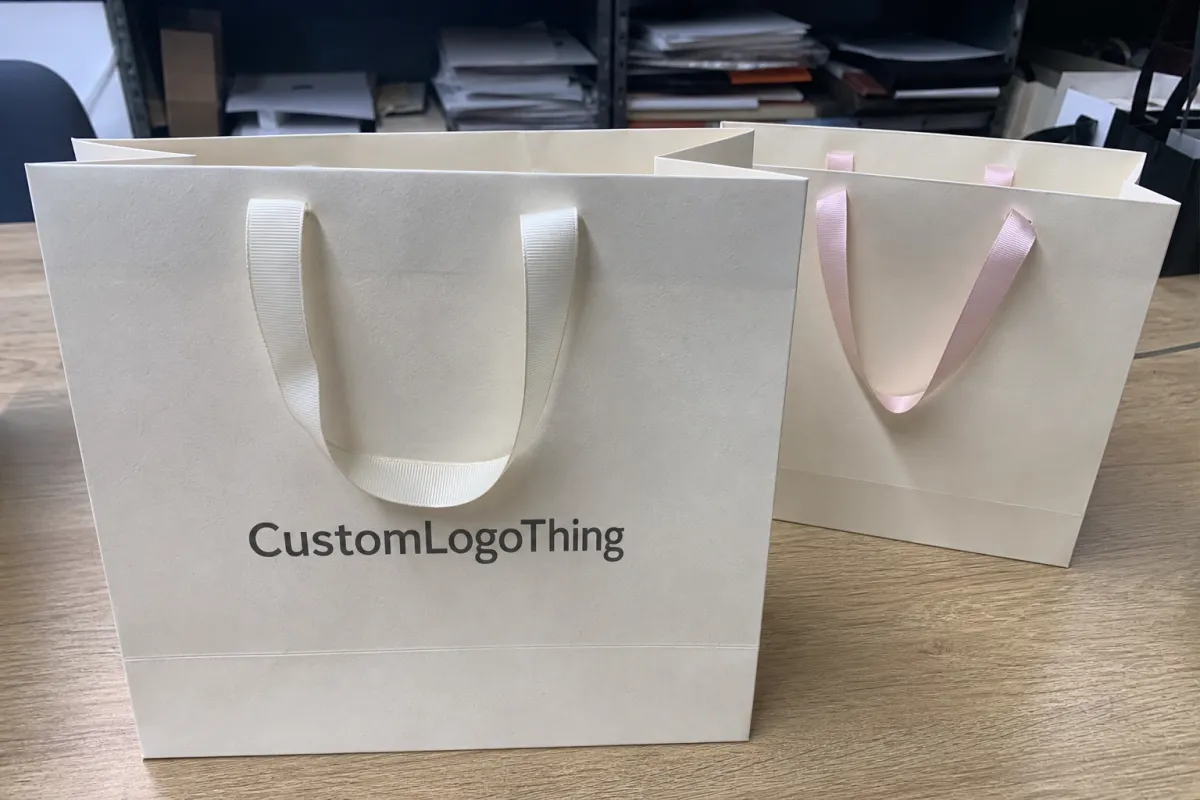
On ribbon handle bags, the handle system and the top reinforcement often move pricing more than the paper stock. A kraft sheet and a coated art paper sheet may not differ dramatically at moderate volumes, but once you add ribbon insertion or attachment, extra glue points, reinforced headers, and inspection time, the unit cost can climb faster than expected.
That happens because ribbon bags often need a cleaner finishing sequence than rope handle bags. The attachment area must look neat, the top edge must stay flat, and the handle must sit consistently from bag to bag. If the ribbon is stitched, tucked, or locked behind a reinforced patch, the assembly time increases again. The result is a product that feels more premium, but also one that usually carries more production steps.
Material quality still matters. A stronger paper grade can reduce failures and help the bag hold shape, especially on heavier loads. Still, the paper choice is only one piece of the bill. Handle type, print design, and finishing method usually create the bigger swings in a ribbon handle paper bags Unit Cost Breakdown.
Ribbon handles are popular for a reason. They lift the perceived value of retail packaging without changing the product itself. Boutique apparel, cosmetics, candles, and gift programs use them because the bag becomes part of the customer’s first impression. That impression only works when the structure supports it. A soft bag with a pretty ribbon can look underbuilt quickly, and a bag that sags or twists undermines the premium effect the handle was meant to create.
The practical takeaway is simple: buy the structure you need, not the structure that looks impressive in isolation. There is no benefit in paying for decorative complexity if the bag is only carrying a lightweight item for a short promotion.
Bag construction and finish options buyers actually pay for
Most of the price differences sit in the build. The bag may still be considered “paper packaging,” but once ribbon handles enter the spec, the job becomes a combination of paper conversion, finishing, and handwork. That is where the quote starts to separate into tiers.
Core build choices
The key cost drivers are paper grade, board thickness, top reinforcement, base reinforcement, handle attachment method, and print finish. A 190gsm or 200gsm art paper bag with standard reinforcement sits in a different pricing category from a rigid board bag with wrapped edges, thicker patches, and stitched ribbon handles. The more the build has to resist folding, tearing, or visual distortion, the more material and labor it uses.
Buyers often ask which structure is best. That question is too broad to be useful. A better question is which structure is enough for the product weight, retail setting, and shelf life of the packaging. Overbuilding a lightweight bag wastes money. Underbuilding a bag for glass jars, bottles, or boxed sets creates return risk and poor brand presentation.
Handle styles and cost impact
Ribbon handle options are not equal in cost or in performance. A stitched ribbon handle usually sits at the higher end because it needs more time at the machine or more careful manual assembly. A glued ribbon can be less expensive, but only if the adhesive area is wide enough and the bag is not expected to carry much weight. A folded ribbon handle can look especially polished, though that style often adds labor because the fold, alignment, and attachment all need tighter control.
Ribbon width and color can also move the price, though less dramatically than the attachment method. A standard-width satin ribbon is usually easier to source and easier to keep consistent across runs. Specialty textures, printed ribbon, or precise color matching can add cost and lead time, particularly if the order size is small. When buyers compare quotes, that difference is sometimes hidden inside a generic “handle” line rather than called out clearly.
Mixed-material builds, such as ribbon plus paper reinforcement patches or ribbon plus board inserts, are worth paying for only when the bag is expected to do more than look decorative. If the packaging will sit in a premium retail environment, pass through multiple touchpoints, or be carried publicly as part of the brand image, the extra cost is easier to justify. If the bag is secondary packaging for a short run, keep the structure lean and put the budget into print quality instead of decorative layering.
Finishes that change the quote more than they seem to
Decoration is easy to request and expensive to execute. Full-bleed print, soft-touch lamination, foil stamping, embossing, debossing, and spot UV all add process steps. They also increase the chance of spoilage if the artwork uses tight alignment or multiple layers that need to register precisely. Every added pass means more setup, more checking, and more scrap risk.
I usually separate finish upgrades into two groups:
- Worth paying for: soft-touch lamination on a premium gift bag, foil on a brand mark, or embossing on a core retail SKU that carries the first impression.
- Usually avoidable: decorative effects on a short-lived promo bag, or multiple coating layers on packaging that will be discarded after one use.
That does not mean finish is unimportant. It means the finish should fit the life of the bag. If the packaging is part of the retail experience, the extra cost can earn its place. If it is only a carrier, the smarter move is to keep the construction direct and use the print well instead of piling on effects.
Print, size, and material specs that move the unit cost
Bag dimensions influence more than appearance. They change sheet usage, die-cut efficiency, carton count, and freight density. A small change in width can reduce how many blanks fit on a sheet, which increases waste and raises the unit cost. A taller bag may need more top reinforcement or a different die line, and both of those choices add time and material.
Print coverage is another major lever. A single-color logo on kraft paper is not comparable to a full-wrap design with dark solids, metallic accents, or precise edge alignment. Ink usage matters, but the bigger cost driver is control. The more coverage and the tighter the visual requirements, the more setup, monitoring, and inspection the job needs.
Material choice can shift pricing in a measurable way:
| Material / spec | Typical use | Cost impact | Buyer note |
|---|---|---|---|
| Kraft paper | Natural, retail, eco-leaning packaging | Usually lowest to mid-range | Works well with simple graphics and earthy branding |
| Coated paper | Gift, cosmetics, premium retail | Mid-range to higher | Better image sharpness, but finish options add cost |
| Specialty paper | Luxury presentation, tactile branding | Highest | Only worth it if the bag is part of the brand story |
| Recycled content / FSC stock | Certified sustainability programs | Small to moderate premium | Useful when documentation and traceability matter |
For buyers who need certification references, FSC is the standard place to verify forest stewardship requirements and current program details at fsc.org. For transit and distribution testing, ista.org is useful because shipping performance can reveal weakness that a flat sample will not show. A bag that looks good on a table still needs to survive handling, stacking, and movement through distribution.
Spec discipline matters more than many teams expect. If the artwork, size, handle length, and paper grade stay stable, repeat orders are easier to quote and easier to run. Once multiple variables change together, the apparent “price jump” is usually just the cost of changing the order.
One other practical point: size drives freight as well as manufacturing. Bags that nest efficiently ship more economically than oversized or rigid versions that trap air in cartons. Even a slight change in gusset depth can alter carton count per pallet, which affects the landed cost more than the bag price alone suggests.
Ribbon handle paper bags unit cost breakdown: pricing, MOQ, and quote inputs
A useful Ribbon Handle Paper Bags unit cost breakdown includes material cost, print setup, handle assembly, finishing, packing, freight, and margin. That sounds obvious until you compare two quotes and discover that one price includes proper packing and the other quietly assumes the buyer will absorb the hard parts somewhere else.
For clarity, I usually think about the cost in these buckets:
- Material cost: paper, board inserts, ribbon, glue, and reinforcement patches.
- Setup charges: artwork preparation, printing plate or screen setup, and die-cut prep.
- Tooling fees: new dielines, custom attachments, or unusual handle hardware.
- Assembly: handle attachment, folding, gluing, and manual checking.
- Finishing: lamination, foil, embossing, or spot UV.
- Packing: carton spec, inner wrap, palletization, and labeling.
- Freight: domestic delivery or export shipping to the destination.
MOQ is the other major variable. Lower quantities push the unit cost up because the fixed work is spread across fewer bags. A 1,000-piece order can look expensive next to a 5,000-piece order even if the paper, print, and handle style are identical. Once the run size rises, the setup burden gets diluted and the pricing usually steps down in a way buyers can actually see.
For a rough sense of market behavior, basic ribbon handle bags in moderate volume may fall in a band around $0.18-$0.28 per unit at 5,000 pieces, while more decorated premium builds can move toward $0.35-$0.70 or higher depending on coating, ribbon style, print coverage, and structural reinforcement. Smaller runs can sit above those numbers very quickly. That is not a pricing trick; it is the cost of setup, proofing, and short-run handling being spread across too few units.
These order-tier patterns are helpful for planning, though they are not promises:
| Order tier | Typical pricing behavior | What changes most |
|---|---|---|
| Sample / pilot quantity | Highest per piece | Proofing, setup, and short-run handling |
| Small wholesale run | Noticeable drop, still setup-heavy | Spread of tooling fees and print prep |
| Repeat production | Best balance of price and consistency | Lower setup burden, better process control |
The quote inputs that matter most are simple and specific:
- Bag size
- Paper type and thickness
- Print colors and coverage
- Handle style, color, and length
- Quantity
- Destination
- Packing requirements
If any of those are unclear, the quote will be unclear too. And vague quotes are usually expensive later, because the missing detail gets resolved after the order has already been set in motion.
There is also a hidden line item buyers forget to ask about: spoilage allowance. If a job involves tight registration, metallic effects, or delicate ribbon handling, the production plan may need extra overage to absorb defects or color adjustment. That does not always appear as a separate charge, but it changes the economics of the run. A transparent quote should make those assumptions visible.
Process, timeline, and lead time from dieline to shipment
The production sequence is usually consistent even when the terminology changes from supplier to supplier. It starts with spec confirmation, moves to artwork review, then dieline approval, then sampling or a pre-production proof. After that comes mass production, inspection, packing, and freight booking. When the sequence is respected, the project tends to stay predictable. When it is rushed, small errors become expensive.
Most delays are avoidable. Unclear artwork leads to revisions. Late approvals push the line. Changes after proofing can restart parts of the process. Freight becomes awkward when a booking is made too close to the ship date and the product is finished before the truck or vessel space is ready. The bag itself may be simple; the schedule rarely is.
Lead time depends on complexity. A repeat order with approved artwork and a stable spec can often move in roughly 12-15 business days from proof approval. Jobs with custom finishes, special ribbon sourcing, or sample revisions can take longer. Peak season stretches timelines further, especially when larger retail programs are already occupying the production schedule.
Buyers planning a Ribbon Handle Paper bags unit cost breakdown should treat lead time as part of pricing. Fast jobs often cost more because they interrupt the normal flow of work. Slow, well-planned jobs are easier to price correctly and easier to execute cleanly.
For heavier or distribution-focused orders, ask how the bags will be packed for transit. A retail-ready pack may not be the best shipping pack. Carton dimensions, pallet height, and stacking strength can affect damage rates and freight cost. A good sample is not just a visual approval; it should also tell you whether the structure holds up under handling.
How we keep repeat ribbon-bag orders consistent and on budget
Repeat orders should become easier to buy and easier to produce. That only happens when the spec is kept stable. The useful controls are plain but effective: retained artwork files, approved color references, saved samples, clear carton standards, and a record of the exact paper and ribbon used on the previous run.
Cost creep usually begins with a small, seemingly harmless change. A buyer switches paper because a different stock looks better on screen. Someone changes ribbon shade to match a new campaign. A thicker lamination gets added because the sample felt too soft. Each change makes sense on its own, but together they move the cost and make the quotation harder to compare.
Quality checks matter because weak packaging is not a bargain. The main checks are handle pull strength, glue bond consistency, print registration, bag squareness, and edge finish. If the handle area fails, the bag loses confidence immediately. If the print is off, the premium look disappears. If the bag leans or twists, customers notice even if they cannot explain the defect.
There is also a commercial upside to consistency. Stable specs reduce approval cycles, which shortens reorder time. Fewer revisions mean less back-and-forth and fewer chances for the quote to drift. In practical terms, the best savings often come from keeping the same bag repeatable across seasons rather than trying to optimize a single invoice by a fraction of a cent.
A strong repeat program also depends on color control. Satin ribbon can show color differences faster than the printed bag body, especially under retail lighting. If the ribbon and print are supposed to coordinate, the approved shade should be documented clearly instead of described loosely. “Close enough” is a weak instruction when the packaging is visible on shelf.
What to send for an accurate quote and a clean next step
If you want an accurate quote, send a brief spec package that leaves very little open to interpretation. The strongest version includes dimensions, quantity, paper stock, print artwork, handle color and length, and target delivery date. If you have a reference sample, include that as well. A photo helps; a physical sample helps more.
Ask for a like-for-like comparison using the same spec set. That is the only way the Ribbon Handle Paper Bags unit cost breakdown becomes genuinely useful. Otherwise the numbers are only pretending to be comparable while hiding differences in paper weight, handle construction, finish, packing, or freight assumptions.
For the cleanest approval path, keep the next steps straightforward:
- Confirm the spec.
- Request a sample or proof if needed.
- Approve the pricing tier and MOQ.
- Lock production timing and freight terms.
That sequence reduces surprises. If you skip it, the order may still move, but the budget can shift after the fact. Buyers usually feel that pain in two places: one in production, and one again in logistics.
For a final cost check, compare total landed cost rather than factory price alone. Freight, packing, duty, and rework risk belong in the same conversation. That is the difference between a tidy purchase and a bargain that stops looking like a bargain once the shipment lands.
The most reliable way to buy ribbon bag packaging is to keep the spec tight, compare identical builds, and judge the full landed number on the ribbon handle paper bags unit cost breakdown instead of the headline quote. That approach is slower by a few minutes and cheaper by a lot more than that.
What drives the ribbon handle paper bags unit cost the most?
Handle attachment labor and finishing usually move the price more than the paper itself. Print coverage, reinforcement, and specialty coatings also matter, especially when the job needs tight visual quality. MOQ is a major factor because setup costs get spread across each bag.
How does MOQ affect ribbon handle paper bag pricing?
Lower quantities raise the unit price because tooling, setup, and proofing are spread over fewer bags. Once the run moves into a higher production tier, the unit cost usually drops in a noticeable step. If you only need a test run, ask for a sample or pilot quantity instead of forcing everything into one short order.
Are ribbon handles more expensive than rope handles?
Usually yes, when the ribbon requires more careful assembly or a more premium visual finish. The difference can narrow if the rope bag uses heavier reinforcement or unusual hardware. The real comparison is attachment method, not just handle material.
What lead time should I plan for custom ribbon handle bags?
Simple repeat orders can move quickly once artwork and spec are approved. Custom finishes, revised samples, or ribbon sourcing can add several days. Freight can take as long as the bag production itself, so both parts should be checked before the schedule is locked.
What should I include in a quote request for ribbon handle bags?
Send dimensions, quantity, paper type, print colors, handle style, and shipping destination. Attach artwork or a rough layout so the production team can check coverage and setup needs. If you want a quote you can compare honestly, ask for the full landed cost, not just the base factory price.

