A Ribbon Handle Paper Bags quality control checklist sounds straightforward until a shipment arrives with handles that look elegant, print that looks sharp, and cartons that still fail the first real use test. The problems are often hidden in the details: a ribbon that shifts under load, a glue line that cures unevenly, a top fold that softens after packing, or a carton that protects the bags on the pallet but not during the last mile. Good QC is not only about catching obvious defects. It is about making sure the bag still performs after printing, die cutting, handle assembly, packing, freight, and storage all do their part.
For buyers ordering custom logo bags for retail, gifting, cosmetics, wine, or seasonal promotions, that checklist is a practical safeguard against returns, rework, chargebacks, and avoidable damage. It gives everyone the same reference for size, appearance, strength, and carton packing. It also helps separate cosmetic polish from real build quality, which matters more than many sourcing teams expect. A bag can look premium on a screen and still fail because the substrate, ribbon, and glue were never matched to the intended load.
What a Ribbon Handle Paper Bags Quality Control Checklist Actually Catches
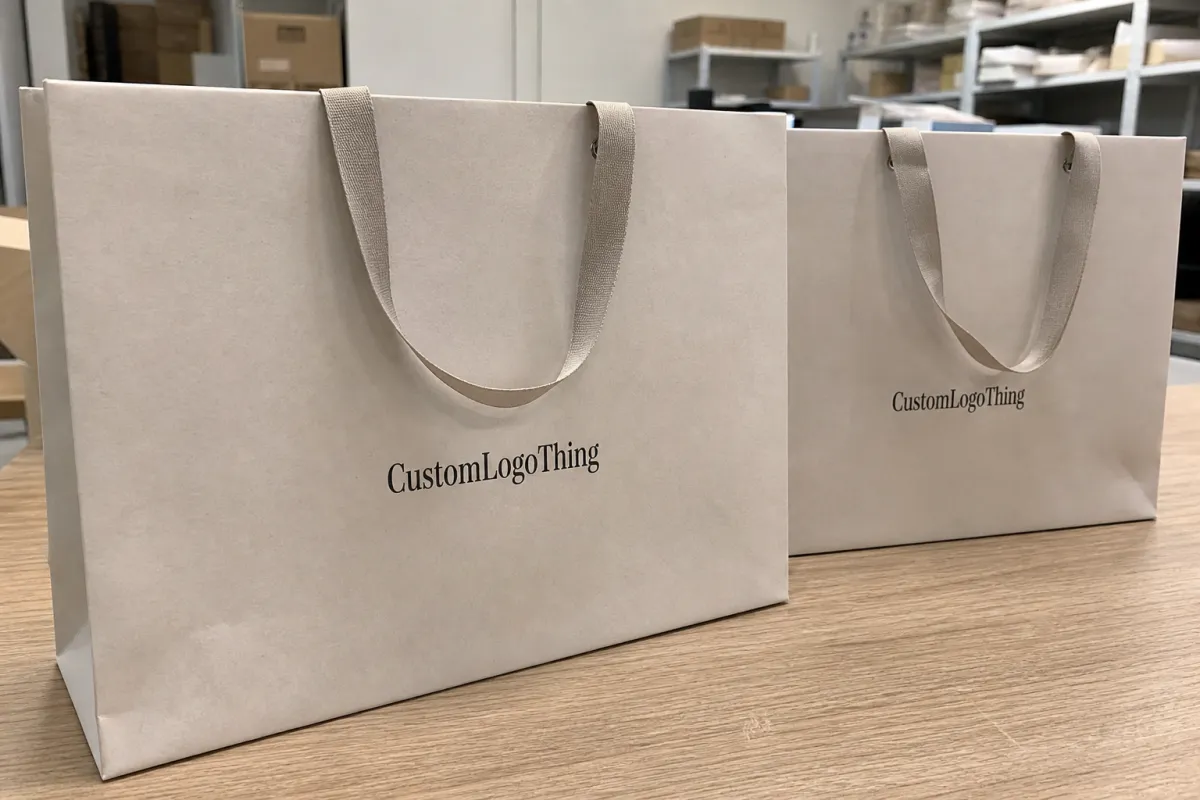
The biggest mistake buyers make is treating ribbon handle inspection like a visual check only. A bag can pass a quick scan and still fail once someone lifts it by the handle with product inside. That is especially true for ribbon handles, because the soft finish can hide a weak attachment point, poor knot formation, or a glue area that is too small for the intended weight. A useful ribbon handle paper Bags Quality Control Checklist has to cover performance, not just appearance.
Most QC issues fall into four groups: strength, appearance, consistency, and packing accuracy. Strength means the bag survives its intended load without tearing, slipping, or deforming badly. Appearance covers print registration, color match, scuffing, and whether the bag stands neatly. Consistency means the run stays within agreed tolerances from carton to carton, with no obvious drift in size or shade. Packing accuracy means the correct quantity, correct SKU, correct carton label, and correct outer condition all reach the shipper in one clean release.
Ribbon handle bags tend to hide defects longer than twisted paper handle bags. A twisted handle usually shows a clear bend or asymmetry. Ribbon often looks graceful even when the load path is wrong. If one handle hole is cut slightly off, or one glue patch is shorter than the other, the issue may only show up after repeated lifting. Buyers who skip load testing usually discover the weakness after the bags are already in circulation, which is the least convenient time to learn it.
A ribbon handle bag can look finished on a table and still fail the first time it is used. That is why the load test belongs on the checklist, not beside it.
Used well, the checklist reduces rework, avoids mixed lots, and protects the finish from handling damage that starts before the bag even leaves the factory. It also keeps buyer and supplier aligned on what acceptable variation actually means. That matters when a job includes foil, matte lamination, custom ribbon color, or a heavier board that behaves differently during folding and gluing.
How the Inspection Process Works From Material to Packed Carton
Reliable QC starts before production and follows the order through each stage instead of waiting for the final cartons. The first checkpoint is material approval: paper grade, board thickness, ribbon specification, surface finish, and any internal reinforcement. The second is sample approval, where the buyer confirms the size, print placement, handle look, and overall feel against the approved spec. The third is in-process inspection, which is where a factory can still catch drift before it affects the whole run. Final inspection comes last and focuses on finished quantity, visual defects, carton condition, and readiness for shipment.
The difference between sample approval and in-process checks is easy to miss. A sample shows what the supplier can make under controlled conditions. Production shows what happens when the line is moving at speed and the team is handling real quantities. If a handle is inserted a little too shallow, or if the paper feed shifts by a few millimeters, those errors can multiply quickly. Final inspection cannot fix that. It can only sort, reject, or document the damage.
A practical Ribbon Handle Paper bags quality control checklist turns subjective comments into measurable checks. Use rulers or calipers for dimensions. Use a physical master sample or Pantone reference for color. Use a defined pull test for handle strength. Check whether cartons are packed to survive compression, stacking, and corner impact. The goal is not perfection for its own sake. It is consistency that matches the order’s purpose and price point.
Buyers should ask for clear records, not just a quick status update. Good documentation includes photos from the same angle and lighting, approval samples marked and labeled, defect counts with descriptions, and notes on any rework. If the supplier claims FSC material, the paper chain should be traceable rather than just described that way in the quote. If shipping integrity matters, packaging practices should be aligned with recognized transit testing principles such as those used by ISTA.
Material Specs, Handle Attachment, and Print Details That Change Quality
Material choice sets the upper limit for how strong and presentable the bag can be. For many retail programs, a common build uses 210gsm to 250gsm coated art paper or 230gsm to 300gsm C1S board. More demanding gift bags often move to 300gsm to 350gsm board, usually with a top reinforcement card or added insert for stiffness. Heavier products and wider bag formats need more structure than a light promotional bag, especially if the bag must hold its shape on a shelf or under a display light.
Ribbon handle details matter just as much. Width, weave density, finish, and colorfastness all affect appearance and comfort. A 10 mm ribbon may suit small and medium bags, while 15 mm or wider is often better on larger formats because it spreads the load and feels less sharp in the hand. The attachment method is where many quality complaints begin. If the ribbon is inserted too shallow, the knot is uneven, or the glue patch is too small, the load does not transfer evenly. That creates twisting, creasing, or tearing near the top fold.
Print and finishing add another layer of risk. Solid dark colors can expose ink density issues. Foil and embossing need tighter registration. Matte lamination can hide some surface flaws while also showing fingerprints, rub marks, or pressure scuffs if the packout is rough. Soft-touch finishes feel luxurious but are less forgiving in transit, especially if the bags are tightly bundled. A bag that looks excellent flat on the press table may still show folds, surface haze, or edge wear once it is packed and moved through the warehouse.
There is also the matter of paper behavior. Board memory, humidity exposure, and fiber direction can change how a bag folds and stands. In dry storage, some papers crack slightly on tight creases; in humid conditions, some lose stiffness and sag faster than expected. Buyers rarely ask about this, yet it can affect everything from gusset shape to handle alignment. If the order is intended for long storage or warm transit lanes, those conditions should be considered before approving the spec.
Here is the practical reality: a well-made render does not guarantee a durable bag. The weakest material, attachment, or finishing step sets the limit.
| Option | Typical unit range | What it changes |
|---|---|---|
| Standard paper with basic ribbon | $0.40-$0.70 per unit at 5,000 pcs | Lower material cost, simpler finishing, suitable for light retail use |
| Heavier board with matched ribbon | $0.70-$1.10 per unit at 5,000 pcs | Better rigidity, stronger hand feel, more stable presentation |
| Premium finish with foil or soft-touch | $1.10-$1.60+ per unit at 5,000 pcs | Higher visual impact, tighter process control, more scuff sensitivity |
Cost, Pricing, MOQ, and Unit Cost Factors Buyers Should Review
Price is rarely just paper plus ink. For Ribbon Handle Paper Bags, unit cost reflects paper grade, ribbon type, print complexity, finish, labor, waste allowance, and packing method. A simple two-color bag at a moderate quantity can sit around $0.40-$0.70 per unit. Heavier board, specialty ribbon, foil, embossing, matte lamination, or premium presentation packaging can push the same style beyond $1.00 per bag without much trouble. Small quantities raise the price quickly because setup time and waste are spread across fewer pieces.
MOQ has a direct effect on the quote. A supplier may offer a better figure at 5,000 or 10,000 pieces because press setup, die cutting, handle assembly, and inspection labor are distributed across a larger run. That said, a lower MOQ can still be the better choice if the project is a trial run or a seasonal program with uncertain sell-through. Buyers should compare not just the headline MOQ, but the effective cost of storage, spoilage risk, and reordering.
Hidden costs often sit in the line items people skim. Extra inserts, tighter size tolerance, custom carton printing, inner sleeves, third-party inspection, sample courier, and rerun sampling all add cost. Freight assumptions matter too. A quote may look attractive until carton strength, packout density, or case weight increases the shipping bill. A cheaper bag that arrives crushed is not a cheaper bag.
When comparing suppliers, ask exactly what is included. Does the quote cover tooling, proofing, and standard export cartons? Are the bags packed flat in bulk or in inner sleeves? Is the term EXW, FOB, or something else? Are approval samples free or charged separately? A Ribbon Handle Paper Bags quality control checklist helps buyers compare apples to apples because it defines the same inspection standard across every quote.
Process, Lead Time, and Turnaround: Where QC Fits in Production
Lead time begins with artwork and ends with carton release, not with the first press run. Clean artwork review can take one to three business days. If foil layers, trapping, or dieline corrections are needed, the schedule stretches. Sample production usually takes a few more days. After approval, printing, die cutting, gluing, handle assembly, packing, and final inspection follow in sequence. For many custom jobs, 12-15 business days after proof approval is a fair planning window, though simple orders can move faster and complex builds can take longer.
QC belongs inside that timeline. Prepress checks catch issues with bleed, font size, and separation. First-article checks catch registration, ribbon position, and glue placement before the run gets too far ahead. Mid-run checks catch drift in ink density, handle tension, or bag squareness. Final inspection confirms that the finished cartons match the approved sample and the packing instruction sheet. A factory that only checks at the end is depending on luck to protect the order.
Tighter quality standards cost time. That is the tradeoff, and it is usually the correct one for branded retail packaging. Buyers who want consistent color across multiple production lots, especially with foil or complex artwork, should expect a little extra time for verification. Rushing tends to produce one of three outcomes: handle defects, color variation, or carton packing mistakes. Sometimes all three show up together.
One practice that saves a lot of argument later is locking the sign-off record before production starts. That record should include the bag size, paper spec, ribbon width and color, print reference, carton count, tolerance range, and the approved sample. If anything changes midstream, the change should be written into the record immediately. A clean paper trail is far cheaper than trying to reconstruct who approved what after the shipment has already been packed.
Step-by-Step QC Checklist for Samples, In-Process Checks, and Final Audit
The ribbon handle paper bags quality control checklist works best when it is split into three phases: sample approval, in-process inspection, and final audit. Each stage answers a different question. The sample asks whether the design and build are right. The in-process check asks whether production is still on target. The final audit asks whether the finished cartons are ready to ship.
Sample approval
Start with size, print layout, ribbon color, handle placement, and overall presentation. Measure width, height, and gusset depth against the spec sheet. Check whether the ribbon is centered, whether the knot or insertion point is clean, and whether the bag stands square on a flat surface. If the bag is intended for a specific load, test it with that weight before approval. A sample that looks elegant when empty but collapses under use is not a usable reference.
Look closely at the finish. Foil should sit inside the intended registration window. Lamination should not show haze, bubbles, or edge lift. If the bag has a special coating, check for scuff resistance by rubbing one sample against another. These details are small individually, yet they shape the customer’s first impression more than a flat artwork proof does.
In-process checks
During production, verify die-cut accuracy, glue coverage, handle pull strength, fold alignment, and print consistency. First-piece approval is useful, but it is not enough. Sample the line at intervals so drift can be corrected before it spreads. If the supplier notices that ribbon tension is changing or paper feed is moving off register, there is still time to stop and adjust. That is far better than discovering the issue after thousands of pieces are already folded and packed.
Ask for photo evidence from the line if you are reviewing remotely. Focus on the same angles each time: front view, side view, handle close-up, carton labels, and outer case condition. Consistency in photos makes comparison easier and avoids false confidence from a favorable angle. If a job has narrow color tolerances, a physical control sample is still better than any screen-based approval.
Final audit
At the end, inspect carton counts, surface defects, crushed corners, tape quality, and label accuracy. Confirm inner pack quantities, outer case condition, and any moisture protection required for the route. If the shipment is going into retail distribution, carton strength matters as much as the bag itself. A clean bag inside a damaged carton still creates claims and repacking work.
A simple pass/fail system keeps the review practical. For example: minor shade variation acceptable if not obvious at arm’s length, or handle pull must hold the stated load without tearing or slipping. That wording removes guesswork and gives both sides a clear reference if a lot needs correction.
Quick checklist recap:
- Match size, print, ribbon color, and attachment method to the approved sample.
- Test loaded handle strength, not just empty appearance.
- Verify glue coverage, fold alignment, and carton counts during production.
- Document acceptable variation and defect limits before shipment.
Common Mistakes, Expert Tips, and Final Sign-Off Before Shipment
The most common mistake is approving a sample without testing it at real use weight. A ribbon can feel pleasant in the hand and still cut too sharply into the paper once the bag is filled. The second mistake is writing specs that sound polished but mean very little. “Premium paper” does not tell a factory what to buy. “300gsm C1S, matte lamination, 10 mm polyester ribbon, centered top insert, 1 mm size tolerance” does.
Another frequent problem is inconsistent color reference. Buyers sometimes approve from a screen image and then wonder why the finished bag feels wrong under natural light. Use a physical master sample whenever possible, or define the Pantone target and review lighting clearly. Ask for photos under the same setup, not random phone shots from different corners of the shop floor. The more visible the reference, the fewer disputes later.
These habits help keep the last stage under control:
- Keep one signed golden sample sealed and labeled for future comparisons.
- Set a clear load test weight based on actual use, not a guess.
- Ask for carton photos showing labels, seals, and outer condition before release.
- Record acceptable shade shift, scuffing, and handle variation in writing.
Final sign-off deserves a careful look, even if the schedule feels tight. Review the packing list, the approved sample, the inspection notes, and the finished cartons together. If anything feels off, ask for proof before release. That discipline is not overcautious; it is how a well-made bag stays a well-made order after shipping, storage, and handling.
That is the real value of a ribbon handle paper bags quality control checklist. It turns a decorative custom product into a controlled purchase with fewer surprises. The bag should look right, carry correctly, and arrive packed the way it was approved. If any one of those three fails, the rest of the order becomes harder to trust.
What should a ribbon handle paper bags quality control checklist include before sample approval?
It should cover size, paper grade, print placement, ribbon color, handle attachment method, and the intended load. The sample should also be checked for squareness, clean finishing, and visible defects under normal light. Buyers should keep one signed master sample so later production checks have a clear reference.
How do you test handle strength on ribbon handle paper bags?
Fill the bag to the intended use weight and lift it by the ribbon handle long enough to expose weak glue, knot problems, or paper tearing. Check whether the handle shifts, slips, or pulls the top fold out of shape after repeated lifting. Record the load and the result so the test can be repeated on future orders.
Which defects show up most often on ribbon handle paper bags?
Common issues include crooked handles, uneven glue lines, print misregistration, crushed corners, and color variation. Packing mistakes such as mixed lots, count shortages, or damaged cartons can matter just as much as visible print defects. A checklist catches these earlier than a quick visual scan.
How does QC affect the cost of custom ribbon handle paper bags?
Stricter inspection, tighter tolerances, and extra documentation raise unit cost a little, but they usually reduce rework and claims later. Higher GSM paper, premium ribbon, foil, or custom packaging also add to the price. A clear checklist makes supplier quotes easier to compare because it defines the same standard across each offer.
What lead time should buyers expect for a ribbon handle paper bag order with QC review?
Lead time depends on artwork readiness, sample approval speed, print complexity, and the number of inspection steps required. A simple custom order may move in roughly 12-15 business days after proof approval, while more complex packaging can take longer. If the spec changes after approval, the schedule usually extends.