A Matte Poly Mailer can be a practical premium-packaging choice for skincare brands: light, flat, fast to pack, and usually cheaper to ship than a box. The real question is not whether it looks good. It is whether the spec supports the order profile, packing workflow, and landed cost you need.
For skincare buyers, that usually means weighing size, film thickness, print coverage, and closure type against order weight and brand presentation. A 2.5 mil matte mailer with a one-color logo may deliver the right balance for DTC replenishment, sample programs, refill pouches, and small promotional drops.
When matte mailers solve the premium-packaging math
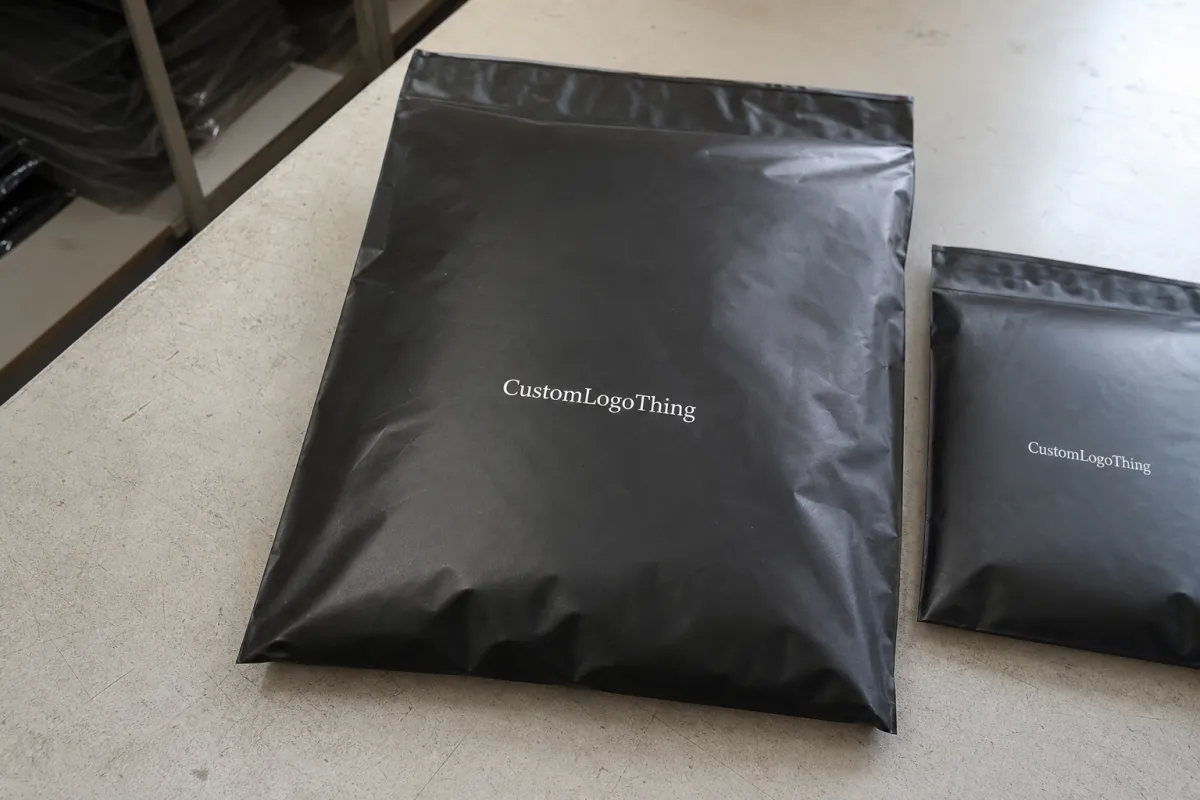
Skincare packaging teams often focus first on the product carton or primary container. Shipping packaging matters too. A matte finish hides scuffs better than glossy film, reduces glare, and gives printed logos a cleaner look in transit photos and unboxing shots.
That does not make it the right structure for every order. Heavy, sharp-edged, or leak-prone products still need a corrugated shipper or more protection. For flat or lightly bundled skincare orders, though, a matte poly mailer can protect the shipment without adding void fill, tape, or a full box.
Dimensional weight is where the math changes fast. A flatter parcel often costs less to ship than a bulkier carton, even if the bag itself is slightly more expensive than stock packaging. On small DTC orders, that tradeoff can matter more than the unit price alone.
Buyer callout: compare the bag’s unit cost with packing labor, parcel size, damage risk, and whether the order needs inserts or extra protection.
Matte mailers are especially useful for sample drops, subscription replenishment, and bundles under roughly 1 lb. They store flat, pack quickly, and take less warehouse space than pre-formed boxes.
If you are building a branded shipping system from scratch, review the broader Custom Packaging Products range first, then narrow the mailer choice once product weight, protection requirements, and monthly order volume are clear.
Material and print details that change the order outcome
A useful quote starts with spec, not artwork. The main variables are film thickness, finish, opacity, seal strength, tear resistance, and closure type. Most skincare orders land between 2.0 mil and 3.0 mil film.
Lighter film can work for samples and flat inserts. Heavier film is usually safer for mixed kits or shipments that move through automated sortation. Opacity also matters: premium skincare orders often need privacy, and too much transparency weakens the presentation.
The adhesive strip has a real operational effect. A strong peel-and-seal closure helps reduce edge lifting in warm delivery conditions and lowers the chance of repacking. A second adhesive strip can help with returns, but it adds cost and is unnecessary for many replenishment orders.
Print choices affect both unit cost and production risk. A one-color logo is usually the cleanest route for first runs. Full-panel artwork creates more brand impact, but it increases ink coverage, proofing time, and the chance of color variation.
| Specification choice | Typical buyer use | Cost impact | Watch point |
|---|---|---|---|
| 2.0 mil matte film | Samples, sachets, flat cards | Lower unit cost | Less puncture resistance for mixed kits |
| 2.5 mil matte film | Most small skincare DTC orders | Moderate cost per piece | Confirm opacity and seal strength |
| 3.0 mil matte film | Heavier bundles or boxed products | Higher material cost | May be unnecessary for flat refills |
| One-color logo print | Launch runs, replenishment bags | Lower setup complexity | Brand impact depends on placement and contrast |
| Full-panel print | Campaign drops, influencer kits | Higher ink and proofing cost | More careful artwork control needed |
Size selection is another common mistake. The mailer should fit the packed product, not the product before tissue, wrap, or insert card. Too tight slows packing; too loose lets the contents shift in transit.
Buyers comparing Custom Poly Mailers should keep the same size, film thickness, print method, and adhesive style across quotes. Otherwise the comparison is not meaningful.
Skincare brands matte poly mailers unit cost review: MOQ and quote inputs that move pricing
Bag price is not driven by “matte” alone. Unit cost changes with size, film thickness, print colors, ink coverage, and total quantity. Special adhesives, recycled content, unusual dimensions, and return-strip construction can move it again.
For planning, a 5,000-piece run of a standard small or medium mailer with one-color printing may land around $0.18 to $0.35 per unit before freight, depending on size and production route. Larger runs can bring the unit cost down, while full-panel print, heavier film, and larger formats can push it higher.
Those numbers are directional, not a binding quote. Resin costs move, freight changes, and print method matters. Still, ranges help buyers spot outliers and identify quotes that are missing critical details.
MOQ usually reflects setup efficiency rather than an arbitrary wall. Film loading, print setup, tooling, color matching, and inspection take time whether the order is 1,000 bags or 20,000 bags. That is why a first order at MOQ often costs more per piece than a practical reorder quantity.
A clean unit cost review should separate product cost, setup charges, tooling fees, samples, and freight. Otherwise a low unit price can hide a higher landed cost. For imported orders, duties and handling charges may also affect the final number.
- Bag size: larger dimensions use more film and increase inbound shipping volume.
- Film thickness: moving from 2.0 mil to 3.0 mil can raise material cost noticeably.
- Print colors: each added color can add setup time and registration risk.
- Ink coverage: small logo marks are easier to manage than edge-to-edge artwork.
- Quantity: bulk pricing improves as fixed setup work spreads across more units.
- Closure style: standard peel-and-seal is usually more economical than dual-strip return construction.
Ask for two quote paths: one at MOQ and one at a realistic reorder quantity. The spread shows whether the first order is a test run or a structurally expensive pattern.
Production steps and lead time from proof to shipment
The production workflow is simple, but delays usually happen before the press runs: artwork review, size confirmation, digital proof, buyer approval, production setup, printing, converting, inspection, packing, and dispatch.
Artwork corrections are the most common friction point. Low-resolution logos, missing Pantone references, unclear print placement, and files without bleed can add rounds of back-and-forth. A one-color mailer usually moves faster than a full-panel design with tight registration requirements.
Production lead time is separate from transit time. A custom matte poly mailer order may require roughly 10 to 20 business days after proof approval for many standard specifications, although current load, print complexity, material availability, and inspection requirements can shift that range. Transit may add several days domestically or several weeks by ocean freight.
Sample approval helps when the order carries launch kits or exact logo placement. A pre-production sample can confirm matte tone, opacity, fit, seal position, and print scale before the full run. Not every order needs one, but it is useful when the arrival photo matters.
Quality control should cover finished size tolerance, film gauge, opacity, seal alignment, adhesive bond, print position, print rub resistance, side-seam strength, and carton count. For skincare shipments, odor is worth checking too.
Rush orders can work when the buyer accepts a standard size, simple print, and fast artwork approval. They work poorly when dimensions are approximate or special materials still need sourcing. Rush fees cannot fix an incomplete specification.
For transport testing and distribution-risk thinking, the International Safe Transit Association publishes packaged-product performance test procedures at ista.org.
Specification choices that fit skincare fulfillment
Skincare fulfillment is usually small-batch, visually sensitive, and promotion-heavy. A mailer that works for a T-shirt may not work for a boxed serum plus a sample card. The bag has to protect, present, and move quickly through packing.
For sheet masks and flat sample cards, smaller mailers with modest clearance usually look best. For jars with secondary wrap, measure the product after the protective layer is added. For refill pouches, check the corners, since flexible packs can still puncture a thin bag if the edge is rigid or folded sharply.
Seal width matters. A narrow or inconsistent seal can create failures during automated handling. A wider, even seal supports heavier contents and gives packers more confidence. Edge finish matters too, because rough side seams can slow the packing line.
Opacity is part function and part brand control. A properly opaque matte mailer gives the brand control over the reveal without adding a second outer layer.
Sustainability should be discussed with specifics. Recycled-content film, source transparency, and right-sizing can all influence the purchase decision, but recycled content is not automatically better if it weakens performance and creates reships. For broader packaging and materials guidance, the U.S. Environmental Protection Agency maintains resources at epa.gov.
Some buyers also ask about FSC-certified paper alternatives for certain mailer programs. That is more relevant for paper-based mailers, and FSC information is available through fsc.org. For poly mailers, focus on film composition, recycled content claims, recyclability language where applicable, and whether the supplier can document the spec.
The best mailer is the one packers do not have to fight. It opens cleanly, fits the packed set with enough clearance, seals on the first press, and stacks efficiently in the packing station.
Ordering mistakes that inflate cost or delay delivery
Oversizing is the most common budget leak. It feels safer to order a larger bag, especially for mixed skincare kits, but extra size increases film use, inbound freight volume, and the chance that product shifts inside the mailer.
Unnecessary print complexity is another quiet cost builder. A second or third color may add little to the delivered package while raising proofing and registration risk. If the brand can be carried by matte film, strong contrast, and a precise logo position, a simpler print is often the better commercial decision.
Vague artwork files slow everything down. Send vector artwork, preferred logo size, print position, color references, and finished bag dimensions. If the design needs a front-only print, say that. If it wraps or bleeds, specify that too.
Comparing quotes only on unit cost is risky. One supplier may include freight, another may not. One may quote 2.5 mil film while another quietly quotes 2.0 mil. One may include setup charges in the unit price while another lists them separately. Without line items, the lowest number can become the most expensive option after revisions or quality issues.
Practical rule: if two matte poly mailer quotes differ by more than 20% for the same quantity, assume the specifications are not truly the same until proven otherwise.
A clean spec sheet fixes most of this. Include product type, mailer dimensions, film thickness, matte finish requirement, print colors, artwork file, closure type, target quantity, delivery location, and deadline.
For inspiration on how packaging decisions affect ordering outcomes, the Custom Logo Things Case Studies section is a useful place to compare practical brand packaging choices without treating every project like a luxury launch kit.
Next steps for a cleaner quote and reorder plan
Before requesting pricing, prepare five items: finished mailer dimensions, target quantity, print file, preferred finish, and delivery postcode or port. Add product weight if the shipment is unusually heavy for the bag size.
Then request two quote paths. One should be at MOQ. The other should be at a sensible reorder volume, such as 10,000 or 25,000, or whatever matches 60 to 120 days of expected use. That comparison exposes the real cost curve.
Ask for a line-item quote. Product cost, setup charges, tooling fees, samples, freight, and estimated production lead time should be visible. If the supplier cannot separate those items, you may still buy from them, but the basis for comparison is weaker.
- Confirm size: measure the finished packed product, not only the individual skincare SKU.
- Confirm print method: decide between one-color logo, limited-color artwork, or full-panel print.
- Confirm MOQ: compare launch quantity against reorder volume.
- Compare landed cost: include freight, setup charges, tooling fees, and transit assumptions.
- Approve proof: check placement, color, closure direction, and final dimensions before production.
The strongest custom mailer programs are usually disciplined rather than flashy. They use the smallest workable size, the right film gauge, a finish that photographs cleanly, and artwork that prints reliably.
A clear skincare brands Matte Poly Mailers unit cost review should show MOQ, cost per piece, lead time, and landed cost clearly enough to support a confident buy and a cleaner reorder plan.
FAQs
What affects skincare brands matte poly mailers unit cost the most?
Size, film thickness, and print complexity usually move price fastest. Quantity matters because setup work spreads out more efficiently on larger runs, which can reduce cost per piece. Freight and packing configuration can also change landed cost even when the quoted unit price looks similar.
What MOQ should a skincare brand expect for matte poly mailers?
MOQ depends on size, print method, film choice, and whether the order uses a stock construction or a custom specification. Smaller runs are possible in some cases, but the unit cost is usually higher because setup charges and production time are spread across fewer bags. Ask for quantity breakpoints so you can compare launch quantity against reorder quantity.
How long does production usually take after artwork approval?
Lead time depends on print complexity, proof turnaround, material availability, and current production load. Simple one-color orders tend to move faster than multi-color or highly customized runs. Ask suppliers to quote production time separately from transit time so inventory planning stays accurate.
What bag size works best for small skincare kits and samples?
Choose the smallest size that fits the finished packed set flat, with enough clearance for sealing and handling. Oversized bags add waste and can make the shipment feel less polished. For mixed kits, measure the complete packed bundle rather than the individual jar, pouch, tube, or sample card alone.
Can I get a quote that separates product cost from shipping?
Yes. That is the cleanest way to compare offers from different suppliers. Separate line items help you see whether a low unit cost is offset by freight, setup charges, or tooling fees. A landed-cost quote gives the most reliable basis for purchasing decisions, especially for repeat skincare packaging orders.