Skincare PVC garment bags Bulk Order Planning starts with a blunt question: does the packaging help the kit sell, or does it just eat budget? Clear PVC often wins because it shows the product, packs fast, and keeps the structure simple. That sounds almost too basic, but packaging is full of expensive ways to overcomplicate a simple job. If the skincare set is the hero, the bag should frame it, protect it, and stay out of the way.
The appeal is practical, not glamorous. A clear bag lets a buyer see the bottle mix, the pouch size, the accessory count, and the overall presentation before the seal is broken. That matters for retail kits, subscription add-ons, spa bundles, travel sets, and sample packs. It also matters in the warehouse, where the packing team needs to move quickly without checking each unit like it is jewelry.
Good planning starts before anyone talks about printing. Fit, closure, material clarity, and how the contents sit inside the bag matter more than a logo placement debate. If the pack slumps, wrinkles, or forces the contents into a bad position, the whole thing looks cheap. I would rather approve a plain bag that fits well than a decorated one that fights the product.
The bag should make the kit easier to understand. If it takes effort to read the contents, the packaging is working against you.
Why a clear bag can beat a printed carton for skincare kits
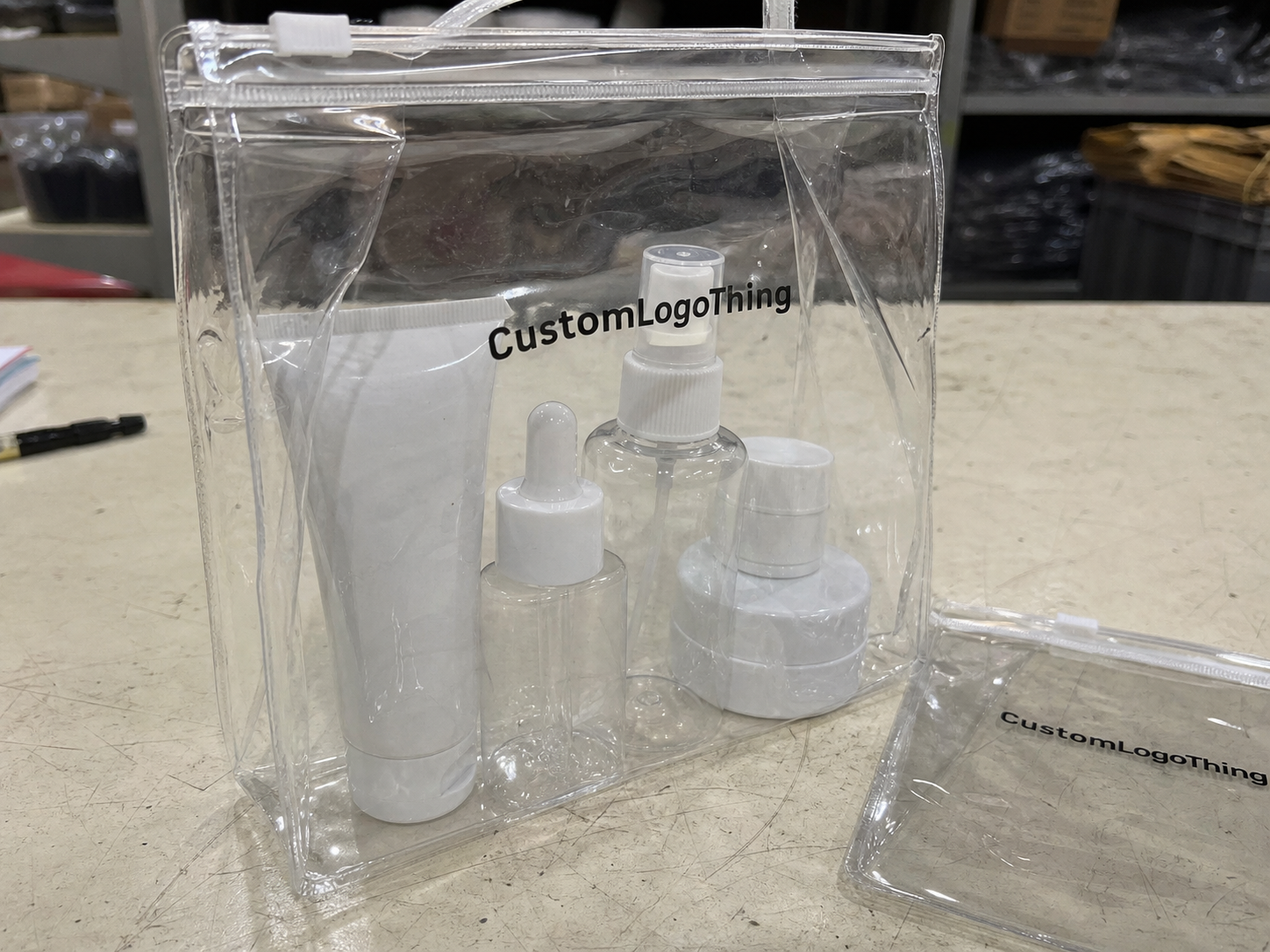
Printed cartons have their place. So do rigid boxes. But they are not always the right answer for skincare bundles. A clear PVC garment-style bag is lighter, easier to fill, and usually cheaper to run when the contents already carry most of the value. That is why this format shows up so often in promotional sets and retail-ready bundles.
The difference is visible on the shelf and in the cost sheet. A carton hides the product and adds layers of structure. A clear bag exposes the product and removes a lot of packaging overhead. That tradeoff is useful when the customer wants to verify what they are buying quickly. It is less useful when the package needs a premium unboxing moment or a lot of printed storytelling.
For skincare, the bag works best when the assortment is tidy. Think facial kits, travel minis, spa retail sets, or refill bundles with repeatable dimensions. If the mix changes every cycle, the bag is even more useful because it can adapt without a full structural redesign. That flexibility is one reason buyers keep coming back to this format.
There is a catch, and it is not subtle. PVC is not a luxury material pretending to be one. It can scratch, pick up fingerprints, and soften in heat if the spec is sloppy. It can also carry a slight odor if material quality is poor or if the goods are packed too tightly after sealing. Those are not deal-breakers. They are reminders that the finish and the source material matter just as much as the shape.
For bulk orders, the real advantage is operational. Fewer components mean faster assembly. Less structure means lower freight volume. A simpler pack also leaves less room for production drift. If a carton shifts by a few millimeters, the unit still fits. If a PVC bag shifts by a few millimeters, the closure can look off and the display loses its clean line. The format rewards precision.
Use this structure only when the packaging brief is honest. If you need heavy protection, tamper resistance, or a premium printed surface that carries most of the brand story, PVC may not be the right answer. If the job is visibility, speed, and controlled cost, it usually is.
Choosing the right PVC style, closure, and finish
Clear, frosted, and tinted PVC each do a different job. Clear gives the most visibility and is the best choice when the contents are the selling point. Frosted softens the look and hides small mismatches between products, which can be useful when the set is assembled by hand. Tinted PVC creates a stronger visual block, but it also reduces the product reveal. That can work for mood-driven brands. It can also defeat the point if the buyer needs to see the bundle at a glance.
Closure choice changes both the appearance and the workflow. A zipper is common for reusable consumer-facing kits. It also gives the customer repeated access without damaging the pack. Heat seal works for one-time shipment packs or sample programs where the bag only needs to arrive intact. Snap closures and flap tops can work in retail display, but they need better alignment and more careful handling during packing. If the closure is fussy, labor cost goes up. That part never shows up in a mockup.
Finish matters more than most buyers expect. Glossy PVC looks clear and bright under store lighting, but it also shows scuffs faster. Matte or anti-scratch treatment calms the surface and reduces glare, though it can soften the transparency a bit. Neither is automatically better. The right choice depends on whether the bag will be stacked, hung, shipped flat, or handled repeatedly by staff and shoppers.
Edge quality is another place where budget packaging reveals itself. A rough weld, cloudy seam, or crooked cut line makes the bag look careless even if the dimensions are correct. The same goes for zipper alignment. If the track bows or the pull sits off-center, the whole unit looks slightly wrong. Customers notice that faster than brands like to believe.
For busy packing lines, handling should be part of the spec. The bag needs to open cleanly, stay flat in transit, and close without snagging. If it sticks when filled, the team will force it. If it pops open under load, someone will tape it or overpack the carton. Both are signs that the bag was chosen for a sample table, not for a working line.
A simple decision guide helps narrow the field:
- Clear PVC + zipper for reusable retail kits that need repeated opening.
- Frosted PVC + heat seal for cleaner presentation and lower handling risk.
- Tinted PVC + hanger top for retail display where partial concealment adds structure.
- Anti-scratch finish if the bags will be stacked, shipped far, or touched often.
One test saves a lot of regret: fill the bag, seal it, stack it, and look at it again. Empty samples are useful, but they hide the problems. Filled samples show collapse, seam strain, wrinkling, and whether the product still reads cleanly from the front. That is the sample worth approving.
Sizes, thickness, inserts, and branding options that hold up
Sizing should start with the packed product, not the biggest item in the set. Leave enough room to load the kit without forcing the opening, but not so much that the contents slide around. Loose packaging looks like overstock. Over-tight packaging looks like the wrong spec was guessed at the last minute. Neither helps.
For thickness, most buyers compare a fairly narrow band of PVC gauges for retail-style skincare bags. Lighter material can work for simple presentation and low-stress shipping. Heavier material makes sense when the bag needs more structure, better shape retention, or repeated reuse. A common planning range sits around 0.20 mm to 0.35 mm, though thicker builds can be justified for heavier kits or rougher distribution lanes. The real question is not “what is the thickest option?” It is “what thickness survives the actual use case without making the bag stiff and awkward?”
Reinforcements can make a basic bag behave much better. Gussets help it stand. A bottom board keeps the shape from collapsing. Reinforced hangers or punched holes improve display reliability. Internal dividers stop bottles from clinking together and scuffing the surface. Small insert pockets can hold instruction cards or refill notes without cluttering the main view. These are not flashy additions. They are the things that keep the bag from sagging in the wrong places.
Branding should support the product, not cover it. A small logo mark, edge print, printed header, or simple insert card often gives enough identity without blocking visibility. Full-surface printing changes the whole buying logic. Once the surface is mostly decorated, the pack is no longer a clear display bag. It is a printed promotional item, which changes both cost and approval time. That is fine if the brief calls for it. It is wasteful if the product itself should remain visible.
Material specs deserve real attention. Ask whether the PVC is virgin or blended, whether the finish is treated for scratch resistance, and whether the bag has any odor issue after sealing. Ask for clarity tolerance if the product depends on a bright, glass-like look. Clear packs can vary more than buyers expect. Small shifts in material quality show up fast once the bags are stacked, shipped, and opened under store lighting.
| Option | Best Use | Approx. Unit Cost Impact | Buyer Note |
|---|---|---|---|
| Simple clear PVC bag | Basic skincare kits and sample packs | Lowest | Fast packing, maximum visibility |
| Frosted PVC with zipper | Retail presentation with a softer look | Moderate | Hides minor content mismatch |
| Heavier gauge with gusset | Structured bundles or reusable packs | Higher | Better shape, higher material cost |
| Printed PVC with insert card | Brand-led launches and gift sets | Highest | More setup, more approval steps |
Pricing, MOQ, and unit cost drivers
Pricing becomes much clearer once the order is broken into pieces. Size, thickness, closure type, print complexity, reinforcement, and packing method all affect the total. Buyers who ask only for the cheapest price usually get a vague quote that leaves out the hard parts. Buyers who define the spec get something they can actually compare.
For a straightforward clear PVC skincare bag in a common retail size, a practical range is often somewhere around $0.20 to $0.45 per unit at a few thousand pieces. Add a zipper pull, heavier gauge, or more complex print and the number climbs. Smaller runs almost always carry a higher unit cost because setup, sampling, and waste are spread across fewer pieces. That is normal. There is no shortcut around it.
MOQ is less mysterious than it sounds. It is usually a mix of material sourcing, labor efficiency, and setup economics. Many custom runs land in the 1,000 to 5,000 piece range, while simpler stock-style builds can sometimes start lower. The useful question is not “What is your MOQ?” It is “What volume gives me a fair unit price without forcing excess inventory?” If a supplier only gives one number and refuses tiered pricing, the quote is doing too much hiding.
Freight can quietly change the landed cost. A bag that ships flat and packs tightly in cartons can stay efficient. A bag with bulky inserts, oversized header cards, or awkward assembly may look cheap on paper and expensive on the pallet. That is why the real comparison is landed cost, not factory price alone. A penny saved in production does not matter if it gets eaten by shipping, packing labor, or damage.
Ask for a quote broken into a few clean lines:
- Unit price by volume tier.
- Sample cost and sample freight.
- Tooling or setup if custom parts are involved.
- Packing method, flat-packed or pre-assembled.
- Freight assumptions so the landed cost is visible.
The same order can look cheap or expensive depending on how it is packed. That is why shaving a few cents off unit cost should never be the only goal. If the lower price creates more labor, more breakage, or a higher freight bill, the savings are fake.
Production steps, lead time, and approval gates
Production should follow a visible path: RFQ, spec review, sample, pre-production approval, bulk production, inspection, packing, shipment. The sequence is simple. The delays are not. Most of them happen because the spec was still moving when the factory needed a final answer.
Lead time depends more on approval speed than on the machine itself. A straightforward order with stocked material can often move in roughly 12 to 20 business days after sample approval. Add custom printing, unusual dimensions, special closures, or mixed components and the schedule stretches. If artwork changes after sampling, expect the clock to reset. That is annoying, but it is also predictable.
The most common delays are boring:
- Missing or inconsistent measurements.
- Late artwork changes.
- Unclear zipper, hole, or hanger specs.
- Slow approval of the filled sample.
- Confusion over clarity, tint, or finish.
A dated milestone plan helps. Not “week four delivery.” Actual checkpoints for sample approval, bulk start, inspection, and freight booking. That gives marketing, warehouse, and retail teams enough room to work. If a supplier cannot commit to milestones, the schedule risk is sitting with the buyer whether anyone says it out loud or not.
Rush orders can happen, but only if the job is simple enough to move fast. Stock material, simple construction, and one round of sample approval can shorten the clock. New tooling, multiple revisions, or custom hardware do the opposite. Speed is expensive when the spec is still unstable. Better to ship a clean order on time than a rushed order that creates a warehouse headache.
Transit testing should not be ignored just because the product looks light. Even a modest pack-out or vibration check aligned with ISTA guidelines can catch scuffed surfaces, crushed corners, or zipper stress before the goods leave. That kind of damage is annoying in transit and expensive once the retail team starts opening cases.
Quality checks, compliance, and supplier fit
The sample usually looks fine until someone inspects the details. That is where quality either holds or falls apart. For skincare packaging, the useful checks are seam strength, zipper glide, edge finish, cloudiness, odor, size tolerance, print alignment, and scratch resistance. If any of those fail, the nice mockup stops mattering.
Material consistency matters more than packaging brochures suggest. Skincare products sit close to finished retail goods, and customers notice smell, haze, and poor surface finish quickly. A bag that looks acceptable in a catalog may read as sloppy once it is filled and lit by store lighting. That is especially true for clear material, where every blemish gets magnified.
Ask suppliers for more than promises. Useful evidence includes in-process photos, final inspection records, sample retention, and carton packing photos. If your brand depends on material claims, ask what paper or insert materials are used and whether any relevant paper stock is FSC-certified. If the supplier cannot show how the goods are protected in transit, they are asking you to trust a system you cannot see.
Compliance is worth checking early. PVC may face different rules depending on the market, the customer channel, and any claims made about recyclability or material safety. That does not mean the format is impossible. It means the buyer should verify the target market requirements before approving artwork and tooling. The wrong assumption here gets expensive fast. Reprinting a pack because the material claim was sloppy is a bad use of time and budget.
Supplier fit is mostly about consistency. The lowest quote is often the noisiest operation. A better partner confirms dimensions, answers spec questions directly, and reproduces the same result on the second order without drama. That repeatability is the real test. A pretty sample is nice. A repeat order that matches the sample is better.
Before committing, compare suppliers on five points:
- Quote clarity and whether every cost is visible.
- Response speed on sample notes and artwork questions.
- Repeatability across reorders.
- Packing protection during transit.
- Willingness to show QC evidence instead of vague assurances.
That is the practical side of skincare pvc garment Bags Bulk Order Planning: choose the source that keeps the spec stable, not the one that sounds cheapest in the first email. The invoice is only one part of the cost.
What to send for a fast quote and clean launch
If the goal is a useful quote, send the essentials in one message. Product dimensions. Desired bag size. Fill weight. Closure style. Finish. Print file. Quantity. Destination. Launch date. That is enough to remove most of the back-and-forth that usually burns a week for no reason.
If the exact size is still flexible, send a packed photo or a reference bag. That is better than guessing from memory. A short, specific brief usually beats a long explanation. It gives the supplier less room to interpret the job badly.
Ask for a breakdown that separates sample cost, unit cost, tooling, packing, and freight assumptions. Otherwise the quote is hard to compare. A lower number that hides setup or transport is not a better deal. It is just a smaller number with missing context.
A clean launch path is simple:
- Confirm the spec and target quantity.
- Review the sample or filled prototype.
- Lock artwork and closure details.
- Approve the production timeline with dated checkpoints.
- Release bulk production and book freight early.
That process keeps the order moving and cuts the usual surprises: wrong size, weak closure, cloudy material, and freight charges nobody planned for. If the bag is planned properly, it disappears into the workflow. That is the goal. Packaging should make the product easier to sell, easier to pack, and harder to mess up.
What MOQ should I expect for skincare PVC garment bags bulk orders?
Many custom runs fall in the 1,000 to 5,000 piece range, though simpler or stock-based builds can sometimes start lower. Ask for tiered pricing so you can compare test volume, launch volume, and replenishment volume. The right MOQ is the one that keeps unit cost reasonable without trapping cash in excess inventory.
What thickness works best for skincare PVC garment bags?
Most buyers compare a range around 0.20 mm to 0.35 mm for retail-style packs, with heavier options used for more structure or reuse. Match the thickness to the filled weight, the closure stress, and the handling conditions. A flat sample can be misleading, so always check a filled version before approval.
Can I add printing without making the unit cost jump too much?
Yes, but simple branding is usually the least expensive path. A small logo, edge mark, or insert card often gives enough identity without turning the bag into a full print job. The more colors, placements, and finishing steps you add, the more setup time and approval cost you take on.
How long does bulk production usually take for these bags?
A straightforward order with approved samples and stocked material often takes about 12 to 20 business days after sample approval. Custom printing, special closures, or last-minute spec changes extend that schedule. Lock the milestones early so shipping and launch planning do not drift.
What should I prepare before requesting a quote?
Send the product dimensions, target bag size, quantity, closure style, finish, print file, destination, and launch timing. If the size is still fluid, include a packed photo or reference bag. Ask for a full cost breakdown so quote, MOQ, and landed cost can be compared without guessing.