skincare Ribbed Winter Beanies Bulk Order planning works because a ribbed beanie solves several buyer problems at once: it is easy to size, easy to ship, and useful enough to feel like part of the bundle instead of filler. The stretch of a rib knit gives one style broad wearability, which makes it practical for gift sets, retail add-ons, and staff programs.
For skincare brands, the beanie also adds a seasonal cue without forcing the rest of the kit to become bulky. The item needs to fit the campaign, though. A fast promo, a retail launch, and a uniform program all call for different decoration, packout, and approval choices, even if the base beanie looks similar.
The most reliable orders usually start with the spec, not the artwork. Yarn type, cuff depth, knit density, quantity tiers, and delivery date drive the quote more than first-time buyers expect. Color matters too, but it is easier to judge once the production path is defined.
The safest winter accessory orders are usually the simplest ones: clear spec, restrained decoration, realistic lead time, and a color that supports the rest of the kit.
Skincare ribbed winter beanies bulk order planning: why the format works
Ribbed knit gives a beanie the stretch that makes bulk buying practical. One size can cover more wearers, which reduces size breaks and keeps sampling simpler. That matters for skincare programs where the same item may need to work across store teams, customer gifts, and bundled shipments.
The value is not only functional. A soft accessory changes the feel of the package in hand and usually adds perceived value without adding much shipping weight. For a winter campaign, that balance is useful: the set feels more complete, but the logistics stay manageable.
The trap is treating the beanie like a freeform fashion piece. In bulk, the item should support the campaign structure. Stock-color ribbed beanies with restrained branding are usually the best fit for fast seasonal promotions. A custom knit, heavier cuff, or specialty yarn can make sense for retail, but only if the timeline and margin can support it.
One practical lesson from repeat buyers: the cheapest beanie is not always the lowest-cost program. Better handfeel, a cleaner cuff, or more stable logo placement can reduce complaints and rework later. Small quality differences show up quickly once the product is worn, folded, and photographed under real lighting.
Choosing yarn weight, cuff height, and knit density
Physical spec drives the quote. If the yarn content, cuff depth, or knit structure is vague, the supplier has to guess, and that is where pricing becomes unreliable. For skincare programs, common options are acrylic, cotton blend, and wool blend. Acrylic is usually the most economical and easiest to source at scale. It keeps shape well, ships light, and handles embroidery or woven labels without much trouble.
Cotton blends feel softer and more natural, which some skincare brands prefer because the material language lines up with clean-label packaging. They are comfortable in milder weather, but they do not always trap heat as well as woolier options. Wool blends add insulation and a more premium hand, though they cost more and need closer consistency checks across the run.
Knit density changes both the look and the decoration performance. A tighter rib usually holds cuff shape better and gives embroidery a flatter surface. A looser knit feels cozier, but it can distort fine text or let a patch sit unevenly. That matters most when the logo is small.
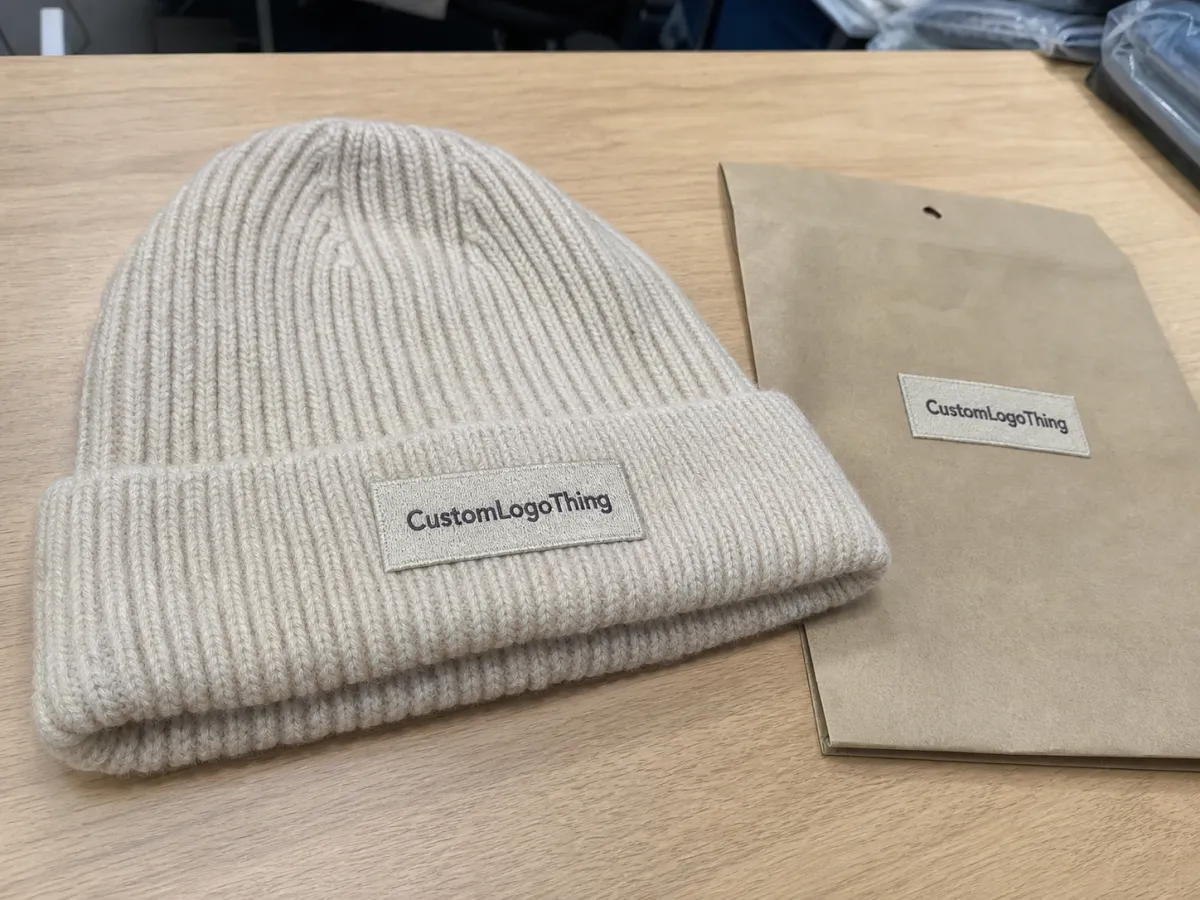
Cuff height has a real effect on branding. A deeper cuff gives more room for embroidery, labels, or woven patches, and it keeps the mark visible when the beanie is folded. Short cuffs can look cleaner, but they reduce placement options. For larger programs, a mid-to-deep cuff is often the safest balance between visibility and production tolerance.
- Low cuff: subtle silhouette, limited branding space, less forgiving for repeat orders.
- Mid cuff: adaptable for embroidery, woven labels, and small patches.
- Deep cuff: strongest logo visibility and easiest to standardize across a larger program.
Most promotional ribbed beanies fall somewhere around 70-120 grams, depending on yarn and gauge. That is not a hard rule, but it helps buyers avoid comparing samples that only look similar online. A 2x2 rib in mid-gauge acrylic behaves differently from a chunky wool blend, even if the photos are close.
Color matching, decoration methods, and brand presentation
Color should follow the skincare line rather than sit apart from it. Charcoal, cream, stone, muted olive, dusty navy, and warm taupe usually work well because they sit quietly beside cartons, jars, and label foils. Bright tones can work too, but they need a reason.
Exact color matching is harder on knit goods than on printed packaging. Yarn availability, dye lots, and fiber content all affect the final shade. Buyers who insist on a perfect match without allowing for lab dips usually end up disappointed. A better approach is to choose a compatible base color, confirm swatches early, and let the logo, tag, or insert card carry the stronger brand cue.
Decoration method shapes the final feel of the product. Embroidery is the most common choice because it is durable, neat, and readable on small runs. Woven labels work well for sharper logos and a more retail-like finish. Sewn patches add texture and can help a simple beanie look more deliberate. Heat-applied graphics can work on short timelines, but they need testing for adhesion and wash performance.
Logo artwork should respect knit behavior. Fine text, thin lines, and tiny details can blur or sink into a ribbed surface. A cleaner mark, a slightly larger logo size, or a simplified layout usually looks stronger than forcing too much detail onto a small cuff. If the artwork was built for cartons or digital ads, it may need adjustment before it works on fabric.
Presentation details matter more than many buyers plan for. Fold style changes how the logo appears in the box. Individual polybags add labor but can make a set retail-ready. Barcode stickers, size stickers, and insert cards are small line items, yet they affect how quickly the product can move through fulfillment. For paper inserts that need a certified source, many brands ask for FSC documentation; the standard is outlined at FSC.
If the beanie sits inside a skincare bundle, the decoration should solve the brand problem rather than fill empty space. A restrained label on a well-chosen color usually reads more premium than a loud logo on a questionable knit.
Cost, pricing, and MOQ tradeoffs to model before quoting
Unit price matters, but landed cost matters more. That includes the garment price, setup, sampling, packing, freight, and any customs handling. A quote that looks sharp on the first line can drift once the smaller charges are added. Buyers who model the full number early usually make better quantity decisions.
The main price drivers are predictable. More knit colors raise cost. Premium yarns raise cost. A complex decoration method raises cost. Special packaging, such as polybagging, custom inserts, or barcode labels, also moves the number. MOQ follows the same pattern: a stock-color acrylic beanie with embroidery will usually have a lower entry point than a fully custom knit with specialty finishing.
| Option | Typical MOQ | Unit Price Range | Lead Time | Best Use |
|---|---|---|---|---|
| Stock acrylic, embroidery on cuff | 100-300 pcs | $2.40-$4.10 | 10-15 business days after approval | Fast winter promos, staff gifts, simple retail add-ons |
| Cotton blend, woven label or patch | 300-500 pcs | $3.20-$5.40 | 15-20 business days after approval | Cleaner retail presentation and more tactile branding |
| Custom knit colorway, premium finish | 500-1000 pcs | $4.80-$8.50 | 20-30 business days after approval | Brand-led seasonal launches and repeat programs |
Those figures are most useful as planning ranges, not promises. Freight can move the landed cost more than the garment spec does, especially if the order needs a tight deadline. Embroidery digitizing often lands around $35-$120 depending on the number of stitch changes. Woven labels or patches can add $50-$150. Sample charges usually sit in the $25-$80 range, and some suppliers credit that back against production if the order proceeds.
A useful way to pressure-test pricing is to ask for two quantity tiers at once. Compare 300 pieces against 500 pieces, or 500 against 1000. The difference often shows whether the larger run improves margin or merely adds inventory risk. For winter campaigns, a slightly bigger order can Lower Unit Cost enough to offset the extra capital, but only if sell-through is realistic.
Packout also deserves a line in the budget. If the beanies ship alongside jars, cartons, or paper inserts, ask how cartons will be packed and tested. Mixed SKUs can crush margins if the shipping plan is too optimistic. Many teams use ISTA distribution methods as a reality check so packaging decisions reflect handling, not hope. More on that standard is available at ISTA.
Production steps, lead time, and approval milestones
The cleanest orders follow a simple sequence: brief, quote, artwork, sample, bulk approval, production, packout, shipment. The delays usually happen at handoffs, not during knitting. For skincare programs, that means someone has to own each approval step and the due date attached to it.
Start with a spec sheet. Include yarn preference, cuff height, knit density, decoration method, logo size, color references, packaging format, and quantity by tier. If the beanie has to coordinate with a skincare collection, attach product images and brand color notes. A good brief saves more time than a fast email thread ever will.
A pre-production sample is worth the extra step when the logo is small, the color needs to be judged in person, or the beanie is going into a premium set. Digital mockups cannot show how a ribbed knit will distort under tension. They also cannot reveal whether the cuff sits too loosely or whether the color reads warmer than expected under store lights.
Lead time depends on the construction. Stock-color decorated beanies move faster because the base materials are already in circulation. Custom colorways take longer because yarn sourcing, dye approval, and stability checks all add time. After production, allow for packing and freight. Ocean shipping can protect margin, but it asks for patience. Air shipping protects dates, but not always profit.
A useful rule is to build in at least one extra week if the campaign date is fixed. That buffer absorbs sample revisions, label reprints, or carton corrections without forcing a rushed freight decision. Winter launches leave very little room for recovery once retail windows close.
How to judge suppliers for repeat seasonal orders
Repeat orders are won by documentation. If the beanie might return next season, ask how the supplier records fit, cuff width, knit structure, decoration placement, and packaging format. The less the team has to relearn, the less likely the reorder is to drift. Reorders should feel almost dull, and that is usually a good sign.
Price alone is a weak comparison tool. A supplier with a slightly higher quote may be preserving tighter tolerances on logo placement or dye lot control. Ask for examples of previous work that match your intended method. If the supplier cannot show embroidery that sits cleanly on a ribbed cuff, or a woven label that stays flat, the risk does not go away because the price looks better.
Consistency also depends on how the supplier handles material changes. Yarn lots can shift in tone. Cuff dimensions can vary if the spec is not locked. Labels can wander if production instructions are too loose. The real cost of a cheap first order often appears on the second order, when the new batch no longer matches the old one closely enough to sit beside it.
For repeat seasonal buying, ask about capacity reservation, split shipments, and recordkeeping. Can they hold a production slot for the next drop? Can they ship part of the order to a fulfillment center and part to a warehouse? Can they reproduce the same finish six months later without rebuilding the brief from scratch? Those answers matter more than a polished sales deck.
Actionable next steps for a clean bulk order submission
A strong brief removes most of the friction. Before requesting pricing, gather the pieces that actually shape cost and lead time: quantity tiers, target ship date, base color, decoration method, logo file, and packaging needs. If the beanie is part of a skincare campaign, include the product context too. That helps the supplier price the order as a system, not as an isolated accessory.
- Quantity tiers: request at least two breaks so unit cost and MOQ can be compared side by side.
- Brand specs: send Pantone references, logo art, placement instructions, and any must-match packaging colors.
- Use case: state whether the beanie is for retail, staff gifts, event giveaways, or skincare bundle inserts.
- Packaging: confirm polybagging, hang tags, barcode stickers, inserts, or carton labeling requirements.
- Timing: give the real delivery deadline and note whether sample approval has a fixed cutoff.
After that, compare the sample against the brief, check the logo on the cuff in natural light, and confirm the packing method before bulk production starts. That keeps the order grounded in production reality instead of sales language. A clear spec, a realistic schedule, and a few hard checks usually do more for the final result than any amount of marketing polish.
How early should I place a skincare ribbed winter beanie bulk order?
For stock-color decorated beanies, a few weeks can be enough if artwork approval is quick and freight is straightforward. Custom yarn colors, specialty labels, and premium packaging need more lead time. Work backward from the arrival date and leave room for sampling, revisions, and transit delays.
What MOQ is typical for ribbed winter beanies in bulk?
MOQ depends on yarn type, decoration method, and whether the beanie is stock or custom knit. Simple embroidery on a standard color often supports lower quantities than a fully custom construction. If the first run is exploratory, ask for two quantity tiers so you can see whether the larger order improves the landed cost enough to justify the inventory.
Can I match winter beanies to a skincare brand color palette?
Usually, yes, but the match depends on yarn availability and the knit process. Exact shade matching is less predictable on fabric than on print, so ask for swatches or lab dips before final approval. If the color cannot be matched precisely, choose a close base tone and carry the brand through the logo, tag, and packaging.
Which decoration works best for skincare promotional beanies?
Embroidery is the most dependable choice for durability and clean presentation. Woven labels can look more retail-ready, and sewn patches add texture. Heat-applied graphics can work on shorter timelines, but they need testing for adhesion and wear. The best method is the one that fits the knit structure, the quantity, and the visual goal.
What details should I send for a quote on bulk winter beanies?
Send quantity, target delivery date, base color, decoration method, logo file, and packaging requirements. Include whether the order is for retail, staff gifts, event giveaways, or skincare bundle inserts. The clearer the brief, the less back-and-forth the quote process needs, and the more accurate the production plan will be.