Skincare slider lock bags Unit Cost Review sounds narrow, but it is usually the point where packaging stops being a design exercise and starts behaving like a supply-chain decision. Minis, samples, travel-size sets, and press kits have a bad habit of exposing weak closures, thin film, and vague specs. A bag that leaks or looks cheap in transit costs more than the price difference on paper. It costs time, replacements, and trust.
From a buyer's perspective, the job is not glamorous: keep the formula protected, keep the presentation tidy, and keep the quote honest. A standard size with plain print often stays near the cost of a basic pouch. The moment you ask for a custom silhouette, heavier film, frosted surfaces, or multi-color branding, the unit price starts moving. That is not inflation. It is the bill for complexity.
The useful comparison is not between “cheap” and “premium.” It is between standard production and anything that forces a factory to slow down, reset, or carry more scrap. That difference shows up in every line of the quote.
Why slider-lock bags solve a real skincare packaging problem
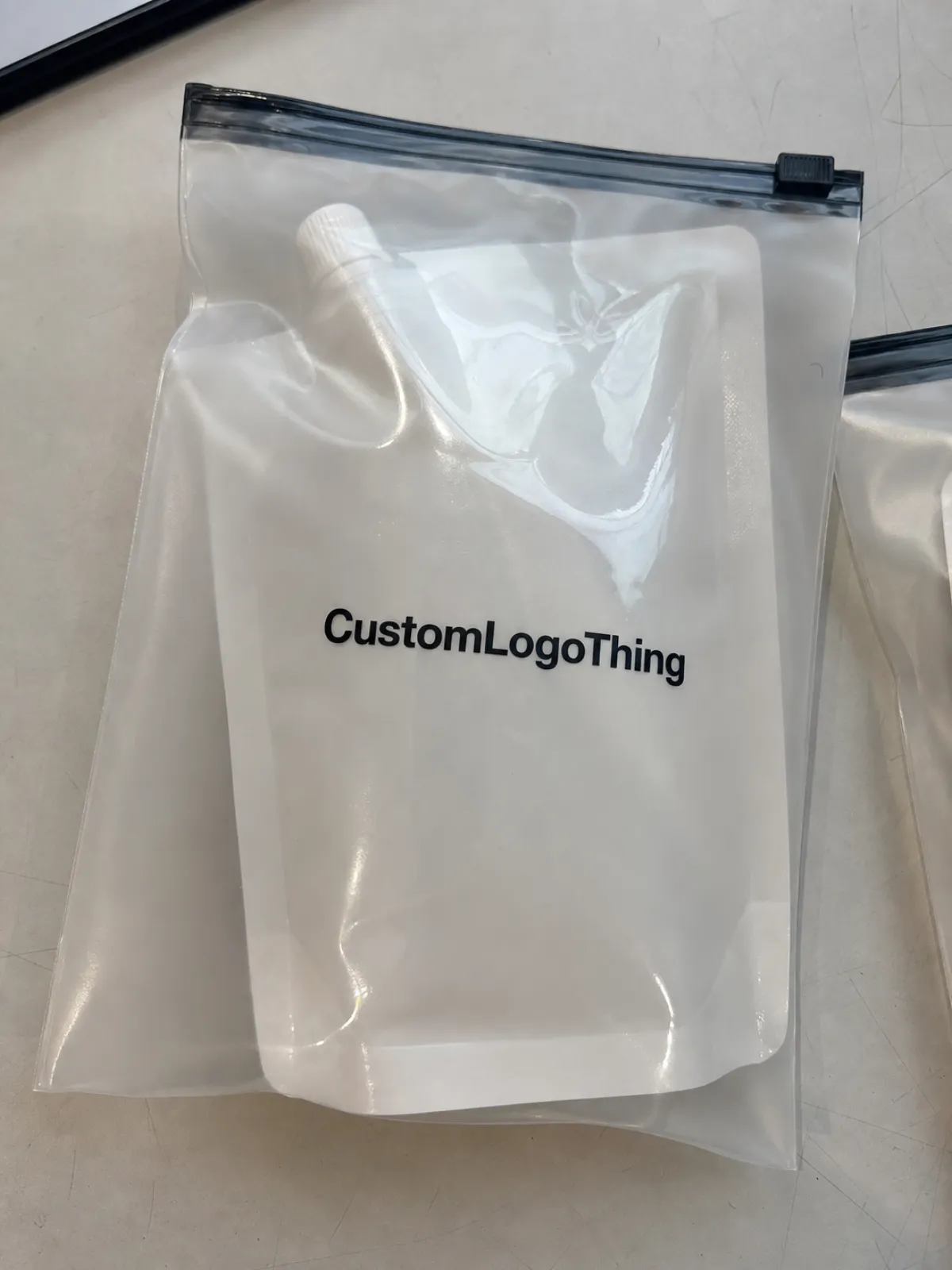
Travel skincare is hard on packaging. Bottles knock against each other. Sample tubes flex. Balm jars leave residue on the inside of the pack. If the closure is weak, the whole set feels careless before the customer even touches the product. A slider lock gives a cleaner reseal point than a basic heat-sealed pouch, which matters when the bag will be opened more than once.
There is also the visual side. Clear or lightly frosted slider bags show the product without turning the pack into a jumble of loose items. They sit better on shelves, in gift sets, and in subscription boxes. That seems cosmetic until you compare it with a curled pouch top, a wrinkled seal, or a bag that sags the moment someone lifts it. Packaging has a way of announcing whether the brand paid attention.
The cost upside is practical. Better closure control can reduce leakage complaints, repacks, and damaged sample sets. In a launch cycle, those invisible losses often matter more than a small difference in unit price. A bag that saves three rounds of fixes is usually cheaper than one that looked economical on the first quote.
Cheap packaging is only cheap until you have to replace it.
For skincare launches that depend on first impressions, the bag is not background material. It is part of the product story. That is especially true for bundled SKUs, holiday sets, and press mailers where one damaged unit can make an entire batch feel suspect.
What material and closure setup makes sense for skincare
Material choice drives performance more than most buyers expect. For non-liquid or lightly oiled skincare, clear PE is usually the lowest-cost option. It is flexible, easy to seal, and gives decent visibility. PET/PE laminate is better when the bag needs more stiffness, a cleaner front panel, or a more polished cosmetic look. If the program needs recycled content, PCR blends can work, but ask for documentation. A marketing claim without paperwork is just decorative language.
The closure matters just as much. A standard slider is fine for light retail use. A firmer lock is better when the bag will travel, be reused, or sit in a fulfillment center for a while before opening. If the bag is meant to be opened and closed many times, test the action before approving production. Sliders that catch, skip, or feel loose on the first pull tend to become customer complaints by the third pull.
Branding choices affect both cost and perception:
- One-color print keeps the run lean and works for samples or restrained logo placement.
- Full-panel branding turns the bag into part of the visual system, not just a container.
- Frosted or matte film gives a softer cosmetic feel and hides fingerprints better.
- Clear film with spot print is useful when visibility matters more than decoration.
If the contents are serums, oils, balms, or any formula that can creep into seals, do not assume a standard film will hold up. Ask for a barrier upgrade when needed, and push for a filled sample. Heat, pressure, and repeated handling expose weaknesses fast. The bag does not need to fail dramatically to be a problem; a slow seep or sticky closure is enough.
For buyers comparing recycled or paper-based secondary packaging, documentation also matters on the paper side. If outer cartons or inserts are part of the order, a certified paper chain can be relevant; the FSC system is one place buyers check that claim. It does not improve the bag itself. It just keeps the paperwork cleaner and the sourcing story easier to verify.
Dimensions, thickness, and finishing details buyers should lock in
Before any quote deserves attention, lock the core spec. That means width, height, gusset depth if there is one, film thickness, closure width, and acceptable tolerance. If those numbers are loose, the quote will be loose too, and the factory will fill in the gaps with assumptions. Assumptions are where budget overruns begin.
- Width and height: define the real product fit, not the optimistic fit.
- Film thickness: usually measured in mil or micron; thicker film costs more but protects better.
- Closure width: wider closures feel sturdier and usually improve repeat use.
- Tolerance range: spell out what is acceptable before production starts.
- Panel layout: leave enough room for ingredients, warnings, or batch codes.
A small size change can alter the order more than buyers expect. An extra 10 mm of width can affect nesting efficiency, carton count, and freight calculation. It can also shift the job into a different production lane, which means a different setup charge and a different unit cost. A smaller-looking package is not always the cheaper one. Sometimes it is only the version that sounded simple until the factory had to make it.
Finishing details deserve the same scrutiny. Rounded corners reduce sharp edges in a kit. Tear notches make sense when the bag is meant to be opened once and reused later. Hang holes and hang tabs help in retail display, but they also change the cut and print process. If the bag needs to sit flat and present cleanly, say so before artwork is approved. After that, changes are slower and more expensive.
For liquid or semi-liquid skincare, do not approve final specs without testing seal integrity and puncture resistance. Ask for filled samples and run them through warm and cold storage for at least 48 hours. If the supplier can measure seal strength under ASTM F88 or check impact resistance under ASTM D1709, even better. Those are not fancy extras. They are practical checks that catch weak film, poor sealing, and hardware problems before the order ships.
Approve the filled sample, not the empty promise.
Pricing, MOQ, and unit cost drivers
Here is where the quote either makes sense or begins drifting away from reality. The main cost drivers are raw film, slider hardware, print colors, bag size, and secondary packing. If the supplier adds insert cards, individual bagging, or special carton packs, those items also show up in the final total. Some factories list every line. Others bury the detail in a lump sum and hope no one asks. Ask anyway.
For a standard cosmetic slider bag, buyers often see these directional ranges around a 5,000-piece run:
| Option | Typical MOQ | Indicative cost per piece | Best fit |
|---|---|---|---|
| Clear PE, one-color print | 1,000-3,000 | $0.14-$0.28 | Samples, minis, simple retail packs |
| PET/PE laminate, matte or frosted | 3,000-5,000 | $0.22-$0.40 | Premium-looking skincare kits |
| PCR blend, 1-2 color print | 5,000-8,000 | $0.20-$0.38 | Eco-positioned programs with documentation |
| Custom shape, heavy branding, extra hardware | 10,000+ | $0.30-$0.60 | Launch sets, retail bundles, branded display packs |
Those numbers are directional, not promises. Size, film thickness, print coverage, and closure style can move them quickly. Still, the pattern is consistent: stock-style clear bags with minimal print stay near the bottom of the range, and custom shapes with heavier finishing climb fast. Bulk pricing often improves sharply between 1,000 and 5,000 units, then flattens out. That is why the jump from a tiny run to a mid-volume run usually changes more than the jump from 5,000 to 10,000.
Tooling fees and setup charges deserve direct scrutiny. A straightforward print job may carry plate charges of roughly $60-$180 per color. If the factory needs a custom slider part, a new bag profile, or a nonstandard cut, tooling fees can rise to $150-$600 or more depending on the method. Those costs are easy to miss if the buyer only looks at unit price. They are also the first place a low quote can stop being low.
One useful habit is to request tiered quotes at 1,000, 5,000, and 10,000 units. That shows where the cost per piece falls cleanly and where it does not. It also makes MOQ tradeoffs obvious. A lower MOQ can protect cash flow during a test launch even if the unit price is unattractive. If the SKU is already proven, higher volume often pulls the price back into a more reasonable band.
Where quotes go wrong
The worst pricing mistakes are rarely dramatic. They are small omissions that compound. A buyer forgets to specify thickness, the factory assumes a lighter film, and the first sample feels flimsy. Or the art file is sent without exact copy placement, so the print panel shrinks to make room for text. Then the quote changes after approval, and everyone argues about who “should have known.”
There are a few recurring traps. First, print coverage is often underestimated. A two-color logo on a sparse layout is not the same as a dense all-over graphic. Second, hardware choice matters more than most people expect. A stronger slider can lift the price more than a design change because it affects both material and assembly. Third, packaging bundles can hide secondary costs. If the bag ships inside an outer box with inserts, the carton spec belongs in the same review, not in a separate later email.
Another common issue is comparing quotes that do not describe the same thing. One supplier may price a clear PE bag at 0.20 mm thickness, another at 0.14 mm. One quote may include individual polybagging, another may not. The unit price looks comparable until the buyer realizes the spec is not. Clean comparison only works when the inputs match.
For skincare, failure usually appears as dull practical problems rather than dramatic defects: a slider that loosens in transit, a seal that peels after repeated opening, a film that scratches too easily, or a shape that refuses to nest properly in the carton. Those are not cosmetic complaints. They are operational costs wearing cosmetic clothing.
Production steps and lead time from proof to shipment
The production flow is simple on paper: quote, artwork check, sample or proof approval, mass production, QC inspection, packing, and shipment booking. Miss one approval step and the timeline slips. Nothing about the process becomes easier because the deadline is tighter.
Lead time depends on material availability, print complexity, hardware choice, and seasonality. A straightforward clear bag with simple print can often move in about 12-15 business days after proof approval. More complex runs, especially with custom film or special hardware, may need 18-25 business days. Shipping sits on top of that. Air is faster and more expensive. Sea is cheaper and slower. The cost difference is real, and so is the schedule difference.
Fast approvals save time. If the dieline, artwork, and compliance copy are ready on day one, several days can disappear from the schedule without changing the production standard. That matters when a launch date is tied to a retailer window or seasonal kit. Rushing the order itself usually means fewer material choices, tighter specs, and a higher unit price. Speed and low cost rarely arrive together.
For transit-heavy programs, ask for carton testing that follows ISTA methods. The bag may hold up, but the outer pack still has to survive drop, vibration, and compression. If the supplier can speak clearly about transit tests and basic QC checkpoints, that is a good sign. It means they have seen problems before and know where they usually start.
Clean production notes matter in skincare because labels often need ingredient text, batch space, and warning copy. If that copy is late, the proof stalls. If the proof stalls, the schedule slips. The fastest orders usually begin with the most boring paperwork, which is inconvenient but true.
How to judge a cosmetic packaging supplier without overpaying
Forget the word premium. It is a sales adjective, not a production standard. What matters is evidence. Ask where QC happens, how defect limits are written, how closure consistency is checked, and what the supplier does when print registration drifts on a small cosmetic bag. A supplier that can answer those questions clearly is usually safer than one that talks only in broad promises.
Useful signs are concrete:
- QC checkpoints: incoming material, first article, in-process, final packout.
- Defect limits: an AQL written into the quote or PO, often 2.5 for major defects and 4.0 for minor.
- Material documentation: film spec, thickness, and any recycled-content claim support.
- Prepress help: careful handling of ingredient text, batch code space, and warning copy.
- Sample repeatability: the second sample should match the first one, not drift away from it.
If the order includes cartons, sleeves, or paper inserts, ask whether the paper side can use FSC-certified stock. A capable supplier should be able to explain the chain without turning it into theater. Buyers who care about packaging consistency should care about documentation consistency too. The two usually rise and fall together.
Do not overpay for vague comfort. Pay for repeatability, measured tolerances, and honest proofing. If a supplier cannot show prior cosmetic packaging examples at a similar scale, or avoids discussing setup charges, slow down. You are not buying reassurance. You are buying a production process that should survive contact with volume.
What to send for an accurate quote and first sample
A clean quote starts with a clean brief. Send the full spec in one message: size, material, thickness, closure type, print colors, quantity, and delivery location. If those details arrive in fragments, the quote will wander. Then you will spend time correcting issues that came from incomplete information, not from the factory.
Include artwork requirements too. The supplier needs vector logo files, copy placement, Pantone references if color matters, and any required warnings or claims. If the bag needs a special finish, a hang feature, or a reference look, add a sketch or reference image. A visual note is usually faster than a long explanation and less likely to be misunderstood.
Ask for two versions of the quote:
- Lowest-cost version so you can see the bare minimum.
- Recommended version so you can compare cost against performance.
That comparison usually exposes the real tradeoff. The cheapest option may look acceptable until you notice thinner film, lower print coverage, or a weaker slider. The recommended option may cost more, but it often saves money by reducing repacks and damaged arrivals. That trade is worth seeing clearly before anyone signs off.
Once the sample arrives, test it with the actual skincare formula or a realistic substitute. Check how the slider feels, whether the closure sits flat, and whether the bag seals cleanly after repeated opening. If the proof passes, approve production and lock the schedule. That is how a skincare slider lock bags Unit Cost Review stops being guesswork and becomes a buying decision you can defend.
Frequently Asked Questions
How do I estimate unit cost before I request samples?
Start with five inputs: size, film type, closure style, print colors, and order quantity. Those drive most of the quote. Then ask for tiered pricing so you can see how the cost per piece changes at 1,000, 5,000, and 10,000 units. Keep freight, cartons, and sample fees separate, or the total will surprise you later.
What MOQ is normal for custom skincare slider lock bags?
Stock-style specs can start in the low thousands, while custom print or special film often pushes the MOQ higher. If a supplier offers a very low MOQ, expect a higher unit price because setup charges and waste are spread over fewer pieces. Match MOQ to launch volume and cash flow, not ego.
Are slider-lock bags a good fit for oily skincare products?
Yes, if the film and seal are thick enough and the supplier tests for leak resistance. Ask for a filled sample using your actual formula or a close substitute before approving production. Thin film and weak seals are usually the failure points, not the slider itself.
What files do you need for a fast quote?
Send a vector logo, target dimensions, print colors, copy text, and the order quantity. If the bag needs a special finish or hanging feature, add a sketch or reference photo. If there is compliance text, send it early so the proof does not stall.
How long does production usually take after proof approval?
Simple orders can move in about 12-15 business days after approval, while custom print, special film, or larger runs take longer. Lead time depends on material availability, QC checks, and how fast you approve the final proof. Add shipping time on top; production done is not the same thing as product in your warehouse.

