A skincare brand orders 500 beanies for a launch kit. The shipment arrives, the yarn feels squeaky, the woven label scratches the forehead, and the cream logo has shifted into a tired gray that looks nothing like the carton artwork. Now the team owns a soft, expensive problem. A skincare Woven Label Beanies material sample guide helps buyers judge yarn handfeel, label construction, logo readability, color behavior, fit, and packaging presentation before bulk production turns a small mistake into a full inventory issue.
That matters because skincare customers are unusually sensitive to surfaces. They notice the glide of a pump, the tooth of an uncoated carton, the weight of a jar, the softness of a cleansing cloth, and the way a promotional item fits inside a self-care ritual. A beanie placed in a gift set or influencer mailer has to feel like it belongs beside moisturizers, treatment bottles, masks, and retail packaging. If it feels like bargain stadium merch, the brand disconnect shows immediately.
What a Skincare Woven Label Beanies Material Sample Guide Actually Prevents
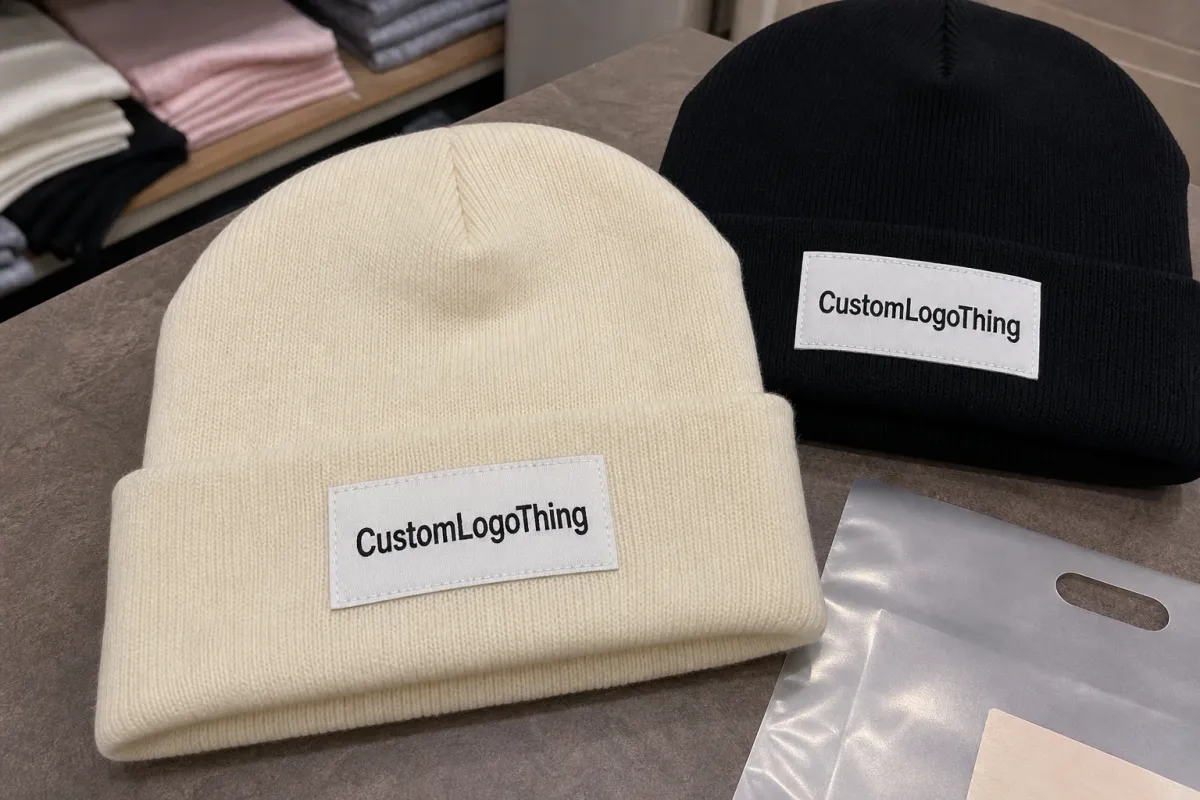
A material sample is a physical pre-production reference. It may show yarn type, knit structure, woven label style, thread colors, label placement, stitching method, fold behavior, and sometimes packaging treatment. It is not decoration or a nice extra for the brand team. It is the buyer’s reality check before the purchase order gets expensive.
Buyers often confuse three sample types, and that confusion causes trouble:
- Stock beanie sample: shows general fit, yarn feel, stretch, cuff shape, and color direction, but not your final branding.
- Material swatch: shows yarn, knit, or label texture in a small piece, useful for narrowing options but weak for judging final presentation.
- Fully branded pre-production sample: shows the actual or near-final beanie, woven label, placement, stitching, fold, and packaging. This is the sample that gives the most reliable approval evidence.
Treating those three as equal proof is how budgets get bruised. A stock sample can feel good, while the branded version looks clumsy because the label is too wide for the cuff. A swatch can look premium, then fail on the head because the knit has poor stretch recovery. A digital mockup can make tiny botanical line art look crisp, then woven thread turns the same artwork into green noise.
Skincare sampling needs tighter control than ordinary merch sampling. Clean beauty brands, derm-led lines, spa retail programs, and clinic gift sets often use restrained palettes: oat, clay, sage, blush, charcoal, cream, warm white. Those shades shift under warehouse lighting, bathroom lighting, studio flash, and warm retail bulbs. Physical samples are not fussy. They are the only practical way to see how the product behaves outside the screen.
A good sample review prevents several common failures: stiff labels on soft cuffs, thread colors that flatten the logo, yarn that pills too quickly, cuffs that stretch out, label placement that disappears in photos, and packaging that crushes the beanie into an awkward shape. The goal is not to make sampling slow. The goal is to catch obvious mistakes while they are still small enough to fix.
How Woven Labels Work on Beanies for Skincare Brands
Woven labels are made by weaving threads together, not by printing ink onto fabric. That construction gives them durability, texture, and a more retail-ready finish than many heat transfers or printed patches. For a beanie that may be worn repeatedly, washed poorly, stuffed into a tote, and photographed next to skincare packaging, woven labels are usually the stronger choice.
Common label formats include flat woven labels sewn onto the cuff, folded end labels, center-fold tab labels, patch-style woven labels, and woven labels paired with backing materials. A flat label gives the cleanest front-facing logo. A folded tab can feel more fashion-oriented, especially on a rib knit cuff. A patch-style label reads heavier, almost like a badge, which may suit outdoor wellness programs or staff apparel but can overpower a quiet skincare brand.
Logo detail sets the limits. Thin serif type, small ingredient icons, delicate leaf drawings, fine-line facial illustrations, and low-contrast tone-on-tone palettes can disappear if the weave density is too low. Higher-density weaving can hold smaller details, but it usually costs more and may feel stiffer. That is the tradeoff: better detail, less softness. Buyers often ask for maximum clarity, a feather-soft hand, six thread colors, and the lowest possible price. The sample is where those wishes meet physics.
Edge finish changes the look too. Merrowed edges feel heavier and more badge-like. Laser-cut or heat-cut edges look cleaner, though they may not suit every backing fabric. Stitching matters as much as the label itself: tonal thread hides the attachment, contrast thread makes the seam part of the design, and hidden edge stitching can look polished if the supplier can execute it cleanly without puckering the cuff.
Do not approve a woven label only because the logo is spelled correctly. Check the edges, backside, corners, thread tension, and how the label feels against skin.
Comfort is not optional. Labels should not create sharp corners, bulky seams, or irritating backsides, especially for beanies used in self-care kits, spas, clinics, or influencer mailers. If the brand promise is calm skin and soft rituals, the beanie cannot scratch like an old laundry tag.
Thread color deserves patience. A pale cream logo on a clay knit may look refined on a screen, then lose contrast once woven. Metallic thread can look premium in small doses, but it may feel scratchier and can push the item away from a soft skincare mood. Matte thread often suits skincare better because it echoes cartons, labels, and jars without adding shine where the brand does not need it.
If hangtags, care labels, or other branded soft goods are part of the same program, review Custom Labels & Tags early so the whole kit follows one consistent label system.
Material Factors That Decide Whether the Beanie Feels Premium
Material does most of the emotional work. The label carries the logo, but the yarn tells the customer whether the item feels premium, cheap, warm, breathable, or oddly shiny. A practical sample review should compare materials by softness, warmth, stretch recovery, durability, brand fit, care expectations, cost, and availability.
| Material Option | Typical Buyer Benefit | Watchout | Best Fit |
|---|---|---|---|
| Acrylic | Budget-friendly, stretchy, warm, strong color hold | Cheap versions can feel shiny, squeaky, or thin | Launch kits, promo drops, seasonal gifts |
| Cotton | Natural handfeel, breathable, clean brand perception | Less stretch and sometimes less warmth than acrylic | Clean beauty brands, lighter lifestyle merch |
| Wool Blend | Warmer, more premium, stronger retail feel | Itch concerns, care-label requirements, higher unit cost | Premium bundles, cold-weather drops, VIP gifts |
| Recycled Polyester or Recycled Acrylic | Sustainability positioning and solid durability | Verify claims, feel, color consistency, and MOQ | Eco-positioned campaigns and brand gifting |
| Cashmere-like Synthetic Blend | Soft touch without true cashmere pricing | Quality varies widely; pilling tests matter | Premium mailers and retail-style sets |
Acrylic is common for a reason. It is affordable, holds color well, and works for most promotional beanies. Basic acrylic Beanies with Woven Labels often sit at the lower end of the custom price range, especially at 500 or 1,000 units. Still, cheap acrylic can feel like a gas station giveaway. Nobody wants spa merch with that energy.
Cotton feels more natural and breathable. It can suit clean beauty brands, minimalist skincare lines, and brands already using kraft cartons, molded pulp, or uncoated packaging textures. The tradeoff is stretch. Some cotton knits do not snap back as well after wear, so test recovery after pulling the beanie over actual hair, not just a mannequin head.
Wool blends create warmth and perceived value, but they bring itch risk, care-label questions, and higher landed cost. If the beanie may go to clinics, spas, staff programs, or broad customer groups, wool sensitivity matters. A 50/50 acrylic-wool blend can feel more premium than straight acrylic, but minimums and pricing often climb.
Recycled yarns can support a sustainability story, especially if the rest of the kit uses recycled paper, post-consumer waste content, FSC certified cartons, or reduced-plastic packaging. Verify the claim before repeating it. Ask for certification details or material documentation, not vague green adjectives. For paper-based sourcing standards, the Forest Stewardship Council is a useful reference point, and the EPA recycling resources can help buyers keep recycling language accurate.
Knit style also affects perceived quality. Rib knit stretches well and works for most cuffed beanies. Fisherman knit looks chunkier and more fashion-driven. Waffle, cable, or specialty textures can feel elevated, but raised stitches may complicate label placement because the label can pucker or float instead of sitting flat against the cuff.
Use simple quality checks before approval. Rub the yarn against black and white paper to check lint transfer. Stretch the cuff several times and leave it on a head form, jar, or rounded object for a few hours to see whether it recovers. Fold and refold the cuff, because many beanies look acceptable once and messy after handling. Place the sample beside actual cartons, tubes, jars, and mailer inserts. A beanie may look beautiful alone and completely wrong beside frosted glass, matte laminate, corrugated dividers, or soft-touch boxes.
Sampling Process, Timeline, and Lead Time Before Bulk Production
The sampling path is usually simple on paper: choose the base beanie material, confirm label artwork, select thread colors, produce a label proof, make or source a sample, review it, revise if needed, approve it, then move into bulk production. Simple does not mean instant.
A stock blank sample review may take a few days if inventory is ready. Woven label sampling often takes 5 to 10 business days after artwork and thread colors are approved. A fully customized beanie sample can take 10 to 20 business days depending on material, custom yarn, knit structure, packaging, and production schedule. Revisions add time, and revisions are common when the logo has fine detail or the brand palette depends on subtle neutrals.
Bulk production usually starts after sample approval, not after the first email. That is where rushed launch calendars learn humility. If a skincare kit has a fixed press date, retail drop, holiday ship window, clinic event, or influencer seeding schedule, build in buffer time. Freight, internal approvals, and packaging fit checks are not decorative details.
Several things slow sampling down: unclear artwork, tiny logo details, Pantone debates over ivory versus warm cream, custom yarn dyeing, unusual label sizes, specialty packaging, and multiple internal stakeholders acting as final approver. A beanie can be technically easy to produce and still miss the ship window because nobody made the beige decision.
Ask suppliers exactly what the sample includes:
- Actual yarn or nearest available substitute
- Real woven label or digital mockup only
- Final stitching method or temporary sample stitching
- Final label size and placement
- Final packaging treatment, such as belly band, polybag, kraft paper wrap, or kit insert
Approval checkpoints can include a digital mockup, physical woven label strike-off, blank Beanie Fit Sample, finished branded sample, and production proof for high-value orders. For retail bundles, clinic uniforms, or high-visibility social content, the finished branded sample is usually worth the fee because it lets the team judge the object as customers will receive it.
If the beanie ships inside a skincare kit, packaging performance matters too. Ask whether the folded beanie changes the kit height, presses against glass jars, shifts during transit, or needs a corrugated cardboard divider. A plush beanie can protect products in one layout and crush cartons in another. For larger mailer programs, review drop-test expectations through ISTA packaging test resources so the presentation does not arrive wrapped around a cracked serum bottle.
Cost, MOQ, and Quote Details Buyers Should Compare
Cost depends on beanie material, knit complexity, label size, weave density, number of thread colors, sewing labor, packaging, quantity, and shipping method. One magic number without those details is just a guess wearing a confident jacket.
For broad planning, stock acrylic Beanies With Custom woven labels usually sit at the lower end. Recycled yarns, wool blends, dense labels, custom dyeing, specialty knits, and premium packaging push unit cost up. At 500 units, a basic acrylic beanie with a sewn woven label may land in a practical promotional range, while premium blended yarns with custom packaging can cost meaningfully more. Freight can swing the final landed cost sharply, especially if the launch calendar forces air shipping.
MOQ varies by customization level. Stock beanies with custom woven labels can often start lower, sometimes around 100 to 250 units depending on supplier setup. Fully custom yarn colors, special knits, private-label packaging, or custom-dyed materials usually require higher minimums, often 500 to 1,000 units or more. Season and available capacity matter; winter accessories get harder to schedule when every brand remembers cold weather at the same time.
Compare quotes line by line:
- Sample fee and whether it applies to the bulk order
- Setup fee, loom fee, or label development charge
- Unit cost by quantity tier
- Packaging cost per unit
- Freight, duties, taxes, and delivery terms
- Rush fees, revision fees, and extra approval samples
Ask for pricing at 100, 250, 500, and 1,000 units. The real price break may not happen where the team assumes it will. Sometimes 250 to 500 drops the unit cost nicely. Sometimes the better break starts at 1,000 because label weaving, sewing setup, and packing labor are spread over more pieces.
Do not choose only by unit cost. A cheap beanie can create expensive brand damage if it pills, stretches out, sheds lint onto white cartons, or makes the skincare logo look like it was woven during a power outage. Paying more makes sense for premium retail bundles, clinic uniforms, VIP Customer Gifts, limited-edition drops, or anything that will be photographed heavily.
Sampling fees are not automatically a red flag. A supplier charging for a proper woven label strike-off and finished sample may be protecting both sides from guesswork. The fee becomes a problem when the sample does not show final materials, final label construction, or final placement. If the sample is only a rough proxy, treat it as a proxy and keep approval language narrow.
If labels, hangtags, belly bands, and care tags are part of the same program, quote them together through Custom Labels & Tags. Consistent materials, thread colors, and finishing details usually look better than five components sourced from five different visual moods.
Common Sampling Mistakes That Make Beanies Look Cheap
Mistake one: approving from a digital mockup only. Mockups sell ideas. Samples reveal reality. A mockup will not tell you whether the cuff collapses, whether the label corner pokes, whether the yarn has an odd shine, or whether the thread color dies against the knit.
Mistake two: using logo artwork that is too detailed for woven thread. Fine lines, tiny text, gradients, delicate botanical icons, and ingredient-inspired illustrations may need simplification before weaving. A good supplier should flag artwork that needs adjustment. A lazy one may weave a blurry version and invoice you anyway.
Mistake three: choosing label colors from a screen instead of thread cards or physical samples. Cream, ivory, beige, pale pink, oat, and warm gray are especially easy to misjudge. A screen cannot show thread sheen, yarn texture, or the way colors shift under retail lighting.
Mistake four: ignoring label size in relation to the cuff. A huge label can make the beanie feel like a trade show handout. A tiny label may disappear in photos, especially if the beanie is packed beside larger skincare cartons. For many cuffed beanies, labels in the 1.5 to 2.5 inch width range are common, but the right size depends on logo shape, cuff depth, and viewing distance.
Mistake five: testing softness but not stretch recovery. A beanie can feel nice in the hand and still lose shape after a few wears. Pull it on, pull it off, fold the cuff twice, leave it stretched for a while, then check whether it bounces back.
Mistake six: forgetting packaging context. If the beanie ships inside a skincare kit, the label, fold, hangtag, bag, and insert need to look intentional next to jars, tubes, cartons, and retail sleeves. A kraft paper wrap may suit a clean botanical brand. A frosted recyclable bag may suit a clinical skincare line. A random clear polybag with a wrinkled sticker rarely helps.
Mistake seven: skipping wear testing. Have someone actually wear the sample for an hour, fold the cuff, pull it off, pack it, unpack it, and check whether the label puckers or the yarn pills. If the beanie sheds lint onto black packaging or white jars, that is not a tiny issue. Customers notice those details before they read the campaign headline.
Next Steps for Approving a Sample Without Wasting Budget
Start with a clear spec sheet. Include beanie material, knit style, color target, label type, label size, logo file, thread colors, placement, packaging, order quantity, delivery deadline, and target unit cost. A one-page spec sheet saves more time than a ten-message email chain with half the details missing.
Ask for two or three material options instead of ten. Too many choices make teams feel strategic while they quietly lose a week arguing about beige. A practical comparison might include one budget acrylic, one softer blended yarn, and one recycled option with documented content claims.
Request a woven label strike-off before approving bulk labels, especially if the logo has small type, fine lines, subtle contrast, or multiple thread colors. The strike-off does not need to be attached to the final beanie to be useful. It tells you whether the label itself can carry the brand properly.
Set approval criteria before the sample arrives. Decide what counts as acceptable softness, stretch, label readability, seam quality, color match, packaging fit, and photo performance. Without criteria, teams start using notes like “make it more premium.” Factories cannot weave vibes.
Photograph the sample in natural light, indoor light, and beside the actual skincare products it will ship with. Put it next to cartons, jars, tubes, mailer inserts, and any FSC certified or recycled paper components in the kit. Brand colors behave differently once they meet real objects.
Document revisions clearly with photos and measurements. Say “reduce label width from 2.5 inches to 2 inches,” not “make the label less loud.” Say “change thread from cool white to warm ivory,” not “make it softer-looking.” Specific notes reduce revision cycles and protect the launch calendar.
Before releasing bulk production, lock the approved yarn, knit, label size, thread colors, stitching method, folding method, packaging, and inspection standard. Keep one approved sample as the control reference. If bulk production arrives with thinner yarn, shifted placement, rough label backs, or dull thread color, the approved sample gives the team something concrete to compare against.
The strongest approval is not the mockup, the promise, or the nicest line in the quote. It is the physical sample that feels right, photographs well, fits the kit, and survives basic handling without making the brand look careless.
FAQ
What should a skincare brand check in a woven label beanie material sample?
Check yarn softness, stretch recovery, cuff shape, label readability, stitching quality, label edge comfort, color match, lint transfer, and how the beanie looks beside your skincare packaging. Do not approve only because the logo appears correct. Wearability and finish matter just as much.
How long does a woven label beanie sample usually take?
A stock blank beanie sample can be faster, often within a few days if inventory is available. A branded woven label sample often takes 5 to 10 business days, while a fully customized beanie sample with special yarn, knit, or packaging can take 10 to 20 business days before revisions.
Is acrylic or cotton better for skincare woven label beanies?
Acrylic is usually more budget-friendly, stretchy, warm, and widely available for promotional or launch-kit beanies. Cotton feels more natural and breathable, which can suit clean beauty brands, but it may offer less stretch depending on the knit and may not feel as warm.
How much do custom woven label beanies cost for skincare promotions?
Cost depends on material, quantity, label size, weave density, thread colors, packaging, freight, and delivery timeline. Ask for tiered quotes at 100, 250, 500, and 1,000 units so you can compare real price breaks instead of relying on one quantity.
Do I need a full production sample before ordering skincare brand beanies?
Yes, if the beanies are for retail bundles, influencer kits, clinic uniforms, or premium customer gifts. At minimum, approve the actual woven label strike-off and a representative beanie material sample before bulk production.
A final practical note: sampling is not paperwork for its own sake. It is how you protect softness, color, logo clarity, packaging fit, and the money you are about to spend.