Soap Maker Frosted Plastic Bags Artwork Proof Checklist
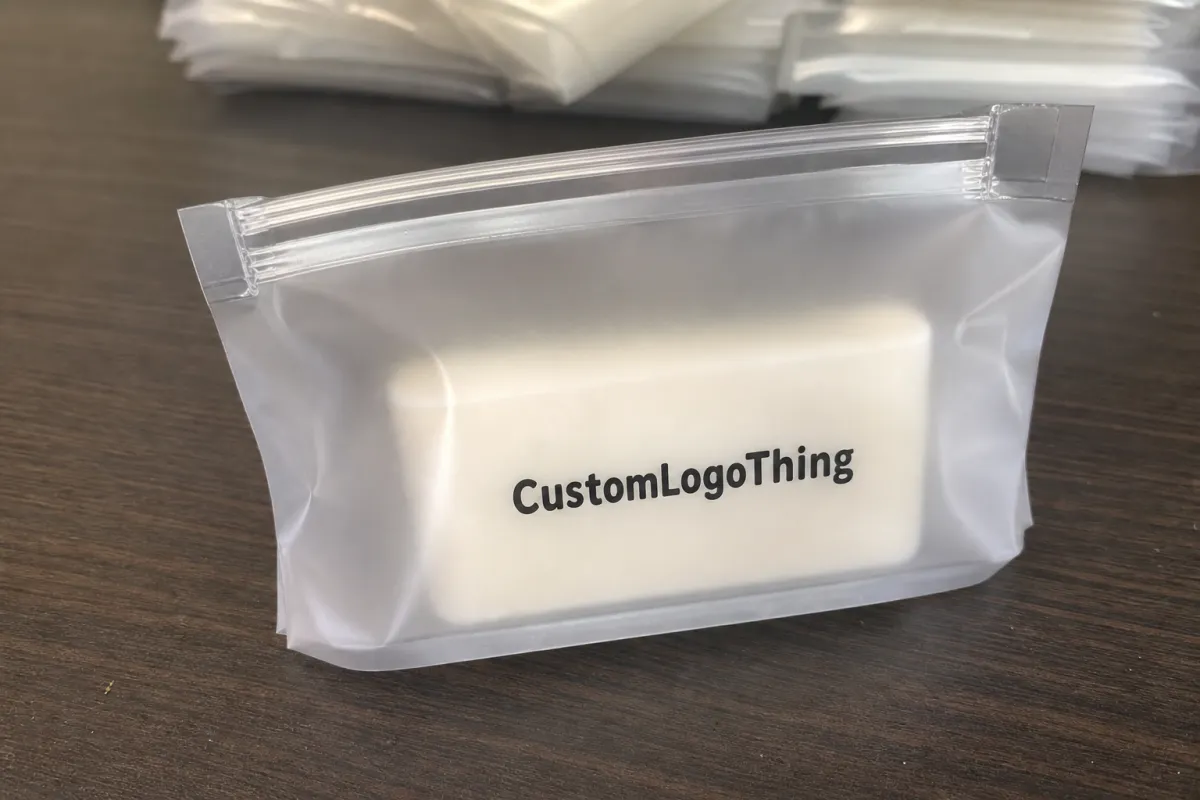
The proof looks clean on screen. Then the bags arrive, a pale goat milk bar goes inside, and the lavender logo almost disappears into the frosted film. That is why a soap maker frosted plastic Bags Artwork Proof checklist belongs in production control, not in the “quick design approval” pile.
Frosted plastic does not behave like a white paper label, kraft soap box, or clear cello sleeve. The film scatters light. It lowers contrast. It can turn a crisp black logo into soft charcoal, make beige botanical artwork look sleepy, and thin out a delicate serif scent name. On a monitor, the artwork is flat, empty, and backlit. In a shopper’s hand, the bag is filled, curved around a bar, photographed under mixed lighting, and judged in roughly three seconds.
Small errors scale quickly. A typo in an ingredient line may be only eight characters, but it can affect a full carton of packaging. A barcode quiet zone trimmed too close may scan badly at retail. A Pantone match that looked acceptable in a PDF can shift once ink hits translucent polyethylene. A seal line through a logo can turn a budget custom bag run into rework, rush freight, and wasted inventory.
From a packaging buyer’s view, the artwork proof is not decoration. It is the manufacturing instruction. The best checklist checks the ordinary things first: size, closure, frost level, print side, safe zone, copy, barcode, opacity, and approval timing. Ordinary is where expensive problems hide.
Proof approval is the point where “I think it looks right” becomes “please manufacture it this way.” Slow down there.
How Frosted Plastic Bag Proofs Work Before Printing
An artwork proof is the manufacturer’s translation of your design file into production terms. It is not a fresh creative concept. It is not a promise that every screen color will print identically on plastic, because screens emit light while frosted film reflects and scatters it. The proof answers a more practical question: “Is this the bag we are about to make?”
A useful proof should identify the bag size, film type, frost level, print colors, imprint position, gusset or flap details, zipper or adhesive closure, bleed, safe zones, hang hole, and finishing notes. If a 5 x 7 inch frosted pouch has a 1.5 inch bottom gusset and a resealable zipper, those details should not live in someone’s memory. One missing dimension can change how the design sits after the bar is inserted.
Digital proofs move quickly. Many suppliers provide them within 1 to 3 business days after receiving clean artwork. They work well for confirming layout, spelling, placement, and specifications. Physical pre-production samples are slower and usually cost more, but they reveal what a PDF cannot: material feel, ink density, translucency, wrinkle behavior, closure stiffness, and scale in hand.
For a repeat order, a digital proof may be enough. For a first custom frosted bag run, a subtle color palette, a retail barcode, or a new bag structure, the sample usually earns its keep.
Filled-bag assumptions deserve extra scrutiny. Charcoal soap behind frosted film can make white ink pop. Cream soap can swallow pale tan lettering. Bright glycerin bars can compete with botanical art. Marbled bars add another variable because the background behind the logo changes from one bar to the next.
Proofing is not so different from a soap recipe test batch. The ingredient list may be correct, but temperature, cure time, mold shape, and surface behavior still decide the outcome. Packaging has its own version: film haze, ink opacity, closure placement, and the way a stiff bar presses against flexible material.
The investigative value of the proof is simple. It forces hidden assumptions into the open. Does the logo print on the front only? Does the hang hole interrupt the border? Is the warning panel readable? Is the back panel printed, blank, or partly covered by a flap? A checklist gives buyers a way to ask those questions before setup money is locked in.
Key Artwork Factors Soap Brands Should Verify
The failure-prone proof elements are predictable: logo clarity, color contrast, type size, barcode placement, seal clearance, opacity, and required product text. Predictable does not mean harmless. Most packaging mistakes are not dramatic surprises. They are small unchecked details repeated across 1,000, 5,000, or 10,000 units.
Frosted plastic lowers visual sharpness. Thin script fonts, delicate serif lettering, pale beige logos, low-contrast botanical patterns, and hairline illustrations all need a harder look. A 0.25 pt line may look graceful in Adobe Illustrator. On flexible plastic, especially with flexographic or screen printing, it can break, blur, or lose authority.
Color expectations need honesty. Pantone references help, but printing on translucent film is different from printing on opaque white stock. CMYK builds can shift. Some designs need an opaque white underprint to hold brightness, especially if the bag will contain darker soap. That white layer can improve contrast, but it may raise cost because it adds a print pass or ink station.
Print the proof at 100 percent. Not 140 percent on a monitor. Not pinched and zoomed on a phone. Actual size. Place it near a real bar and read it from 3 feet away, then from hand distance. If the ingredient text only works under a desk lamp, it probably does not work for wholesale shelves, market tables, or product photography.
Soap-specific copy deserves a line-by-line check: scent name, batch identifier, net weight, ingredients, maker contact information, website, social handle, usage warnings, and any “handmade,” “natural,” “vegan,” or “palm-free” claim. Claims affect both compliance and trust, so old copy should not drift into a new proof by accident. The EPA’s sustainable materials guidance is also a useful reminder that packaging decisions have disposal and material-use implications beyond the visual design.
Placement is the quiet killer. Keep critical information away from heat seals, crimp zones, gussets, folds, zipper tracks, punch holes, and areas that wrinkle around thick-cut artisan bars. A 1 inch thick bar and a 1.35 inch thick bar may use the same bag on paper. The thicker bar can still distort the front panel enough to bend a logo or buckle a barcode.
Process and Timeline From Proof Upload to Bag Approval
The usual path runs through inquiry, quote, artwork upload, file preflight, digital proof, buyer review, revisions, final approval, plate or screen setup, printing, converting, quality check, packing, and shipping. It looks linear. Real projects often pause at preflight because the uploaded file is not production-ready.
Proofing delays often come from incomplete files rather than factory capacity. Missing fonts. Low-resolution logos pulled from a website header. A 72 dpi PNG where vector art is needed. Unclear bag dimensions. Conflicting instructions, such as “print centered” in one email and “shift logo up” in another. Every contradiction adds a question, and questions eat business days.
Separate proof review time from production lead time. A supplier may provide a proof in 1 to 3 business days, while full custom production still requires 12 to 20 business days after written approval. Print method, material, quantity, workload, and finishing all affect that range. Freight adds another clock: parcel delivery, truck shipment, and ocean freight do not behave alike.
Build a decision buffer. Holiday bundles, wholesale line reviews, farmers market restocks, influencer mailers, and product photography schedules all punish late packaging. For a launch, it is safer to approve packaging 3 to 4 weeks before the hard need date than to save three days in proofing and lose ten after a correction.
Assign one final approver. Not three. A founder may care most about brand feel, a designer may focus on color, and an operations assistant may catch barcode or SKU issues. All useful. But one person needs to own the final proof as a complete manufacturing document. Contradictory edits create new errors.
Treat approval as a lock point. Once plate or screen setup begins, changes may mean reproofing, added setup cost, delayed production, or scrapped material. A soap maker Frosted Plastic Bags artwork proof checklist helps everyone understand that approval is not a casual preview; it is the instruction production teams follow.
Cost, Pricing, and MOQ Variables Hidden in the Proof
The proof can expose cost drivers that were easy to miss during quoting: extra print colors, larger imprint area, two-sided printing, gusset printing, custom size, resealable zipper, hang hole, or opaque white underprint. Each sounds small in isolation. Together, they can move the quote.
MOQ is usually a manufacturing efficiency issue, not an arbitrary barrier. Short frosted plastic bag runs carry higher unit costs because setup time, plate preparation, ink mixing, press washup, and quality checks are spread across fewer units. A run of 1,000 bags might land around $0.28 to $0.55 per unit for a simple custom print, while 5,000 pieces may fall closer to $0.18 to $0.32 per unit depending on size, coverage, and freight. Highly custom structures or multi-color work can sit above those ranges.
Higher quantity often lowers the per-bag price. It can also create waste if soap scents, net weights, ingredient lists, or branding change frequently. A maker with rotating seasonal bars may be safer using a generic branded frosted bag plus a small variable label. A maker with a stable hero product can usually justify more specific printed packaging.
Revision economics are blunt. Before approval, small copy or placement changes are usually manageable. After approval, the same edit can trigger new proofing, setup changes, press delays, or scrapped printed film. A missing comma is cheap in a PDF. It is not cheap after 5,000 bags are converted.
| Proof Variable | Typical Cost Effect | Buyer Check |
|---|---|---|
| One-color front print | Usually lowest setup and unit cost | Confirm contrast against light and dark soap bars |
| Two-sided print | Often adds setup and print time | Check back-panel copy, barcode, and flap interference |
| Opaque white underprint | Can add a print pass or ink station | Ask whether it is needed for pale logos or dark soap |
| Custom size or gusset | May increase MOQ or tooling requirements | Test fit with the thickest bar, not the average bar |
| Barcode on flexible film | May require sample testing or adjusted placement | Verify quiet zones, size, contrast, and flat scanning area |
Ask for quotes that name the bag size, material thickness, print method, number of colors, MOQ, setup charges, proof type, and freight assumptions. If the quote does not say whether the film is 2 mil, 3 mil, or another gauge, ask. If it does not clarify one-sided versus two-sided printing, ask again. Pricing should not feel like a black box.
Step-by-Step Checklist for Reviewing the Proof
A reliable checklist starts with the bag, not the artwork. Designers naturally look at the logo first. Production problems often begin somewhere less glamorous.
- Verify the physical specification. Confirm width, height, gusset, material thickness, frost finish, closure type, hang hole, lip, flap, zipper, and seal areas. A 4 x 6 inch flat bag and a 4 x 6 inch gusseted bag behave differently after filling.
- Confirm every piece of copy. Check logo file, brand name, scent name, net weight, ingredient text, website, social handle, batch field, and contact information against the latest approved brand copy. Do not trust memory.
- Inspect safe zones. Mark any text or art too close to edges, seals, gussets, zipper tracks, punch holes, or bend points. Keep critical copy away from areas likely to wrinkle around the bar.
- Test actual-size readability. Print the proof at 100 percent, place it near a real soap bar, then view it from shelf distance and hand distance. Tiny text is often exposed by this one step.
- Evaluate contrast against real soap colors. Test white, cream, charcoal, green, amber, and marbled bars if those are part of the line. Frosted film plus pale ink plus cream soap can become a low-contrast trap.
- Verify barcode performance. If retail scanning matters, check barcode size, quiet zones, orientation, contrast, and whether the printed area stays flat enough to scan. Ask whether a physical sample or scannability check is appropriate.
- Approve in writing only after documenting details. Include final proof version, bag spec, print colors, quantity, delivery deadline, and any approved exceptions.
For transit packaging or wholesale shipping, think beyond the pouch. If packed soap bags are going into cartons, the International Safe Transit Association provides testing frameworks that help brands evaluate compression, vibration, and handling risk. A beautiful pouch still has to survive distribution.
Keep a copy of the approved proof with the purchase order. Reorders become easier when the next production run can be compared against a documented specification instead of rebuilt from emails, screenshots, and memory.
Common Mistakes That Turn Pretty Proofs Into Bad Bags
The most common mistake is approving the proof from a bright laptop screen. That screen is not frosted plastic. It is not wrapped around soap. It is not sitting under warm retail lighting beside 40 competing products. Screens flatter artwork.
Opacity is the second trap. Pale ink can look elegant in a PDF and nearly vanish on a translucent, light-diffusing bag. Thin white lettering over cream soap is especially risky. So is muted sage over pale green soap, or warm gray over oatmeal-colored bars.
Tiny type creates liability. Ingredient panels, batch details, warning statements, wholesale barcodes, scent names, and multi-scent product lines often get squeezed to fit a restrained design. Restraint is good. Illegibility is not. If the type is below about 6 pt on a flexible bag, question it hard; if it is mission-critical copy, question it even harder.
File version confusion is painfully common. A maker uploads an old logo. A designer exports the pre-rebrand color. A net weight from a previous mold size remains in the panel. A retired scent name appears in a footer. Nobody notices because the proof “looks familiar.” Familiarity can be dangerous.
Approval by committee carries its own risk. Five people may each catch one issue, yet no one reads the proof as one complete manufacturing document. One person must check the final version after all edits are merged. Otherwise, a corrected barcode can sit beside an outdated ingredient list.
Skipped measurement checks cause physical failures. A bag can be technically correct on paper but too tight for thick-cut bars, especially handmade soap that varies by batch. Tight fit can distort artwork, stress seals, create wrinkles across barcodes, and slow insertion. Labor matters. If packing staff need an extra 10 seconds per bar across 2,000 units, that is more than five and a half labor hours spent fighting the bag.
The cheapest mistake to fix is the one caught before proof approval. That is the plain truth behind every soap maker frosted plastic bags artwork proof checklist.
Next Steps Before You Approve Production
Before requesting or reviewing the proof, gather the current logo file, final product copy, soap dimensions, barcode file, color references, packaging photos, and any wholesale requirements. Clean inputs reduce proof revisions. Messy inputs multiply them.
Create a one-page approval sheet. It does not need to be elaborate. Use checkboxes for size, material, frost level, film thickness, print side, print color, safe zone, seal clearance, barcode, copy, quantity, and shipping deadline. If the product has multiple scents, add a line for each SKU so names, ingredients, and net weights are not reviewed as a blur.
Run three physical checks before approval. First, print the proof at actual size and place it beside the soap. Second, view it under normal retail-style lighting, not just bright studio light. Third, slide the printed proof or a mockup behind a frosted or semi-transparent material so your eye can judge softness and contrast. It is not a lab test, but it is better than approving from a glowing rectangle.
Ask targeted questions before signing off:
- What print method is being used: flexographic, screen, digital, or another process?
- Is white ink recommended under the logo or text?
- Are all seals, gussets, zipper tracks, and punch holes clear of artwork?
- What is the expected lead time after written proof approval?
- What happens if revisions are requested after approval?
Keep proof approval records with the purchase order. Future reorders should be compared against the same specification, not reconstructed from memory. If Custom Logo Things is producing the bags, send the approval sheet with the art files so the quoting, proofing, and production notes point to the same target.
Packaging does not need to be overcomplicated, but it does need disciplined checking. Before signing off, use one document that follows the bag from design to production: a soap maker frosted plastic bags Artwork Proof Checklist.
FAQ
What should a soap maker check first on a frosted plastic bags artwork proof?
Check the physical bag specifications first: size, thickness, frost finish, closure type, gusset, seal areas, hang hole, and print side. Artwork can look perfect but still fail if the bag is too tight, the seal crosses the logo, or the frost level changes readability.
Does frosted plastic change how soap packaging artwork colors print?
Yes. Frosted plastic diffuses light and can make colors look softer, lighter, or less sharp than they appear on a screen or white paper label. Pale inks, thin lines, and low-contrast natural palettes usually need stronger contrast or an opaque white underprint.
Should I request a physical sample before approving custom frosted soap bags?
A physical sample is useful for new bag sizes, first-time orders, retail barcodes, premium launches, or designs with subtle colors. For repeat orders with unchanged specs, a digital proof may be enough if the prior production run matched expectations.
How can I avoid delays during the artwork proof process for soap bags?
Submit final artwork, outlined fonts, high-resolution logos, barcode files, exact bag dimensions, and clear print instructions at the start. Assign one approver and consolidate edits before sending revisions back to the manufacturer.
What affects the quote or unit cost for frosted plastic bags with artwork?
Cost depends on bag size, film thickness, MOQ, print method, number of colors, print area, one-sided versus two-sided printing, setup charges, and freight. Proof changes before approval are usually easier to manage than changes after production setup begins.

