Pricing a stationery shop Padded Mailers Quote starts with the practical details that usually get glossed over first, because a few millimeters in size can change postage, packing speed, and the way a customer feels when the parcel lands on the desk. A padded mailer usually ships more efficiently than a small box, yet it can still present journals, refill packs, pen sets, and card assortments with a neat, deliberate look. That is why a strong stationery shop padded mailers quote is never just a unit number; it is shaped by fit, structure, print method, and the way the pack performs after it leaves the counter.
For packaging buyers, this format works because it cuts dead space and helps staff move faster without forcing the brand into a plain, purely utilitarian package. The right mailer protects flat goods, reduces the chance of bent corners, and gives the customer a cleaner unboxing moment than loose wrap or an oversized carton. The real question behind every stationery shop Padded Mailers Quote is straightforward: which material, size, and print combination gives the best overall value for the items you ship most often?
Stationery Shop Padded Mailers Quote: Why the Right Fit Matters
A well-fitted mailer does more than hold product in place. It supports the whole order flow from packing table to delivery. If a notebook, sticker set, and pen bundle fit into a mailer that closes cleanly, packers work faster, the parcel looks sharper, and the shipping weight often stays in a better range. That matters because a stationery shop padded mailers quote should reflect the full cost picture, not the mailer alone. A low unit price can still turn expensive if the mailer forces inserts, adds void fill, or pushes the package into a higher postage bracket.
Stationery items are often more delicate than they first appear. They may not be fragile in the glassware sense, yet they can still arrive bent, dented, scuffed, or dog-eared if the mailer is too loose or the cushion is too light. A custom printed mailer can solve two problems at once: it protects slim goods and carries your brand through the final mile. That is why a thoughtful stationery shop padded mailers quote should begin with the items you sell most often, whether those are A5 notebooks, planner refills, card packs, or mixed gift bundles.
A mailer that is two millimeters too tight can slow packing and crease the product; one that is too large can make the shipment look careless. The best quote is the one that matches the packed item as it actually ships, not the catalog version of it.
There is also a brand side to the decision. Stationery buyers notice details. A clean mailer with the right print coverage can make a small shop feel more established, and that matters when customers compare your package to one from a large marketplace seller. If repeat recognition is part of the goal, your stationery shop padded mailers quote should leave room for a logo, return information, or a restrained repeat pattern that still looks composed on the packing table.
- Less waste: the right size reduces filler and handling time.
- Better postage control: a slimmer package often ships more efficiently than a small box.
- Cleaner presentation: branded mailers create a more finished customer experience.
- Lower damage risk: the right cushion helps protect corners, edges, and laminated covers.
For retailers building a broader packaging program, it helps to compare this format alongside other options in Custom Packaging Products. That makes it easier to decide whether the mailer should stand alone or whether certain products still need a box. A solid stationery shop padded mailers quote begins with that decision, because the best material choice depends on what is leaving the shop door.
Stationery Shop Padded Mailers Quote: Pricing Factors That Matter
The price of a mailer is shaped by more than size. Material selection, cushioning type, print coverage, quantity, and order structure all influence the final number in different ways. A basic stationery shop padded mailers quote for blank stock mailers can look very different from a fully custom run with specific artwork, a Pantone match, and a specialty closure. If you are comparing offers, make sure each supplier is quoting the same base spec; otherwise, the numbers may look close while the products are not.
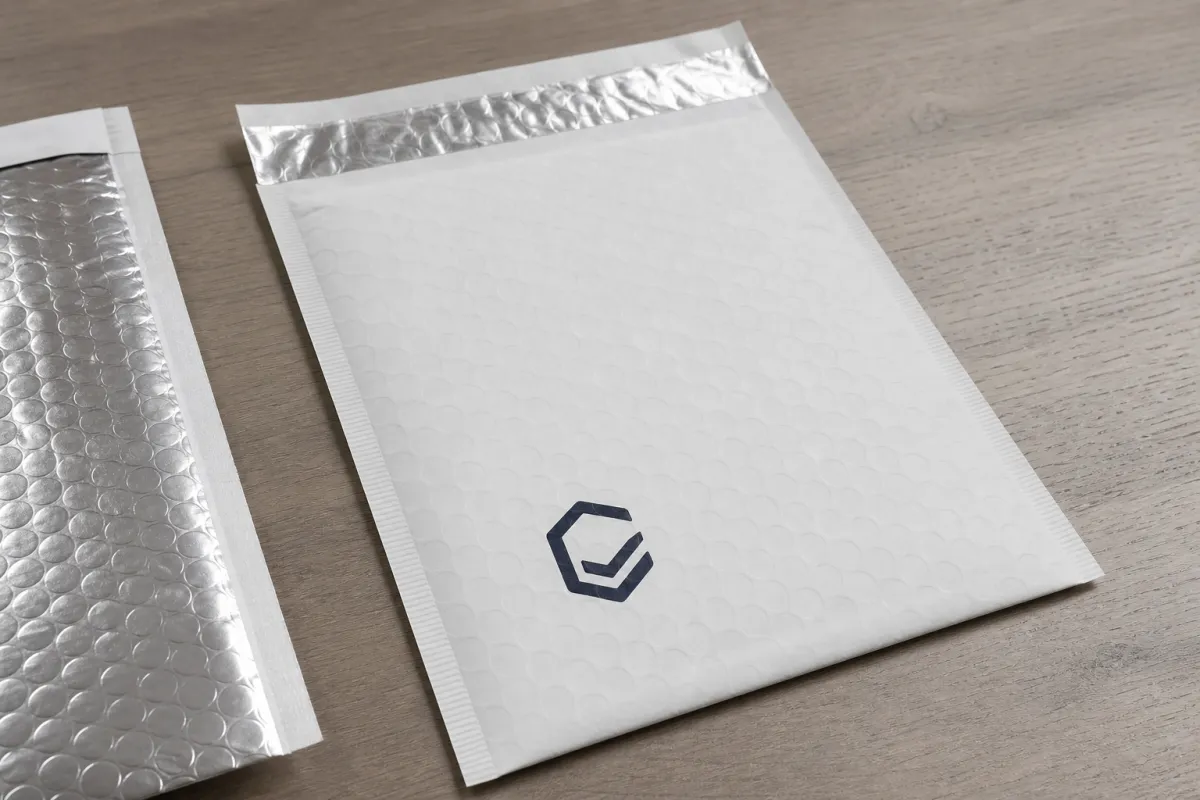
Material is usually the first cost driver. Kraft padded mailers often sit in a different price band than poly bubble mailers because the outer face, sealing system, and recycled content all affect manufacturing. Paper-based padded mailers can suit stationery brands that want a natural, tactile feel, while poly options are often chosen for moisture resistance and a smoother print surface. For a clear stationery shop padded mailers quote, ask what is inside the construction, not just what the outside appears to be. A paper face with paper padding behaves very differently from a paper face over bubble.
Print coverage changes cost in a real, measurable way. One-color branding with a simple logo is usually more economical than full-coverage artwork that wraps across the front and back. Registration, ink density, and setup time all matter. If your design includes multiple colors, ask whether the press method is flexographic, digital, or another process, because the answer can shift both the setup charge and the per-unit cost. A useful stationery shop padded mailers quote should spell out the print method, the number of colors, and whether the quoted price includes plates or screens.
MOQ matters too. Small runs are almost always pricier per unit because fixed costs are spread across fewer pieces. That is normal production behavior, not a sign that the supplier is overcharging. For many stationery shops, the real question is whether a slightly larger quantity lowers the unit cost enough to justify holding more inventory. If you only need a short branded run, a stock-based option may be the better spend. If you ship the same assortment every week, a custom run may win over time. That logic should be visible inside every stationery shop padded mailers quote.
Freight and packing format can move the final number as well. A quote that looks attractive on paper may become less competitive once carton counts, palletization, and destination charges are added. Ask for a landed-cost view whenever possible. If you need a side-by-side comparison, the table below is the kind of format that saves time and reduces guesswork.
| Option | Typical MOQ | Typical Unit Range | Best For | Notes |
|---|---|---|---|---|
| Blank stock mailer | Low to moderate | $0.12-$0.28 | Fast replenishment, basic protection | Usually the quickest path to a lower stationery shop padded mailers quote |
| One-color branded kraft mailer | Moderate | $0.18-$0.42 | Simple logo use, earthy brand look | Good balance of cost and presentation |
| Full custom printed mailer | Moderate to higher | $0.24-$0.55+ | Strong branding, repeat recognition | Artwork complexity can raise the stationery shop padded mailers quote |
| Recycled-content premium build | Varies | $0.22-$0.50+ | Eco-positioned stationery lines | Check substrate details before assuming recycle claims |
If you are ordering across several product lines, it can help to compare this spend against your other formats, such as Custom Poly Mailers, especially if some stationery kits need stronger moisture protection than paper-based options can offer. The best stationery shop padded mailers quote is the one that fits the product, not the one that simply looks cheapest on the page.
Product Details: Materials, Liners, and Print Options
The outer face of the mailer shapes the first impression, but the liner does the actual work. A stationery brand that ships flat, lightweight goods should think about the full construction, because the right liner can protect edges without making the pack bulky. A paper-based exterior with fiber padding feels more tactile and natural, while a poly exterior with bubble cushioning tends to resist moisture and abrasion more effectively. That is why a stationery shop padded mailers quote should name the face stock, the inner cushion, and the closure system separately. Those details determine how the pack feels in the hand and how it behaves in transit.
Closure style matters more than many buyers expect. A self-seal adhesive strip speeds up packing and keeps the process consistent. Tamper-evident strips can help if you want a clearer signal that the parcel has not been opened. Tear-open features can improve customer convenience, especially when the mailer is used for subscription packs or recurring stationery kits. If the package is moving through a busy fulfillment table, a practical stationery shop padded mailers quote should also consider seal width and bond quality, because weak adhesion can cost more than it saves.
Print options deserve a plain-language discussion. A single-color logo on kraft is usually the simplest and cleanest route. Multi-color branding can look excellent, but the artwork needs enough open space and the substrate must hold registration well. Pantone matching is useful when your brand depends on specific color discipline, yet it is not always the most economical choice for a short run. For a precise stationery shop padded mailers quote, share vector artwork and ask which print method suits your quantity best. Flexographic printing is often a good fit for larger runs, while shorter runs may benefit from simpler print setups depending on the material.
Finish also shapes perception. A matte paper surface gives a calmer, more editorial look, which many stationery brands prefer because it feels aligned with notebooks, paper goods, and desk accessories. A smoother poly surface looks more technical and can support bolder graphics. Neither is automatically better. The right one depends on the product and the brand language. If you want the mailer to echo the organized feel of a stationery collection, the stationery shop padded mailers quote should include sample references for texture and sheen, not just dimensions.
Recycled and recyclable claims need careful wording. Paper-based mailers may be recyclable in many curbside systems, but local rules vary and any coatings, tapes, or inks can change the outcome. When in doubt, ask for the exact material breakdown and any certification details. If you want paper sourcing that supports responsible forest management, look for FSC-certified material and verify the scope of that certification at fsc.org. A good stationery shop padded mailers quote should never blur material claims; clear labeling protects both the brand and the buyer.
For teams comparing performance, transit testing language is useful too. The ISTA resources help when you want to think beyond a simple fit check and consider vibration, drop, and compression stress. Even when a full test program is not needed, the terminology helps you ask better questions. That makes the stationery shop padded mailers quote more actionable because it connects price to real shipping conditions.
Specifications to Match Books, Kits, and Accessories
Stationery covers a wide range of products, and that is where sizing errors start. A slim journal, a boxed pen set, and a mixed creative kit each need different internal clearances. The first step is to measure the finished packed item, not only the product by itself. If the product includes wrapping, inserts, or a small thank-you card, those elements belong in the measurement too. A detailed stationery shop padded mailers quote should always be built from the packed stack, because the packed stack is what the shipper actually handles.
Internal dimensions are the key number, but they are not the only one. Outer dimensions affect postage and carton packing, while thickness determines how the item sits once the adhesive is closed. Seal width matters if the mailer needs enough space for a clean bond, and product weight ranges help the supplier decide whether the cushioning level is sufficient. A careful stationery shop padded mailers quote should list all of those fields so the buyer can compare spec sheets without guessing. If those numbers are missing, the quote is not ready yet.
Books and notebooks usually prefer a slim, tidy fit. If the mailer is too deep, the order shifts around. If it is too tight, corner pressure can mark the cover or wrinkle a dust jacket. Card sets, sticker packs, and flat accessory kits often do better with a slightly more forgiving pocket, especially if the kit contains more than one rigid insert. I have seen a two-millimeter change fix a problem that looked bigger on paper, and I have also seen a mailer that was just a touch too snug slow a whole packing line. That is why the same stationery shop padded mailers quote can produce very different results depending on the packed item mix. One SKU may be ideal in a shallow mailer, while another needs a little more cushion and flap space.
For mixed stationery bundles, think in layers. Start with the thickest point of the stack, then add the clearance needed for compression, closure, and any protective sleeve or rigid insert. That may sound simple, but it is where most sizing errors are made. A retail team might measure a notebook at 8 mm and forget that the ribbon bookmark or outer wrap adds another 2 mm. The supplier then quotes a snug mailer, and the pack looks good on paper but closes badly in practice. A reliable stationery shop padded mailers quote should prevent that mismatch before production starts.
A sample fit test is worth the time. Put the real item into a prototype mailer, close it, shake it gently, and look at the corners. Does it move too much? Does the flap sit cleanly? Does the printed face still look balanced once the product is inside? Those checks take minutes, yet they can save an entire run. If the fit is reviewed early, the stationery shop padded mailers quote becomes a planning tool instead of a gamble.
- Measure the packed item: include wrap, inserts, and anything that ships with it.
- Confirm internal dimensions: this is the number that drives fit.
- Check thickness and seal width: both affect closure quality.
- Test with a real sample: paper specs do not always show how the pack feels when sealed.
Pricing, MOQ, and Sample Ordering
MOQ shapes the economics of the order more than many buyers expect. A small branded run can be perfectly sensible if you are testing a new collection, but the unit cost will usually be higher because setup costs are spread across fewer pieces. That is normal production behavior, not a surprise charge. A well-prepared stationery shop padded mailers quote should show price breaks at multiple quantities so you can see where the step-downs begin. Sometimes the difference between 2,000 and 5,000 pieces is enough to change the total spend in a meaningful way.
Sample ordering needs its own conversation. A blank sample lets you test dimensions and closure. A pre-production proof helps you review print placement and color before the full run. A short test run can be useful if you want to validate how the mailer feels in real fulfillment conditions. These are not the same thing, and the pricing should not be treated as if they are. If the first number you receive is for a sample, do not assume it mirrors full production. A responsible stationery shop padded mailers quote separates the stages clearly so there is no confusion later.
For comparison shopping, ask every supplier to quote the same spec set: exact dimensions, material, print colors, finish, quantity, destination, and any special packing instruction. Without that discipline, the quotes become hard to compare because one vendor may be pricing a heavier build, another may be excluding freight, and a third may be including a different closure style. If you want a fair apples-to-apples read, your stationery shop padded mailers quote request should read like a short specification sheet, not a casual message.
There is a trade-off between stock and fully custom goods. Stock mailers are often the fastest way to control spend and keep inventory flexible. Custom printed mailers support stronger branding and can make repeat orders feel more polished, especially when your packaging is part of the customer experience. The choice depends on volume, brand goals, and how often the assortment changes. A shop that ships the same notebook line all year may benefit from a custom run, while a shop with seasonal kits may prefer a stock-based stationery shop padded mailers quote until demand stabilizes.
Always compare total landed cost, not only the unit price. Freight, carton count, pallet charges, and packing format can move the final number in a way that changes the real margin. Buyers often focus on a low unit quote only to discover the shipping expense wiped out the savings. That is why a thoughtful stationery shop padded mailers quote should be read as a complete purchasing document, not a sticker price.
- Blank sample: best for fit and closure checks.
- Pre-production proof: best for artwork and print placement.
- Short test run: best for real fulfillment validation.
- Full production: best when the spec is already proven and repeatable.
Process, Timeline, and Lead Time for Approval to Delivery
The quote stage moves faster when the buyer sends complete information. Dimensions, quantity, print colors, artwork files, destination, and any packaging preference all help compress back-and-forth. If the request is vague, the supplier has to ask follow-up questions, and the timeline stretches. A clean stationery shop padded mailers quote request usually gets a cleaner answer because the manufacturing team can assess material fit, print setup, and shipping method in one pass.
The process itself is simple to describe, though each step matters. First comes spec review. Then pricing. Then proofing, where the artwork or sample layout is checked. After approval, the supplier moves into production, which may include material sourcing, printing, curing, converting, and packing. Finally, the goods are shipped. If any one of those steps changes, the lead time changes too. That is why a realistic stationery shop padded mailers quote should mention whether the timeline starts from artwork approval or from order confirmation.
Lead time is affected by artwork complexity, substrate choice, and quantity. A simple one-color run on a common material may move faster than a multi-color job on a specialty paper face. If the order is urgent, ask whether a standard substrate can shorten the schedule or whether a simpler print setup can keep the date intact. From a production standpoint, the more custom the build, the more carefully the schedule needs to be managed. A transparent stationery shop padded mailers quote should tell you that up front instead of promising a date that cannot be held.
Packaging and transit terminology also help here. The resources at packaging.org are useful if you want a broader understanding of packaging terms and categories before you finalize the spec. For shipping performance, ISTA testing language gives you a better handle on how a mailer should perform under handling stress. You do not need a full lab program for every stationery order, but knowing the standard names makes the stationery shop padded mailers quote conversation more precise.
There are simple ways to shorten the timeline without sacrificing quality. Send print-ready files in the correct format, confirm your quantity early, and answer proof questions quickly. If the supplier needs to wait three days for artwork approval, the schedule moves three days. That sounds obvious, but it is one of the most common delay points in packaging orders. A well-run stationery shop padded mailers quote process should make these handoffs visible so the buyer can plan around them.
- Best speed boost: deliver finished artwork in the right file format.
- Best planning move: lock quantity before proofing begins.
- Best quality safeguard: approve a sample or proof before production.
- Best timeline control: keep the spec simple when the delivery window is tight.
Why Choose Us for Stationery Shop Padded Mailers
What buyers usually want is not a long explanation; they want a clear answer, a clean spec, and a quote they can actually use. That is where a packaging supplier earns trust. When the material, print method, and dimensions are explained clearly, the buyer can compare options without decoding technical noise. A dependable stationery shop padded mailers quote should help you understand what you are getting, how it will perform, and why the price lands where it does. That level of clarity saves time for both sides.
Custom Logo Things focuses on the practical side of the order: consistent print quality, specification guidance, and packaging that supports both protection and presentation. For stationery brands, that means helping you compare paper and poly constructions, Choose the Right internal size, and decide whether a printed or stock format makes more sense for your mix. If your assortment includes moisture-sensitive items or mixed flat products, the right answer may not be the same for every SKU. A smart stationery shop padded mailers quote should be tailored to the goods, not forced into a one-size-fits-all answer.
Communication matters just as much as the physical build. When a buyer knows what the minimum quantity is, where the price breaks sit, and what the lead time includes, the order moves forward with less friction. That is the kind of experience most packaging teams value because it reduces surprises after approval. If you want to move from discussion to action, send over the product dimensions, quantity, artwork, and destination through Contact Us, and ask for a stationery shop padded mailers quote that matches your actual packed goods.
There is also a repeat-order advantage to doing the first run carefully. Once the size, print layout, and closure are right, reordering becomes easier and faster. The spec is already proven, the customer-facing appearance is already set, and your packing team knows exactly how the mailer behaves. That is the real value behind a well-prepared stationery shop padded mailers quote: it is not just a number for today, it is the base for a packaging system you can use again and again.
If you are still comparing options, start with the product measurements, the desired finish, and the quantity you expect to reorder. From there, the quote can narrow quickly. The best decisions in this category are rarely dramatic; they are practical, repeatable, and built on details that hold up in daily shipping. That is why a clear stationery shop padded mailers quote is the right first step for any stationery brand that wants clean presentation without unnecessary waste.
What details do I need for a stationery shop padded mailers quote?
Provide finished product dimensions, product weight, quantity, print colors, and the ship-to location. Include whether you want stock, blank, or custom printed mailers so the quote reflects the right production method. If you are unsure about size, share a sample pack or product photo so the supplier can recommend a fit. That information helps turn a basic request into a usable stationery shop padded mailers quote.
Are padded mailers better than small boxes for stationery orders?
Padded mailers are usually better for flat or lightly fragile items because they ship with less bulk and less packing labor. Small boxes are a better choice when the product is rigid, awkwardly shaped, or likely to crush in transit. The right choice depends on the item stack, shipping method, and the presentation you want when the customer opens the order. If you compare both options with the same packed item, the stationery shop padded mailers quote often shows where the efficiency comes from.
What MOQ should I expect for custom stationery shop padded mailers?
MOQ depends on the material, print method, and whether the mailer is stock-based or fully custom. Lower quantities are often available for blank stock options, while printed custom runs usually need a higher minimum. Ask for price breaks at several quantities so you can see where the best unit cost starts. That comparison makes the stationery shop padded mailers quote easier to evaluate against your actual sales volume.
How do I choose the right size for notebooks or stationery kits?
Measure the thickest packed version of the item, not just the flat product dimensions. Add clearance for inserts, seal flap space, and light compression from the cushioning layer. Request a sample fit test before production so you can confirm both protection and the finished look. When those steps are followed, the stationery shop padded mailers quote becomes a sizing tool instead of a guess.
How long does it take to move from quote to delivery?
Lead time depends on proof approval, material availability, order quantity, and shipping distance. Supplying final artwork and clear specs early usually shortens the approval stage. If timing is tight, ask whether a standard material or simpler print setup can reduce turnaround. The fastest orders usually start with a complete stationery shop padded mailers quote request and a quick proof approval once the spec is confirmed.
Before you request pricing, measure the packed item, decide whether the mailer needs to be stock or custom, and note the finish you actually want on the desk. Those three inputs usually sharpen the stationery shop padded mailers quote faster than anything else, and they keep the final spec grounded in how the order will really ship.