Custom Logo Things
Stationery Shop Tissue Paper Unit Cost: Order Smarter
Two Tissue Paper Quotes can look nearly identical at first glance, yet the stationery shop Tissue Paper Unit cost can shift quickly once sheet size, print coverage, folding style, and pack count change. A plain folded sheet, a retail-ready bundle, and a logo-printed wrap sit in the same product family, but each one asks for a different amount of paper, labor, and finishing work. If you are trying to keep a stationery budget tight, the trick is not just finding the lowest number on paper; it is understanding what that number actually includes.
Stationery shop tissue paper unit cost: why small changes move the price
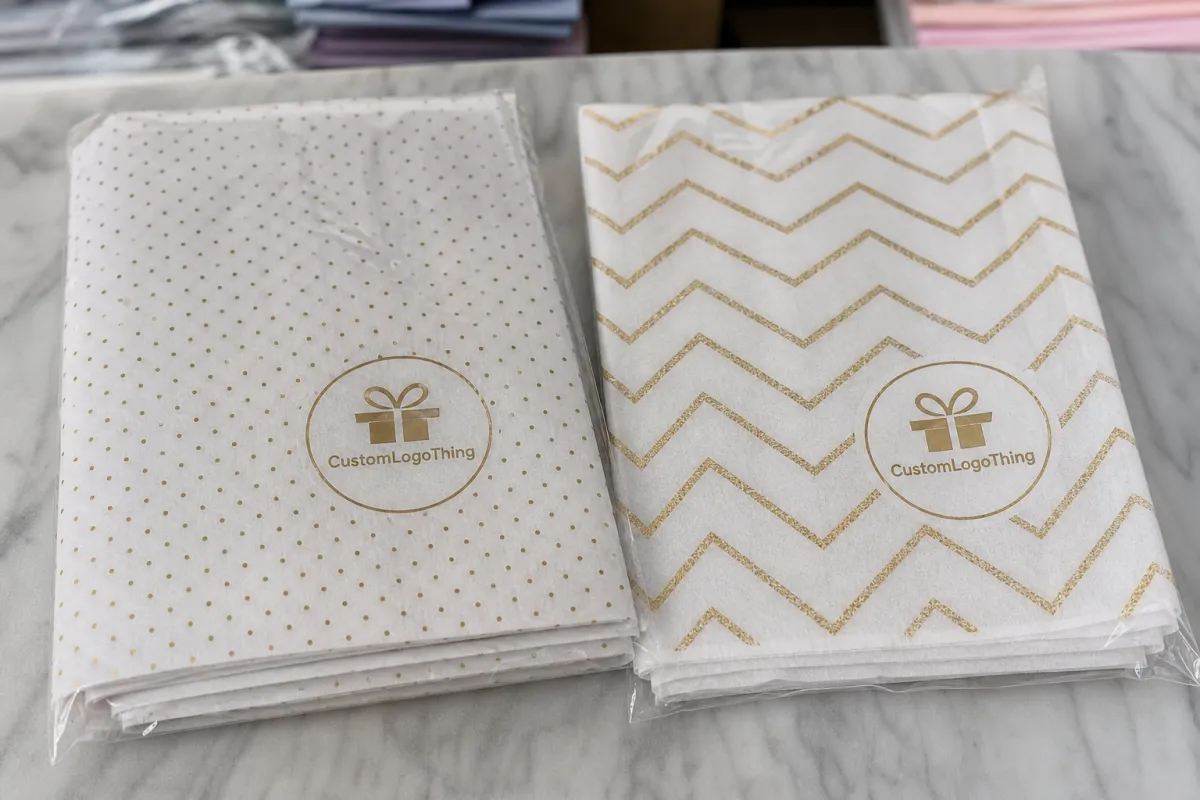
Two orders can look close on a spreadsheet and still land at very different price points. The stationery shop tissue paper unit cost is sensitive to details that seem modest until production begins. A sheet sized 10 x 15 inches instead of 12 x 18 inches changes paper consumption, cutting yield, carton loading, and often the way the printer nests the artwork. Add a single logo color, switch the fold style, or move from loose sheets to retail packs, and the quote can move more than many stationery buyers expect.
The paper itself is only part of the story. The stationery shop tissue paper unit cost usually reflects a chain of conversion steps: sheeting, printing, drying, cutting, folding, bundling, inspection, and protective packing. A buyer who compares only the paper weight misses the work sitting behind the finished sheet. On the shop floor, those labor steps and machine setups often matter as much as the base tissue.
That explains why two tissue orders can share the same material grade and still behave differently in production. One may be a stock white tissue sheet with no print and no special packing. The other may need a custom logo, tighter color control, and a retail bundle that has to look neat enough to sit on a stationery shelf without extra handling. The stationery shop tissue paper unit cost follows the work required to make the sheet sale-ready, not just the raw paper roll.
Handling costs are easy to overlook because they do not show up as a single line item on every quote. Folding, counting, bundling, sleeve insertion, and cartonizing take time, and that time becomes part of the final number. When an order needs tissue inserted into sleeves or arranged in a presentation carton, the stationery shop tissue paper unit cost rises because the labor per finished piece rises too. That is true for a boutique stationery chain, a gift shop, or an e-commerce brand that wants a polished unboxing moment.
A better buying question is not only, "What does the paper cost?" It is also, "What exactly is included in the quoted unit?" That distinction matters because the stationery shop tissue paper unit cost may already include printing, trimming, bundling, and packing in one quote, while another supplier may list those steps separately or leave them out until later. Once the quote is broken into parts, the pricing usually starts to make sense.
Example: a plain stock tissue sheet order for a stationery shop may come in at a lower number because the material is standard, the finish is simple, and carton loading is efficient. A retail-ready branded wrap order of the same size can cost more per sheet because the printer has to control ink coverage, alignment, and final presentation. The sheets may be made from the same paper grade, but the stationery shop tissue paper unit cost will not be the same.
Product details that shape stationery tissue paper orders
The cleanest comparison starts with the spec sheet, not with a guess. Sheet size, paper weight, opacity, surface finish, fold style, and print method all feed directly into the stationery shop tissue paper unit cost. A light 14gsm sheet behaves differently from an 18gsm sheet, and a smooth printed surface needs different handling than a soft uncoated stock sheet. Once the spec is fixed, the pricing conversation gets a lot clearer.
Sheet size is usually the first lever. A smaller sheet uses less paper and may improve nesting on the press or cutter, which can pull the stationery shop tissue paper unit cost down. Yet a smaller sheet is not automatically cheaper in real use if the buyer then needs more sheets to cover the same package size. That is why a useful quote starts with the actual retail use case: lining a gift box, wrapping a notebook, padding a pouch, or filling a mailer.
Paper weight matters too, though not in a simple one-size-fits-all way. Heavier tissue often feels more premium and resists tearing better, which helps the brand presentation. Lighter tissue may be perfectly suitable for soft inserts or decorative wrapping, but it can wrinkle or show through more quickly. From a packaging buyer's point of view, the stationery shop tissue paper unit cost should reflect the performance you need, not only the thinnest sheet available.
Opacity and finish shape the result as well. If the tissue needs to hide the product beneath it, a denser sheet may be worth the extra cost. If the goal is a delicate, airy look, a lower-opacity sheet may be the better fit. The stationery shop tissue paper unit cost can also move with finish choices such as matte, smooth, or lightly calendared surfaces because each one affects print behavior and the way the sheet folds.
Brand presentation matters in stationery. Tissue often sits beside notebooks, bags, organizers, and gift sets, so the paper cannot look random or loose. A clean edge, a crisp fold, and a color that matches the product line make the whole package feel intentional. If the tissue is part of a premium presentation, the stationery shop tissue paper unit cost should be measured against that brand lift, not against the cheapest sheet on the market.
Print details deserve close attention. One-color logos are usually simpler than full-bleed repeat patterns, and repeat patterns are easier to manage when the artwork grid is built with consistent spacing. Ink coverage matters because heavy coverage can affect softness and dry time. Registration matters as well, since a slightly offset logo can make an otherwise polished tissue feel off. Those factors directly influence the stationery shop tissue paper unit cost because they change setup, inspection, and reject risk.
Color matching adds another layer. A deep navy, a soft cream, or a warm gray can look subtly different under store lighting or inside a shipping carton. That is why many buyers ask for proofs and compare them under the same lighting conditions they expect at retail. If color control is tight, the stationery shop tissue paper unit cost may rise a little, but the result is often worth it for consistency across a product line.
Pack structure is easy to overlook, yet it shapes both handling and appearance. Inner bundling, carton configuration, and retail-ready presentation all add handling steps. A count of 500 sheets in a master carton may look efficient, but if the tissue has to be counted into small retail bundles afterward, the cost per finished piece changes. That is why the stationery shop tissue paper unit cost should always be reviewed alongside the packing format, not in isolation.
A clean sheet that folds well and prints cleanly is usually worth more than a cheap sheet that tears at the counter, wrinkles in the carton, or arrives with uneven color. That is the practical side of tissue buying, and it saves time later.
How to compare stationery shop tissue paper unit cost with real usage
Price comparison only works when every quote is translated into the same unit. If one supplier quotes by sheet and another quotes by pack, the stationery shop tissue paper unit cost has to be normalized before you can make a fair call. Divide the pack price by the sheet count, then add any setup or shipping costs that are not already included. That one step removes a lot of noise from the buying process.
Real usage matters just as much as the list price. A slightly higher stationery shop tissue paper unit cost can still be the better deal if the sheets fold cleanly, the print stays consistent, and the paper does not tear during packing. A low quote that creates waste is not really low once you count rework, damaged presentation, and the extra handling needed to keep the order usable.
Thinking in cost per piece helps more than staring at total order value. If a thinner tissue sheet has to be doubled to get the right look, the apparent savings disappear quickly. The same thing happens if a print is so light that the logo fades into the paper tone. In those cases, the lower stationery shop tissue paper unit cost is misleading because the actual usable output is lower.
Another common mistake is comparing raw paper input instead of finished units. Stationery tissue often serves as part of a branded unboxing experience, so the right comparison is the tissue that lands in the customer's hands, not the roll that went into the machine. That means the stationery shop tissue paper unit cost should reflect the finished, usable sheet or pack after printing, folding, and packing are complete.
Sample testing is worth the time. Ask for a stock sample if you want to judge feel, or a printed proof if you need to check fold behavior, color accuracy, logo size, and repeat spacing. A sample run does more than confirm aesthetics; it shows whether the stationery shop tissue paper unit cost is justified by the actual handling quality. If the paper cracks at the fold or drifts in color, you will see it before buying the full run.
The buyer who compares on usage usually makes the stronger call. A stationery retailer may pay a little more per sheet for tissue that holds a neat crease and sits flat in a box, because that paper reduces packing time at store level. In that situation, the higher stationery shop tissue paper unit cost can still lower the total packaging expense by cutting labor and waste.
| Spec choice | Typical MOQ | Typical unit cost | What drives the number | Best fit |
|---|---|---|---|---|
| Plain stock tissue, no print, standard fold | 3,000 to 5,000 sheets | $0.04-$0.08 per sheet | Paper grade, sheet size, carton count | Simple inserts and low-friction packing |
| One-color branded tissue | 5,000 to 10,000 sheets | $0.07-$0.13 per sheet | Setup charges, print coverage, drying time | Retail branding with modest artwork |
| Two-color repeat print | 10,000 sheets or more | $0.10-$0.18 per sheet | Tooling fees, registration, ink volume | Premium presentation and repeat patterns |
| Retail-packed bundle set | Depends on pack count | $0.12-$0.22 per sheet | Bundling labor, inner packs, labeling | Store shelves and direct-to-consumer kits |
Those numbers are not fixed, and they should not be treated as promises. They are practical ranges that help you sanity-check quotes before you commit. The stationery shop tissue paper unit cost can move above or below those bands depending on destination, paper grade, artwork complexity, and how much finishing work the order needs. A quote that looks high may still be fair if it includes packing and delivery that another supplier left out.
For buyers who want a broader packaging context, the resources at packaging.org are useful for general packaging practices, while fsc.org is a solid reference for responsible fiber sourcing. If your tissue order has sustainability expectations, those references make it easier to ask better questions and compare claims with more clarity.
Another useful habit is to compare the same spec at several volumes. A quote for 3,000 sheets may have a very different stationery shop tissue paper unit cost than a quote for 10,000 sheets because setup charges are spread differently. If the larger run is only a little more expensive in total, the lower unit price may justify buying ahead for a seasonal launch or a replenishment cycle.
Cost, pricing, MOQ, and quote details to request
Good pricing conversations start with the right inputs. The main drivers are paper grade, sheet dimensions, print method, color count, finishing, packing format, and shipping destination. If any of those are unclear, the stationery shop tissue paper unit cost will be a guess rather than a quote. That is rarely useful for a buyer who needs a firm budget before approving an order.
MOQ deserves special attention. A lower MOQ helps when you are testing a design or matching a short seasonal window, but lower quantities usually raise the stationery shop tissue paper unit cost because the setup work is spread over fewer finished sheets. More time is spent on approval, machine changeover, and inspection relative to the size of the run. That does not make small orders a bad choice, but it does make them more expensive per piece.
Ask for each quote line item in plain language. You want to know whether the price includes plate or setup charges, proofing, sample fees, inner packing, and freight. Some quotes fold those items into the total, while others list them separately. If tooling fees apply, the stationery shop tissue paper unit cost may look low at first and then climb once the extras are added. A clean quote should make those costs visible before you approve anything.
Tiered pricing is one of the most useful tools a buyer can request. Ask for several volume breakpoints, such as 3,000, 5,000, and 10,000 sheets, so you can see where the real savings begin. That makes it easier to decide whether the lower stationery shop tissue paper unit cost at the higher volume is worth the extra inventory. In many cases, the answer depends on shelf turnover and how often the design changes.
Artwork support should also be confirmed early. A supplier may be able to help clean up a repeat pattern, set a bleed line, or position a logo so it nests properly on the tissue sheet. If artwork is not production-ready, delays creep in and the final pricing can change. That is why the stationery shop tissue paper unit cost should be discussed together with the art approval process, not after the fact.
Side-by-side comparison only works if the spec is identical. Keep sheet size, paper grade, print coverage, pack count, and packing style the same across every quote. Otherwise you are not really comparing price; you are comparing different products. The stationery shop tissue paper unit cost becomes meaningful only when the quotes line up on the same technical basis.
From a practical buying point of view, I would rather see a supplier be precise than optimistic. A clear quote that names the setup charges, explains whether packing is retail-ready, and shows the shipping assumption is more useful than a vague low number. If the offer is honest, the stationery shop tissue paper unit cost can be planned into your margin instead of becoming a surprise later.
One more point: if your order needs special carton labeling, barcode stickers, or store-ready bundles, mention that early. Those details can be small on paper but meaningful in labor time. Again, the stationery shop tissue paper unit cost follows the handling steps, not just the sheet count. The clearest quote is the one that leaves as few hidden tasks as possible.
Process, timeline, and turnaround for custom tissue orders
The production path stays straightforward when the buyer and supplier share the same spec. It usually runs from inquiry to spec confirmation, then artwork review, proof approval, sample signoff if needed, production, packing, and shipment. Each step touches the stationery shop tissue paper unit cost in a small but real way because the more review and rework the order needs, the more time and labor it absorbs.
Print complexity is one of the biggest timing factors. A simple one-color logo can move faster than a dense repeat pattern with several registration points. Color matching, special finishing, and retail packing also add time. If the schedule is tight, ask the supplier which choices would have the least impact on the stationery shop tissue paper unit cost and the lead time. Often the simplest path is the most efficient path.
Approvals are usually the slowest part, not the machine run itself. Quick feedback on color, fold, and logo placement keeps production on track. A slow proof cycle stretches the schedule and can sometimes raise the stationery shop tissue paper unit cost if the order has to be held or rescheduled. For seasonal launches, that timing discipline matters a great deal.
A responsible supplier should communicate milestones clearly. You should know when the proof will be ready, when production will begin, when packing is complete, and when shipment is expected to leave. That kind of communication helps a buyer manage the launch calendar and avoid last-minute shortages. It also keeps the stationery shop tissue paper unit cost from being the only number on the page; timeline and reliability matter too.
Rush orders are possible in some cases, but only if the spec is simple and the artwork is ready to approve quickly. A short lead time is easier with stock tissue or a light print load than with a multi-color branded run. If speed is the priority, say that early and ask what changes would protect the stationery shop tissue paper unit cost from rising too far. A practical supplier will tell you which choices are worth keeping and which ones are optional.
Stationery buyers often plan tissue around product launches, holiday displays, and store reopens. That means timing and packaging presentation are tied together. A delayed proof can miss a campaign window, and a weak packing spec can create shelf issues after arrival. The best result is a schedule that supports the launch and a stationery shop tissue paper unit cost that still fits the budget.
For transit, many buyers also ask how the cartons will hold up under normal freight handling. It is fair to ask about compression resistance, carton stacking, and whether the pallet load is protected enough for the route. Some teams refer to general test practices such as ISTA methods or paper strength checks under ASTM-style procedures, especially when the shipment is traveling a long distance. Those standards do not change the stationery shop tissue paper unit cost by themselves, but they help you judge whether the packing plan is appropriate.
Why choose Custom Logo Things for stationery tissue paper
Custom Logo Things is a practical Fit for Buyers who want the right balance of appearance, production reality, and budget. The goal should never be to overspecify tissue just because the catalog makes it look easy. A good supplier helps you choose a sheet size, paper weight, and packing format that supports the use case while keeping the stationery shop tissue paper unit cost under control.
Consistency matters as much as the first sample. Branded tissue has to look uniform from one shipment to the next and one retail display to the next. If the print shifts, the fold drifts, or the bundle count varies, the shelf presentation suffers. That is why buyers care about the stationery shop tissue paper unit cost together with process control. A stable product is usually worth more than a slightly cheaper one that varies run to run.
Direct guidance is especially helpful when a buyer is trying to reduce waste. If a paper is too heavy, too wide, or too richly printed for the job, the order may look premium but cost more than it should. A supplier that understands packaging can help trim the spec without making the product look cheap. That sort of advice often improves the stationery shop tissue paper unit cost more than a simple price negotiation would.
Clear communication on samples, approvals, and timelines gives buyers confidence. Nobody wants to discover late artwork problems or a missing packing requirement after production has started. When the process is clean, the result is easier to budget and easier to receive. That is the kind of predictability that keeps the stationery shop tissue paper unit cost from turning into a moving target.
Quality control still matters at the practical level. Tissue should arrive aligned, cleanly folded, and ready to use in a retail or gift packaging environment. If the bundles are crooked or the cartons are overfilled, the store team pays the price in labor and frustration. A supplier that respects that final presentation is helping protect the stationery shop tissue paper unit cost in a way that extends beyond the invoice.
Next steps to lock in your stationery shop tissue paper unit cost
Before asking for a quote, gather the basic details: sheet size, quantity, print colors, packing style, and delivery address. If you already know the paper tone or the finish you want, include that too. The more complete the brief, the more accurate the stationery shop tissue paper unit cost will be. Missing information forces the supplier to assume, and assumptions usually widen the price range.
It helps to compare at least two spec options. A slightly smaller sheet, a lighter paper weight, or a simpler print can change the numbers more than many buyers expect. That comparison makes the stationery shop tissue paper unit cost easier to interpret because you can see exactly which change buys which savings. Sometimes the smarter choice is not the cheapest sheet, but the sheet that gives you the best overall yield.
Send artwork early, even if it is only a draft. That gives the supplier time to flag bleed problems, repeat spacing issues, or logo placement concerns before production begins. Early artwork review also supports a tighter stationery shop tissue paper unit cost because it reduces the chance of delays or a second setup pass. In packaging, time lost at the approval stage often costs more than time lost on the machine.
Decide what matters most: speed, lowest unit price, or the best presentation. You can usually optimize two of those three, but not all three at once. That tradeoff is normal. If lowest price is the goal, the stationery shop tissue paper unit cost is usually best at a higher MOQ and a simpler spec. If speed matters more, the right answer may be a cleaner design and a smaller run. If presentation matters most, a slightly higher unit cost may be the better business call because the tissue does more visual work at the shelf.
Once the quote, proof, timeline, and packing details line up, move forward with confidence. Review the figures, confirm the spec, approve the proof, and keep the approval cycle tight. That is the practical way to keep the stationery shop tissue paper unit cost within budget while still getting tissue that looks sharp on the shelf and performs well in packing. The details are where the savings live, and the order usually gets easier once those details stop being fuzzy.
FAQ
What affects stationery shop tissue paper unit cost the most?
The biggest drivers are sheet size, paper weight, print coverage, color count, and how the tissue is packed for shipment. Lower quantities usually raise the stationery shop tissue paper unit cost because setup and approval time are spread across fewer finished sheets.
How does MOQ change stationery shop tissue paper pricing?
A higher MOQ usually lowers the per-unit price because the production run is more efficient. If you only need a small run, ask whether the supplier offers shared setup options or tiered pricing breaks, since that can soften the stationery shop tissue paper unit cost without forcing you into an oversized order.
Can I get a sample before placing a stationery shop tissue paper order?
Yes, many suppliers can provide a stock sample or a printed proof so you can check feel, fold, and print appearance. Ask whether sample costs are credited back on order, because that changes the real stationery shop tissue paper unit cost once you place the full run.
What details should I send for an accurate quote on tissue paper?
Send dimensions, quantity, print colors, packaging style, delivery location, and any brand color references. If you already know your target budget, share it up front so the supplier can recommend a spec that fits the stationery shop tissue paper unit cost you are trying to hold.
How long is the lead time for custom stationery shop tissue paper?
Lead time depends on artwork approval, print complexity, quantity, and packing requirements. Simple jobs move faster, while color-matched or retail-packed orders usually need more review before production starts, which can influence the final stationery shop tissue paper unit cost as well as the delivery date.
If you want to keep stationery shop tissue paper unit cost under control, start with the clearest possible spec, ask for the real MOQ breakpoints, and compare quotes only after the sheet size, packing format, and print method are identical. That is the simplest way to buy smarter, avoid hidden extras, and end up with tissue paper that looks right for the stationery shelf. It keeps the buying process grounded in what actually gets used, not just what looks cheap on a quote.


