If you need a subscription Fleece Lined Beanies quote, the first decision is not the logo. It is whether the hat will stay comfortable, hold shape, and reorder cleanly through the season. That is the difference between a useful winter item and a low-cost item that creates problems later.
Fleece-lined beanies work well in recurring programs because they are practical, easy to size, and simple to standardize. They also fit a wide range of use cases: employee kits, member rewards, seasonal subscription inserts, and cold-weather giveaways. When the style is repeatable, pricing and fulfillment are easier to control.
A useful fleece-lined beanie should be comfortable, consistent, and easy to reorder. Everything else is secondary.
The notes below focus on the choices that affect cost, lead time, and repeat order quality.
Why fleece-lined beanies win in recurring winter programs
Fleece-lined knit caps solve three procurement problems at once: they are warm, forgiving on fit, and easy to standardize. That matters when the same product has to work across different audiences and multiple drops without changing the spec every time.
Consistency is the biggest advantage. A recurring program can keep the same shell knit, cuff depth, fleece insert, and logo placement from one order to the next. That reduces artwork revisions and lowers the chance of mismatched replenishment runs. If your calendar already has several fulfillment dates, fewer variables usually means fewer failures.
The quality test also happens later than most buyers expect. A beanie can look fine at approval and still disappoint after a few wears if the knit loosens, the fleece pills, or the decoration looks too heavy. Buyers who pay attention to stretch recovery, warmth, and forehead comfort usually get better results than buyers focused on novelty.
There is also a sourcing advantage. One style can often support onboarding, retention, and seasonal program drops with only minor changes to packaging or decoration. That repeatability helps stabilize pricing because suppliers can produce the same item more efficiently than a one-off custom concept.
Practical takeaway: a fleece-lined beanie should be treated as a repeatable winter staple, not a trend piece.
Product details that affect comfort, wear, and repeat orders
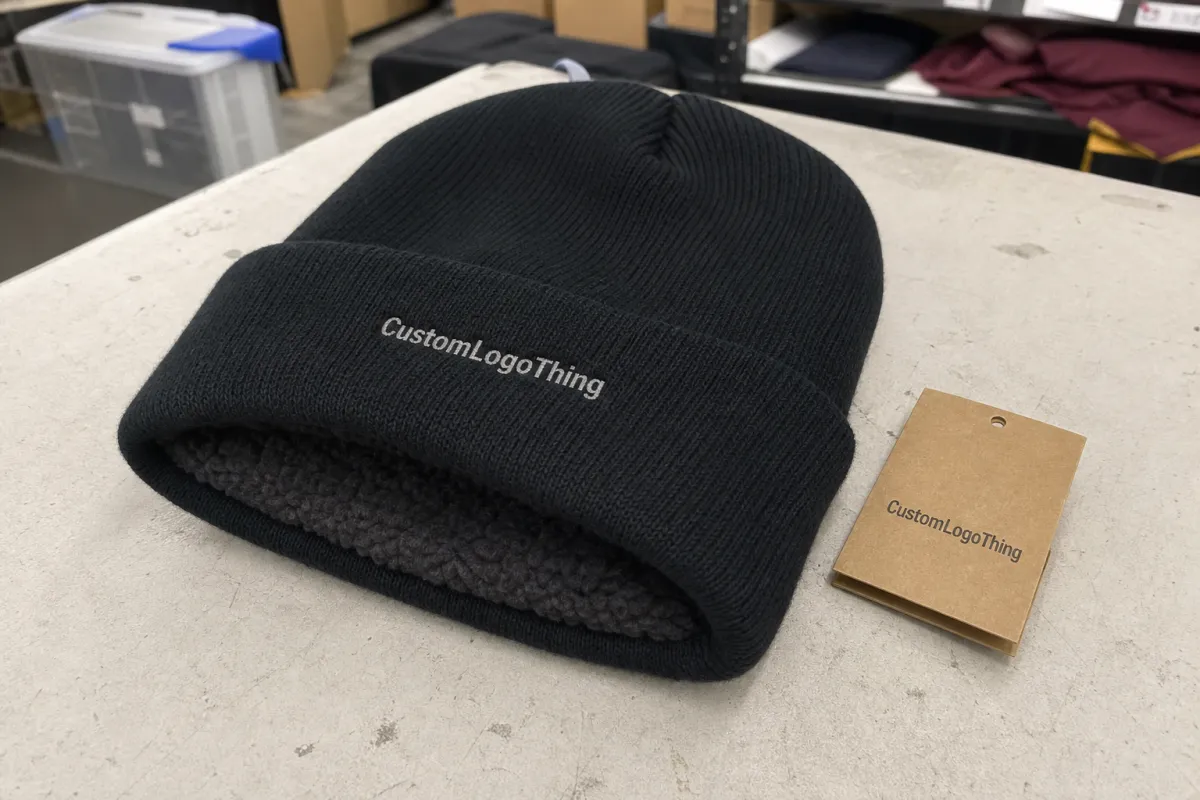
The construction details matter more than most buyers expect. A typical fleece-lined beanie includes an outer knit shell, an inner fleece layer, and a cuff that affects fit and decoration space. The shell can be acrylic, polyester, or a blend. The fleece may be brushed polyester or recycled content. Each choice changes softness, weight, drying time, and how the hat behaves after repeated use.
Acrylic is usually the budget-friendly option and gives solid warmth with reliable color saturation. Polyester blends can improve durability and drying speed, which helps if the hats will be worn often or washed frequently. Recycled yarns can support sustainability goals, though they may narrow color options or raise minimums slightly. Buyers should ask early rather than after artwork is approved.
Fit is the other quiet variable with a big impact. One-size-fits-most works because knit stretch and fleece provide enough flexibility for most adult heads. That matters in subscription programs, where the same item may go to different audiences over several drops. If the cuff is too short or the knit too tight, complaints rise quickly.
Decoration zones also shape the decision. Front cuff embroidery is still the most common choice, but woven patches can show more detail and stay readable on dark colors. Woven labels, side tabs, and tonal logos work well for brands that want a quieter look. For winter kits, a low-contrast logo on black, charcoal, or navy often feels more premium than a high-contrast graphic.
Color planning should be handled like inventory planning. Core neutrals such as black, heather gray, navy, and olive are usually the safest choices for recurring programs. Accent colors can work for seasonal drops, but too many colorways make replenishment harder. If the program is meant to repeat, keep the base spec steady and vary only what truly needs to change.
Typical spec checks before requesting a quote:
- Outer knit material and yarn weight
- Inner fleece thickness and hand feel
- Cuff depth and logo placement area
- Colorway count and reorder availability
- Decoration method and thread or patch colors
subscription fleece lined beanies quote: pricing and MOQ drivers
If you ask for a quote without enough detail, the numbers will be noisy. Price changes with yarn type, fleece thickness, stitch count, decoration method, color count, packaging, and freight. The key is whether the supplier shows those drivers clearly enough for a real comparison.
MOQ is one of the first numbers to pin down. Lower minimums usually carry a higher unit price because setup costs get spread across fewer pieces. Larger runs improve efficiency and often unlock cleaner price breaks, especially if the design will repeat across several subscription waves. If the program might scale, ask for tiered pricing at 300, 500, 1,000, and 5,000 pieces.
For planning, a stock-style fleece-lined beanie with simple embroidery may land around $3.90-$6.25 per unit at mid-size quantities, while more customized versions can run $4.80-$9.40 per unit depending on materials and decoration. Freight, duties, and packaging can move the landed number higher. The lowest quote on paper is not always the lowest total cost.
| Option | Typical MOQ | Unit Price Range | Best Fit | Notes |
|---|---|---|---|---|
| Stock fleece-lined beanie + 1-color embroidery | 100-250 | $3.90-$6.25 | Trials, small member gifts, pilot programs | Fastest path, simplest setup, limited color flexibility |
| Recycled blend + woven patch + custom label | 300-500 | $4.70-$7.20 | Recurring subscription insert, premium retention gifts | Better perceived value, more packaging coordination |
| Fully custom knit + specialized packaging | 500-1,000 | $5.80-$9.40 | Brand-led seasonal programs, retail-adjacent bundles | More time, more proofing, better control over the final look |
There are also hidden costs that show up after the first quote. PMS color matching can add cost if exact brand alignment is required. Custom woven labels, hangtags, and individual polybags increase both labor and material spend. Rush production and split shipments raise the total as well. A quote is only useful if those line items are separate.
- Blank product or base garment cost
- Decoration setup and digitizing
- Sampling and pre-production proofing
- Packaging and insertion costs
- Freight to your destination or fulfillment hub
The clearest comparison comes from asking for multiple quantities on the same spec. That shows the break point where a larger buy drops the per-unit cost enough to justify extra inventory. A good supplier should present that spread without making you chase the information.
Production steps, process, and lead time from approval to delivery
A sensible production flow starts with the quote request and ends with shipment, but the middle is where most schedules slip. The usual stages are spec review, artwork check, sample or mockup, approval, production, quality control, and final shipment. If any one of those steps is vague, the lead time becomes hard to trust.
For custom knit headwear, the timeline usually depends more on decoration complexity than on the beanie itself. A simple stock cap with embroidery can move faster than a fully custom knit style with specialty labels and packaging. Add sample revisions, color matching, or split deliveries, and the calendar stretches. For simpler runs, a realistic window may be 12-15 business days from proof approval; more involved programs usually need longer.
Artwork is the most common delay point. Logos arrive in the wrong file format, line weights are too thin for embroidery, or the brand sends revisions after proofing has started. Color changes can cause a second delay, especially if seasonal tweaks come after sample approval. Shipping congestion is the final variable, and it is not always under anyone’s control.
Subscription buyers should work backward from the first required ship date, not from the launch date in the marketing calendar. If customers expect the first shipment on November 1, the production clock should be set by the date cartons need to leave the warehouse, not the day the campaign is announced. That buffer helps protect the program when proofs or freight need extra time.
If the beanies are part of a larger fulfillment workflow, ask for carton counts, inner pack counts, and master carton dimensions early. Those details affect receiving speed and warehouse labor. Suppliers who answer those questions quickly tend to handle repeat orders better too.
Packaging tests can be useful if the item will move through a lot of handling. ISTA publishes packaging and distribution testing frameworks that help buyers think about compression, vibration, and transit stress; see ISTA testing resources. If the program uses paper inserts or cartons, FSC-aligned sourcing may also matter; see FSC standards for chain-of-custody context.
Decoration, compliance, and packaging details that shape the final product
Decoration is not just branding. Embroidery density, patch size, thread count, and label placement all affect how the beanie feels and how much it costs. A dense logo on a small cuff can stiffen the fabric. A patch that is too wide can distort once the knit stretches. For cold-weather headwear, the best decoration is the one that stays legible without changing the fit.
Packaging deserves the same level of attention. Subscription programs often work best with a folded presentation that looks clean in a mailer or retail-style kit. Insert cards can explain the seasonal theme, barcode labels help fulfillment, and a tidy bundle configuration reduces pick-and-pack errors. If the item is shipping directly to subscribers, ask whether individual polybags are necessary or whether a simpler pack-out will do the job.
Compliance is usually straightforward, but skipping it creates avoidable risk. Larger buyers may need documentation for fiber content, country of origin, and carton marking. Some programs also need care labels or destination-specific packaging language. The exact requirements depend on where the product is being sold, so confirm the end market before approving the final spec. A low-priced quote loses its shine if the paperwork causes delays later.
Quality control should cover more than the logo. Seam inspection, color consistency, logo alignment, and stretch recovery checks all matter. If the style will repeat over several drops, save the approved sample and the spec sheet with color references. That file becomes the benchmark for future production and prevents the kind of drift that turns a repeat order into a new product search.
For larger subscriptions or multi-wave fulfillment, think of the beanie as a repeatable system, not a one-off promo item. The packaging, labeling, and carton logic need to support that system. If the first wave is right and the second wave is slightly different, subscribers notice.
What separates a dependable bulk supplier from a cheap quote
A cheap quote is easy to find. A dependable supplier is harder. The difference usually shows up in communication speed, proof accuracy, factory transparency, and reorder consistency. If a supplier cannot explain how the beanie will be made, how the logo will be applied, and how a repeat order will match the first one, the low price is doing too much of the talking.
For subscription buyers, reorder consistency matters more than almost anything else. The same item may need to ship in October, again in November, and again in January. If the yarn shade shifts, the cuff depth changes, or the patch placement drifts, the program stops looking intentional. A good supplier keeps the spec on file and treats repeat production as a controlled process, not a fresh guess.
Service also matters in ways that do not show up on the line item sheet. Sampling support saves time. Backup stock can rescue a tight schedule. Clear issue resolution protects a launch if a shipment gets delayed. The boring questions are often the most revealing: What is the MOQ? What does proofing look like? What is the delivery window? A supplier should answer those quickly and directly.
Ask for these three things before comparing price:
- A written spec sheet with materials, decoration, and packaging details
- Tiered pricing at multiple quantities
- A realistic delivery window tied to proof approval
There is a reason experienced buyers sometimes choose the higher quote. If a slightly more expensive supplier avoids remakes, missed fulfillment dates, and inconsistent reorders, the total landed cost can be lower. That is procurement math, not a slogan.
Next steps to compare quotes and place a repeatable order
Before requesting a subscription Fleece Lined Beanies quote, gather the basics: quantity, target ship date, logo file, preferred colors, decoration method, and whether packaging is included. If the subscription cadence is already set, include that too. A supplier can usually quote faster when they know whether the order is a one-time drop or the first of several replenishment waves.
Ask for two or three price breaks. That gives a clearer view of how inventory planning affects unit cost. In many cases, the difference between 500 and 1,000 units is smaller than buyers expect, and that can change the economics of the whole program. If repeat shipments are likely, a little extra inventory may lower the seasonal average cost.
Ask for a sample or mockup if the design will carry across multiple drops. It does not need to be perfect to be useful. The point is to verify cuff proportion, logo scale, and color against the product you will reorder later. That first approval becomes the reference for every future shipment.
The best vendor is the one that balances three things: unit cost, lead time, and consistency across reorders. If one of those is missing, the program usually pays for it later.
Frequently asked questions
What should I include in a subscription fleece lined beanies quote request?
Quantity, target delivery date, decoration method, logo file, and color preferences are the minimum inputs. Add packaging needs, sample requirements, and whether you need multiple ship dates for recurring orders. The more complete the spec, the faster you get an accurate quote with fewer revisions.
How low can the MOQ be for fleece lined beanies with custom branding?
MOQ depends on the decoration method, factory capacity, and whether the style is stock or fully custom. Lower MOQs usually mean a higher unit price, especially if you need custom colors or special packaging. Ask for tiered pricing so you can see the cost difference between trial quantities and full replenishment runs.
What affects the unit cost most on fleece-lined beanies?
Material choice, fleece thickness, stitch complexity, and embroidery size usually drive the biggest price changes. Packaging, rush orders, and split shipments can also raise the total landed cost. Comparing quotes only on blank product price can hide the real cost difference.
How long does production usually take after I approve the proof?
Timelines vary by order size, customization level, and season, but approval speed matters almost as much as factory capacity. Simple stock-style orders move faster than fully custom knit or heavily decorated runs. Build in extra time for sampling, corrections, and shipping if your subscription shipment date is fixed.
Can I reorder the same fleece lined beanie for future subscription drops?
Yes, but only if the supplier keeps the same spec, color references, and decoration details on file. Ask for a repeat-order process so future drops match the first production run. Consistent documentation reduces variation between monthly or seasonal shipments.