A subscription Jacquard Knit Beanies Quote should show more than a piece price. It needs the landed cost, packaging assumptions, freight path, and the production choices that decide whether the beanie arrives looking intentional or just shipped.
That matters more in subscription programs than in one-off retail drops. Reorders expose inconsistency fast. A beanie that samples well can still fail if it compresses badly in transit, shifts size from batch to batch, or needs a different packing method every time it is reordered.
Buyers usually focus on the art first. Production teaches the opposite lesson: knit structure, yarn choice, fold, label, and carton count decide whether the artwork survives the supply chain with its shape and value intact.
Why subscription beanie programs fail on packaging and fit
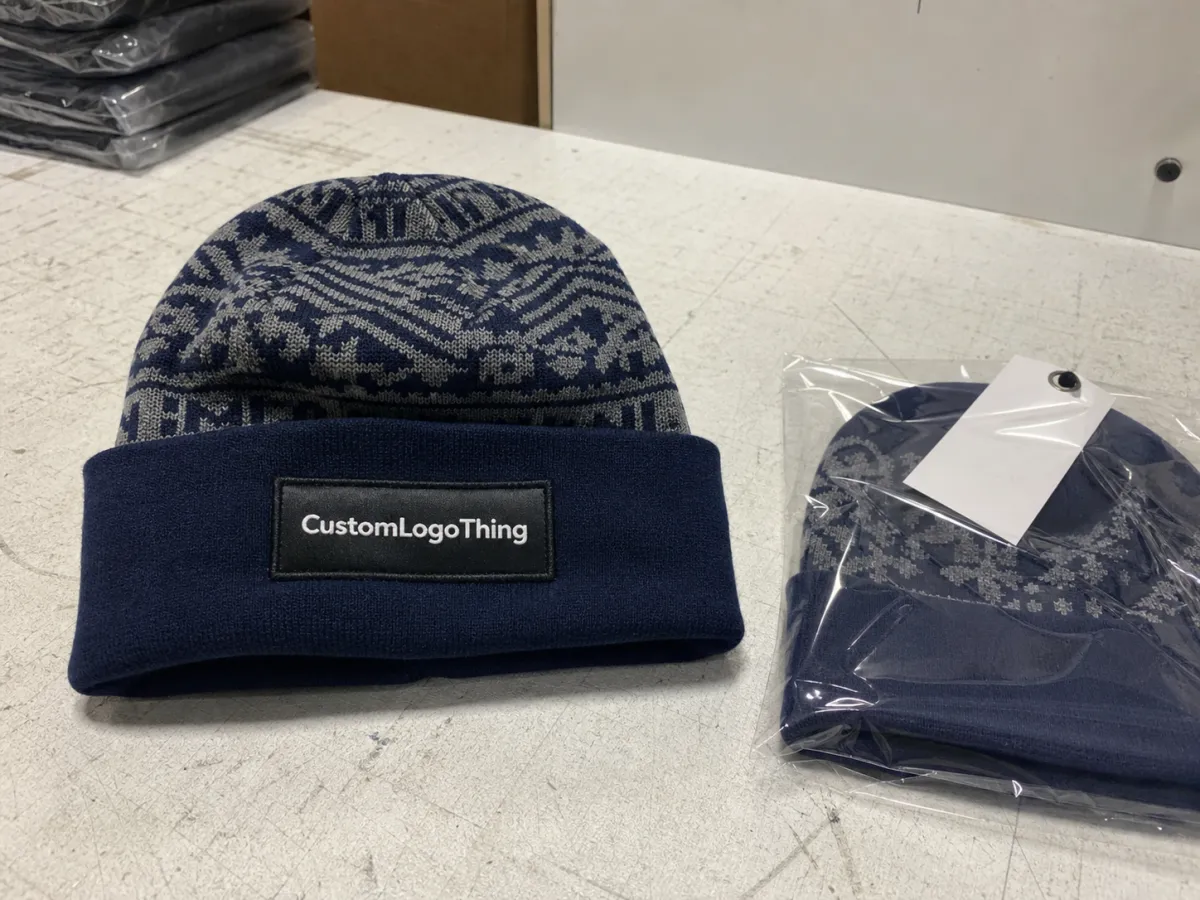
The most common mistake is treating a jacquard knit beanie like a flat promo item. It is not flat, and it is not forgiving. Knitwear has memory, stretch, and bulk, which means the way it is folded and packed affects the customer’s first impression as much as the yarn itself.
Packaging is where many seemingly cheap programs get expensive. A factory quote can look attractive until the buyer adds individual bagging, a branded insert, a custom fold, tighter carton specs, and the freight method needed to protect the presentation. A unit price of $2.40 can move into the $3 range quickly once those pieces are counted honestly.
The simplest way to avoid that surprise is to separate three cost buckets before comparing suppliers: knit cost, packaging cost, and freight cost. If the quote blends them together, the number is hard to trust. If the supplier cannot tell you how the beanie will sit in a subscription box, ask for a revised spec before you approve the build.
Fit is just as important as presentation. A subscriber may not measure crown depth or cuff width, but they will feel a loose fit, a shallow shape, or a crown that collapses after one wear. Consistency matters more than a dramatic sample photo.
In practical terms, the safer programs are often the boring ones: fixed fold, fixed insert size, fixed carton count, fixed yarn reference, and a clear tolerance range. That is how you keep reorders from turning into fresh negotiations every quarter.
For packing and transit planning, think like the box has to survive handling, not like it has to win a mockup review. If sustainability is part of the brief, paper inserts should be specified as carefully as the yarn, because a recycled beanie in a generic plastic-heavy pack sends mixed signals.
Jacquard knit construction, yarn choices, and artwork limits
Jacquard knitting builds the artwork into the fabric. That is the strength of the method: there is no print layer to crack or peel, and the design can feel integrated rather than applied. The tradeoff is that knit artwork has a natural ceiling. Fine lines, tiny text, gradients, and delicate details often need simplification before they can be translated into stitches.
A logo that reads crisply on screen may turn fuzzy when reduced to a beanie panel. Blocky shapes, strong contrast, and clean color separation tend to translate better than narrow outlines or thin serif type.
Color count changes the economics faster than many buyers expect. A two-color jacquard is usually easier to control, easier to sample, and easier to reorder. Add more colors and you add programming complexity, yarn changes, and more chances for the image to lose clarity at small scale.
Yarn choice affects feel, cost, and consistency.
- Acrylic is the baseline: warm, accessible, widely available, and usually the most practical choice for larger subscription runs.
- Recycled acrylic can support a sustainability story, but color matching and stock availability should be confirmed early.
- Wool blends feel richer and usually wear better in colder climates, but they raise unit cost and can introduce sourcing drift if the blend is not tightly controlled.
- Mixed-fiber constructions can balance softness and price, but only if the supplier can hold the blend steady across reorders.
Finish details are not decorative extras. A cuff adds structure and gives you more branding room. A pom-pom raises the profile and the carton volume. A woven label can make a simple knit feel more considered, while interior branding keeps the outside panel cleaner for recurring subscription shipments.
The best time to simplify artwork is before the first sample is made. If the logo has hairline borders or tiny copy, ask what will be reduced, thickened, or dropped. A supplier that promises to knit everything exactly as drawn is usually planning to simplify it later anyway.
Fit, gauge, and finish specs that keep reorders consistent
Fit is where reorders either stay predictable or start drifting. Gauge, stitch tension, and yarn thickness all influence stretch, recovery, warmth, and hand feel. If the first shipment fits snugly and the next shipment feels loose, customers notice immediately, even if they cannot explain why.
Ask for the measurements that actually control repeatability.
- Beanie height from cuff to crown.
- Cuff depth if the style folds.
- Relaxed width and stretched width.
- Weight per piece, ideally in grams.
- Tolerance range for production variation.
- Seam type and whether the seam is flattened or left bulky.
Those numbers define the product instead of leaving it to interpretation. The problem is surprise variation, not variation itself. Good suppliers know the difference and will tell you where the natural range sits.
QC should be more than a checkbox. Ask how many units are measured, which dimensions are checked, and whether the buyer receives a pre-production sample, a photo proof, or both. For a subscription program, that extra clarity is worth more than a dramatic approval email.
Durability deserves the same attention. Look for colorfast yarn selection, secure seam finishing, and enough pilling resistance for repeat wear. A heavy beanie that pills early is a poor trade. A slightly lighter beanie that holds its shape and surface cleanly usually wins over time.
Packaging specs belong in the same conversation. If the beanies will be inserted into a subscription box, confirm the folded dimensions, bagging method, insert size, and carton count before bulk production starts. Those details affect fulfillment speed and whether the product arrives with a deliberate presentation.
How to read a subscription jacquard knit beanies quote
This is the part many buyers rush through, then spend weeks correcting. A quote is only useful if it breaks the job into separate parts: sample cost, setup or programming fee, unit knit cost, label or patch cost, packaging cost, and freight assumptions. Without that separation, comparison becomes guesswork.
MOQ changes the economics in a straightforward way. Smaller runs cost more per unit because the same setup work is spread across fewer pieces. That includes yarn matching, machine programming, proofing, finishing, and packing.
| Build | Typical MOQ | Typical unit price at 1,000 pcs | Best fit |
|---|---|---|---|
| Two-color acrylic jacquard | 200-300 pcs | $2.10-$3.20 | Clean logo, tight budget, repeat subscription drops |
| Recycled acrylic with woven label | 300-500 pcs | $2.45-$3.75 | Sustainability-led programs that still need a controlled cost |
| Wool blend with cuff branding | 300-500 pcs | $3.60-$5.80 | Premium positioning and colder-weather merchandising |
Those are practical ranges, not fixed pricing. Add-ons move the number quickly. A pom-pom might add $0.20-$0.60. A woven label can add $0.08-$0.25. Individual polybagging often adds $0.06-$0.18. An insert card or branded belly band can add another $0.08-$0.22. Freight can exceed any of those line items without much warning.
Ask for pricing at multiple quantities, such as 300, 1,000, and 3,000 pieces. That shows the break point and makes the subscription forecast easier to read. If the supplier only provides one price, you are looking at a snapshot, not a decision tool.
If two quotes look identical, they usually are not identical in production. The difference is often hidden in yarn grade, tolerance, packaging, or freight assumptions.
Shipping terms matter as much as the unit price. FOB, EXW, and delivered pricing are not interchangeable. If the quote does not state the term clearly, the cheapest-looking number can become the most expensive outcome once the goods hit the receiving dock.
One useful habit: compare the per-unit cost against the total program cost, not just the factory line. A 20-cent label on 1,000 units sounds small. On a low-margin subscription pack, it can decide whether the beanie stays in the assortment or gets cut after the first quarter.
Production process, approvals, and lead time checkpoints
The production path is usually simple on paper: artwork review, spec confirmation, sample or digital proof, approval, bulk knitting, finishing, packing, and shipment. The paper version looks tidy. The real version slows down at the approval that everyone thought could wait one more day.
Color approval is often the schedule gate. If the buyer waits three days to sign off on yarn shades, the factory queue does not pause. If the artwork changes after the production slot is booked, the lead time extends and the cost can rise.
Lead times should be broken out instead of compressed into a single promise.
- Sampling or proofing: often 3-7 business days, depending on complexity.
- Bulk knitting and finishing: often 10-18 business days for standard runs.
- Packing and carton prep: usually 1-3 business days.
- Transit: varies by air or ocean, destination, and customs timing.
That breakdown gives you a real calendar. A single delivery date does not. If the supplier cannot separate production time from freight time, the launch plan is being guessed rather than managed.
Rush orders deserve caution. Some factories can move faster for a fee, but a faster production window does not shorten yarn sourcing, proof approval, or shipping. If the process is truly compressed, ask which step changed and what got protected.
Packaging proofing should happen with the same discipline as knit approval. Ask for folded dimensions, carton count, and outer carton strength. If the subscription box is tight, the beanie may need to be folded flatter or packed with fewer inserts.
When the product feeds a fulfillment flow, carton spec matters more than presentation language. A supplier who understands packing reality will often save money even if the quote starts a little higher. That difference usually shows up in fewer damaged units, fewer repacks, and fewer delays at receipt.
How to compare suppliers without overpaying for basic knitwear
Compare the same spec, not just the same image. Two suppliers can quote what looks like the same beanie and still be pricing different yarn, different gauge, different tolerance, and different packing methods. That is how a buyer thinks they found a bargain and later realizes they bought a thinner or less stable version of the product they wanted.
Ask each supplier to identify what is standard and what is extra. Standard yarn. Standard label placement. Standard bagging. Standard carton count. Then ask what changes the price: more colors, denser knit, custom trim, premium packaging, or higher shipping protection.
Communication speed is part of the price too. A supplier that takes four days to answer a color question is likely to be slow on proof corrections and reorder issues. That delay does not show up in the quote sheet, but it often shows up in the calendar.
Look for the quote that is easiest to audit. Clean spec sheet, transparent pricing, and the fewest hidden variables usually beat a low number with scattered assumptions. Cheap pricing can be useful. Cheap pricing with surprise adjustments is how budgets start shedding layers.
If sustainability is part of the brief, ask whether the paper inserts are FSC-certified and whether cartons come from responsible fiber streams. If the beanie uses recycled yarn but the packaging undermines the message, the story feels patched together.
Sample photos matter. So do references from prior production. Neither is enough by itself. A beautiful photo can hide weak stitch density, sloppy trim, or a packing setup that falls apart once the carton is opened. Compare the spec, then compare the proof, then compare the price.
What to send for a fast quote and clean first run
The fastest path to a useful quote is a complete brief. Not a partial sketch. Not three emails with conflicting details. One message with enough information to price the actual build.
Include the basics first.
- Target quantity and at least one alternate quantity.
- Color count and Pantone references if available.
- Yarn preference such as acrylic, recycled acrylic, or wool blend.
- Logo file in vector format if possible.
- Intended launch date and ship destination.
- Packaging requirements such as bagging, inserts, or carton count.
Add an image reference if the style already exists in your mind. Written descriptions can drift. “Premium knit beanie” means one thing to a merchandiser, another to a production manager, and something else entirely to a warehouse that has to pack 5,000 units before noon.
It also helps to request alternate pricing in the same brief. Standard yarn versus upgraded yarn. Woven label versus printed insert. Bulk carton packing versus individual bagging. That shows where the money is going and makes the tradeoffs visible instead of hidden in follow-up emails.
For the first run, the cleanest brief is usually the most profitable one. A clear spec sheet reduces sampling mistakes, keeps the approval chain short, and gives the factory fewer reasons to guess.
FAQ
How do I get an accurate subscription jacquard knit beanies quote?
Send quantity, colors, artwork, yarn preference, packaging needs, and shipping destination in the first request. Ask for pricing at more than one volume so you can see the break point. Make sure setup, packaging, and freight are shown separately.
What is the usual MOQ for custom jacquard knit beanies?
MOQ varies by color count, pattern complexity, and yarn type. Simpler builds usually support lower minimums than dense multi-color designs. Ask the supplier for the minimum that still keeps unit cost workable for your budget.
How long does production take after artwork approval?
Sampling or proofing usually comes first, then bulk knitting and finishing. Lead time changes with yarn availability, order size, and the factory queue. Keep production time separate from freight time so the launch date is not guessed.
Can I use detailed artwork in jacquard knit beanies?
Yes, but small text, thin lines, and gradients often need simplification. High-contrast shapes and limited color counts usually knit more cleanly. A supplier should tell you what will read well before production starts.
What affects the unit cost most on subscription beanie orders?
Color count, yarn choice, and order quantity are the biggest cost drivers. Packaging, labels, and special finishing can move the price faster than expected. Quote comparisons only work when every supplier is pricing the same spec.
How can I make reorders easier later?
Lock the spec sheet, keep the same yarn references, and save the approved measurements and packaging notes. If the first run is documented clearly, the second run is less likely to drift. That is how a subscription program stays stable instead of becoming a recurring correction cycle.
The best subscription Jacquard Knit Beanies quote is the one that makes the actual job visible: yarn, stitch, fit, packaging, freight, and the tolerances that hold the program together. Once those pieces are separated, the real decision becomes much clearer. You are not just buying a hat. You are buying repeatability.