Subscription ribbon Handle Paper Bags look straightforward until the first shipment exposes the weak point: handles that bite, bottoms that bow, or paper that feels fine in a mockup but not in the hand. That mismatch is expensive because buyers judge the outer bag before they ever see the kit inside it.
The best planning starts with use, not artwork. A light beauty set, a heavier apparel bundle, and a seasonal gift box all need different paper weight, handle width, and reinforcement. If those variables are vague, the quote may still look clean while the production result falls short.
A mockup is not a production spec. If the bag has to carry weight, travel through fulfillment, and still look premium at handoff, structure matters as much as the logo.
The quickest way to avoid rework is to answer three questions early: how heavy is the packed kit, how often will the bag be reused, and how polished does the unboxing need to feel? Those answers drive the stock, ribbon, attachment, and finish choices that actually affect cost and performance.
Subscription ribbon handle paper bags bulk order planning: start with the unboxing moment
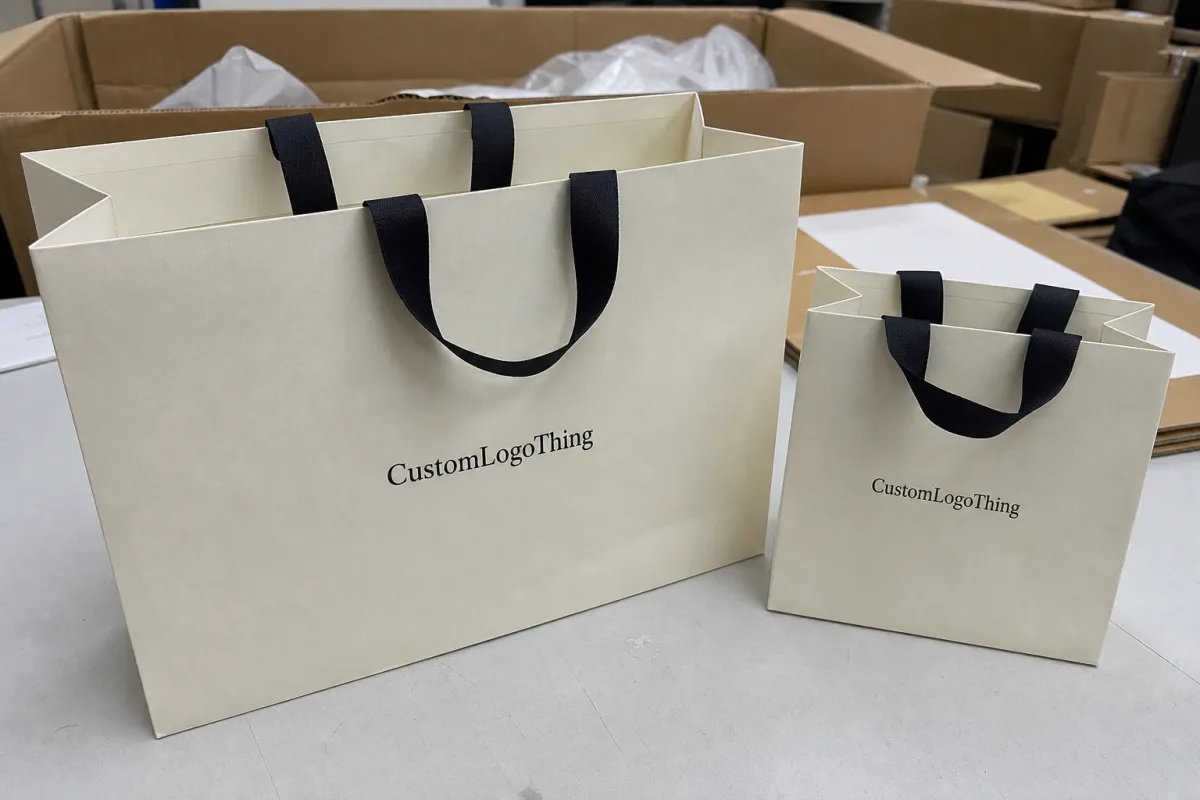
The first job of a ribbon-handle bag is to survive packing, transit, and the grab-and-go moment when a customer lifts it without thinking. Thin paper wrinkles, narrow ribbon digs in, and weak attachment makes the whole package feel cheaper than the print suggests.
For subscription kits, the outer bag is part of the product experience. It should support shelf appeal, carry weight, and repeat handling if the customer keeps it. A bag that photographs well can still fail the practical test if the handle twists or the base sags after one use.
Keep the decision simple: lighter kits can use lighter stock with a clean ribbon finish, while heavier bundles need stronger board, wider ribbon, and better reinforcement at the handle and base. If the bag is likely to be reused, the surface should resist scuffing and crease marks instead of only looking good on launch day.
Useful buyer questions stay practical:
- What is the finished weight of the packed kit?
- Will the bag be used once or several times?
- Does the bag need shelf appeal, carry strength, or both?
- Will it be lifted in-store, shipped to a pickup point, or handed off at home?
Those answers separate a premium carrier from a workhorse bag dressed up with ribbon. One is elegant; the other is built to hold up.
What the ribbon handle bag needs to do for subscription kits
Ribbon style changes both the feel and the load behavior. Satin reads softer and more gift-like. Grosgrain feels firmer and usually holds its shape better. Wider woven ribbon spreads weight more comfortably, while narrow ribbon can look refined in a sample and then disappoint in real use.
The rest of the build matters just as much: handle patches, top folds, gusset depth, and base reinforcement all affect how the bag behaves under load. A coated or well-finished paper surface also helps reduce scuffing during packing and transport. These are not decorative details; they decide whether the bag stands upright, carries cleanly, and survives repeat handling.
Subscription packing adds another constraint: speed. Fulfillment teams need bags that stack flat, open cleanly, and load without extra fiddling. If a worker has to wrestle the handles or fight the gusset every time, labor cost rises quietly and consistently.
There is also a difference between retail display and shipping duty. A bag can look excellent in a photo and still fail under real handling if the handles twist, the bottom panel bows, or the print rubs during transit. That is why buyers should review the bag where it will actually be used: on the packing table, in the hand, and in the carton.
A restrained spec usually performs better than an overworked one. One paper stock, one ribbon color, and one or two finish effects are usually enough. If the order includes other packaging items, keep the sourcing logic aligned so the bag does not become a standalone problem.
Specifications that affect strength, print, and reuse
To get a quote that means something, send the dimensions first: width, gusset, height, handle drop, print area, and packed weight. If the bag must fit a standard insert or a custom product stack, include that too. Otherwise the factory is filling gaps with assumptions, and assumptions usually show up later as extra charges or a sample that solves the wrong problem.
Paper stock should match the payload. For lighter kits, 170 to 210 gsm often works. For heavier subscription bundles, 230 to 250 gsm is a better starting point, especially if the bag will be reused. Surface finish and handle construction still change the outcome, but those ranges are a solid baseline for planning.
Ribbon width is easy to underbuy because the sample can look elegant even when it is underbuilt. For light bags, 10 to 15 mm can be enough. For heavier kits, 15 to 25 mm is usually safer because it spreads load better and feels steadier in the hand. Handle drop matters too: too short and the bag rides awkwardly; too long and it swings around.
Print affects both appearance and risk. Heavy ink coverage needs tighter control. Foil stamping can look strong, but it adds setup and may slow production. Spot UV and other specialty finishes should earn their place. If they do not support the brand story, they mostly raise cost. For a more natural or eco-minded look, kraft or lightly coated stock often makes more sense than a high-gloss build.
Working ranges are useful for early comparison:
| Option | Typical Use | Indicative Cost Impact | Notes |
|---|---|---|---|
| 170-210 gsm stock, 10-15 mm ribbon | Light subscription kits, gift sets | Lowest to low uplift | Best when the bag is carried lightly and reused sparingly |
| 230-250 gsm stock, 15-25 mm ribbon | Heavier bundles, repeat-use bags | Moderate uplift | Better hand feel and better load comfort |
| Foil, spot UV, or special finish | Premium gifting or launch campaigns | Higher setup and unit cost | Use only when the finish supports the presentation goal |
| Reinforced bottom and handle patches | Higher weight or reuse | Moderate uplift | Usually worth it if the bag will be carried more than once |
Before approval, ask for simple performance checks: seam pull testing, drop testing, handle load testing, and a quick reuse check. If a bag collapses after one good-looking photo, it is not premium. It is a prop with a price tag. For transit context, the ISTA guidance on packaging tests and PMMI packaging resources are useful references.
Pricing, MOQ, and unit cost for bulk runs
MOQ is driven by more than volume. Size, print complexity, finish, ribbon type, and whether the bags ship flat-packed or fully assembled all change the minimum. A simple one-color bag with a standard ribbon is a very different order from a foil-stamped run with a custom ribbon color and reinforcement.
Unit cost follows the same logic. Paper weight, ribbon material, print sides, finish, reinforcement, and assembly labor all matter. A lighter bag with minimal print can stay efficient. Add heavier board, custom ribbon, and premium finishing, and the price climbs for predictable manufacturing reasons.
The number that matters most is landed cost. Compare the unit price plus freight, duties, packing, and any assembly charges. A cheap quote can become the most expensive order once freight lands and storage starts, especially when the launch calendar slips and inventory sits before it ships.
Small runs are often expensive because setup, plates, and color matching are spread across fewer units. Replenishment gets easier when the spec stays fixed. Ask for several quantity breakpoints and compare them against your actual forecast rather than the optimistic version where sell-through is instant and storage is free.
Indicative bulk pricing usually works like this: a basic build may land in the low tens of cents per bag at higher quantities, while heavier premium builds with ribbon upgrades, custom print, and reinforcement can move into the low dollars before freight and duties. If a supplier gives only one number without a tier structure, the quote is incomplete.
If the supplier cannot state MOQ, lead time, and the handle attachment method clearly, keep shopping. That is not flexibility. It is uncertainty dressed up as a quote.
Production steps, timeline, and reorder checkpoints
The production path should be easy to follow: brief, dieline, artwork, sample, approval, mass production, quality check, packing, shipment. If that sequence is unclear, you are being asked to trust luck. Luck is a poor procurement system.
Timing depends on the spec, but there is a usable range. Sampling often takes about a week or a little more, depending on artwork and finish. Bulk production usually needs several weeks after proof approval. Special finishes, custom ribbon sourcing, and tight color matching can stretch the timeline, as can late approvals.
Common schedule killers are predictable: foil stamping, custom handle colors, FSC documentation, heavier print coverage, and last-minute art changes after sign-off. If the launch date is fixed, build buffer into both production and freight. If the first run supports a subscription drop, reserve extra bags for replacements, sample packs, and customer service issues.
A reorder checkpoint should exist before the first batch is half gone. Production slots do not appear when stock hits zero, and a supplier with honest lead times protects the launch better than one who promises miracles and sends apologies later.
For recurring orders, lock the spec and write the reorder trigger down. The more often the bag changes, the more each subsequent order costs in time, attention, and money. The hidden cost is operational drag, not just the unit price.
What a reliable bulk-order partner should flag before print approval
A reliable supplier does more than quote. They catch weak art files, vague dimensions, unsupported finishes, and handle choices that look good on a screen but fail once the bag is built. That feedback is not nitpicking; it is what prevents a bad assumption from becoming a full-order mistake.
They should also flag risky color builds and overprinted panels. Heavy ink coverage on the wrong paper can make the bag feel dull, warp the panel, or show stress marks sooner than expected. If the ribbon and paper combination does not hold up during packing and transit, a responsible partner should say so before the run starts.
Handle consistency matters more than polished sales language. If the ribbon attachment is uneven, the bag reads as low grade even when the print is perfect. The same is true of folds and top finishing. Small mechanical errors stand out because customers hold the bag in their hands.
The proofing process should include a spec sheet, a digital proof or preproduction sample, and clear sign-off before mass production. If sustainability claims matter, ask for the paper documentation up front instead of treating the label as decoration. FSC certification is worth verifying through FSC, and any end-of-life claim should be checked against realistic recycling guidance rather than marketing language.
If a supplier cannot explain how the handle is attached, what the likely lead time is, and where the production risk sits, you do not have a partner yet. You have a quote.
Next steps for a fast quote and a clean first shipment
Send the basics first: finished dimensions, quantity tiers, print files, ribbon color, destination, and the weight of the subscription kit or retail bundle. If you already know whether the bags are for pickup, gifting, delivery, or repeat carry, say so clearly. Use case changes the spec, and the spec changes the price.
Then ask for an apples-to-apples quote on the same build: same paper, same ribbon, same print setup, same reinforcement. If you want a sample or proof step before production, ask for that too. It is always cheaper to fix a proof than to explain a mistake in a warehouse full of cartons.
Add a small overage for spoilage, VIP packs, and replacements. Perfect inventory counts belong in spreadsheets that have never had a rush order. Most teams need cushion, especially on the first order when the customer service team is still learning what can go wrong.
Compare vendors by clarity, not just price. Ask whether they can state the MOQ without side-stepping, whether they can show the handle attachment method, and whether they will warn you when a design choice pushes the budget or weakens the bag. That is the kind of help that keeps a launch from turning into a fire drill.
For subscription ribbon handle paper bags Bulk Order Planning, the clean sequence is straightforward: lock the spec, approve the proof, and reserve the production slot before the calendar fills up. That keeps margin intact and gives the bag a real chance to do its job.
What ribbon width works best for subscription ribbon handle paper bags?
Use 10 to 15 mm ribbon for lighter kits or small premium gift bags. Move to 15 to 25 mm when the bag carries heavier inserts or needs a steadier hand feel. Handle drop and attachment style matter too, so width alone does not solve comfort.
What MOQ should I expect for subscription ribbon handle paper bags bulk orders?
MOQ depends on size, print colors, finish, ribbon type, and whether the handle is custom. Small pilot runs usually cost more per unit because setup is spread across fewer bags. Ask for tiered pricing so you can compare launch quantity against the next break.
How long does a bulk subscription bag order usually take?
Sampling often takes about a week or a little more, depending on artwork and finish. Bulk production usually needs several weeks after proof approval. Foil, custom ribbon, or late design changes can extend the schedule quickly.
What artwork files do you need for a quote on ribbon handle paper bags?
Send finished dimensions, print area, and a vector file such as AI or PDF. Include PMS colors, logo placement, and whether the design prints on one side or both. If you already have a dieline, send it. It cuts down on back-and-forth and bad assumptions.
Can subscription ribbon handle paper bags be reused after delivery?
Yes, if the paper stock, reinforcement, and handle attachment are built for repeat use. Heavier kits usually need stronger paper and a better handle spec to survive reuse. If reuse matters, ask for load testing and seam checks before approval.

