Wedding Logo Patch Beanies bulk order planning gets real as soon as guest count, event date, and artwork meet in the same spreadsheet. The patch has to read clearly. The knit has to feel good. The delivery window has to leave room for corrections. This is a production job, not a last-minute favor.
Beanies work for weddings because they are useful, easy to distribute, and more forgiving than sized apparel. A stitched or woven patch adds identity without turning the item into loud merch. That balance matters when the goal is a favor people keep rather than something they set aside.
If the ceremony is outdoors or the forecast is cold, the beanie stops being optional and becomes the item people actually reach for.
From a buyer’s point of view, beanies also remove sizing drama. One unisex fit usually covers a mixed guest list, which makes ordering easier for planners, families, and venue teams. The remaining question is whether the patch style, fabric weight, and schedule fit the event. Once those pieces line up, the order is manageable.
Why Logo Patch Beanies Make Weddings Feel More Intentional
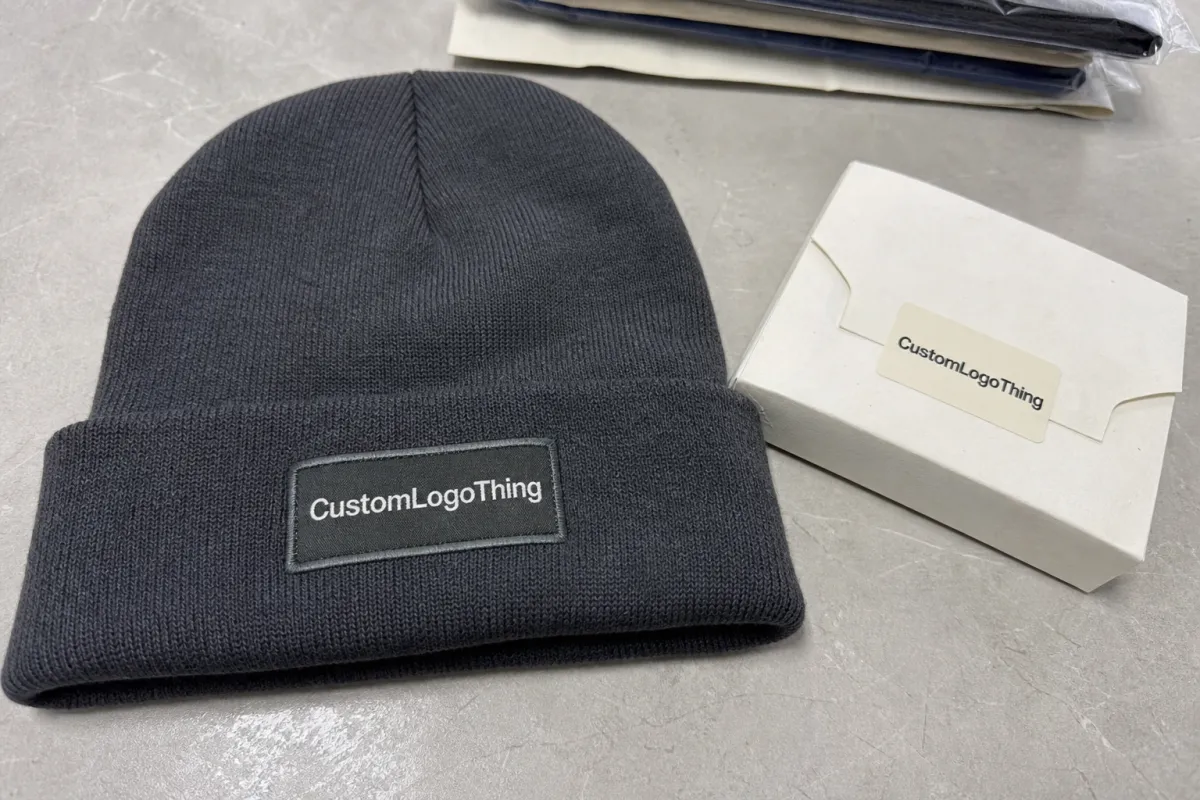
A good wedding favor should be easy to understand and easy to use. A logo patch beanie does both. The item is practical on its own, and the patch gives it a custom finish without covering the whole surface. Front-cuff placement is especially strong because it looks clean in photos and stays visible in use.
Compared with candles, mini boxes, or decorative keepsakes, a beanie is more likely to stay in circulation. It gets worn at the venue, folded into a coat pocket, or handed to someone who needs it. That utility makes the favor feel deliberate instead of decorative.
That same practicality gives buyers more room to keep the design restrained. A 2.5-inch woven patch, a compact embroidered mark, or a simple faux leather badge can carry the logo without making the beanie feel promotional. Most couples want memorable, not branded like staff gear.
Beanies also make planning simpler because a standard cuffed silhouette works across a wide range of heads. If the order includes bridal party, volunteers, photographers, or venue staff, the same shape can often be reused with a different patch or color. That keeps the order consistent without making it boring.
For planners comparing options through Wholesale Programs, the advantage is control. The product is custom enough to feel thoughtful, but not so complex that it becomes fragile. Fewer moving parts usually means fewer schedule problems.
Logo Patch Styles, Fit Options, and Wedding-Ready Finishes
Patch style sets the tone, so it should be chosen before colors are locked. Woven patches usually work best when the logo has small text, thin outlines, or layered details. Embroidered patches add texture and can suit rustic or winter weddings. Faux leather reads more minimal and polished. Printed patches can work for simple artwork or tight timelines, but they are not the best fit for fine detail.
Placement matters just as much as material. Front-cuff placement is the most reliable because it gives the logo a stable, visible area. Center-front placement works when the cuff is deep enough. Side placement is quieter and better if the couple wants the item to feel less branded. The patch should follow the visual plan, not just wherever the art file fits.
Fit changes the impression too. Cuffed beanies are the easiest to work with because they create a flat patch area and hold shape well in packing. Slouch styles feel more relaxed. Fisherman beanies have a shorter, more fashion-forward profile. Standard rib knits are the most familiar and usually the safest choice if the order needs to cover a mixed crowd.
Color should follow the event palette, but it should also hold up in real conditions. Charcoal with a tan patch often photographs better than bright white in winter light. Cream and sand can look refined in daylight, but they show dirt faster outdoors. The best option is the one that still looks good after transport, handling, and a full event day.
Logo complexity is where patch choice really matters. Tiny letters and narrow shapes can disappear if the method is wrong. If the logo includes script or fine lines, ask for a proof at final size on the actual beanie silhouette. A logo floating on a white artboard is not the finished product.
Finish choices buyers usually compare
- Woven patch for sharper small text and cleaner edge detail.
- Embroidered patch for texture and a more tactile, handmade feel.
- Faux leather patch for a minimal finish that still feels premium.
- Printed patch for quicker artwork conversion and simple color layouts.
Specifications That Affect Branding, Comfort, and Durability
The spec sheet tells you more than the mockup. For wedding logo patch beanies Bulk Order Planning, the important details are yarn content, knit gauge, cuff depth, patch size, patch shape, thread colors, and packaging format. Those choices determine whether the beanie holds its shape, whether the patch sits flat, and whether the item feels finished.
Material changes the feel quickly. Acrylic is common because it keeps costs predictable and takes color well. Acrylic-wool blends usually feel softer and warmer, which helps for colder weather. Heavier knits hold structure better and can make the patch look more substantial. Lighter knits feel casual and may fit more comfortably across a wider range of head sizes.
Patch size needs discipline. Too small and the logo loses clarity. Too large and the beanie starts to look like staff merch instead of a wedding favor. Many buyers land in the 2 to 3 inch range for front patches, but the right size depends on logo shape and cuff depth. A wide icon may need more width; a vertical monogram may need more height.
Durability depends on more than yarn strength. Attachment method, stitch density, and backing all matter. Heat-applied patches can work, but poor application can lift after repeated wear or packing. Stitched application is usually safer for orders that need to survive shipping, storage, and repeated handling. Packaging matters too. A crushed patch face can arrive wrinkled or bent if the carton plan is weak.
One useful habit keeps the decision grounded: use the same checklist on every sample. Edge definition. Softness. Color accuracy. Patch adhesion. Cuff stability. If every sample is judged the same way, the order is easier to compare and approve.
For transit and packaging, shipping standards like ISTA are useful because they force buyers to think about abrasion, vibration, and handling even when the product seems simple. For inserts or hang tags with responsible paper claims, FSC is still a useful reference.
Cost, Pricing, and MOQ for Wedding Beanie Orders
Pricing usually comes down to five variables: quantity, patch complexity, beanie style, artwork revisions, and packaging. Quantity matters most because setup and decoration costs spread better across larger runs. Patch detail comes next. A woven patch with fine text is not priced like a simple one-color faux leather badge.
Smaller runs almost always cost more per unit. A custom order in the 100 to 250 piece range often lands higher than a 500-piece run, even if the design is unchanged. That is normal because setup cost is fixed. It is also why the lowest quote is not always the best value. A low price can hide weak patch finish, thin knit, poor packing, or shipping that becomes expensive later.
MOQ needs a direct question. It may apply per design, per color, or per patch type. A supplier can advertise a low minimum and still require separate counts for each colorway. That matters if the bridal party gets one color and the vendor team gets another. Ask early whether mixed assortments count toward the same minimum.
Budget separately for samples, rush fees, and freight. Sample costs are usually minor compared with the full order, but they are worth paying because they remove guesswork. Rush fees usually reflect production resequencing. Shipping is the line item buyers underestimate most often, and it can change landed cost more than expected if the event has a fixed delivery window.
| Order Size | Typical Unit Range | What Usually Changes | Buyer Takeaway |
|---|---|---|---|
| 100-250 units | $7.50-$13.50 | Setup spread is thin; patch detail and packaging matter more | Best for smaller guest lists or premium favors |
| 250-500 units | $5.50-$9.50 | Better cost efficiency; more room for custom patch work | Common sweet spot for wedding and event programs |
| 500+ units | $4.20-$8.00 | Volume helps, but material and decoration still set the floor | Best when the beanie also serves staff, vendors, or multiple uses |
Production Steps and Lead Time for Bulk Wedding Orders
A clean production schedule usually follows the same path: artwork review, patch mockup, sample approval, bulk knitting or sourcing, decoration, quality check, and final packing. Orders get messy when a buyer sends incomplete files or keeps changing color decisions after proof approval. Timing is often determined by how quickly decisions are made, not just by factory capacity.
Artwork is the most common delay point. Vector files are best because they keep lettering and lines sharp at any size. If the logo only exists as a flattened JPG, it has to be rebuilt before proofing can start. PMS references help when the wedding uses a consistent palette across signage, favors, and printed materials.
Standard lead time and rush lead time are not the same. A standard run may allow time for one proof round and a sample review. Rush orders compress approval windows and narrow packaging choices. Not every part of the process can be shortened equally. A detailed patch still takes the time it takes.
Shipping should be treated as part of production, not an afterthought. A wedding order may need to go to a planner, a venue, a hotel block, or directly to the couple. Build in a buffer. If the ceremony is on Saturday, Friday delivery is not a safe plan. The safer plan leaves time to count cartons and replace anything damaged.
Lock artwork first, confirm quantity second, and protect a real buffer before the event. That sequence keeps the order controlled and reduces the chance of a last-minute scramble.
A buyer who approves a proof too quickly usually pays for that speed later, either in revisions, missed detail, or a shipment that lands too close to the event.
What a Reliable Beanie Supplier Should Prove Before You Order
Not every supplier who can quote a beanie should be trusted with a wedding deadline. Wedding orders are tied to a fixed date, so vague answers are a problem right away. A dependable supplier should prove four things early: proof quality, response speed, sample consistency, and transparent pricing.
Proofing should be specific enough that a planner can tell what will happen before production starts. The patch should appear on the actual beanie style, not just on a flat background. Close-up sample photos help too because they show stitch density, edge trimming, and how the patch sits on the knit.
Communication matters just as much. If the event date is fixed, you want a supplier who catches artwork problems early instead of after production begins. Strong partners make it easier to reject a weak proof, which prevents the schedule from getting pinned to a late correction.
Packaging support is another sign of whether the supplier understands wedding orders. If the beanies need to be sorted by table, role, or guest group, the packing plan should be clear before production starts. A wedding order often needs labeled bags, bundle counts, or a packing list that helps the planner distribute units quickly at the venue.
Consistency is the last check. One sample is not proof that the whole run will look the same. Ask how the same patch behaves on a different knit weight or beanie silhouette. If the answer is vague, the production controls are probably vague too.
Next Steps to Lock in Artwork, Quantities, and Delivery
At this point, the order should move from idea to checklist. Confirm the event date. Choose the beanie silhouette. Decide on patch style. Gather the logo file in vector format before asking for a quote. A quote based on incomplete art is usually only a placeholder.
Quantity should be based on guest count plus overage. Add a buffer for replacements, late additions, and any beanies the planner wants for the photographer, venue team, or couple. Ordering exactly to headcount is the most common mistake, and it leaves no room for surprises.
Ask for color standards, delivery addresses, and packaging instructions in writing. If the beanies need to be split across multiple drop points, say so early. If the patch size needs to be checked against the cuff height, say that too. Specificity is not fussiness here. It is risk control.
When comparing options, do not stop at “Does it look good?” Ask whether it will still look good after packing, shipping, unboxing, and six hours outdoors. That is the real test. It is also the point where the order stops being a design task and becomes a logistics task.
Keep the sequence simple: artwork first, quantity second, delivery buffer third. That keeps the purchase grounded and avoids the kind of rushed approval that turns a thoughtful favor into avoidable stress.
What patch style is best for wedding logo patch beanies in bulk?
Woven patches are usually the strongest choice when the logo has small text or thin lines. Faux leather works well for simpler artwork and a cleaner finish. Embroidery adds texture, but it can soften tiny details, so it is better when the logo is bold instead of delicate.
How many beanies should I order for a wedding bulk run?
Start with the guest count, then add overage for replacements and last-minute additions. Add more if the beanies will also be used by staff, planners, or photographers. Before finalizing, ask whether the MOQ applies per design or per colorway.
How long does a wedding logo patch beanie order usually take?
Plan for proofing, sample approval, production, and shipping as separate steps. Artwork delays are the most common reason schedules slip. Rush options may exist, but they depend on stock, patch complexity, and how far the shipment has to travel.
Can I mix colors or sizes in one bulk wedding beanie order?
Many orders can mix colors, but each colorway may affect MOQ and timing. Unisex sizing usually reduces complexity and avoids separate size runs. Ask how mixed assortments will be packed before production starts so distribution is easier later.
What files do you need for a quote on logo patch beanies?
A vector logo file is the safest starting point for accurate proofing. Include target quantity, preferred beanie style, patch size, and event deadline. Color references and packaging notes help keep the quote realistic and reduce revision rounds.
Done well, wedding logo patch beanies Bulk Order Planning is about choosing a favor people will use, approving specs that keep production predictable, and giving the supplier enough detail to hit a fixed date without improvising.