Supplement trucker Caps Digital Proof Checklist sounds technical, but the job is simple: make sure the cap you approve is the cap that gets made. A logo can look clean on a screen and still land poorly on a trucker cap with a structured front, mesh back, crown seams, and a curved bill. That matters for supplement brands because the hat usually carries a compact identity system — wordmark, icon, or short line — that has to read fast and stay consistent across packaging, apparel, and events.
The proof is where placement, size, color, and decoration method become real production decisions instead of guesses. A line that looks sharp in a mockup may need to be simplified for embroidery. A patch border may need more room than expected. A front panel might be too tall or too narrow for the logo at the scale shown. Catching those issues at proof stage is the cheapest place to fix them.
A good checklist is less about paperwork and more about avoiding rework. It helps a buyer verify the parts that affect price, MOQ, lead time, and inspection: cap style, closure, decoration method, artwork quality, and final placement. That is usually enough to separate a clean order from a costly correction.
Why a Digital Proof Matters on Trucker Caps
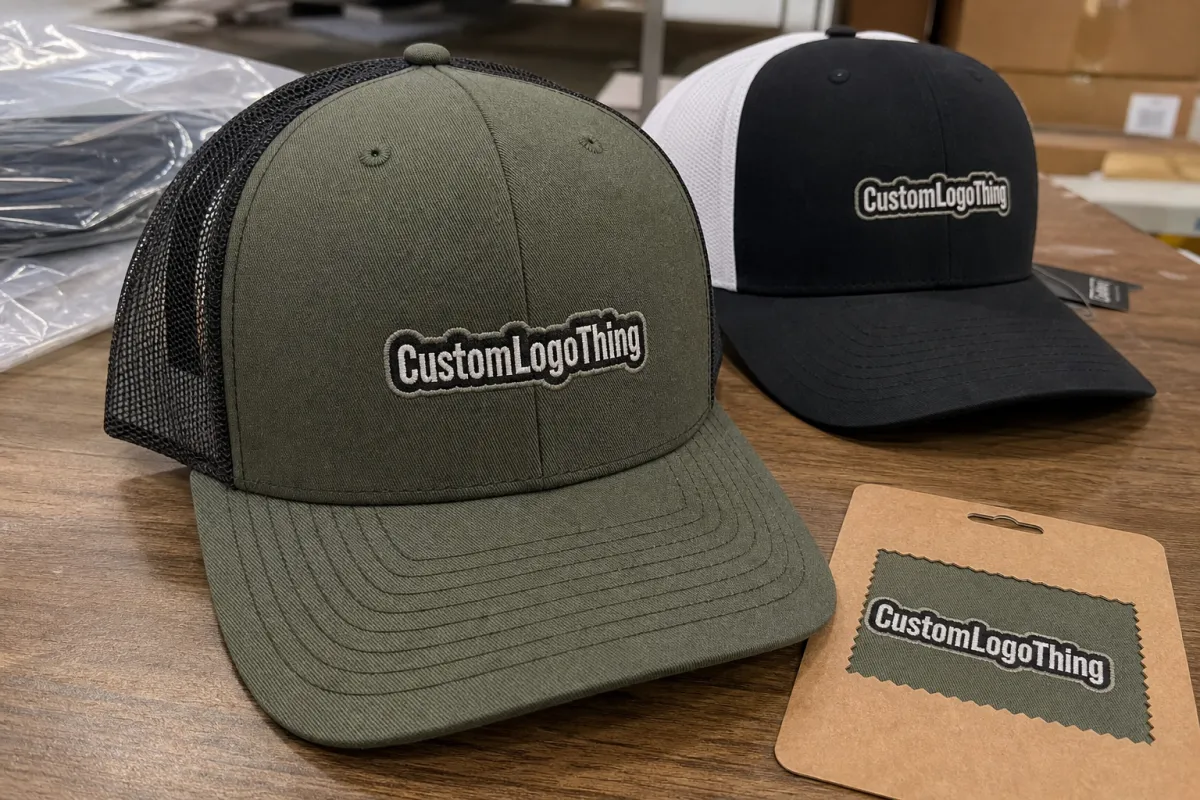
Trucker caps are harder to judge than flat artwork suggests. The front panel may be structured or foam-backed, the crown may be tall, and the mesh and seams interrupt the artwork area. A logo centered on a proof can still look off once the hat is worn because the cap is not a flat surface.
For supplement brands, the problem is usually readability. Thin strokes, small taglines, and low-contrast colors can disappear on mesh-heavy headwear. If the proof does not expose those issues, the finished cap may look acceptable from far away but weak up close.
A proof is not a concept mockup. It is the production map.
That is why the proof has to answer practical questions: does the art fit the front panel, does it avoid a seam, and does the chosen decoration method support the detail level? If the answer is unclear, the buyer should treat the proof as unfinished.
It also gives the buyer an early pricing check. Small changes made before digitizing or patch setup are usually easy to absorb. The same change after production starts can affect cost and timeline. Reviewing the proof carefully keeps the order aligned before the factory schedule does.
How the Proofing Workflow Works from Art File to Approval
The cleanest proof process starts with clean inputs. The buyer sends the logo file, cap style, quantity, decoration method, and any brand color references. Vector art is best because it lets the supplier size details accurately. Screenshots and compressed JPGs can work for a mockup, but they make it harder to spot production problems.
A useful digital proof should show the actual cap model or a close match, not a generic hat. It should identify front panel color, mesh color, closure style, and decoration placement. If the logo is moved slightly to avoid a seam or the patch needs a specific border width, that should be visible or called out in notes.
The workflow is usually straightforward:
- Send artwork, cap style, quantity, and decoration notes.
- The supplier builds a proof against the blank and chosen method.
- The buyer checks spelling, placement, contrast, and proportions.
- The supplier revises the proof if needed.
- The approved proof becomes the production reference.
That final step matters because approval turns the proof into the instruction sheet. If a detail is wrong there, it usually gets repeated across the order. Buyers should read the proof like a manufacturing document, not like an ad layout.
Design, Material, and Decoration Factors That Change the Proof
Trucker caps use mixed materials, and mixed materials do not decorate the same way. A structured front gives more stability than an unstructured cap, but profile still changes the result. A low-profile cap can make a logo feel wider and more modern. A taller crown can make the same logo feel smaller unless the placement is adjusted.
Decoration method changes the proof as much as the blank cap does. Embroidery is durable and familiar, but fine lines and tiny type can fill in. Woven patches hold detail better. PVC patches create a raised look with a modern edge, but they work best with simplified shapes. Leather patches feel premium, though very small detail can disappear into the grain. Heat-applied decoration can reproduce more detail, but the texture may differ from a traditional trucker cap finish.
| Decoration option | Typical strengths | Watch-outs on the proof | Common add-on cost per cap |
|---|---|---|---|
| Embroidery | Durable, familiar, works well on bold logos | Small text can fill in; dense stitch areas may pucker | $0.85-$2.25 |
| Woven patch | Strong for detail and sharp edges | Border width and patch shape can crowd the artwork | $1.10-$2.75 |
| PVC patch | Raised texture, clean modern look | Gradients and fine type usually need simplification | $1.40-$3.25 |
| Leather patch | Premium appearance, strong contrast on many cap colors | Very small detail can disappear into the grain | $1.25-$3.00 |
Color is another common surprise. A warm beige logo may look refined on a monitor and flat on stone fabric. Bright white can pop against black mesh but feel harsh on charcoal. Thread, patch stock, front panel fabric, and mesh all affect the result, so the proof has to be read as a material combination rather than a detached graphic.
Use case matters too. Retail caps usually need tighter execution because shoppers inspect them closely. Promo giveaways can tolerate more simplification if the brand still reads fast. Staff wear sits in the middle, where durability and repeatability matter more than a luxury finish.
Before approval, check the practical details every time: front-panel width, crown height, decoration location in inches, closure type, and whether the cap is structured or foam-front. If those specs are not stated clearly, the finished cap can drift from the intended order even when the mockup looks fine.
Cost, Pricing, and Quote Inputs for Cap Orders
Cap pricing comes from a few main variables. The blank cap is one. A basic foam-front trucker cap will not price the same as a heavier structured cap with a better sweatband and closure. Decoration method is another. Embroidery, woven patch, PVC patch, leather patch, and heat transfer each carry different setup paths and labor requirements.
Order size changes the math as well. A run of 300 units spreads setup costs very differently than a run of 2,000. For simple embroidery, buyers often see lower unit pricing than for custom patch work, but that depends on stitch count and complexity. A small logo with limited coverage may stay in a lower add-on range, while dense artwork or a custom patch can move the price up quickly.
Ask for an itemized quote. A useful one should separate blank cap price, decoration cost, digitizing or setup fee, proof revisions, and freight. Some suppliers include proofing in setup; others treat extra revisions separately if the buyer keeps changing direction after the first mockup.
The quote should match the production method shown in the proof. If the proof shows a two-color woven patch but the quote assumes single-color embroidery, the order needs correction before approval. Mismatches like that create budget friction and usually slow production.
It also helps to look at landed cost instead of unit price alone. The cap, decoration, packing, and shipping all matter. In many orders, freight can erase the advantage of a lower per-cap number. A quote that explains the full path is more reliable than one that only advertises an attractive rate.
Proof Turnaround, Lead Time, and Revision Steps
Proof turnaround is usually faster than production, but only if the input is usable. Clean vector art, exact placement notes, and one clear cap choice can often produce a first proof in 1 to 3 business days. If the source file is messy or the decoration method is undecided, the proof stage slows down while the brief gets clarified.
Revision cycles are where schedules stretch. A small logo shift is easy. A switch from embroidery to patch work can trigger a different production path. A new front-panel color can change contrast enough to require another mockup. If several stakeholders are reviewing the proof, the timeline can expand even when nobody objects to the design itself.
Once the proof is approved, the production clock starts. A standard embroidered cap already in stock often moves faster than a custom patch build that requires sourcing and added inspection. Straightforward orders may fit into a 10 to 15 business day production window after approval, while more complex projects can take longer depending on quantity and material availability.
Packaging can matter too. If the order is going to retail shelves, trade-show kits, or direct fulfillment, the packing method affects how caps arrive. Flat-packed cartons, polybags, and insert cards can change shipping efficiency and damage risk. Transport testing standards such as ISTA are worth checking if the shipment is likely to be stacked, dropped, or handled repeatedly.
The best schedule habit is to approve only when the proof, quantity, quote, and delivery date all line up. Many delays come from approving art before the order details are stable, then changing quantity, closure style, or artwork one more time after the fact.
Common Proof Mistakes That Delay Supplement Cap Orders
Low-resolution artwork is the first common problem. A logo can look crisp on a screen and still be unsuitable for production if the outlines are soft or the file has been resized too many times. Embroidery digitizing needs clean vector edges, and patch work benefits from controlled line weight too.
The second mistake is approving by color alone. Monitor color is not fabric color. Navy, black, charcoal, stone, and olive behave differently under daylight and indoor lighting. A mark that looks balanced on a white screen can feel too flat on a dark front panel or too harsh on a light one.
Another miss is ignoring small details because they seem minor. Back closures, side placements, punctuation, trademark symbols, and taglines all need review. A missing line of copy can matter if the cap is tied to a regulated supplement line or a brand that uses the same identity across packaging and apparel.
If the proof does not show it, do not assume the finished cap will get it right.
Approval timing is another pressure point. Rushed buyers often send corrections one at a time, which turns one review into several rounds of back-and-forth. Consolidating feedback is one of the easiest ways to keep an order on schedule.
Mockups can also hide scale problems. A logo that feels balanced in isolation may look too small once the cap is worn, or too large once the crown curves forward. The checklist should answer one simple question: does the design still read like the brand after it leaves the screen?
Final Approval Steps for the Supplement Trucker Caps Digital Proof Checklist
Before final signoff, run the proof against a short internal checklist. Start with the artwork file. Is it vector, are the brand colors identified, and is the spelling correct? Then move to the cap spec. Does the proof show the right front panel, mesh color, crown profile, and closure type? If the proof and the spec sheet do not match, stop there.
Next, confirm the decoration method. Embroidery, patch, PVC, leather, and print each change the final look and final cost. If the design has delicate elements, ask for an annotated proof with notes or arrows. Those callouts save time when purchasing, marketing, and leadership all need to review the same file.
It also helps to compare the proof against the written spec. The spec should answer the practical questions: structured or unstructured, low profile or high profile, polyester mesh or cotton blend, snapback or hook-and-loop closure, and what the decoration width is in inches. That level of detail is what keeps a production run clean.
For brands running a wider apparel program, the cap proof should follow the same quality-control logic used for packaging. The logo should not change size without a reason. The color should not drift without a note. The decoration method should not be implied. That discipline protects the look of the product line and reduces corrections after approval.
That is the point of the supplement trucker caps Digital Proof Checklist: it forces the buyer to slow down long enough to catch issues that would otherwise become expensive later. Done properly, it verifies the cap that will actually be made.
What should I check on a supplement trucker caps digital proof?
Check spelling, logo size, placement, cap color, mesh color, closure style, and the decoration method shown in the mockup. Confirm whether the artwork is centered or intentionally shifted and whether the final cap profile matches the intended use.
How many revisions are normal before approving a trucker cap proof?
One to two revision rounds are common when the artwork is clear and the buyer has specific notes. More than that usually means the cap style, decoration method, or color direction still needs alignment. Consolidated feedback keeps the schedule tighter.
What file format is best for a supplement cap proof?
Vector files such as AI, EPS, or PDF are usually best because they keep edges clean at any size. High-resolution PNG or SVG can work for mockups, but editable vector art gives the supplier more control when placement or scale needs to change.
Does embroidery cost more than a patch on trucker caps?
It depends on stitch count, logo complexity, patch shape, and material choice. Simple embroidery can be more economical for small logos, while custom patch work may cost more because of tooling, material, and finishing. An itemized quote is the easiest way to compare the true unit cost.
How fast can a proof turn into production for custom caps?
Fast approvals happen when the artwork is clean, the cap style is in stock, and no revision is needed. Production usually slows when the proof requires color matching, layout changes, or approval from several departments. The quickest path is to approve only after the proof, quote, quantity, and delivery date all match.


