Buyer Fit Snapshot
| Best fit | Sustainable Gift Cartons with Logo projects where brand print, material claims, artwork control, MOQ, and repeat-order consistency need to be specified before quoting. |
|---|---|
| Quote inputs | Share finished size, material target, print colors, finish, packing count, annual reorder estimate, ship-to region, and any compliance wording. |
| Proofing check | Approve dieline scale, logo placement, barcode or warning zones, color tolerance, closure strength, and carton packing before bulk production. |
| Main risk | Vague material claims, crowded artwork, missing packing details, or unclear freight terms can make a low unit price expensive after revisions. |
Fast answer: Sustainable Gift Cartons with Logo: Board, Finish, Dieline, and Unit Cost should be specified like a repeatable production item. The safest quote records material, print method, finish, artwork proof, packing count, and reorder notes in one written spec.
Production checks before approval
Compare the actual filled-product size with the drawing, then confirm tolerance on folds, seals, hang holes, label areas, and retail display edges. Reserve space for logos, QR codes, warning copy, and material claims before decorative graphics fill the panel.
Quote comparison points
Review material grade, print process, finish, sampling route, tooling charges, carton quantity, and freight assumptions side by side. A quote is only useful when the supplier can repeat the same color, closure quality, and packing count on the next order.
Sustainable Gift Cartons with Logo: A Smart Buyer’s Guide
A carton can land on a desk looking crisp, premium, and expensive, while the simplest version is often the one with the lightest footprint. That tension is exactly why sustainable gift cartons with logo deserve more than a quick yes or no. A good carton balances structure, board, print, and finish so the package does its job without drifting into packaging theater. Done well, it feels considered. Done badly, it just feels like decoration.
From a packaging buyer’s point of view, sustainable gift cartons with logo are not about slapping a green label onto a nice-looking box. They are about choosing paper-based materials that hold up in real production, giving the logo enough presence to support the brand, and making sure the carton still ships cleanly, stacks neatly, and opens with care. Simple on paper. Less simple once deadlines, freight, and budget start pulling in different directions, which they always do.
Sustainability works as a system, not as one badge on a spec sheet. Board choice matters. Ink choice matters. Adhesives matter. Coatings matter. Packing method matters too, because a carton that arrives crushed has already failed the basic test. In the sampling rounds I’ve reviewed over the years, the projects that held together usually had one thing in common: the buyer asked enough practical questions early and didn’t get dazzled by the mockup. That kind of discipline saves money later.
Restraint often beats decoration in this category. A clean logo, disciplined typography, and a carton shape that suits the product can feel more premium than a stack of effects layered on top of one another. That is the part people tend to miss. Sustainable gift cartons with logo can look expensive without acting wasteful, but the choices need to be deliberate. If the carton needs three specialty finishes to feel special, the structure is probably carrying too little of the work.
What Are Sustainable Gift Cartons with Logo?
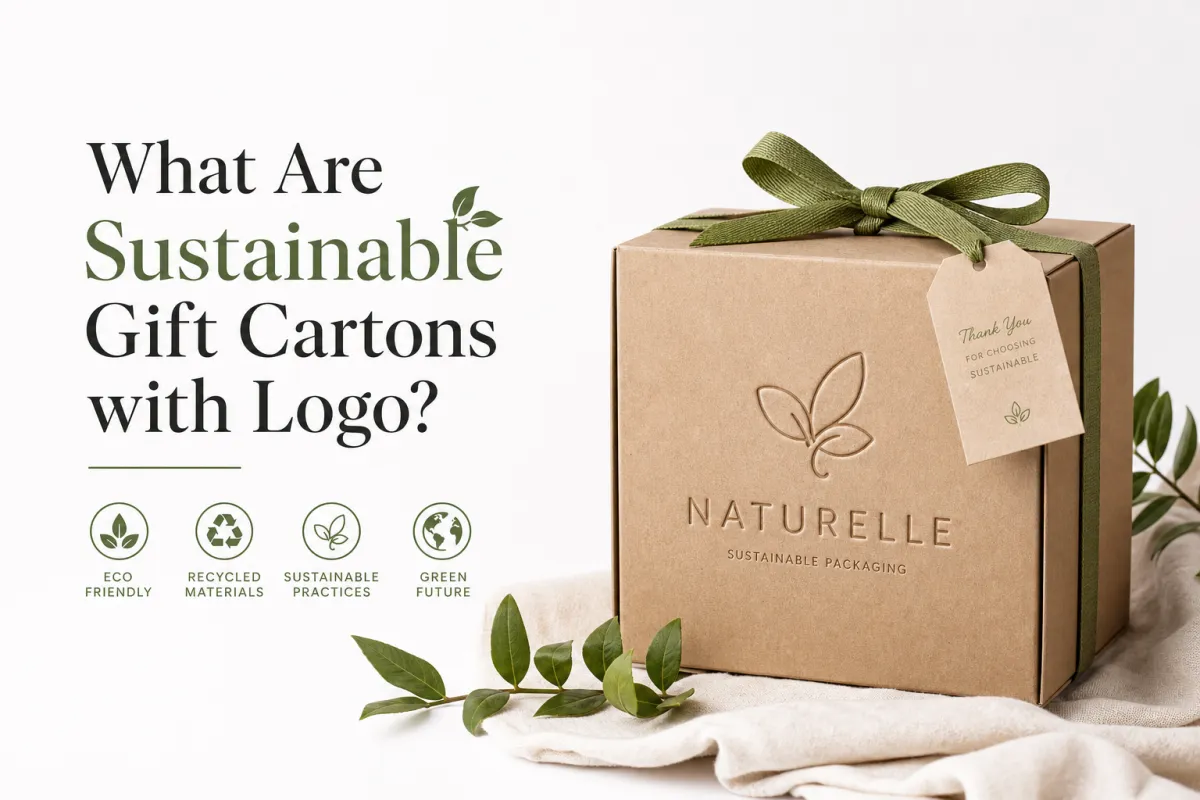
Sustainable gift cartons with logo are paper-based cartons designed to protect, present, and brand a gift item while avoiding unnecessary material waste. In practice, that usually means recycled or responsibly sourced paperboard, efficient print coverage, and a structure that skips mixed-material clutter unless there is a clear functional reason for it. A carton with a plastic window, thick laminated wrap, metallic foil, foam insert, and glossy coating all at once starts to lose the point of the word “sustainable.” Buyers should keep a sharp eye on that kind of spec drift, because it creeps in fast.
The logo matters because it gives the carton a clear identity. A logo on a carton does not make it less sustainable; in many cases, a single logo printed cleanly in one or two colors is a better choice than a dense, fully covered design. The carton feels intentional rather than busy. Good branding on sustainable gift cartons with logo usually stays quiet and confident. The mark should support the product experience, not shout over it like a billboard folded into a box.
Another mistake buyers make is treating recycled content as the whole story. A carton can use recycled board and still perform badly if the dimensions are off, the score lines are weak, or the finish interferes with later recycling. A carton made from responsibly sourced virgin board can also be a sensible choice if it protects the product better, reduces spoilage, and handles end-of-life more cleanly. Sustainable gift cartons with logo need to be judged as a full system: board, ink, adhesive, coating, structure, and disposal path.
Common paperboard options include SBS, C1S, kraft board, and recycled gray-back or white-back board. Each one behaves differently in print, folding, and handling. A 350gsm folding carton may suit a small gift item, while a rigid carton built around 1.5mm to 2mm greyboard gives a higher-end unboxing feel. The carton does not need to be complicated. It needs to be appropriate. That usually solves most of the problem with sustainable gift cartons with logo.
A useful rule is simple: use the least complex structure that still protects the product, then build the branding around shape and typography. More layers do not automatically mean more value. More discipline usually does. That applies to sustainable gift cartons with logo used on shelves, in mailers, and inside retail gift sets. The best version is often the one that feels almost obvious once you hold it, because nothing extra is fighting for attention.
How Sustainable Gift Cartons with Logo Are Made
The production path for sustainable gift cartons with logo starts long before printing. The first decision is the carton style. A folding carton suits lighter items and retail presentation. A rigid carton adds structure and a more premium hand feel. A mailer-style box works better for direct-to-consumer shipping, where the outer shell needs to take more abuse. Each job has its own shape, and the wrong structure is usually where a packaging budget starts leaking.
After the structure is chosen, the supplier confirms dimensions, board thickness, and load requirements. A light cosmetic item may work well in 300gsm to 400gsm paperboard. A heavier gift set may need thicker board, reinforced corners, or inserts that keep the product from moving in transit. The smartest structural choice for sustainable gift cartons with logo is usually the one that removes excess material without making the carton fragile. You’re not trying to prove toughness with overbuilt packaging; you’re trying to get the product there in one piece.
Board, print, and finishing stack
The next step is the production stack. That means board selection, printing method, die cutting, folding, gluing, finishing, and packing. Short runs often fit digital printing because setup waste stays lower and the MOQ can stay manageable. Larger runs tend to favor offset printing because consistency improves and unit cost usually drops. Water-based inks or soy-based inks are common choices for sustainable gift cartons with logo, especially when the project needs a clear material story.
Finishing should act like a tool, not a trophy. A matte aqueous coat can protect the print and keep the carton from scuffing. Embossing can add tactile value if it is used with restraint. Soft-touch lamination feels nice in hand, but it can complicate recyclability if that matters to the program. The strongest sustainable gift cartons with logo usually do not rely on a long list of decorative tricks. They use one or two details well and stop there. That’s usually enough to make the carton feel polished without getting fussy.
Why the same-looking box can behave differently
Two cartons can look nearly identical on screen and behave very differently in production. One may crush in transit. Another may hold a rigid insert without trouble. One may fold smoothly on the line. Another may split at the score because the board is too stiff for the construction. Sample review matters for exactly that reason. The hand feel of sustainable gift cartons with logo often gives away whether the spec is right or off by a small but important margin.
End-of-life matters too. A carton built with fewer mixed materials is easier for most users to recycle or dispose of responsibly. Reputable references from the Forest Stewardship Council and testing guidance from the International Safe Transit Association can help anchor the conversation in actual packaging practice. Those references do not solve every packaging decision, but they keep the discussion grounded. They also give buyers a cleaner way to explain why one spec is better than another.
Put simply, sustainable gift cartons with logo are made by balancing structure, print, finish, and handling so the carton looks right and behaves right. If one of those pieces is wrong, the entire carton feels off. Usually within the first few seconds of holding it. That first-hand test matters a lot more than a render does.
Key Factors That Affect Quality, Branding, and Shelf Appeal
Board thickness is often the first quality signal people notice, even if they cannot name it. A carton that feels too light usually reads as cheap. A carton that feels too heavy for the product can read as wasteful. For sustainable gift cartons with logo, the sweet spot is usually a board grade that gives enough stiffness for clean edges and stable stacking without overbuilding the pack. As a general guide, 250gsm to 400gsm works for many folding cartons, while rigid formats often use chipboard in the 1.5mm to 2mm range.
Crush resistance matters more than style points. A handsome carton that collapses in transit is not premium. It is a complaint waiting to happen. Buyers shipping through parcel networks should think about drop risk, corner compression, and product weight inside the carton. That is where transit testing earns its place. ISTA-style tests and basic fit checks can show whether sustainable gift cartons with logo will survive real handling, not just a perfect mockup photo. I’ve seen otherwise strong projects stumble because the box looked good on the table but gave up the minute it met the conveyor. Not glamorous, but very real.
Finish choices affect both branding and sustainability. Matte aqueous coating gives a clean, modern look and a bit of surface protection without the heavier plastic feel of some laminates. Embossing adds tactile interest and can lift a logo without adding more ink coverage. Spot effects can work, but they should earn their place. If the goal is to keep sustainable gift cartons with logo simple and recyclable, every extra layer needs a practical reason.
Logo placement sounds minor until the carton is in hand. A centered mark with generous negative space often feels more confident than a crowd of graphics fighting for attention. Tight typography, controlled margins, and a restrained palette can make sustainable gift cartons with logo look far more expensive than the print budget suggests. That is not magic. It is editing, and the good news is that editing is cheaper than adding more ink, more finish, or more drama.
Print coverage is another cost and sustainability variable. Heavy flood coats use more ink and can change the look of the board. More colors mean more plates or more digital passes, which usually raises cost. If your brand can live with one or two colors, use that to your advantage. Some of the strongest sustainable gift cartons with logo are nearly plain at first glance, then feel sharp and complete once the eye settles on the paper, type, and brand mark.
“A sustainable carton should look considered, not crowded. If the design needs three extra finishes to feel premium, the structure is probably doing too little.”
Material proof points help buyers explain the decision internally. Ask for recycled content claims, FSC chain-of-custody documentation where applicable, and clear notes on coatings or adhesives. If a supplier cannot explain what the carton is made from, how it prints, and what happens after use, that is a problem. Sustainable gift cartons with logo should be easy to justify to finance, marketing, and operations without a translation layer. That clarity is part of the trust equation, and it matters when multiple teams sign off.
Shelf appeal is not just about looking good in a photo. It is about holding shape, surviving handling, and still looking like the brand cared. That is the real test for sustainable gift cartons with logo. If the carton can do that with less material and a cleaner build, it has done its job properly.
Production Steps, Process, and Timeline
The cleanest way to manage sustainable gift cartons with logo is to treat the project like a controlled sequence, not a creative fire drill. Start with the product brief. Confirm dimensions, weight, storage conditions, and shipping route. If the carton has to travel through parcel carriers, the spec should reflect that. If it sits on retail shelves, the structure should support display and repeated handling. If it is part of a gift set, the inside fit matters as much as the outside print.
Next comes the supplier brief. A strong brief includes carton style, target board grade, logo files, print colors, finish preferences, quantity, and timing. Then the supplier creates or confirms the dieline. That step deserves more attention than it often gets, because a bad dieline wastes everything that follows. For sustainable gift cartons with logo, a precise dieline saves material, reduces rework, and keeps the box from turning into a frustrating assembly puzzle. It also keeps the assembly line from turning into a headache later on.
Typical workflow and timing
The usual sequence is straightforward: brief the supplier, confirm size and load, request a dieline, review artwork, approve proof, and move into production. For a simple folded carton, dieline and artwork revisions may take a few days if everyone responds quickly. Sampling often takes about a week, sometimes longer if the carton has a custom insert or special finish. Full production commonly lands in the 2 to 4 week range after final approval, though rigid cartons, complex inserts, or overseas freight can stretch the schedule. Sustainable gift cartons with logo are not slow by nature. They get delayed when decisions bounce around.
Sample production is worth the time. A physical sample catches weak scores, color shifts, awkward opening force, and poor fit. On a screen, everything can look acceptable. In hand, a carton can feel too loose, too stiff, or simply odd. More than one buyer has saved a production run by catching a problem at the sample stage rather than after 5,000 units were already committed. That is the practical value of testing sustainable gift cartons with logo early. A decent sample can save a bad quarter, which sounds dramatic until you’ve had to replace a full run.
Special finishes and extra parts add time. Foil, complex embossing, magnetic closures, custom inserts, and unusual die cuts all slow down production. That does not make them bad choices. It means they should earn their place. If the launch date is fixed, build buffer time into the schedule and protect it. There is no prize for making the packaging schedule heroic. There is only the shipment window, and it does not care about optimism.
Small changes midstream cause large delays. A color tweak after proof approval can force another sample. A size change can trigger a new dieline. A different insert material can change fit and assembly. Sustainable gift cartons with logo benefit from disciplined approval gates. The fewer surprises left for production, the better the result. That is especially true when multiple departments are reviewing the same spec and each one has a slightly different idea of what “finished” means.
The blunt advice is simple: freeze the structure first, then polish the artwork. It is much easier to adjust logo treatment later than to rebuild a carton spec after the launch date is already close. Sustainable gift cartons with logo reward planning and punish improvisation. If the box size, board, and closure are right, the branding work becomes a lot easier.
Cost, Pricing, and MOQ: What Changes the Quote
Pricing for sustainable gift cartons with logo depends on more variables than most buyers expect, but the main drivers are easy to name: board grade, recycled content, print method, coating, inserts, complexity, and setup. If any of those change, the quote changes too. That is normal. What is not normal is a vague quote with no spec detail. If the numbers are fuzzy, the comparison is useless. You end up comparing guesswork, and guesswork is where budgets go missing.
MOQ means minimum order quantity, and it matters because setup costs are spread across the run. Lower quantity usually means higher unit cost. A digital short run can start in the low hundreds for some carton styles, while offset-Printed Folding Cartons often need larger volumes to become competitive. Rigid cartons, since they involve more manual work and more parts, often carry higher minimums. For sustainable gift cartons with logo, the MOQ decision is a tradeoff between flexibility and unit price. There is no free version of either.
To make that tradeoff easier to read, compare total landed cost instead of just unit price. Include tooling, freight, packing, assembly, and any special handling. A low quote that leaves out freight or inserts is not cheap. It is incomplete. Buyers of sustainable gift cartons with logo get burned when they compare numbers that do not describe the same carton. That mismatch is common, and it is avoidable if the spec is written clearly from the start.
| Carton Type | Typical MOQ | Common Unit Price Range | Best For | Main Tradeoff |
|---|---|---|---|---|
| Folding carton | 500-5,000 units | $0.18-$0.32 each | Light gift items, retail shelves, fast-turn programs | Lower structure than rigid formats |
| Mailer-style box | 300-3,000 units | $0.40-$0.75 each | E-commerce gifts, ship-ready packs, subscription kits | More board usage than a simple folding carton |
| Rigid carton | 1,000-3,000 units | $0.85-$1.60 each | Premium gifting, luxury sets, higher perceived value | Higher labor and more setup cost |
Those ranges assume a fairly standard spec, such as one- or two-color print, moderate coverage, and a sensible finish. Heavy ink coverage, soft-touch lamination, foil, embossing, windows, or custom inserts will push the price upward. If your sustainable gift cartons with logo need retail presentation and transit strength, expect to pay for both. That is how packaging works. The carton is not just a container; it is a performance object with a bill attached.
The simplest way to ask for an apples-to-apples quote is this:
- State the exact carton dimensions and product weight.
- Specify board grade, recycled content, and finish.
- Confirm print method, number of colors, and logo coverage.
- List whether inserts, windows, or special closures are included.
- Ask for unit cost, tooling, freight, and packing separately.
If a quote looks too cheap, something is usually missing. Often it is the part that matters most: finish, board strength, freight, or actual assembly. Sustainable gift cartons with logo should be priced against the full job, not a fantasy version of it. Buyers who ask the right questions usually pay less overall because they avoid rework, damage, and second orders. A cleaner quote is not only easier to approve, it is easier to trust.
Common Mistakes Buyers Make With Sustainable Gift Cartons with Logo
The most common mistake is assuming every carton with an eco-friendly label is actually recyclable. That is not how it works. If the carton has plastic windows, heavy lamination, foil-heavy decoration, or mixed-material add-ons that cannot be separated, recyclability changes fast. Sustainable gift cartons with logo need a real material review, not a label that sounds nice in a sales deck.
Another mistake is choosing the thinnest board available just to save money. That usually backfires. Weak board can dent in transit, collapse at corners, or make the carton feel disappointing in hand. The unit price looks better for a short moment. Then damage, complaints, and replacement orders show up. For sustainable gift cartons with logo, saving a penny on board can cost much more later.
Overdesign comes in a close second. Too many colors, too many effects, too many decorative layers, and too much visual noise all raise cost and reduce clarity. A carton should support the brand, not audition for a holiday parade. If the logo is strong, let it breathe. If the typography is good, let it do its job. Well-edited sustainable gift cartons with logo often feel more premium because they are less desperate to prove themselves.
Skipping fit testing is another classic error. A carton can look perfect in a PDF and still fail once the product is inserted. Maybe the lid is too tight. Maybe the insert shifts. Maybe the opening sequence is awkward. Maybe the closure weakens after repeated handling. These problems stay invisible until they become customer complaints. Fit testing saves embarrassment and protects the sustainability claim because a carton that has to be remade is the opposite of efficient.
Finally, buyers sometimes trust vague wording without asking for documentation. “Eco-friendly,” “green,” and “sustainable” do not mean much unless the supplier explains the board source, coating, adhesives, and end-of-life behavior. Ask for facts. Ask for spec sheets. Ask for a sample. Sustainable gift cartons with logo should be easy to verify, not a guessing game wrapped in friendly language. If the answer stays fuzzy, treat that as a real signal, not just a communication hiccup.
One practical rule helps here: if the supplier cannot explain why a material choice was made, assume it was made for convenience or margin, not for performance. That is not cynicism. It is packaging math. And in this category, packaging math usually wins.
Expert Tips and Next Steps
Start with the product, the shipping route, and the retail moment you want to create. Do not start with artwork. Structure comes first. A carton that protects a delicate candle is not the same as one that holds a skincare set or a subscription gift. Once the structure is right, sustainable gift cartons with logo become much easier to design and price because the rest of the spec has a stable base.
Order samples before you commit. Two or three material samples are usually enough to compare stiffness, finish, and color in hand. If possible, request at least one printed proof. Screen color is not the same as ink on board, and anyone who has spent time in packaging knows that gap can be frustrating. For sustainable gift cartons with logo, the tactile sample is often the one that settles the decision. It gives the project something concrete instead of a string of opinions.
Build a simple comparison sheet before choosing a supplier. Include carton style, board grade, finish, MOQ, lead time, unit cost, tooling, freight, and packing method. A neat spec sheet makes differences visible fast. It also stops the conversation from drifting into vague opinions. Vague opinions are expensive and hard to invoice. Clear specs, on the other hand, make the tradeoffs visible without the usual back-and-forth.
Design with restraint. Strong typography, a disciplined layout, and one clean logo treatment often outperform a crowded pack with too many premium tricks. The carton should feel intentional, not decorated to death. If you want sustainable gift cartons with logo to look elevated, give the design room to breathe and keep the material story honest. A good carton can be quiet and still feel expensive.
For quality control, ask about transit testing, board sourcing, and assembly tolerance before production starts. If the product is valuable or fragile, a supplier that understands ISTA-style shipping stress is usually the better fit. Not always the cheapest. Usually the better fit. That difference matters, especially once the cartons leave the factory and reality starts handling them.
Action-wise, keep it simple:
- Shortlist two or three suppliers that can show real samples.
- Request exact specs, not just rough estimates.
- Compare the cartons on board, finish, lead time, and total landed cost.
- Approve the dieline only after fit testing the product.
- Set a reorder plan so sustainable gift cartons with logo are ready before you need them again.
If you handle those steps properly, sustainable gift cartons with logo stop being a packaging headache and start acting like what they should be: a clean, practical brand asset that ships well, presents well, and keeps waste under control without pretending to be magic. That is the standard worth aiming for, and it is reachable if the spec stays honest.
Frequently Asked Questions
Are sustainable gift cartons with logo actually recyclable?
Usually yes if they are made from paperboard and avoid plastic windows, heavy lamination, and mixed-material add-ons. Coatings and adhesives can change the recycling path, so ask the supplier exactly how the carton is built. If recyclability matters most, choose simple board, simple inks, and the fewest extra layers possible. That is the honest version, even if it is less glamorous than a marketing claim.
What MOQ should I expect for sustainable gift cartons with logo?
Digital or short-run programs can start in the low hundreds, while offset or rigid carton runs often need a higher MOQ. More custom shapes, specialty finishes, and inserts usually push the minimum order up. Lower MOQ often means higher unit cost, so decide whether flexibility or price matters more before you spec the job. That decision shapes almost everything else.
How long do sustainable gift cartons with logo take to produce?
Dieline approval and artwork revisions are usually the first schedule risk, not the press run itself. Samples often take about a week, while full production commonly adds 2 to 4 weeks depending on complexity. Special coatings, inserts, or overseas freight can stretch the timeline, so build in buffer time rather than pretending the calendar will cooperate. It usually won’t.
How do I compare sustainable gift cartons with logo quotes?
Make sure every quote uses the same board grade, print method, finish, carton size, and packing style. Compare total landed cost, not just unit price, because freight, tooling, and assembly can change the final number fast. Ask whether setup charges, proofing, and packaging are included so there are no surprise add-ons later. If one quote is missing a line item, treat it as incomplete until proven otherwise.
What design choices make sustainable gift cartons with logo look premium?
Use a sturdy board, disciplined typography, and a clean layout instead of piling on effects. One or two strong inks often look more premium than a noisy, overprinted carton. Subtle tactile details like embossing can help, but only if they do not undercut the sustainability goal. Premium usually comes from control, not excess.
Bottom line: if you want sustainable gift cartons with logo that look good, ship cleanly, and keep waste under control, focus on structure, board, print, and proofing before you start chasing decorative extras. Lock the carton spec first, test the fit in hand, and only then polish the branding. That is how sustainable gift cartons with logo stay practical instead of performative.


