Buyer Fit Snapshot
| Best fit | printed folding cartons with embossing for packaging buyers comparing material specs, print proof, MOQ, unit cost, freight, and repeat-order risk where brand print, material, artwork control, and repeat-order consistency matter. |
|---|---|
| Quote inputs | Share finished size, material target, print colors, finish, packing count, annual reorder estimate, and delivery region. |
| Proofing check | Approve dieline scale, logo placement, barcode or warning zones, color tolerance, and any recyclable or compostable wording before bulk production. |
| Main risk | Vague material claims, crowded artwork, or missing packing details can create delays even when the unit price looks attractive. |
Fast answer: Printed Folding Cartons With Embossing: Specs and Costs should be specified like a repeatable production item. The safest quote includes material, print method, finish, artwork proof, carton packing, and reorder notes in one written spec.
What to confirm before approving the packaging proof
Check the product dimensions against the actual filled item, not only the sales mockup. Ask for tolerance on folds, seals, hang holes, label areas, and retail display edges. If the package carries a logo, QR code, warning copy, or legal claim, reserve that space before decorative graphics fill the panel.
How to compare quotes without losing quality
Compare board or film grade, print process, finish, sampling route, tooling charges, carton quantity, and freight assumptions side by side. A lower quote is only useful if the supplier can repeat the same color, closure quality, and packing count on the next order.
Printed Folding Cartons With Embossing: Specs and Costs
Printed Folding Cartons with embossing can make a modest product line feel deliberate and high value before a shopper even reads the front panel. That tactile lift matters. Raised detail adds dimension, and on a crowded shelf, touch can communicate premium quality faster than copy ever will. For brands ordering through Custom Logo Things, Printed Folding Cartons with embossing are one of the more practical ways to add presence without drifting into heavy, plastic-forward packaging.
The real work is in the balance. Printed Folding Cartons with embossing look polished only when the board, artwork, fold pattern, and emboss depth are matched with care. Push the relief too hard and the edges crush. Crowd the layout and the impression turns muddy. Get the structure and the artwork working together, and the carton can elevate wellness products, specialty foods, gift sets, and limited-run retail packaging with very little visual clutter.
A carton earns attention with shape and touch first, then print supports the story. If the embossing is fighting the artwork, the package is doing too much and saying too little.
Printed folding cartons with embossing: what they are
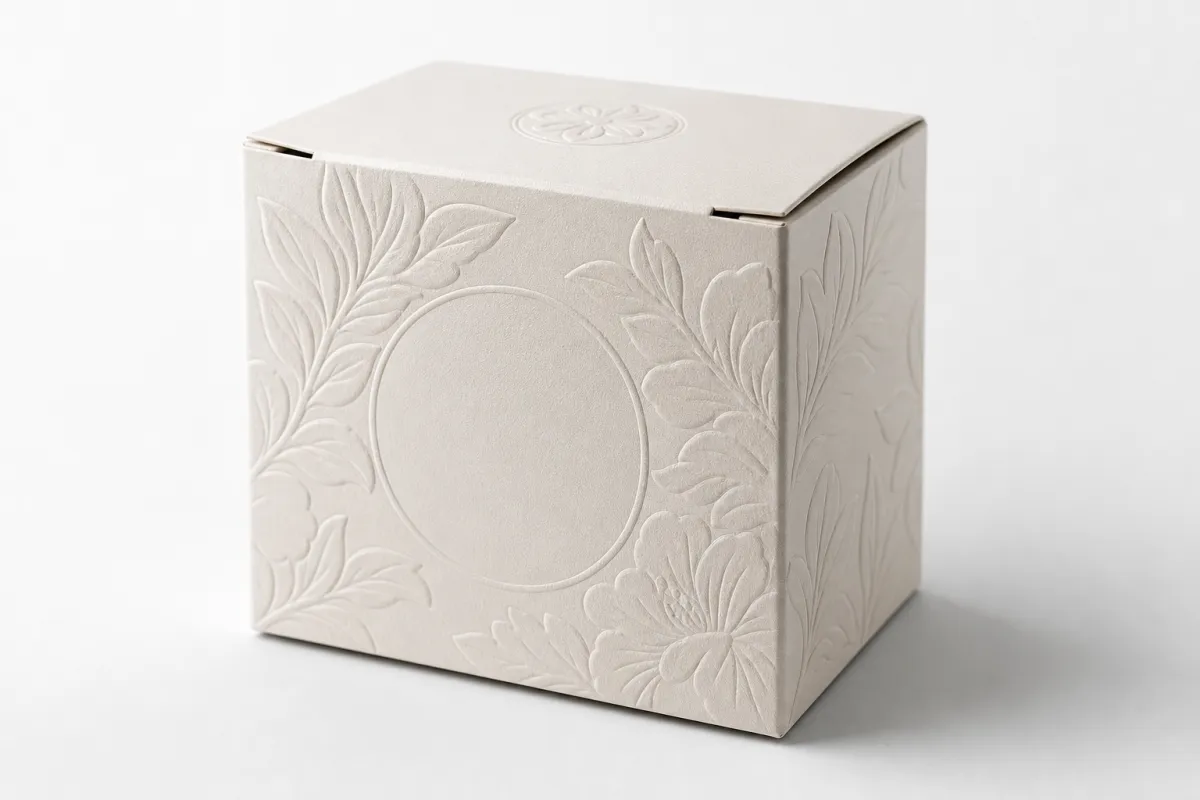
At the simplest level, a folding carton begins as paperboard that is printed, scored, die cut, folded, and glued into a finished box. The carton may start as flat printed sheets or rolls, then move through die cutting to create cutlines, creases, and glue tabs. Embossing is a separate step that presses a raised or recessed design into the board. Put the two together and you get printed folding cartons with embossing: a package that carries brand graphics and a tactile surface detail at the same time.
The effect is easy to understand and easy to misuse. Printed folding cartons with embossing do not need to cover every panel. In practice, they usually work best when the relief is concentrated in one hero area, such as a logo, seal, product name, or signature motif. That single raised detail gives the shopper a reason to pause. For skincare, supplements, candles, gourmet treats, and giftable retail items, printed folding cartons with embossing can feel premium without demanding a big jump in material usage.
From a packaging buyer's point of view, the appeal is practical. You are not relying only on thicker board, full-surface lamination, or heavy decoration to create value. Printed folding cartons with embossing can raise perceived quality with a relatively small change to the construction. That matters when product margins are tight and the box still has to survive shipping, shelf handling, and filling. A well-designed embossed panel can do more than a flashy print treatment that never gets touched.
There is a sustainability angle too, and it is not just marketing language. If the structure stays paperboard-based, the finish stack stays simple, and the board is sourced responsibly, printed folding cartons with embossing can support a cleaner packaging story than mixed-material alternatives. That is one reason brands often choose them for sustainable packaging programs. You get texture, shadow, and visual depth without automatically adding thick plastic components or overbuilt sleeves.
Embossing still has limits. It performs best when the artwork respects the physical behavior of the board. Fine type, tiny linework, and crowded pattern fills can disappear or distort if the emboss area is too ambitious. Printed folding cartons with embossing look strongest on clear, deliberate shapes. Think of it as a restrained premium cue rather than a fireworks show.
I have seen plenty of cartons where the emboss looked great on a monitor and then got flattened by bad structure, and that is usually where the trouble starts. Paperboard has memory, but it is not magic. If the relief sits too close to a score, the fold will win every time, kinda no matter how nice the render looked in prepress.
In practice, the strongest applications usually show up in these categories:
- Luxury and specialty food where the box needs to feel giftable at first touch.
- Wellness and beauty where the carton needs to imply care, precision, and trust.
- Gift packaging where the unboxing moment matters as much as the display panel.
- Limited-edition retail packaging where small changes in texture help signal exclusivity.
- Subscription and direct-to-consumer launches where the carton needs shelf appeal and camera appeal.
One mistake buyers make is assuming embossing should carry the whole brand. It should not. Printed folding cartons with embossing work best when they support the print rather than replace it. Typography, imagery, and board choice still need to do their jobs. Embossing is there to add a tactile cue, not rescue weak design.
How printed folding cartons with embossing work: process, timeline, and lead time
Good production starts in prepress. The printer reviews the dieline, panel sizes, glue areas, fold direction, and exact placement of the embossed elements before tooling is made. That sounds obvious until you see a carton where the emboss lands too close to a score line or a glue flap. Printed folding cartons with embossing need enough structural breathing room so the raised area survives folding, shipping, and retail handling.
Production can follow a few different sequences. Some jobs are printed first and embossed afterward. Others use a different order depending on the artwork, the finish stack, and how tightly the emboss must register to the print. If the design includes foil stamping or spot UV, the vendor may adjust the sequence again so the package comes out clean. Printed folding cartons with embossing are not a simple press-and-go project. The order matters, and the tighter the alignment, the more carefully the workflow has to be planned.
Timeline is where buyers usually get caught off guard. Simple printed folding cartons with embossing can move in roughly 2-4 weeks after approval if the artwork is locked, the board is available, and the tooling is straightforward. More complex work, especially with first-time samples, extra finishes, or new die cutting tools, often needs 4-8 weeks. If you are changing emboss depth, shifting placement, or adding foil stamping, assume the schedule will stretch. That is not pessimism. That is how the work behaves.
The biggest delays are usually not the press itself. They are revisions, sample approvals, board sourcing, freight, and the last-minute request to make the logo a little larger. That small change can trigger a new emboss plate, a new proof, and another round of checking. For printed folding cartons with embossing, the fastest path is a locked spec sheet and a client who decides early.
What a good converter should give you is a production map, not hand-wavy confidence. You want milestones:
- Art and dieline review.
- Board and finish confirmation.
- Tooling creation.
- Digital or flat sample approval.
- Press and emboss run.
- Fold, glue, and final inspection.
- Shipping and receiving window.
That kind of schedule is especially useful if the cartons must pass transit testing. If the product is fragile or the route is rough, ask whether the packaging should be checked against ISTA-style distribution expectations and whether extra crush resistance is needed. Printed folding cartons with embossing can still pass transit requirements, but only if the board and structural design are chosen with the shipping environment in mind.
Here is the part most people underestimate: sample approval matters more than the glossy render. A carton may look perfect on screen and still fail once the emboss, print, and fold interact in the real world. A flat mockup or hard sample lets you check the tactile depth, the shadow line, and the way the embossed area behaves around the scores. If the embossing is off by even a small amount, printed folding cartons with embossing will show it immediately.
If you want a rough rule, think like this: the simpler the design, the faster the project. A single embossed logo on a standard carton might move quickly. A carton with registered embossing, foil stamping, spot UV, and a precise die cut window is a different animal entirely. Printed folding cartons with embossing reward planning. They do not forgive chaos.
Printed folding cartons with embossing cost and pricing factors
Cost depends on more than quantity. The main drivers are board grade, print coverage, emboss size, emboss depth, tooling, setup time, and whether the design uses blind or registered embossing. Printed folding cartons with embossing also cost more when the artwork demands tight alignment between relief and print. That is why two cartons that look similar at a glance can carry very different quotes.
Volume matters because setup gets spread across the run. A 1,000-unit order may feel expensive per carton because the tooling and press time are divided across fewer boxes. A 5,000-unit run usually lands in a more comfortable range. As a rough guide, simple printed folding cartons with embossing might land around $0.75-$2.00 per unit at 500-1,000 pieces, about $0.30-$0.65 at 2,500 pieces, and roughly $0.18-$0.40 at 5,000 pieces, depending on board, coverage, and finish complexity. That is not a universal price list. It is a planning range, which is more useful than fantasy pricing.
Tooling is its own line item. A simple emboss tool might run around $120-$350. Larger or more detailed forms can land closer to $300-$800 or more if the geometry is complex. Add a matched die, new die cutting tooling, sampling, or special registration requirements and the number climbs. Printed folding cartons with embossing often look inexpensive from the outside because people see a clean box and assume the manufacturing was simple. It usually was not.
To compare quotes properly, the spec has to match. Ask vendors to quote the same board thickness, the same coating, the same print coverage, the same glue style, and the same emboss definition. Otherwise, you are comparing two different packages and pretending the numbers mean the same thing. That is how procurement teams buy the wrong job and then wonder why the delivered carton does not match the render.
| Option | Typical use | Typical unit cost at 5,000 pcs | Tooling / setup | Notes |
|---|---|---|---|---|
| Blind emboss only | Logos, seals, subtle texture | $0.18-$0.30 | Low to moderate | Clean look, usually the easiest path for printed folding cartons with embossing |
| Registered emboss | Emboss aligned to printed art | $0.25-$0.45 | Moderate | Tighter prepress and proofing; better for premium branding |
| Emboss + foil stamping | Luxury cosmetics, gifts, seasonal packs | $0.30-$0.60 | Moderate to high | Higher shelf impact, more setup, more chances to misregister if rushed |
| Emboss + spot UV | Contrast-rich retail cartons | $0.28-$0.55 | Moderate | Good contrast, but spot UV can complicate recycling claims if overused |
Hidden costs are where projects get messy. Sampling, freight, rush fees, storage, and rework can all eat into the budget if the brief is not clear. Printed folding cartons with embossing also cost more when the emboss is too shallow and has to be rerun, or too deep and starts cracking the board. Cheap boxes are never cheap if you have to remake them.
The simplest way to save money is to emboss one hero element well. Do not emboss everything because the design software made it look easy. A narrow, intentional relief zone usually produces better shelf appeal and less waste than a full-panel texture that nobody understands. Printed folding cartons with embossing are strongest when the effect feels deliberate.
Here is a useful way to think about pricing: board quality controls structure, print coverage controls ink and press time, and embossing controls tooling and precision risk. Raise all three at once and the quote climbs fast. If you want the carton to stay within budget, keep the premium signal in one place and let the rest of the spec stay practical. That is usually the sweet spot for printed folding cartons with embossing.
Key design and sustainability factors for embossed cartons
Board choice is the starting point. Printed folding cartons with embossing need paperboard that holds detail without cracking. Recycled content can work well, but the fiber mix has to support the emboss depth and the structural demands of the carton. A soft board can flatten the relief or show stress at the fold. A board that is too stiff can crack along the embossed edge. The right answer usually sits in the middle, often in the 16-24 pt range for many retail cartons, though the exact spec depends on product weight and panel size.
Visual hierarchy matters more than people think. Printed folding cartons with embossing work best on a logo, a seal, a product name, or one signature motif. If every decorative element competes for the same tactile spotlight, the carton loses focus. That is why strong premium packaging often looks quiet. The box is not trying to shout from every surface. It is guiding the eye with controlled contrast, one embossed zone at a time.
For sustainability, the finish stack should stay as simple as the branding allows. Water-based inks, aqueous coatings, and limited lamination are usually easier to defend than heavy mixed-material decoration. If recyclability is a priority, check whether the carton needs a full plastic laminate or whether a coating can do the job. Printed folding cartons with embossing can be environmentally sensible, but only if the rest of the spec does not work against the recycling stream.
That is where references matter. For recycled fiber sourcing and chain-of-custody questions, look at fsc.org. For broader packaging sustainability context and material guidance, packaging.org is a useful place to start. Neither site will choose your board for you, because that would be too convenient, but both help frame the decision with real industry language instead of vague eco slogans.
Testing under real lighting is another step people skip. Embossing catches shadows differently under LED store lights, daylight, and warm residential lighting. What looks subtle in a PDF can read much louder on shelf. Printed folding cartons with embossing often look better in person than they do on screen, but that only helps if the relief is positioned where the light will hit it.
Be careful with sustainability claims, too. Keep them specific. Say what the board is, whether it is FSC-certified, what coating is used, and how the carton should be disposed of in the target market. Vague green language is a fast way to make a premium carton feel cheap. Printed folding cartons with embossing should sound confident, not fuzzy.
Related finishing choices can help or hurt the result:
- Foil stamping adds shine and can amplify the embossed area, but it should be used with restraint.
- Spot UV creates contrast, though it may complicate the finish stack if paired with multiple effects.
- Lamination improves scuff resistance, but it can weaken the recyclability story if overused.
- Die cutting should stay crisp, because a sloppy cut makes any embossed detail look cheaper than it is.
- UV coating can be useful for protection, especially on cartons that face heavy handling.
One practical rule: if the carton has to look premium and stay environmentally defensible, keep the tactile effect focused and the finish stack minimal. Printed folding cartons with embossing do not need a dozen embellishments. They need one strong idea and the right construction to support it.
Step-by-step guide to ordering printed folding cartons with embossing
Step 1 is defining the product. Before anyone opens design software, decide what the carton has to do: hold the product, sell the product, travel safely, or all three. Then define the retail channel, the target price, and the one tactile message the box needs to communicate the second someone picks it up. Printed folding cartons with embossing are much easier to spec when the brand purpose is clear.
Step 2 is requesting a proper dieline. Confirm the board, coating, glue style, and emboss zones before the artwork team starts decorating the wrong structure. This is the point where die cutting details matter. A box that looks elegant as a flat layout can fail when the emboss sits too close to the fold or when the glue flap steals space from the design. Printed folding cartons with embossing reward teams that respect the structure first.
Step 3 is checking proofs in more than one format. Digital proofs help with color and layout, but a flat sample or mockup is worth asking for if the emboss placement is a central brand feature. If the logo is supposed to float above a texture field, you need to see the spacing in real life. Printed folding cartons with embossing are about the relationship between light, touch, and paper thickness. A screen cannot fully show that.
Step 4 is approving the prepress proof and locking the quantity. This is where the clock starts to matter. Get the production milestones in writing, including any expected sample window and ship date. If the supplier cannot explain those steps clearly, that is a warning sign. Printed folding cartons with embossing should come with a timeline you can actually plan around, not a shrug and a guess.
Step 5 is inspecting the first cartons from the run. Check registration, fold quality, crush resistance, and emboss consistency. If the first cartons are off, stop and resolve the issue before full release. Do not assume the next pallet will magically improve. It rarely does. A short inspection window can save an entire run of printed folding cartons with embossing from becoming expensive scrap.
Here is a simple quote brief that gets better answers:
- Finished carton dimensions.
- Quantity needed, plus any reorder expectation.
- Board spec or target thickness.
- Artwork files and dieline.
- Finish stack, including embossing, foil stamping, spot UV, lamination, or UV coating.
- Target ship date and destination.
- Whether the emboss is blind or registered.
- Desired depth or visual prominence of the emboss.
A good brief does more than save time. It keeps the quote honest. Printed folding cartons with embossing often change price when the spec changes, and the quote should reflect that. If you send the same dieline and the same artwork to three suppliers, you should be comparing board quality, lead time, finishing capability, and communication, not guessing which vendor lowballed the job.
For launch planning, build backward from the ship date. Leave room for proofing, sample approval, tooling, rework, and freight. If the cartons are part of a bigger packaging line that includes inserts, labels, or secondary shipping boxes, get those specs in sync early. Printed folding cartons with embossing are easiest to execute when they are part of a clear package system, not a pile of last-minute decisions.
Common mistakes with printed folding cartons with embossing
The first mistake is placing embossing too close to folds, edges, or glue flaps. That is where cracking and distortion show up. It also tends to flatten after assembly, which defeats the whole point. Printed folding cartons with embossing need a little structural respect. If the relief has no room to breathe, the final box will look tired before it ever reaches the shelf.
The second mistake is choosing board that is too thin or too soft. A raised detail on weak stock can collapse instead of staying crisp and readable. The package may still function, but the premium signal disappears. This is especially painful when the artwork is otherwise strong. Printed folding cartons with embossing only work if the substrate supports the image.
The third mistake is stacking too many finishes at once. Foil stamping, heavy ink coverage, lamination, spot UV, and embossing can all coexist, but not always cleanly, and not always economically. Every extra effect adds registration risk and production complexity. Sometimes the smartest move is to remove one finish and let the embossing breathe. Printed folding cartons with embossing usually look more expensive when the design is not trying to prove anything.
The fourth mistake is skipping sample approval. Yes, the sample costs time. So does reprinting a run that looks wrong. People often assume the press run will fix the issue. It will not. If the first sample shows the emboss is too shallow, too wide, or misaligned, stop there. That is the cheap moment to make the correction. Printed folding cartons with embossing should never move to production on wishful thinking.
The fifth mistake is ignoring shipping and storage conditions. Humidity, heat, and long transit can all affect how the carton holds up before filling. If cartons will sit in a warehouse or move through different climates, the board and coating need to be chosen with that in mind. Printed folding cartons with embossing can survive a lot, but paperboard is still paperboard. Treat it like a material with limits, not a miracle surface.
Here is a blunt buyer's checklist:
- Is the emboss away from folds and glue?
- Does the board hold detail without cracking?
- Are the print and emboss aligned in the same spec?
- Do you have a sample in hand before release?
- Can the finish stack survive shipping and storage?
If one of those answers is weak, the job needs more work. Printed folding cartons with embossing are simple in concept and unforgiving in execution. That is not a flaw. It is just what happens when physical detail meets a mass-produced package.
Expert tips and next steps for printed folding cartons with embossing
Ask for a quote matrix. You want pricing at multiple quantities, plus separate line items for tooling, sampling, freight, and any rush fees. That makes it easy to see where the money is going and where volume starts to help. Printed folding cartons with embossing often look more expensive than they are because the tooling is bundled into one number. Break it out and the decision becomes much clearer.
Start with one strong embossed focal point, then decide whether foil stamping or spot UV is actually worth adding after you see a sample in hand. That is a much smarter sequence than loading every effect into the first version and hoping the result is elegant. Printed folding cartons with embossing usually benefit from restraint. A clean relief, a useful coating, and crisp die cutting can outperform a box stuffed with finishes.
Build the launch calendar backward. Set approval deadlines, buffer days, and shipping windows early, because delays do not care about your marketing plan. If the product launch matters more than the cheapest quote, pay attention to the sample stage and the freight timeline. Printed folding cartons with embossing can be produced reliably, but only if the schedule is realistic from the start.
Ask for a sustainability sheet from the supplier. It should list board composition, coating type, and any recycling guidance that applies to your market. If the board is FSC-certified, if the coating is aqueous, and if lamination is limited, you have a much easier story to tell. Printed folding cartons with embossing can support a responsible packaging narrative without sounding like a guilt trip disguised as branding.
Compare two or three suppliers using the same spec sheet, then choose the one that can deliver printed folding cartons with embossing on time, not the one with the fanciest sales pitch. That last point matters more than people like to admit. Pretty presentations do not ship boxes. Process does.
For brands that want stronger shelf presence without leaning on unnecessary plastic or oversized construction, printed folding cartons with embossing are still one of the best tools in the box. They add touch, shadow, and perception in a controlled way, and when the board, finish, and timeline are handled properly, printed folding cartons with embossing can make a product feel far more considered than the cost alone would suggest.
My practical takeaway is simple: decide the one area that deserves to be touched, spec the board so it can hold that detail, and lock the finish stack before anyone starts chasing pretty render tweaks. If the emboss, print, and structure all support the same idea, the carton will do its job without drama.
Are printed folding cartons with embossing recyclable?
Usually yes, if the carton uses recyclable paperboard and the finish stack stays friendly to local recycling rules. Avoid heavy plastic lamination and mixed-material decoration when recyclability matters. Ask the converter for a market-specific recommendation instead of a vague yes, because recycling rules are not identical everywhere.
How much do printed folding cartons with embossing usually cost?
The price depends on board grade, quantity, tooling, emboss size, and whether the design needs one pass or several. Short runs usually have higher unit cost because setup and tooling are spread across fewer cartons. Ask for tooling and run charges separately so you can see where the money is actually going.
What is a realistic timeline for printed folding cartons with embossing?
Simple jobs can move in about 2-4 weeks after approval, while more complex jobs often need 4-8 weeks. Sampling, dieline revisions, and tooling creation are the biggest schedule risks. Add buffer time if the launch date matters more than the cheapest quote.
Should embossing happen before or after printing on folding cartons?
It depends on the design, registration needs, and the effect you want on the finished package. Many jobs print first and emboss later, but some designs need a different sequence to protect alignment. Ask the printer which order fits your artwork and sample requirements.
What should I send for a quote on printed folding cartons with embossing?
Send dimensions, quantity, board spec, artwork, finish stack, target ship date, and shipping location. Include notes on the embossed area, desired depth, and whether you need a blind or registered effect. The more exact the brief, the less likely you are to get a quote that changes later.


