Buyer Fit Snapshot
| Best fit | Sustainable Product Boxes Supplier projects where brand print, material claims, artwork control, MOQ, and repeat-order consistency need to be specified before quoting. |
|---|---|
| Quote inputs | Share finished size, material target, print colors, finish, packing count, annual reorder estimate, ship-to region, and any compliance wording. |
| Proofing check | Approve dieline scale, logo placement, barcode or warning zones, color tolerance, closure strength, and carton packing before bulk production. |
| Main risk | Vague material claims, crowded artwork, missing packing details, or unclear freight terms can make a low unit price expensive after revisions. |
Fast answer: Sustainable Product Boxes Supplier: Materials & Cost should be specified like a repeatable production item. The safest quote records material, print method, finish, artwork proof, packing count, and reorder notes in one written spec.
Production checks before approval
Compare the actual filled-product size with the drawing, then confirm tolerance on folds, seals, hang holes, label areas, and retail display edges. Reserve space for logos, QR codes, warning copy, and material claims before decorative graphics fill the panel.
Quote comparison points
Review material grade, print process, finish, sampling route, tooling charges, carton quantity, and freight assumptions side by side. A quote is only useful when the supplier can repeat the same color, closure quality, and packing count on the next order.
A Sustainable Product Boxes supplier is not the one yelling the loudest about recycled fiber. Usually, it is the one that quietly gets the boring parts right. The carton ships flat. The product fits without a wrestling match. The board uses less material than the overbuilt box someone "felt good" about in a meeting. That is where real packaging work happens. Not in the slogan. In the details.
For brands trying to cut packaging waste without wrecking shelf appeal or transit performance, that difference matters. A good sustainable product boxes supplier does more than print a logo on kraft board and call it eco. They help match the box style to the product weight, the shipping method, the budget, and the end-of-life reality of the carton itself. If you are comparing Custom Packaging Products, the real question is not "Which box looks green?" It is "Which box works cleanly, costs fairly, and still tells the truth?"
That is the thread running through this piece. A sustainable product boxes supplier should help reduce unnecessary material, keep the packaging strong enough for actual use, and make sure print and finishing choices do not quietly sabotage recyclability. A box that looks green but needs oversized void fill, a plastic-heavy laminate, and a second reprint is not a win. It is just expensive guilt with a logo on it. The smarter route is usually a well-sized carton that does its job without drama.
I have seen plenty of packaging programs get stuck because the first version was designed for a presentation, not for the warehouse. The pretty mockup passed around the office. The production version needed a different board grade, different scores, and a different outer shipper. Annoying, yes. Avoidable, also yes. A seasoned sustainable product boxes supplier helps catch that gap before it turns into scrap and late-night email threads.
What a sustainable product boxes supplier really means
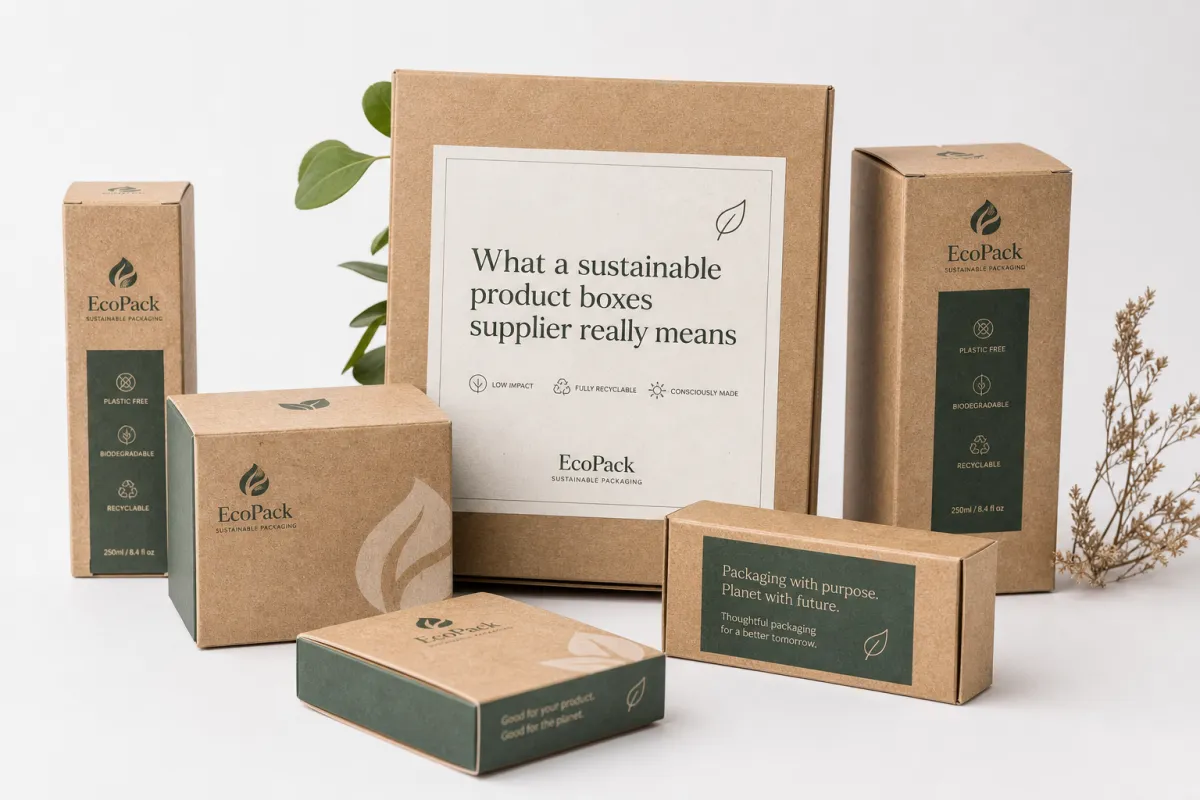
People sometimes use the phrase sustainable product boxes supplier as if it only means "uses recycled paper." Too narrow. That misses most of the picture. The phrase covers the whole packaging chain: where the board comes from, how the box is built, what inks and coatings are used, how it performs in transit, and what happens after the customer opens it. A supplier can source decent board and still miss the point if the structure wastes space or the finish makes recycling harder than it needs to be.
From a buyer's point of view, the best box often ships flat and folds fast. Less air inside the carton. Fewer dunnage materials. A clean fit around the product. That usually beats a flashy oversized presentation box that looks nice in a deck and falls apart in the warehouse. A sustainable product boxes supplier should be asking basic, practical questions: How heavy is the product? How fragile is it? Does it hate moisture? Is it going into a retail shelf, an e-commerce parcel, or both? Those answers decide whether folding carton stock, rigid board, or corrugated protection makes sense.
Material sourcing is part of the story, but not the whole thing. Recycled paperboard, FSC-certified board, kraft substrates, and corrugated options all come with different performance profiles. Inks matter too. Water-based inks are often a solid choice for lower-impact printing, and minimal coatings usually keep the box easier to recycle than a heavy film laminate. A sustainable product boxes supplier should be able to explain those trade-offs in plain language instead of hiding behind vague eco language and a leaf icon.
Practical rule: if the "green" box needs extra inserts, extra void fill, or a larger outer shipper to survive transit, the sustainability story is weaker than it looks.
Honestly, this is where a lot of packaging programs go sideways. The brand starts with the marketing image and only later discovers the box needs structural changes to protect the product or stay within freight limits. A good sustainable product boxes supplier helps prevent that mess by tying the design to the actual supply chain. Stack strength. Fold quality. Print clarity. Repeatability across runs. Those are not glamorous topics, but they keep the project from turning into a cleanup job.
End-of-life matters too. Some substrates are widely recyclable. Others depend on local waste systems and the use of adhesives, coatings, or lamination. The EPA's recycling guidance is a useful reference point for how packaging recovery works in practice: EPA recycling resources. A sustainable product boxes supplier does not promise magic here. They help you pick a box that fits the real disposal path, not the fantasy version printed on the side panel.
For brands that want to show responsibility without overcomplicating the packout, the supplier's job is to translate goals into structure. That can mean a slimmer carton, fewer colors, a different board weight, or a fold style that avoids glue-heavy components. A sustainable product boxes supplier is part material expert, part production planner, and part reality check. Frankly, that last part is doing a lot of heavy lifting.
And yes, sometimes the answer is not as sexy as the brand team hoped. I have had clients ask for a box that looked like a premium gift set, then ask why freight and damage claims jumped. Because the structure was gorgeous and kind of silly for the product. Packaging has a habit of exposing wishful thinking.
How a sustainable product boxes supplier plans materials and runs production
A solid sustainable product boxes supplier usually starts with a brief that sounds dull and saves a lot of pain later. What are the product dimensions? How much does it weigh? Is it fragile, oily, powdered, or moisture sensitive? Does it need a retail-ready presentation, or is the box mostly a shipping carton? Those answers shape the dieline, the board grade, the print layout, and the finishing method long before anyone opens a design file.
After the brief, the supplier picks a material path. Recycled paperboard works well for many lightweight consumer goods, especially when the goal is a crisp printed carton with a smaller material footprint. FSC-certified board is a strong option when the brand wants traceability from responsibly managed forests, and it can be used for retail cartons or outer packaging. Kraft substrates bring a natural look that many brands like, though the brown tone changes how print behaves and can shift color perception on press. For heavier products or e-commerce orders, corrugated board often gives the best balance of protection and responsible material use.
A thoughtful sustainable product boxes supplier also watches how print and finishing affect recyclability. Water-based inks are often preferred because they fit well with paper recycling streams. Heavy UV coatings, full lamination, and metallic effects may look sharp, but they can complicate recovery or push the box into a more mixed-material category. That does not mean those finishes are forbidden. It means they should be chosen on purpose, not because somebody liked the sample on a Tuesday.
The production workflow usually follows a simple chain:
- Collect product specs and sustainability goals.
- Develop the structural dieline and board recommendation.
- Create a digital proof or prototype.
- Review fit, graphics, and finishing.
- Approve the final spec sheet.
- Run production and quality checks.
This sequence matters because a sustainable product boxes supplier is trying to reduce material waste and production waste at the same time. A box that folds poorly or crushes at the corners creates scrap, rework, and damage claims. A box that prints beautifully but stacks badly can create headaches in the warehouse. Good suppliers think about the entire chain, not just the part that looks good in a photo.
There is a real technical side to this. Board caliper, bend score depth, grain direction, and glue flap placement all affect how cleanly a carton closes. If the score is too deep, the board can crack. If the board is too light, the box may spring open or deform under load. A skilled sustainable product boxes supplier is balancing the minimum material needed with the structural integrity the product actually demands. That is where sustainability and performance stop fighting each other and start working together.
If you want a broad view of common box formats, compare them against your product needs instead of guessing from photos. Our Custom Packaging Products page is a useful starting point for that kind of comparison. The same goes for a sustainable product boxes supplier conversation: the more specific the product data, the better the recommendation.
For brands that care about verified material sourcing, the Forest Stewardship Council is another useful reference point: FSC certification information. A sustainable product boxes supplier does not need every box to be FSC-certified, but they should be able to explain what the certification means and where it fits in the supply chain.
Put simply, the planning stage is where the best results are won. The supplier who takes the time to match material, structure, and finish usually ends up with less waste, fewer surprises, and better repeatability across production runs. That is the kind of sustainable product boxes supplier most buyers are after, even if they do not say it that cleanly.
The best suppliers also know when to say no. If a brand asks for a super-thick board, five special finishes, and a tiny mailer that has to survive cross-country shipping, the honest answer is not "sure, no problem." It is a short explanation of the trade-offs and a better path. That kind of pushback saves everyone money later.
Key factors that shape pricing, performance, and material choice
Pricing is where sustainability discussions stop being abstract. A sustainable product boxes supplier can quote two boxes that look similar from the outside, then one lands at double the cost because of board grade, print coverage, coating, inserts, or order volume. The trick is understanding what drives the number before deciding whether the quote is high or low.
Board grade is usually one of the biggest cost drivers. Heavier paperboard, premium recycled content, and specialty kraft surfaces all change the base price. Box style matters too. A simple tuck-end folding carton is generally cheaper than a custom mailer with internal locks, while a rigid setup box usually costs more because of labor and construction complexity. A sustainable product boxes supplier should make those differences visible instead of hiding them in a vague lump sum and hoping nobody asks questions.
Print coverage is another important factor. One-color black on kraft board is not the same as full-bleed four-color process with a white underbase. Spot colors, embossing, foil, and textured coatings all add expense. Some of those finishes make sense for shelf appeal, but they should be measured against the product's margin and the job's actual goal. A sustainable product boxes supplier can often suggest a cleaner, less expensive route if the brand is open to hearing it.
Here is a practical comparison buyers can use to frame the conversation:
| Option | Typical use | Relative cost | Sustainability notes |
|---|---|---|---|
| Recycled folding carton | Light retail goods, cosmetics, supplements | Low to moderate | Good choice for reducing virgin fiber use, especially with water-based inks |
| FSC-certified board carton | Retail packaging with sourcing requirements | Moderate | Useful when traceability matters and the brand wants documented sourcing |
| Kraft mailer or sleeve | E-commerce, apparel, lightweight goods | Low to moderate | Simple look, often a good fit for minimal-material programs |
| Corrugated mailer | Heavier items, shipping protection | Moderate | Strong protection, often reduces damage and repackaging waste |
| Rigid box with specialty finish | Premium presentation | High | Best used selectively; can increase material use and finishing impact |
As a rough working range, a simple custom carton at 5,000 units may land around $0.18-$0.30 per unit, while heavier board, a custom insert, or a more demanding finish can push a job toward $0.45-$0.90+ per unit. That is not a universal price list, and a sustainable product boxes supplier will always need the full spec before giving a firm number. Still, those ranges help buyers avoid fantasy pricing that belongs in a spreadsheet dream, not a real quote.
Low unit price can also be misleading if the box performs badly. A carton that saves two cents but causes more product damage, more void fill, or more oversize freight fees can cost more overall. That is why a good sustainable product boxes supplier thinks in terms of total packaging cost, not just box cost. If a slightly better structure cuts returns, protects the product more reliably, and reduces extra materials, the higher box price may actually be the cheaper choice in real life.
The same logic applies to dimensional weight. E-commerce brands are often squeezed by parcel size, because bigger boxes can raise freight spend fast. A well-sized carton or mailer from a sustainable product boxes supplier can trim shipping waste and improve warehouse handling. That is a sustainability gain and a cost gain at the same time, which is rare enough to enjoy when it shows up.
Material choice is also tied to brand positioning. A natural kraft box can signal restraint and recycled content, while a white SBS carton with clean graphics can feel more premium and retail-ready. Neither is automatically better. The right sustainable product boxes supplier helps you choose the option that fits the product story, the channel, and the margin instead of forcing a one-size-fits-all answer.
One more thing that gets skipped too often: minimum order quantities. A low MOQ can look friendly, but it can also raise unit pricing or limit material choices. A supplier who explains that trade-off clearly is doing you a favor. A supplier who hides it is just making the later quote feel like a surprise gift nobody asked for.
Process and timeline: from first brief to production-ready boxes
The fastest route to a finished carton usually starts with a very complete brief. A sustainable product boxes supplier can move quickly when the dimensions, product weight, artwork status, sustainability requirements, and target quantity are clear. If the brief is vague, every step takes longer because the supplier has to keep guessing about fit, stock, and finish. Guessing is not a strategy. It is just delayed decisions with better punctuation.
The process often looks like this: discovery, dieline development, proofing, revisions, approval, production, and delivery. Discovery is where the supplier collects the basics and asks the questions that prevent waste later. Dieline development is where the physical structure gets mapped. Proofing can be digital or physical depending on the complexity of the job. Revisions are normal, especially when the brand is balancing shelf presence with shipping efficiency. A sustainable product boxes supplier that keeps the process organized usually saves the client more time than one that says yes to everything and hopes the job sorts itself out.
Timelines vary, but a simple project with ready artwork and a standard structure often moves in 10-15 business days after proof approval if the material is in stock and no special finishing is involved. More complex orders can take 3-6 weeks or longer, especially if the supplier needs to source custom board, build prototypes, or run multiple review rounds. A sustainable product boxes supplier should be upfront about that range instead of promising something impossible just to sound convenient.
Several things slow production down more than buyers expect:
- Missing artwork specs, especially bleed, resolution, or spot color definitions.
- Last-minute size changes after the dieline is approved.
- Unclear sustainability requirements, such as recycled content thresholds or certification needs.
- Slow sample approvals when multiple teams are involved.
- Finishes that require extra setup or drying time.
That last point matters more than people think. A sustainable product boxes supplier can often keep a job moving if the finish is simple and the substrate is standard. Add a specialty coating, a custom insert, or a nonstandard fold pattern, and the timeline can stretch. None of that is strange. It just needs to be planned honestly from the start, instead of discovered after someone has already announced a launch date.
One useful habit is to treat the sample as a decision tool, not a formality. Hold it next to the product. Test the fold. Check shelf presence. Simulate shipping if you can. A supplier may say the board is fine, but the sample will show whether the flap closes cleanly and whether the printed finish looks right under real light. A sustainable product boxes supplier should welcome that scrutiny, because it cuts rework later.
The best projects also define what "done" means before production starts. Is the target simply a functional carton, or does it also need a documented recycling path, a specific recycled-content target, or a certain unboxing feel? A sustainable product boxes supplier can make much better recommendations once those priorities are clear. The clearer the brief, the fewer surprises, and the faster the cartons move from idea to production-ready package.
I also like to see a pre-production signoff that names the exact board, print method, finish, and carton dimensions. That sounds tedious because it is. It also saves a ton of grief. A vague "green box" approval does not help when the finished run does not match what procurement thought it approved.
Common mistakes when choosing a sustainable packaging supplier
One of the most common mistakes is trusting the word "eco" before asking for the details. A sustainable product boxes supplier should be able to tell you exactly what the box is made from, whether it uses recycled or certified fiber, and what finish or adhesive choices could affect disposal. If the explanation stays fuzzy, the sustainability claim probably does too. Fancy words are cheap. Data is the part that costs effort.
Another mistake is giving incomplete product information. If the supplier does not know the weight, fragility, shipping distance, storage conditions, or expected shelf life, the design can easily come back underbuilt or overbuilt. Underbuilt cartons create damage and returns. Overbuilt cartons waste board and increase cost. A responsible sustainable product boxes supplier needs the real use case, not just a product photo and a logo dropped into a folder.
There is also the trap of choosing a box because it looks natural. A kraft exterior can feel more sustainable, but if the structure is oversized or packed with extra inserts, the total material use may be worse than a tighter, better-engineered carton. A sustainable product boxes supplier should be pushing the conversation toward fit and function, not just appearance. Looks are useful. They are not a substitute for good packaging design.
Print expectations can create another problem. Some brands approve a design without checking whether colors will hold on kraft, whether the logo needs a white underbase, or whether a finish will slow lead time. Then the project gets redesigned after sampling, which burns time and money. That is why a sustainable product boxes supplier should lock down print specs early and confirm them with a proof. Surprises are fun at birthdays. Not during production.
Here are a few warning signs that the sourcing process needs more discipline:
- The quote does not list board grade or thickness.
- There is no mention of lead time, sample cost, or MOQ.
- The supplier cannot explain recyclability in plain terms.
- The packaging looks attractive but is obviously oversized for the product.
- There is no structural sample before full production.
For a packaging buyer, the cost of these mistakes shows up in different places. Sometimes it is direct, such as a higher carton price or a reprint. Sometimes it is indirect, such as higher freight, more void fill, or more customer complaints. A thoughtful sustainable product boxes supplier helps you see the full cost picture before the job is approved, which is useful because problems rarely stay in one column.
Standards can help here. ISTA test methods are widely used to evaluate transit performance, and that matters because a "green" box that fails in shipping is not sustainable in practice. The same goes for ASTM references and material specifications, which can help buyers compare performance more fairly. A sustainable product boxes supplier does not need to drown you in acronyms, but they should know what these standards mean and how they affect the pack.
My honest take? A lot of box problems are really communication problems. The brand wants a premium look, the warehouse wants easy packing, and the supplier is trying to keep the structure recyclable and cost-controlled. A strong sustainable product boxes supplier is the one who keeps those three conversations aligned before anyone presses approve.
The biggest red flag is speed without questions. If a supplier says yes to every request in five minutes, they probably have not thought through the structure, the finish, or the waste implications. Fast is good. Blind is not.
Expert tips for getting better results with less waste
The best sustainability gains often come from restraint. Start with the product, then build outward. A sustainable product boxes supplier can usually help most when you begin with protection, fit, and handling, and only then layer in graphic treatment. That keeps the design grounded in performance instead of style alone. Pretty packaging that fails in use is just expensive decoration.
Right-sizing is one of the cleanest wins. A box that closely matches the product cuts board usage, reduces shipping volume, and often removes the need for void fill. That is especially useful for e-commerce, where oversized cartons can quietly inflate freight costs. A sustainable product boxes supplier can recommend changes to internal dimensions, flap depth, or mailer style that make the whole package leaner.
It also helps to ask for material swatches and structure samples before committing to a large run. A swatch tells you how the board feels and how print may sit on the surface. A prototype tells you how the box folds, closes, and protects the product. A sustainable product boxes supplier that offers these steps usually helps clients avoid expensive surprises later.
Here are a few practical moves that often improve the outcome without making the packaging dull:
- Use a mono-material structure where possible so the box is easier to recover.
- Limit heavy coatings unless the finish has a real functional purpose.
- Keep insert design simple, especially if the product can be stabilized with folds or tabs.
- Choose the lightest board that still passes transit and handling needs.
- Plan inventory carefully so old packaging does not sit unused after a design refresh.
That last point matters more than it gets credit for. A sustainable product boxes supplier can produce a beautiful carton, but if you over-order the wrong size or forget a seasonal update, those boxes become waste sitting on a shelf. Good packaging planning includes buying discipline, not just design discipline.
There is a sensible middle ground between plain and cheap and premium and heavy. A careful print layout, a smart board choice, and a clean fold structure can still look intentional and sell the product well. A sustainable product boxes supplier should help you hit that middle ground, because that is where many brands get the best mix of cost control and customer experience.
If you want a useful reference point for what can be built in different structures, compare your ideas against the options inside Custom Packaging Products. The point is not to copy a stock style. It is to understand which structure supports your actual sustainability goals. That is where a sustainable product boxes supplier earns its keep: not by selling the fanciest box, but by steering you toward the most efficient one that still feels right in the hand.
One more practical habit: keep a feedback loop with operations after the first run. If the boxes slow down packing, scuff in transit, or need extra tape, that is useful information, not failure. The supplier can only improve the next run if someone tells them what happened in the real world. Fancy decks do not catch that stuff. Shipping does.
Next steps for comparing suppliers and moving forward
If you are ready to compare quotes, gather the basics first. A sustainable product boxes supplier can only quote well if they know the product dimensions, target quantity, weight, shipping method, finish preference, and sustainability goals. Without that, every estimate is just a guess wearing a blazer.
It helps to build a small comparison sheet before you send inquiries. Include the product size, preferred box style, board type, print method, finish, target MOQ, sample options, and required lead time. Ask each sustainable product boxes supplier to quote the same assumptions so you can compare apples to apples instead of comparing a recycled carton to a premium rigid box and pretending they are the same job.
When the product is new, seasonal, or sensitive to transit damage, a pilot run is often the smartest next step. A smaller order lets you test shelf fit, warehouse handling, and customer reaction before committing to a larger volume. A sustainable product boxes supplier should be comfortable with that approach because it reduces the risk of overbuying the wrong spec.
Use this checklist as a final filter:
- Can the supplier explain the board, print, and finish in plain language?
- Do they provide a structural sample or prototype before full production?
- Are lead time, MOQ, and freight clearly stated?
- Can they discuss recyclability, recycled content, or FSC options without guessing?
- Do they ask about product weight, shipping conditions, and handling?
A strong sustainable product boxes supplier makes packaging easier to understand, easier to buy, and easier to defend on cost and environmental grounds. That is the real value. Not just a box that looks responsible, but one that performs well, buys cleanly, and stands up to practical scrutiny from operations, finance, and sustainability teams alike.
If I had to reduce the whole subject to one sentence, it would be this: the right sustainable product boxes supplier helps you use less material without creating more problems elsewhere. That is the balance worth paying for, because a box that saves waste, protects the product, and stays in range on price is usually the one That Holds Up best over time.
So the actionable move is simple: ask every supplier for the same spec sheet, the same sample standard, and the same freight assumptions, then compare the results side by side. That is the cleanest way to spot who is actually solving the packaging problem and who is just selling you a greener-looking version of the same old mess.
What should I ask a sustainable product boxes supplier before ordering?
Ask what the box is made from, whether the board is recycled or certified, and what finishes may affect recyclability. Confirm minimum order quantity, lead time, sample availability, and whether pricing changes at different volume levels. Share product dimensions, weight, and shipping method so the sustainable product boxes supplier can recommend a box that actually performs.
Are recycled boxes always the most sustainable choice?
Not always, because the best option depends on product weight, shipping distance, and whether the structure needs extra reinforcement. A well-sized box with efficient design can sometimes outperform a heavier recycled board that creates more shipping and material waste. The most sustainable choice usually balances recycled content, strength, print needs, and end-of-life recyclability, and a good sustainable product boxes supplier should explain that trade-off plainly.
How long does it take to make custom sustainable product boxes?
Simple projects can move quickly if the artwork is ready, the structure is standard, and materials are in stock. More complex projects take longer because they need dieline development, sampling, approval rounds, and print or finish checks. The fastest timelines usually come from clear specs, fast feedback, and fewer design changes after sampling, which is why a prepared brief helps any sustainable product boxes supplier move faster.
What affects pricing from a sustainable product boxes supplier the most?
Material grade, box size, print coverage, special finishes, and order quantity are usually the biggest price drivers. A custom structure or insert can raise costs, but it may reduce damage rates and lower total packaging waste. Comparing quotes requires the same specs across every supplier so you can see the real difference in value, which is especially true with a sustainable product boxes supplier that offers multiple material options.
How do I compare two sustainable packaging quotes fairly?
Match the material, dimensions, print method, finish, quantity, and delivery terms before comparing unit prices. Check whether the quote includes samples, setup fees, freight, and any sustainability certifications you need. Look beyond the cheapest number and judge the total package: performance, timing, and long-term packaging efficiency. That is usually the clearest way to evaluate any sustainable product boxes supplier.


