Buyer Fit Snapshot
| Best fit | Sustainable Retail Bags with Handles projects where brand print, material claims, artwork control, MOQ, and repeat-order consistency need to be specified before quoting. |
|---|---|
| Quote inputs | Share finished size, material target, print colors, finish, packing count, annual reorder estimate, ship-to region, and any compliance wording. |
| Proofing check | Approve dieline scale, logo placement, barcode or warning zones, color tolerance, closure strength, and carton packing before bulk production. |
| Main risk | Vague material claims, crowded artwork, missing packing details, or unclear freight terms can make a low unit price expensive after revisions. |
Fast answer: Sustainable Retail Bags with Handles: Film, Print, MOQ, and Carton Packing should be specified like a repeatable production item. The safest quote records material, print method, finish, artwork proof, packing count, and reorder notes in one written spec.
Production checks before approval
Compare the actual filled-product size with the drawing, then confirm tolerance on folds, seals, hang holes, label areas, and retail display edges. Reserve space for logos, QR codes, warning copy, and material claims before decorative graphics fill the panel.
Quote comparison points
Review material grade, print process, finish, sampling route, tooling charges, carton quantity, and freight assumptions side by side. A quote is only useful when the supplier can repeat the same color, closure quality, and packing count on the next order.
Sustainable retail bags with handles: Smart Buying Tips
Sustainable Retail Bags with handles look straightforward from the checkout counter, but they have a lot to prove in a very short amount of time. The customer lifts the bag by the handle, shifts the weight, and makes an instant judgment about the brand. If the bag feels weak, prints poorly, or gives off the impression that it was chosen only because it was cheap, the customer notices. Not always consciously, but they notice. I have seen a lot of otherwise thoughtful retail programs get undercut by packaging that felt like an afterthought.
The material story matters too, and this is where buyers can get tripped up. "Sustainable" can mean recycled paper, FSC-certified kraft, rPET, cotton, jute, nonwoven polypropylene, or a compostable film structure, and those are not interchangeable. Each one behaves differently in production, in the hand, and at end of life. A supplier who treats them like they are the same thing is usually trying to keep the conversation simple, not actually helping you make a better choice.
For Custom Logo Things and any retailer ordering at scale, the real task is not finding the prettiest bag description. It is matching sustainable retail bags with handles to the product weight, the checkout flow, the reuse expectation, and the budget that actually exists. That match decides whether the bag supports the sale or becomes a small, expensive annoyance that keeps showing up in customer feedback.
What Sustainable Retail Bags with Handles Actually Solve
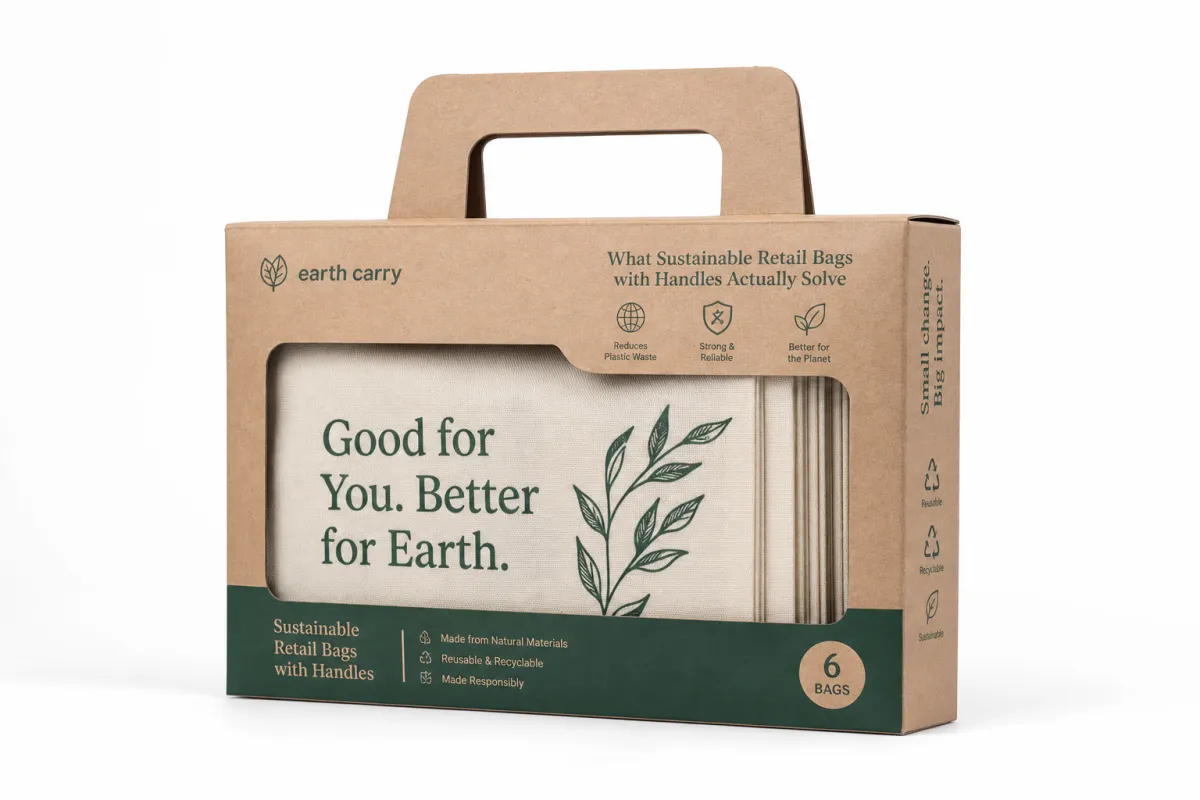
Sustainable retail bags with handles solve a practical retail problem that has a branding layer on top: a shopper needs a way to carry merchandise, and the store needs that carry method to feel intentional. A flimsy bag changes the mood in seconds. A bag that bows under a sweater, a candle, or a boxed set sends a message the brand probably did not mean to send, and once that impression lands, it is hard to walk it back.
Handles matter because they change how the load feels the moment the customer picks it up. They are not decoration, even though spec sheets sometimes make them sound that way. Handle length, shape, attachment, and stiffness all affect comfort and balance. A weak handle can make a 2 kg purchase feel risky. A well-built one can make a heavier order feel normal, which is exactly what you want at the point of sale. That little detail is often the difference between a bag that feels considered and one that feels kind of thrown together.
In retail, sustainable retail bags with handles usually play one of three roles. Boutiques and gift shops use them to keep the purchase looking premium after it leaves the counter. Grocery-adjacent stores, pharmacies, and specialty food counters use them as a more responsible carry option than low-cost plastic. Some brands choose reusable bags because repeat use is part of the value, and honestly, that is where the environmental case starts to make more sense. A bag that survives five or ten trips has more utility than one that disappears before the customer reaches the car.
The sustainability claim deserves careful handling. Recycled content, FSC certification, reusable woven material, compostable film, and plant-based language are not the same promise. FSC tells you something specific about fiber sourcing and chain of custody. It does not automatically tell you that every local recycling system will accept the finished bag. Recycled paper may reduce virgin fiber use, but coatings, heavy inks, and lamination can still complicate recovery. If you want to verify the standards, start with the FSC site and the recycling guidance from the EPA.
Picture a boutique selling candles, knitwear, and gift sets. Picture a specialty market carrying jars, produce, and boxed snacks. Picture a stationery shop selling notebooks, ceramics, and tools in compact packaging. In each of those settings, sustainable retail bags with handles do more than hold merchandise. They hold shape at the counter, carry more comfortably to the car, and keep the brand visible after the sale. That last part matters more than a lot of buyers expect. A bag is not dead packaging once it leaves the store. It keeps working as a moving surface that other people see.
"A bag either supports the sale or exposes the shortcut. There is not much middle ground."
The first job of sustainable retail bags with handles is plain retail performance. If the bag protects the product, carries comfortably, and gets reused, it earns its place. If it fails any of those tests, it becomes an expensive reminder that the cheapest option is rarely the least expensive choice.
How Sustainable Retail Bags with Handles Work in Real Use
Most sustainable retail bags with handles share the same basic structure: the body, the gusset, the base, the handle attachment, and the reinforcement points that keep the whole piece from failing under load. Weakness usually appears at the junctions. Handle seals pull first. Corners crease next. Bottoms bow when the bag gets pushed past its comfort zone. Good construction matters as much as the material because the material alone cannot rescue a poor build.
Kraft paper stays popular for good reasons. It is familiar, printable, and often easier to recycle than heavily coated alternatives. Recycled paper also works well, especially for brands that want a natural look and a clear recycled-content message. On the reusable side, nonwoven polypropylene, rPET, cotton, and jute show up often in sustainable retail bags with handles because they tolerate repeat use and heavier loads. The right material depends on whether the bag is meant to be used once, a handful of times, or long enough to become part of a shopper's routine.
Handle style changes the feel of the bag immediately. Twisted paper handles are common on paper bags and offer solid lift for moderate loads. Flat paper handles can reduce cost and suit lighter merchandise. Rope handles, especially cotton or polypropylene rope, usually read as more premium and tend to feel better in the hand. Die-cut handles keep the profile clean and can be economical, though they are less comfortable unless the opening is reinforced carefully. Stitched fabric loops and heat-sealed loop handles are common in reusable formats because they spread the load across the top panel more effectively.
Reinforcement decides whether the bag survives the real world. A handle attached to a weak fold line is asking for trouble. A stitched or reinforced attachment spreads stress and lowers the chance of a failure at the worst possible moment, which tends to be right after the cashier has already moved on to the next customer. Buyers who plan to use reusable bags should ask about the attachment area, the stitch pattern, and whether the bag was tested with an actual load instead of a flattering sample weight.
Printing affects performance and cost more than many buyers assume. Flexo printing can be cost-effective for straightforward graphics and larger quantities. Offset printing gives sharper detail on paper and suits brands that want a more polished appearance. Screen printing is a strong choice for reusable bags because it can produce durable logos with excellent opacity. If recyclability matters, lighter ink coverage and water-based inks often make more sense than full-coverage artwork, metallic finishes, or heavy coatings. Attractive design is welcome. Attractive design that blocks recovery is a different problem.
End-of-life behavior needs equal attention. Sustainable retail bags with handles are not automatically sustainable just because they are made from paper or carry a natural color. A paper bag that gets reused a few times and then recycled can be a sensible option. A cotton bag that stays in a cupboard and then gets thrown out offers far less environmental value than people tend to assume. Compostable film only makes sense when the disposal system can actually handle it, and even then the handle, print, and seal structure need to fit the material story rather than work against it. Too many brands confuse the label with the outcome.
Material families buyers actually compare
If you are narrowing down sustainable retail bags with handles, these are the material families most buyers compare and the tradeoffs they usually face:
- Kraft paper - economical, recyclable in many programs, good for lightweight to medium loads, and often the best fit for boutiques and gift retail.
- Recycled paper - strong sustainability message, slightly rougher surface, and a good match for lower-ink designs that want visible fiber character.
- Nonwoven polypropylene - durable, lightweight, and reusable, though not the same as paper recyclability, so it suits supermarkets and promotional use more than paper-centric claims.
- rPET - recycled polyester with good longevity and sharp print quality, though disposal still depends on local recovery systems.
- Cotton and jute - premium feel, high perceived value, heavier weight, and a stronger fit for repeat-use retail and brand gifts.
Matching the material to the moment matters more than chasing an abstract ideal. A single candle, a folded sweater, or a boxed accessory can travel comfortably in a reinforced kraft bag. Groceries or heavier merchandise usually deserve a reusable structure with more margin. There is no universal answer here, and anyone claiming there is one is usually selling a shortcut that will cost you later.
Key Factors That Decide Bag Performance and Cost
Width, depth, and height determine whether the bag actually fits the product or just looks right in a mockup. Add handle drop to that list and you get comfort, not just size. A bag can be tall enough to look premium and still fail because the base is too narrow for the item inside. It can also be wide enough on paper and still feel awkward if the handles are too short to carry by hand or over the forearm.
Load rating should be treated as a real spec instead of a vague reassurance. Many paper retail bags are used comfortably in the 2-5 kg range, depending on paper thickness, handle style, and reinforcement. Better-built paper bags can go higher, though that should never be assumed without asking for specifics. Reusable bags can often carry more, sometimes 6-10 kg or beyond, but only when the seams and handle attachment points are built for the task. Overpacking is still overpacking, whatever the sales sheet says.
Thickness and finish influence both appearance and cost. Paper is commonly discussed by basis weight, with many retail bags landing around 120-180 gsm for lighter builds and moving higher when added stiffness is needed. Reusable fabrics are usually judged in grams per square meter, and a move from a lighter nonwoven material to a stitched or thicker build changes the economics fast. Matte finishes often feel restrained and hide scuffs better. Gloss and soft-touch effects can look more refined, though they frequently raise the unit cost and can complicate recycling if they are overused.
Sustainability claims deserve proof. Recycled content percentages are useful only if the supplier can document them. FSC chain-of-custody matters when a brand needs fiber sourcing evidence. Compostable claims should be backed by the relevant standard, and for some film structures ASTM D6400 is one of the references buyers should recognize. If a supplier cannot explain how the claim behaves in the actual disposal stream, the claim needs more scrutiny. Packaging language gets stretched often enough that skepticism is part of good purchasing.
Brand value also belongs in the cost calculation. Sustainable retail bags with handles sit at the intersection of packaging and advertising, which is why a good one keeps working after checkout. A bag that looks considered, photographs well, and gets reused keeps the brand visible without another media buy. A bag that looks cheap and goes straight into the trash is not really inexpensive. It just hides the waste behind a lower invoice.
The best spec is usually the lightest option that still survives the real product load with a sensible margin. That margin matters more than people think. If the product weighs 1.8 kg, do not specify a bag as though 1.8 kg is the hard limit. Give yourself room for uneven packing, inserts, receipts, and the ordinary roughness of retail handling. A 20-30 percent buffer is often a reasonable place to start.
Testing should mirror actual use rather than idealized handling. If the bag moves from shelf to counter to car to home, it should survive that trip with some abuse. Transport and handling principles are well documented by organizations such as ISTA, and while a shopping bag is not a shipping carton, the same logic applies: real loads expose weak points faster than polished mockups ever do.
How Sustainable Retail Bags with Handles Are Priced
Price is never just one number. Material cost, handle style, print complexity, labor, tooling, freight, and packaging setup all find their way into the final quote. Sustainable retail bags with handles can appear cheap at first glance and then climb quickly once the buyer adds custom dimensions, premium printing, and a more refined handle finish. The reverse also happens: a reusable bag can look expensive per unit and still make sense because it survives many more uses.
Order quantity changes the math in a very ordinary way. Small runs spread setup costs across fewer units, which keeps the per-bag price high. Larger runs reduce the cost per piece because setup and labor get divided across more bags. A 1,000-piece run of sustainable retail bags with handles can feel expensive, while a 10,000-piece run of the same specification can look far more reasonable. The catch is obvious enough: if the spec is wrong, buying more of it only gives you more wrong bags.
Paper and reusable materials also carry different value logic. Paper bags often win on lower unit cost, especially for lightweight to medium loads and standard dimensions. Reusable bags cost more up front, but they often deliver stronger perceived value and a longer service life. If customers shop again and again, sustainable retail bags with handles in a reusable format can keep the brand in circulation much longer than a cheaper paper option.
Custom dimensions are another cost driver. Nonstandard sizes can increase waste, slow machine setup, and stretch lead time. The farther you move from standard sheet or roll sizes, the more you pay for that flexibility. Sometimes the custom size is worth it because the product fit is cleaner and the bag looks more intentional. Sometimes it is just a costly preference. Buyers Should Know the difference before approving tooling.
Hidden costs tend to surprise first-time buyers. Sample fees, proofing, plate charges for certain print methods, die charges for custom cutouts, protective inserts, and storage fees can all show up after the first quote. If you are comparing sustainable retail bags with handles, ask what is included and what is not. A tidy quote can change shape quickly once the extras appear, and the confusion usually starts with the parts nobody asked about early enough.
| Option | Typical unit price | Best for | Tradeoff |
|---|---|---|---|
| Basic kraft paper with twisted handles | $0.18-$0.35 at 5,000 pcs | Boutiques, gifts, light retail | Lower cost, shorter life span |
| Recycled paper with rope handles | $0.30-$0.65 at 5,000 pcs | Mid-market retail, higher perceived value | Better look, higher print and handle cost |
| Nonwoven reusable bag | $0.35-$0.90 at 5,000 pcs | Stores expecting repeated use | Durable, but not paper-recyclable |
| Cotton, jute, or rPET tote | $0.90-$3.50+ at 5,000 pcs | Premium branding, gifts, long reuse cycle | Higher cost, heavier freight |
Those figures are not promises. They are a sensible range, and sustainable retail bags with handles will still shift by country, freight lane, print coverage, material choice, and order size. A small custom run can cost far more than a repeat order of the same spec, while premium finishes can lift the quote quickly. Even so, a range like this gives buyers something useful to compare, which is far better than vague phrases like "affordable" or "budget-friendly" that usually only become meaningful after the invoice arrives.
The bag's marketing value belongs in the budget discussion too. A bag that feels considered, photographs well, and gets reused can justify a higher unit cost because it keeps doing work after the sale. Finance teams sometimes miss that part. The bag does not stop mattering the moment the customer leaves the store. Sustainable retail bags with handles can continue carrying the brand around for days or weeks if the construction and design are strong enough.
Process and Timeline: From Quote to Delivery
The cleanest buying process starts with a brief that is specific enough to be useful. Give the supplier the bag dimensions, the product weight, the expected reuse level, print colors, handle preference, and any sustainability requirements that actually need verification. If you ask for sustainable retail bags with handles without those details, you are asking the supplier to guess at your operating model, and guessing is not a procurement strategy.
The usual workflow is simple on paper: brief, material recommendation, quote, artwork review, sample or digital proof, approval, production, and shipping. Every step sounds short until a vague answer or a late revision slows it down. Custom sizing takes longer than standard sizing. New artwork takes longer than a logo tweak. Certification checks take longer than a simple paper quote. Last-minute changes after proof approval are where schedules tend to unravel.
Timelines depend on the build. Stock or lightly customized sustainable retail bags with handles can move quickly, sometimes in about 7-12 business days if the stock is local and the artwork is straightforward. Fully custom bags usually need more planning time, often 15-30 business days after proof approval, and that does not include shipping. International sourcing adds another layer, where ocean freight, customs clearance, and port delays can matter more than the production time itself. That is the part nobody wants to hear, even though it is often the part that decides the launch date.
If the schedule needs to stay under control, approve one decision at a time. Do not change the size, the handle, the print layout, and the material all in the same revision unless you enjoy vague delays and hard-to-read updates. Lock the dimensions first. Then settle the material. Then review the print. Then approve the sample. Sustainable retail bags with handles are much easier to buy once the target stops moving.
Testing also belongs in the process. If the bag will carry heavier merchandise or travel through a rough distribution path before the customer sees it, ask whether the supplier can reference load or transport testing. A simple drop test, seam pull check, or carry test can reveal a problem before a large order is placed. That is far less painful than discovering a handle weakness in a live store during launch week.
What to prepare before requesting quotes
- Dimensions - width, gusset, and height in millimeters or inches.
- Target load - the actual product weight and any add-ons like inserts or tissue.
- Reuse goal - one-time carry, several uses, or long-term retail tote.
- Print details - number of colors, placement, and finish level.
- Sustainability proof - recycled content, FSC, or compostable documentation if required.
- Order quantity - because 2,000 and 20,000 pieces are different conversations.
That checklist saves time and makes quotes easier to compare. Sustainable retail bags with handles get confusing when one supplier is pricing a paper bag, another is pricing a woven bag, and nobody has defined the carry load. A precise spec produces a more honest quote. A fuzzy one usually produces a guess dressed up as a recommendation.
Common Mistakes Buyers Make with Sustainable Retail Bags
The first mistake is buying for appearance alone. A beautiful bag that cannot hold the product is not branding. It is a complaint waiting at the register. Sustainable retail bags with handles need to survive the actual merchandise, the actual cashier behavior, and the actual walk to the car. If the bag fails in any of those places, the graphics do not matter much.
The second mistake is ignoring product depth and handle drop. A bag may fit the product height neatly and still feel poor because the gusset is too narrow or the handles are too short. That problem shows up often with boxed items and gift sets. Buyers tend to focus on the front-facing size because it is easier to picture. Packaging does not reward oversimplification.
The third mistake is mixing sustainability claims without checking how the bag behaves at end of life. A paper bag with heavy lamination, metallic ink, and a plastic-coated rope handle is not the same as a plain recyclable kraft bag. A reusable bag that lasts longer may still be the better environmental choice, but only if customers actually reuse it. Sustainable retail bags with handles work best when the claim and the construction align.
The fourth mistake is cutting corners on handles. Handle failures are unpleasant and public. They create replacements, returns, and a lot of silent embarrassment at the register, which is always more expensive than the small amount saved on the spec sheet. A better attachment may raise the unit cost slightly, but it also protects the brand from looking careless. Careless packaging stays in memory for the wrong reasons.
The fifth mistake is ordering too much before testing. Even a modest sample run can reveal print shifts, seam weakness, handle comfort issues, or color differences that a digital proof will never show. Sustainable retail bags with handles need to be judged in hand, with actual product inside, under normal store conditions. That is the only reliable way to know whether the bag truly fits the job.
The sixth mistake is writing "eco-friendly bag" on the brief and expecting useful quotes. Suppliers need dimensions, material goals, print expectations, and load requirements. Without those details, they have to fill in the blanks. Blanks get filled with assumptions, and assumptions are a very efficient way to waste money without learning anything useful.
Practical rule: if you cannot explain the bag in one sentence with size, weight, handle, and use case, the spec is not ready.
What failure usually looks like
Most bag failures are not dramatic. They show up as small annoyances that pile up: handles digging into hands, bottom seams bowing, print rubbing off, bags arriving crushed, or customers stuffing the bag with more weight than it should reasonably take. That is why sustainable retail bags with handles need to be judged on the boring details. Boring details are what keep the sales floor calm.
One more caution: do not confuse "reusable" with "indestructible." A reusable bag still has a realistic service life. Paper bags can be reused for lighter carry. Fabric-style bags can last much longer. Every format has limits, and honest specs beat marketing theater every time.
Expert Tips and Next Steps Before You Order
Start with a short internal checklist: product size, expected weight, reuse frequency, brand feel, budget range, and whether the bag must be recyclable, reusable, or simply responsible enough for the application. That sounds basic because it is. Sustainable retail bags with handles are much easier to buy once the job is defined before the finish gets all the attention.
Test two or three material options instead of hunting for one perfect sample on the first try. A paper option, a reusable option, and a premium option usually reveal the best value faster than endless revisions on a spec that was weak to begin with. You are solving a retail problem, not entering a material beauty contest.
Ask for side-by-side pricing that separates material, print, handle, and freight. Buyers get clarity faster when the quote shows where the money goes. If a supplier lumps everything together, it is hard to tell whether the price jump came from the handle upgrade, the print coverage, or the shipping method. Sustainable retail bags with handles become easier to approve when the tradeoffs are visible.
Request a physical sample and load it with the actual products you sell. Not a random weight. Not a guess. Your actual candle box, sweater fold, bottle, or gift set tells the truth in a way a PDF never can. Handle comfort changes in hand. Seam strength changes under real load. Shelf presence changes once the bag is holding something. Hands-on testing shows what a spec sheet leaves out.
Plan the first order like a controlled pilot. Do not commit to huge volume before the bag has actually been used in the store. Start with a realistic quantity, collect customer feedback, check return rates, and watch how the bag performs at checkout. Then refine. Sustainable retail bags with handles improve through evidence, not optimism.
If you are buying for a chain, ask stores what actually happens at the counter. Some locations need a longer handle drop because staff carry several bags at once. Some need a wider gusset for boxed goods. Some want a more elevated look because the bag ends up in customer photos. The right bag spec often changes by channel, even when the brand stays the same.
Lock one approved spec and keep it in place long enough to learn from it. That approach feels dull, but it saves money. Sustainable retail bags with handles become much easier to scale once the product, the budget, and the checkout flow fit together. If the bag works, expand it. If it does not, fix the spec before ordering more of the same mistake.
FAQs
Are sustainable retail bags with handles actually reusable?
Yes, if the material and construction are built for repeat use rather than a single checkout trip. Paper versions can be reused for lighter loads, while woven, rPET, cotton, or jute versions usually last longer. Check seam strength, handle attachment, and load rating before treating any bag as reusable.
What affects the price of sustainable retail bags with handles the most?
Material choice, custom size, handle type, print count, and order quantity usually move the number more than anything else. Special finishes, certification requirements, and freight can raise the total quickly. Larger runs usually lower the unit price, but only if the spec is already right.
Which material is best for sustainable retail bags with handles?
There is no single best option. It depends on product weight, reuse goals, and brand presentation. Paper is often easier to recycle, while fabric-style bags usually last longer and feel more premium. The lightest material that still handles the real load is usually the most sensible choice.
How long does production usually take?
Stock or lightly customized bags can move faster than fully custom builds. Custom dimensions, new artwork, special handles, and proof revisions all add time. Build in buffer for shipping and approval delays so the launch date does not get derailed by one slow step.
How do I know if a bag is truly sustainable?
Ask what the bag is made from, how it is sourced, and whether the claim can be verified with documentation. Look at the full build: material, ink, coating, handle, and end-of-life behavior all matter. A bag is only as sustainable as the least recyclable or least reusable part of it.
Buyers who get the best results usually treat sustainable retail bags with handles as a packaging spec, not a slogan. That means testing the build, checking the claim, and matching the bag to the product instead of hoping the universe will excuse a weak choice. It usually does not. Get the spec right, and you will end up with sustainable retail bags with handles that do their job quietly, hold up in real use, and keep the brand looking like it paid attention.


