For a drop-day shipment, a visibly sealed bag does more than keep fabric clean. It signals that the piece is untouched, accounted for, and packed with a clear chain of control. That matters for authenticity checks, missing-item disputes, and the confidence a brand builds when every unit arrives with first-open proof.
Streetwear buyers notice details quickly. A switched size, a loose reseal, or a repackaged return can trigger complaints fast, especially when the item was part of a limited run. In practice, a tamper-evident bag can act as a control point between the warehouse and the customer. It protects preorder drops, replenishment stock, and bundled sets, while also separating shelf-ready presentation from transit protection.
Why a sealed bag changes the customer’s first impression
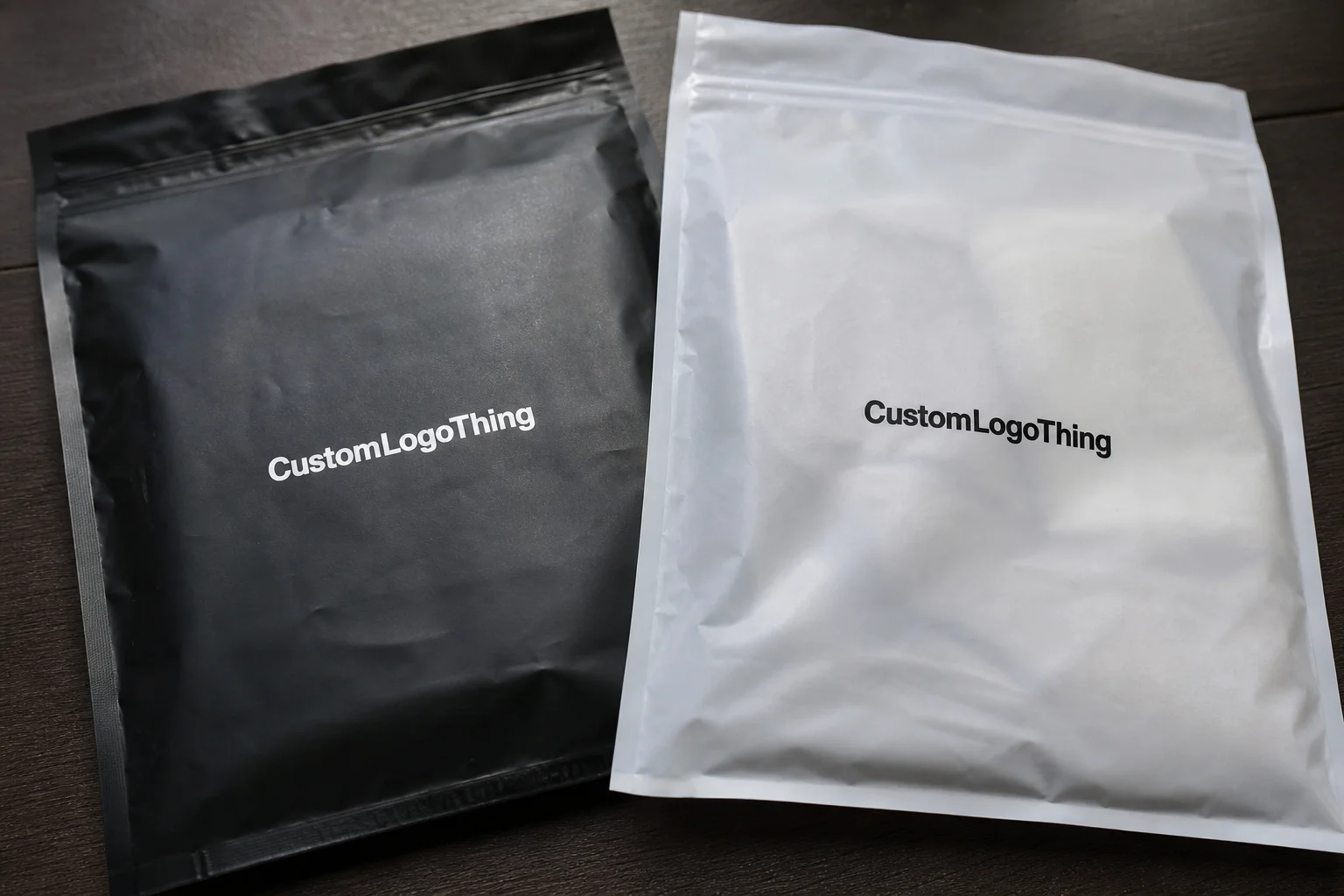
Streetwear is a trust business. The garment may be the product, but the packaging becomes the evidence. When a sealed bag arrives intact, the customer reads it as proof that the item has not been handled, swapped, or quietly reinserted into inventory after a return. That signal can cut post-purchase friction more effectively than a generic insert card ever will.
It also lowers the noise around fulfillment errors. Missing pieces, wrong sizes, and repackaged returns become harder to argue when the seal clearly shows first-open status. The bag cost is visible; the dispute cost is usually hidden until the quarter closes.
For limited drops, the bag can support the brand story. For wholesale replenishment, it is closer to inventory control. Same material, different objective. One is merchandising. The other is chain-of-custody discipline.
“If the bag cannot prove first-open status, it is only half a control measure.”
Bag formats, closure styles, and anti-tamper features
The right format depends on how the item leaves the warehouse and how the customer receives it. Flat bags work well for tees and light accessories. Gusseted bags handle thicker hoodies or bundled sets better because they give the garment room without forcing the seal line. Zipper-style pouches with break seals can work for premium presentation, but the closure still has to show clear first-open evidence. Adhesive closure bags stay common because they are economical, quick to run at pack-out speed, and easy to standardize.
Streetwear labels usually care most about tear strips, security seals, serialized labels, and warning text that makes the tamper function obvious. Opaque or frosted film can hide interior contents in transit while still leaving room for branding. Clear film supports retail presentation and size identification, but it also shows scuffs and handling marks more easily.
Material choice matters too. PE is common for soft, flexible bags. CPP gives a smoother, crisper feel and can improve clarity. Multi-layer film is used when a brand needs a stronger seal or a better balance between softness and stiffness. If the bag has to survive warehouse handling, the seal design matters as much as the film.
There is a difference between a simple evidence strip and a stronger chain-of-custody design. If the item only needs to show that it was unopened, a breakaway adhesive strip may be enough. If the bag will be used for premium resale, wholesale transfers, or controlled inventory movement, serialized labels or numbered seals add traceability.
Custom print should support the tamper function, not compete with it. Size marks, SKU codes, logo placement, and warning copy can all sit on the panel without interfering with the seal line. The better layouts make the bag easier to sort in the warehouse and easier to recognize on shelf.
For buyers comparing format options, the decision usually comes down to use case rather than brand preference:
| Format | Best use | Typical MOQ impact | Cost tendency |
|---|---|---|---|
| Flat adhesive bag | Tees, light accessories, simple DTC packing | Lower | Lowest cost per piece |
| Gusseted sealed bag | Hoodies, bundles, thicker folded items | Moderate | Moderate |
| Zipper pouch with break seal | Premium presentation, limited editions | Higher | Higher unit cost |
| Serialized security bag | Controlled inventory, wholesale, audit trails | Highest | Highest |
If you need adjacent packaging support, a label or tag system can help the warehouse move faster. See Custom Labels & Tags for branded identification options that pair well with security packaging.
Spec sheet decisions that affect fit, durability, and shelf appeal
Start with the packed garment, not the flat garment spec. A hoodie folded with tissue, a tee packed with an insert card, and a two-piece set do not occupy the same footprint. Measure the final packed dimensions in the sequence your team actually uses. That is the most reliable way to avoid a bag that looks correct on paper but fights the seal line during packing.
Thickness is another point that gets overcomplicated. Buyers often ask for heavier film when they actually need a wider seal or better material behavior. A 2.5 mil bag may outperform a thinner option if the adhesive or heat seal is consistent. On the other hand, thicker film can raise cost without changing first-open evidence. For many streetwear runs, the useful range sits around 2.0 to 3.0 mil, depending on item size and handling risk.
Seal width affects both durability and tamper visibility. A narrow seal may save material, but it can be more vulnerable during packing or transit. A wider seal improves confidence, yet it can reduce usable interior space. That tradeoff becomes obvious when a hoodie is compressed too hard and the seal line wrinkles.
Print requirements should be planned with warehouse operations in mind. Leave a clear panel for barcodes, SKUs, and size identification. Place the logo where it helps retail presentation without covering the seal path. If the bag is used in a busy distribution center, add warning copy that is visible at a glance.
Finish choice depends on channel. Clear film suits direct retail display and transparent merchandising. Frosted film hides minor internal imperfections and usually feels more premium in hand. Matte or tinted options can work for brand expression, but they should not make it harder to inspect the contents.
Compliance basics should not be ignored. Apparel bags are not food-grade or medical packaging, but storage stability, odor control, and handling quality still matter. For shipping protection standards and transportation testing, suppliers should be comfortable discussing ISTA test methods. If recycled content or sourcing claims are part of the brief, FSC information may matter for inserts or paper components; see FSC for chain-of-custody context. For general materials and waste reduction guidance, EPA resources are useful when comparing recycled content claims and disposal assumptions.
Tamper Evident Bags for Streetwear Labels: Cost, Pricing, and MOQ
This is where most buying decisions get made. The price is not just the price. It includes size, film thickness, print colors, closure type, tooling fees, and whether the bag is a stock format or a fully custom build. If you ask for a quote without those variables pinned down, you will get a number that looks usable but is not actually comparable.
For stock-style tamper-evident bags, MOQs are usually lower because the supplier is using existing tooling and standard dimensions. Fully branded runs generally need a higher MOQ because the artwork, structure, or closure features must be set up for your order. A realistic buying range for custom streetwear packaging may start around 1,000 to 3,000 pieces for simpler stock-based customization, then move higher for custom sizes, additional print colors, or serialized security features.
Pricing moves faster than many buyers expect. A plain clear security bag will usually cost less than a frosted printed version with warning text and a reinforced adhesive strip. Add a second print color, and the cost per piece climbs. Add custom sizing, and it climbs again. If there are tooling or setup charges, those can matter more on short runs than on larger production orders.
Read a quote by separating the line items:
- Unit cost: the price per bag at your stated quantity.
- MOQ: whether the minimum is per size, per artwork version, or per combined order.
- Setup charges: plate, artwork, or machine preparation costs.
- Sample cost: whether a pre-production sample is free, credited, or billed separately.
- Freight: whether shipping is included or billed from origin.
- Reprint terms: what happens if the first production run misses spec.
For context, simple printed security Bags for Apparel can sometimes land in the roughly $0.12 to $0.25 per piece range at higher quantities, while more complex custom versions can move into the $0.25 to $0.60 range or beyond, depending on print coverage, closure Design, and Order size. Those figures are directional, not universal. If your drop is small, the lowest unit price may still be the wrong decision if the MOQ ties up cash or leaves dead inventory after launch.
The real rule is straightforward: do not choose a lower cost per piece if the order structure creates waste. A label that sells 1,500 units but orders 5,000 bags to save a fraction on unit price is not saving money. It is carrying packaging inventory instead of product inventory.
If you are comparing packaging costs across channels, line up like for like. A slightly higher bulk pricing tier may be the better option if it reduces spoilage, mispacks, or manual sealing time. Packaging economics are rarely about one number on a quote. They are about total landed cost and the friction built into operations.
Process, turnaround, and lead time from proof to shipment
The order flow should be clear: inquiry, spec confirmation, artwork review, sample or digital proof, approval, production, quality control, and shipment. If a supplier cannot explain that sequence cleanly, expect confusion later. A buyer should never have to guess which version was approved or whether the quoted MOQ applies to the final artwork.
Turnaround changes with customization depth. A stock bag with a logo mark and standard closure may move through production in roughly 10 to 15 business days after proof approval. A custom structure, special film, or serialized design can stretch that to 15 to 25 business days or more. Rush requests can compress the schedule, but they also raise the chance that something else slips.
The most common delays are usually boring: missing artwork files, a size change after proofing, or late approval on the first article. Buyers often underestimate how much time is lost when three people approve one detail differently. If one person owns the final sign-off, lead time usually improves.
Pre-production samples are worth the time because they catch errors before the run starts. Seal strength, fit, print placement, and closing behavior all need to be tested with the actual garment inside the bag. A sample is not a formality. It is a cheap way to avoid a costly reprint.
To shorten lead time without giving up control, finalize the dimensions first, then the print, then the closure spec. That order works better than the reverse. Keep a version note for artwork files so the next order does not restart from scratch.
What a streetwear-focused supplier should prove before you order
Repeatability is the first test. A supplier should be able to match the same seal behavior, dimensions, and print quality across reorder cycles. If the first batch looks good but the second batch changes in seal strength or panel alignment, the packaging system is not stable. For a brand with drop-based sales, that inconsistency shows up quickly.
Quality control should be specific, not vague. Ask whether the supplier checks dimensions in-line, tests seal performance, and inspects print registration before shipment. If the answer is only “we do QC,” keep asking. Buyers need evidence, not slogans. Packaging testing may include drop checks, seal integrity checks, or transit simulation aligned with ISTA methods, depending on the product risk.
Responsive communication matters more in streetwear than in slower categories. Small-batch restocks, preorder fulfillment, and limited releases do not leave much room for silence. A supplier that answers clearly on MOQ, pricing, and print options helps keep the calendar on track.
The better partners also help with practical decisions. They can suggest a more accurate size, explain why one film is better for folded hoodies, and identify where artwork should be trimmed to protect the seal area.
Next steps: lock the spec, request samples, and plan the reorder
Start with three things: the packed garment dimensions, the target quantity, and whether the bag needs to signal first-open tamper evidence or simply support retail display. That is enough to frame a useful quote without turning the first conversation into a spec audit. If the order is for a hoodie drop, a tee restock, or a bundled set, say so directly.
Request at least one sample or production-style proof before approving a bulk order. Then test it in the real packing workflow, not just by hand. A sample that looks perfect on a desk can still fail on the line if the seal is too narrow, the film is too stiff, or the print sits too close to the closure.
Get the final details in writing: spec, MOQ, lead time, and the rule for artwork changes after approval. That protects both sides and makes reorders faster because there is no guessing about film type, seal style, or print version. The best packaging systems are the ones you do not have to relearn each season.
For future runs, keep a short reorder note: SKU, film type, seal style, printed message, and file version. That note can save time on the next quote and reduce back-and-forth. If you keep a packaging archive with your supplier, launches move faster and replenishment gets cleaner.
What MOQ should I expect for tamper evident bags for streetwear labels?
Stock-style bags usually support lower minimums than fully custom printed builds. MOQ rises when you add custom size, special film, extra colors, or serialized security features. Ask whether the quoted MOQ is per size, per artwork version, or per combined order.
Can tamper evident bags be custom printed for a streetwear drop?
Yes, most suppliers can add logos, size marks, warning text, and barcode space. Keep print placement away from the seal path so the tamper signal stays clear and functional. Request a proof that shows both the artwork and the closure area before production starts.
How do I choose the right size for hoodies, tees, and sets?
Measure the final packed item, not the flat garment, because folding and inserts change the footprint. Leave enough room for clean sealing without forcing the seam or stretching the film. For bundled sets, test with the actual packing sequence to avoid a bag that is technically large enough but hard to close.
What affects lead time the most on custom security bags?
Artwork approval and sample signoff are the most common bottlenecks. Material availability, print complexity, and order volume also move the schedule. If you need a faster turnaround, finalize the spec before requesting the quote.
What should I check in a sample before placing a bulk order?
Check seal performance, tear behavior, print clarity, and whether the bag fits the packed item without stress. Test the bag through your actual packing workflow, not just by hand. Confirm that the sample matches the quoted thickness, closure style, and artwork version exactly.


