A supplement launch can look tidy on paper and still wobble once packaging enters the picture. That is the hidden arithmetic behind vitamin brand Kraft Paper Bags MOQ. A team can spend months on formula work, label copy, and channel planning, then discover the bag spec nudges the budget in a direction nobody expected. A zipper, a liner, a window panel, or one more print color can do that. Packaging is not the final box to tick. It sets the cost shape of the launch before the first unit leaves the plant.
The first question is rarely about looks, even if the brand deck makes it feel that way. The real questions are practical: does the structure protect the product, does it survive transit, and does it keep cash from being trapped in excess inventory? Kraft Paper Bags attract vitamin brands for a reason. They are lighter than rigid containers, easier to store, and often better suited to trial runs. A warehouse can hold a stack of flat bags in the same footprint that bottles would need in a few pallets. For a launch that is still being tested, that difference matters a lot.
I have seen brands approve a beautiful mockup and then get blindsided by the production side. The art looked clean. The unit cost did not. The issue was not the designer. It was the mismatch between a nice-looking bag and a build that could actually handle filling, shipping, and shelf handling. That gap is where many first orders get expensive. A low MOQ only helps if the structure behaves in real life, not just in a render.
If you are comparing packaging formats, our Case Studies show how different builds affected actual launches, and the order details in our FAQ cover the production questions that tend to slow approvals.
Why vitamin brand kraft paper bags MOQ changes the launch math
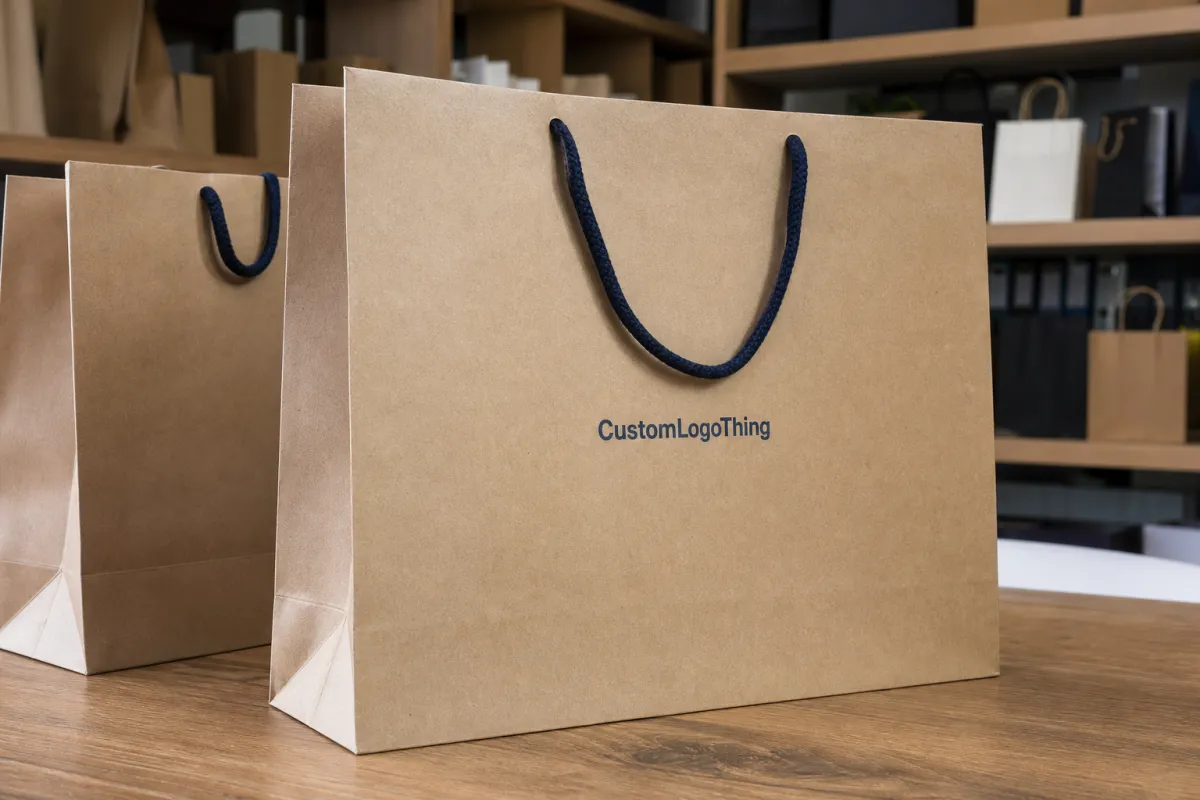
Vitamin Brand Kraft Paper Bags MOQ changes more than the purchase order total. It changes the risk profile of the launch. Fixed packaging costs do not shrink just because the run is small. A die line still has to be created. Plates still have to be prepared. Proofs still need review. Sampling still takes time. Spread those costs across 3,000 bags instead of 30,000, and the unit price climbs quickly. One small design change can move the number more than a modest material upgrade.
That is why a single extra print color can matter more than buyers expect. A zipper closure can do the same. Add a metalized liner or a window panel and the quote changes again, not only because of materials but because the workflow gets more complicated. The true cost is never just ink or film. It is labor, setup, waste, and the chance that the order needs revision after approval. Packaging behaves like infrastructure, even if the brand treats it like decoration.
Kraft Paper Bags make sense for vitamins for practical reasons. They are light. They stack efficiently in shippers. They usually cost less to store than rigid options. They also signal a restrained wellness position that feels credible without trying too hard. That matters for brands that want a natural look without locking themselves into a heavy opening buy. The package can support the first impression without becoming the most expensive line item in the product.
For launch planning, the structure usually has to do one of four jobs:
- Testing: a new SKU, flavor, or dosage format in a small pilot run.
- Subscription packs: compact units that ship repeatedly and need low freight weight.
- Channel splits: inventory divided between retail, e-commerce, and sample programs.
- Reorder readiness: a format that can scale once sales data supports a larger run.
The lowest MOQ does not automatically mean the lowest risk. A weak structure can erase any savings if it fails on seal integrity, shelf presence, or moisture control. That risk rises with capsules and tablets if the barrier is underspecified, and it rises even faster with gummies or powders, which can clump or change texture when the package is not built for the formula. Vitamin brand Kraft Paper Bags MOQ works best when the build matches the product, not just the mood board.
That is the part many teams miss. Packaging quantity is an operating decision, not a branding accessory. A clean kraft bag can support a smart launch without forcing the brand into oversized inventory. It can also keep the unboxing simple: one compact primary package inside a labeled shipper is often better than a bulky container that eats margin before the first sale lands.
Product details for vitamin brand kraft paper bags MOQ orders
The strongest vitamin brand Kraft Paper Bags MOQ quote starts with a clear bag type. Four structures show up most often: flat bags, gusseted pouches, stand-up pouches, and paper-finish bags with inner liners. Each solves a different problem. Flat bags suit samples and small tablet counts. Gusseted formats add depth without the jump that comes with a rigid carton. Stand-up pouches improve shelf visibility. Paper-finish bags with liners give extra protection for formulas that need stronger moisture control.
Capsules and tablets are usually the easiest products to pack. They are dense and stable, so the package does not have to fight the product. Gummies and powders need more attention. They absorb moisture, clump, and change texture faster if the package is not designed well. That is why the formula should be settled before the print finish is chosen. A low vitamin brand Kraft Paper Bags MOQ looks attractive until the product starts degrading before the end of shelf life.
Branding choices matter more than procurement teams sometimes expect. Uncoated or matte kraft surfaces create a natural look, but they absorb ink differently from coated films. Window panels reveal the product, though they usually reduce barrier performance unless the structure is built carefully. Spot color printing can keep a premium feel without pushing the order into expensive full-coverage art. Sometimes a disciplined custom label and a consistent dieline create a stronger brand impression than decorative extras that slow proofing and inflate cost.
Small details decide whether the bag is shelf-ready or prototype-only. Look for tear notches, resealable zippers, hang holes, desiccant-compatible interiors, and enough room for lot code and expiry date placement. Those details look minor on a spec sheet. In production, they affect fill speed, sealing behavior, and whether the warehouse has to relabel every unit after receipt.
Panel sizing deserves equal attention. A bag can still feel premium when the artwork is restrained, the margins are clean, and the layout respects the cut line. Crowded graphics and mismatched spacing usually make a structure look cheaper, not more polished. Vitamin packaging tends to look strongest when it reads as calm and controlled. The package should look like it knows what it is doing.
A lower MOQ only helps if the structure survives filling, shipping, and shelf handling.
Quoting should never start from a vague brief. If the team is unsure whether the bag needs to be flat or stand-up, the dieline may change later, and that reopens the proof cycle. The timeline slips, the cost changes, and the launch team starts making decisions under pressure. Vitamin brand kraft paper bags MOQ should be based on a fixed structure, closure, liner, and print scope before the first price is requested.
I have sat in review calls where everyone liked the same sample, but nobody had locked the fill weight. That sounds small. It is not. A few millimeters of extra width can change case pack counts, freight density, and even the way the bag sits on a retail shelf. The bag spec is not paperwork. It is the thing the rest of the launch has to fit around.
Specifications that affect print quality, barrier, and compliance
The spec sheet is where packaging becomes measurable. For vitamin brand kraft paper bags MOQ orders, the core variables are paper thickness, inner liner or film, bag dimensions, gusset depth, seal strength, and closure type. Two bags can look almost identical in a mockup and perform very differently once the outer kraft, barrier layer, and seal are combined. A buyer who compares only appearance is comparing the wrong thing.
Barrier needs depend on the product, not the trend. Vitamins can be sensitive to moisture, oxygen, and light. Some formulas are forgiving. Others are not. Overbuilding the barrier adds cost that may never pay back. Underbuilding it risks stability, returns, and complaints after launch. The right answer sits between those extremes and depends on the formula, the storage environment, and the expected shelf life after fulfillment.
Print specifications need to be locked early too. Artwork bleed, safe margins, Pantone references, barcode area, ingredient panel space, and warning copy all affect the proof. A quote can look excellent until the designer notices the barcode sits too close to a seal or the lot code needs a different panel. That is not a design failure. It is a production conflict. Packaging and compliance have to share the same space without crowding each other out.
Procurement teams should ask direct questions before approval:
- Where will the lot code and expiry date be printed?
- Does the structure need child-resistant features, or is that outside scope?
- Will the bag serve as primary retail packaging or live inside another carton?
- Is the outer kraft FSC certified, and can that claim be documented?
- Does the build contain recycled content or post-consumer waste, and can the supplier prove it?
Those details matter because words like recycled materials and biodegradable packaging get used loosely. A kraft outer layer does not make the full pack biodegradable if the liner is plastic or metalized. Recycled content claims need documentation. They need a paper trail, not just a label. If sustainability is part of the buying brief, the construction should match the claim.
Transit testing should go beyond visual inspection. Fill the bag. Seal it. Put it in a shipper. Handle it. Inspect it after movement. If the team wants a more formal method, ISTA publishes package testing standards used to simulate shipping stress. For sourcing teams that need fiber documentation, FSC remains the reference for chain-of-custody and responsible forest management. Those standards do not replace the brief, but they sharpen the questions a buyer asks.
Shelf footprint deserves its own check. A vitamin pouch that stands a few millimeters taller than expected can throw off case packing, pallet counts, or retail fit. That sounds trivial until the logistics team has to redesign the master carton or revise a retail display plan. Good specifications prevent those surprises before they become chargebacks.
Another practical point: print on kraft can shift warmer or duller than a brand team expects from coated stock. That is normal. If the palette depends on bright whites or crisp metallic effects, the team should test whether the chosen surface can actually carry that look. Otherwise the sample may come back technically correct and emotionally wrong. That mismatch is easy to miss on screen and hard to ignore in hand.
Vitamin brand kraft paper bags MOQ pricing and quote math
Pricing follows the build. For vitamin brand kraft paper bags MOQ, the main drivers are size, print colors, paper grade, liner type, closure style, and whether the order is stock or fully custom. A one-color flat bag on basic kraft behaves very differently from a stand-up pouch with a zipper, a window, and multiple finishes. The supplier is pricing setup, labor, waste, and schedule risk as much as materials.
The buyer’s version of MOQ is slightly different from the factory’s. It is not only the smallest number the supplier will accept. It is the point where setup cost, labor, and material waste become workable enough that the order can support a real launch. At lower quantities, errors are amplified. At higher quantities, the unit price improves, but only if the structure is not overbuilt and freight stays under control.
| Build | Typical MOQ | Indicative unit cost | Best fit | Notes |
|---|---|---|---|---|
| Flat kraft bag, one-color print | 3,000-5,000 | $0.16-$0.26 | Samples, trial launches, small tablet packs | Lowest setup burden, limited barrier |
| Gusseted kraft pouch, zipper, inner liner | 5,000-10,000 | $0.24-$0.42 | Capsules, gummies, subscription packs | Better reseal behavior and shelf stability |
| Stand-up kraft pouch, window, spot finish | 10,000+ | $0.32-$0.58 | Retail launches, premium wellness lines | Stronger shelf presence, more setup complexity |
These ranges are illustrative, not fixed. Freight, taxes, and sampling sit outside them. Artwork changes do too, along with die-line revisions, rush production, and post-approval edits. A quote that looks inexpensive can become costly if the buyer has to revise files twice or move the ship date. For vitamin brand kraft paper bags MOQ, landed unit cost is the figure that matters. The headline price is often just the opening move.
Tiered pricing helps reveal the real economics. A pilot run may be the right move for a new SKU, but a core production run shows the cost once demand is proven. Reorder pricing can differ sharply from launch pricing because the setup is already complete and the supplier understands the structure. Buyers who compare only one quantity are often comparing the wrong stage of the product life cycle.
Hidden costs tend to hide in predictable places:
- Artwork changes after proof approval
- Dieline revisions when the format shifts
- Sample edits caused by copy or barcode placement
- Rush fees when the launch date moves
- Imported freight changes when shipping terms are unclear
The rule is simple. Never compare bag quotes unless the size, print method, material, closure, and shipping assumptions are identical. If one supplier includes a liner and another does not, the lower number is not the lower cost. In vitamin brand kraft paper bags MOQ buying, disciplined comparison saves more than aggressive haggling.
The cheapest quote is not the cheapest package if the spec changes after approval.
One more thing tends to get missed: sample charges can be a signal, not just a fee. If a supplier is willing to produce a realistic mockup that reflects the actual build, that sample may save far more than it costs. A cheap sample that ignores the real barrier, closure, or print method can send the team down the wrong path. I would rather pay a little more for a sample that tells the truth.
Process, timeline, and lead time for vitamin brand kraft paper bags
Strong packaging timelines are built step by step. The usual workflow for vitamin brand kraft paper bags MOQ is discovery call, spec confirmation, artwork review, digital proof, sample or mockup, approval, production, and shipping. Each stage can stall for a different reason. The buyer who knows where the risk sits can control the schedule more effectively.
Fast quoting is not the same as fast production. A quote can return quickly if the brief is complete. Lead time depends on final artwork, sample approval, and whether the production queue is already full. The supplier can move quickly only if the buyer makes the order easy to execute. Clarity is a production asset. It saves more time than pressure ever does.
Send complete information from the start:
- Target bag size and fill weight
- Expected quantity and any tiered quantity options
- Print count, Pantone references, and artwork files
- Closure type, liner type, and barrier target
- Ship-to location and requested delivery window
- Any compliance copy, lot-code rules, or retail requirements
The common blockers are easy to predict. Missing dielines. Unclear Pantone values. Late label changes. Incomplete ingredient panels. Back-and-forth on zipper or window choices. Each one pushes the order back into proofing. A solid vitamin brand kraft paper bags MOQ plan removes those loops before production starts, which is where most delays become expensive.
Internal approval time matters just as much. Procurement review, brand signoff, quality review, and freight planning can each add days. If the product launch is tied to retail commitments or subscription shipments, sample handling and transit time need room in the schedule. A good bag order can still slip if the team assumes production is the only clock that counts.
In practice, a straightforward order with final artwork and a locked structure often moves faster than a smaller order with open questions. That is not a contradiction. It is a reminder that the number of changes matters more than the number of units. A buyer who settles the structure first usually gets a cleaner timeline than a buyer who is still debating between formats.
For teams that are juggling a launch calendar, the safest move is usually to freeze the packaging spec before the product announcement goes public. That keeps the sample path, compliance checks, and freight booking from colliding at the last minute. I have watched that collision happen. It is not pretty, and it is almost always avoidable.
The best lead time is the one the team can actually keep. Brands that decide the packaging spec first and place the order second tend to avoid rework, protect the launch calendar, and keep vitamin brand kraft paper bags MOQ inside a manageable procurement process instead of a late-stage scramble.
Why choose us and what to send for your quote
The value of a packaging supplier shows up in the quote, not the sales pitch. For vitamin brand kraft paper bags MOQ orders, the supplier should confirm the build clearly, flag MOQ issues early, and help the buyer compare equivalent options instead of fuzzy approximations. Good sourcing is usually less about persuasion and more about precision.
That matters because packaging mistakes hurt in the least forgiving places. A bag that is even slightly off on size can slow filling. A liner that is too light can threaten product stability. A closure that does not fit the way the product is packed can create complaints later. The supplier should be able to explain those tradeoffs in plain language and back them up with numbers. If a source cannot do that, the quote is not ready.
If you want a quote that is actually useful, send this:
- Bag dimensions or target fill weight
- Preferred style: flat, gusseted, stand-up, or liner-backed
- Print colors and whether you want full coverage or restrained branding
- Closure type, window requirement, and barrier expectation
- Artwork file, dieline, barcode placement, and copy blocks
- Target quantity plus a second quantity for comparison
- Ship-to address so freight is part of the discussion
Ask for two pricing paths if possible. One should reflect the lowest feasible opening quantity. The second should show a more efficient reorder volume. That gives the team a cleaner view of the cash tradeoff and a better sense of whether the launch should begin as a pilot or move straight into a more scalable run. For many vitamin brands, that comparison is more useful than a single number.
A sample or mockup is usually worth the time, especially when the brand is introducing a new line or replacing an old structure. It helps verify panel balance, closure behavior, shelf fit, and the overall unboxing experience. If the bag will sit beside glass bottles, corrugated cartons, or other supplement packs, the sample will reveal whether the finish is too dull, too busy, or just right.
The point is not to chase the lowest quote. The point is to place the right order once, with the right data, at the right volume. If you are ready to compare specs, send the details, review the proof, and confirm the vitamin brand kraft paper bags MOQ that fits the launch instead of forcing the launch to fit the packaging.
That is the cleanest takeaway here: lock the structure, verify the barrier, compare landed unit cost, and only then decide whether the MOQ works for the launch. Do that, and the packaging stops behaving like a surprise expense and starts acting like part of the plan.
FAQ
What is a typical MOQ for vitamin brand kraft paper bags?
It depends on size, print complexity, and whether the bag is stock or fully custom. Plain or lightly printed builds often allow lower volumes than multi-color branded structures. If you are planning a launch, ask for tiered vitamin brand kraft paper bags MOQ options so you can compare a pilot run against a reorder-friendly quantity.
Can vitamin brand kraft paper bags MOQ orders include barrier protection?
Yes, but the liner or coating choice affects cost, recyclability, and the minimum order size. Moisture and oxygen protection should match the stability needs of the vitamin product. Request a sample build so you can verify seal strength and shelf performance before approval.
How do I compare vitamin brand kraft paper bags MOQ quotes correctly?
Match the same size, paper grade, print method, closure type, and shipping assumptions across every quote. Include freight, samples, artwork changes, and setup charges in the comparison. The better measure is landed unit cost, not the lowest headline price. That approach is especially important for vitamin brand kraft paper bags MOQ orders with different liner or finish options.
What artwork do you need for a fast quote on vitamin brand kraft paper bags?
Send the target size, quantity, print colors, and the full artwork file or dieline. Include barcode placement, lot-code space, expiry-date area, and any compliance text. The more exact the file pack, the faster the quote and proof cycle.
How long does production take after MOQ approval?
Lead time depends on proof approval, sample signoff, and the production queue. Simple orders move faster when artwork is final and the specs are already locked. Ask for a stage-by-stage timeline so you know when approval, production, and shipping will happen.
Are kraft paper bags always a sustainable choice?
Not automatically. The outer kraft layer may be recyclable or FSC certified, but the full pack can still include plastic film, metalized liner, or adhesive layers that change the end-of-life story. Ask for construction details and documentation before making any sustainability claim.


