Tea Printed Poly Mailers material thickness guide is a narrower topic than it first looks. Thickness affects shipping durability, print quality, storage behavior, freight cost, and even how premium the package feels in hand. Choose too light a film and the mailer can split at the corner or crease badly around the seal. Choose too heavy a film and you pay for material that adds little real value.
Tea is a good example of why this decision deserves more than a quick guess. The product usually ships inside a retail pouch, carton, or gift set, so the outer mailer is not carrying the full burden by itself. Still, the outer layer is the first thing a customer sees, and the first thing carrier handling tests. That combination changes the spec. A mailer for tea is not just a sack for transport; it is part of the product presentation and part of the damage control plan.
Thicker film can improve puncture resistance, but the best result usually comes from balancing thickness, seal strength, bag size, and the packaging already inside the mailer.
Tea Printed Poly Mailers Material Thickness Guide for Buyers
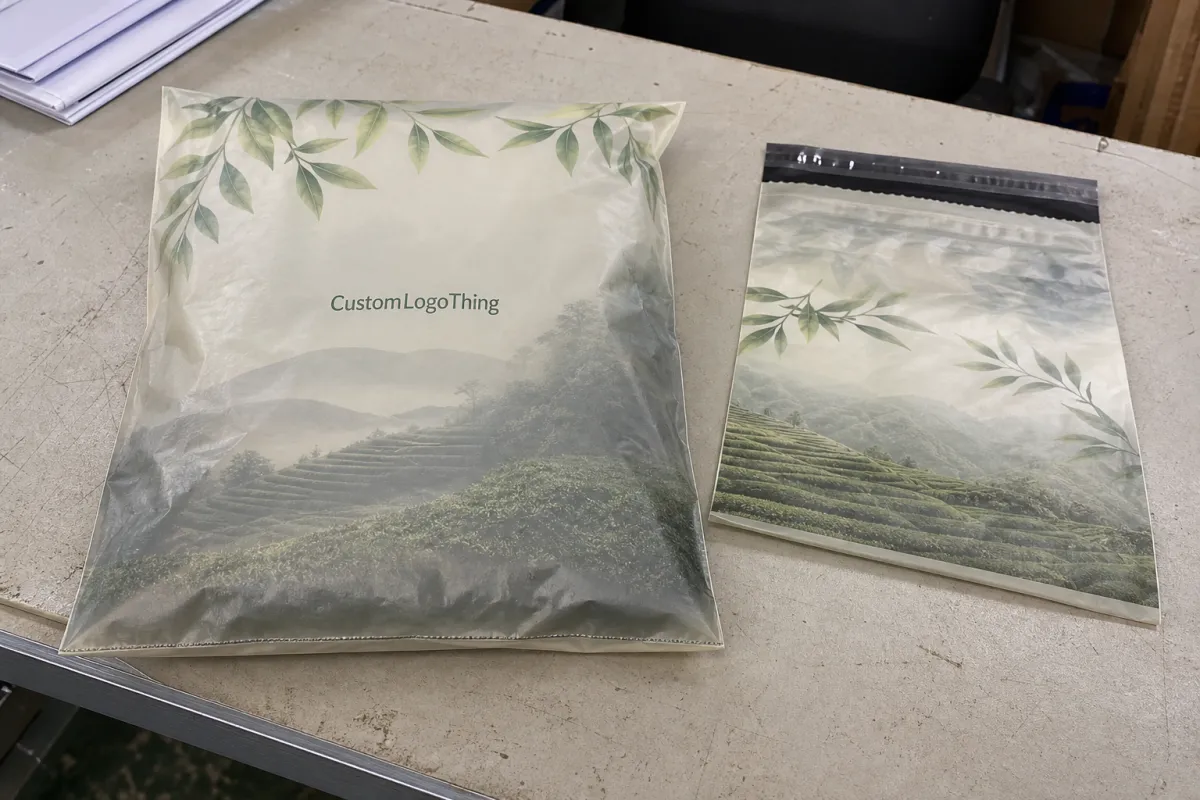
Most buyers begin with one question: how many mils should the mailer be? A mil is one-thousandth of an inch, and in practice it is a quick way to compare film heft. The number matters, but not in isolation. A 2.5 mil mailer can perform well for light tea shipments if the seams are clean and the inner packaging is protective. A 4 mil mailer can still fail if the closure is weak or the dimensions leave too much empty space.
For tea brands, the outer package has three jobs. It needs to protect aroma-safe inner packaging, maintain a clean retail look, and survive the trip without looking worn out on arrival. That is a different brief from a generic apparel shipment. Tea often moves as stand-up pouches, sampler kits, boxed sets, or seasonal bundles. Each format changes the load profile and the amount of flex the mailer has to tolerate.
Thickness is often used as shorthand for durability, but the terms buyers use are not always precise. Some people mean puncture resistance, some mean stiffness, and some mean how “substantial” the bag feels during packing. Those are related, but not identical. A stiffer film can help artwork lay flatter and make the package feel more deliberate. It does not automatically fix poor sealing or a bag size that is too loose for the contents.
As a starting point, light tea shipments usually land in the 2.5 to 3 mil range. Mixed kits, subscription boxes, or packages with inserts often do better at 3 to 4 mil. Heavier bundles or rougher routes may justify 4 mil and above. The point is not to buy the thickest option. The point is to match film to the actual stress the mailer will face.
That is where many orders go sideways. A buyer sees a price difference of only a few cents and assumes the thicker option must be safer. Sometimes it is. Sometimes the real weakness is not the film at all, but the seal geometry, the cut accuracy, or the way the bag dimensions leave slack around the product. Thickness is part of the answer, not the whole answer.
How Film Thickness Changes Print Quality and Shipping Performance
Printed mailers behave differently as the film changes. A slightly heavier film usually lies flatter during printing, which helps fine details, small text, and dense color blocks appear cleaner. Thin film can wrinkle more easily, and those wrinkles show up fast in dark artwork. That does not make thin film unusable. It means the artwork and the film need to be matched carefully.
From a shipping standpoint, a lighter film is easier to fold and cheaper to ship in bulk. That matters if the mailers themselves are stored in large volumes or shipped to multiple packing locations. Heavier film tends to resist corner punctures and abrasion better, especially when parcels are stacked in bins or moved through automated sortation. The tradeoff is predictable: more resilience usually means more resin, more weight, and a higher unit cost.
Seal performance matters just as much as raw thickness. In quality control, the first failures usually show up at the seal edge, not in the center panel. A strong adhesive strip, a consistent heat seal, or a well-formed closure can carry more practical value than an extra fraction of a mil. If a mailer flexes open under load, the customer does not care that the film was technically thick enough.
For tea shipments, the comparison usually looks like this:
- 2.5 mil - suitable for lightweight pouches, samplers, and lower-risk routes.
- 3 mil - a practical middle ground for retail packs and moderate handling.
- 4 mil - better for heavier bundles, more fragile inner cartons, or routes with rougher handling.
If you want a more formal benchmark, ask suppliers how their material relates to handling tests and distribution standards such as those used by ISTA. Lab data will not tell you everything, but it can expose the difference between a paper-thin promise and a bag that has actually been checked under load.
Key Material Factors That Change the Right Spec
Material thickness is only one variable. Packed weight comes first. A 50g tea pouch behaves very differently from a multi-pack sampler with inserts, thank-you cards, or a rigid gift box. Add size into the mix and the picture gets clearer: oversized mailers let the contents shift, which increases scuffing, corner pressure, and the chance of a split seal. Too tight, and the bag can buckle or burst under pack-out pressure.
Closure style changes the buying decision as well. A reliable self-seal is not the same thing as a weak strip that opens when the mailer is flexed. If packing happens at speed, the closure needs to seal consistently without extra rework. A line that is stopping to press and re-press seals is losing both time and quality. That is one of those practical details that never looks dramatic on a quote sheet, yet affects the actual cost of fulfillment.
Tea packaging format matters in a very mechanical way. Sealed pouches are softer and usually easier on the mailer. Retail cartons add edges and corners, which increase puncture risk. Mixed sets create an uneven load and may concentrate stress at the fold line. In those cases, a modest increase in film thickness can make more sense than chasing a special finish that does nothing for durability.
Artwork coverage also changes the result. Full-bleed graphics, dark backgrounds, and large solid color blocks make wrinkles more obvious. A flimsy film with bold print can look tired even before it leaves the warehouse. If the brand depends on a premium visual impression, slightly sturdier film often does more for the final appearance than expensive decoration on a weak substrate.
Storage conditions deserve more attention than they usually get. Poly mailers stacked in a humid room, or compressed under heavier cartons, may not behave the same way they did in the sample photo. Warehouses are not controlled photo sets. Temperature, humidity, and stacking pressure all influence how the film feels and how much abuse it can take. If the package is likely to sit under weight before shipping, build in margin for compression, not just transport.
Sustainability claims should be handled with specifics, not adjectives. Recycled materials and post-consumer waste content are real material questions, and they should be documented clearly if the supplier offers them. If the pack includes paper inserts or cartons, FSC certified board may be more relevant than the mailer film itself. Claims like “biodegradable packaging” need scrutiny, because polyethylene mailers do not become eco-friendly by wording alone. Ask for the standard, the composition, and the end-of-life pathway.
For broader packaging planning, compare the outer shipper with Custom Packaging Products and review the mailer options through Custom Poly Mailers. The same logic applies across formats: the right material is the one that matches the product, the route, and the customer expectation.
Process and Timeline: From Spec Sheet to Production Steps
A clean order usually starts with a plain spec sheet. Size, thickness, closure style, print colors, artwork format, quantity, and target ship date should all be visible on one page. If any of those pieces are vague, the schedule becomes vague too. That is how orders drift.
The production sequence is fairly consistent. Confirm the bag size first. Lock in the thickness next. Review artwork, then approve the proof. After that, production can start. The buyers who avoid delays are usually the ones who settle the practical details early. A late change in width or color count sounds small, but it can push the timeline because plate setup, print registration, and pack-out checks all depend on stable specs.
Timing depends on how customized the order is, but a typical range is 12 to 18 business days from proof approval to production for a straightforward custom run. Sample turnaround often falls around 5 to 7 business days, though that can stretch if the artwork needs fixes or if multiple material options are requested. Freight is another separate clock. A smooth production timeline can still miss a launch date if shipping is not planned with the same discipline.
Rush orders are possible, but they narrow the field. Faster schedules can reduce room for material changes, special finishes, or extra sample rounds. That is not a flaw in the supplier; it is the physics of production. If a factory promises every option on an accelerated timeline, ask what gets compressed. Usually the answer is sample time, finish options, or tolerance for revisions.
For premium tea launches, a basic handling check is worth the effort. Pack a real sample the way fulfillment will pack it, then shake it, stack it, and inspect the seams and corners. If the package looks stressed in ten minutes, it will look worse after transport. Simple, but effective. Formal testing can add more confidence, yet a realistic pack-out test often catches the obvious failures first.
Cost, Pricing, MOQ, and Unit Cost Tradeoffs
Pricing is driven by a handful of material facts: film usage, bag size, print coverage, closure style, and quantity. Thicker film uses more resin. Bigger bags use more film even if the print is simple. Dense artwork or multi-color printing adds complexity. None of that is glamorous, but it is the basis for every quote that lands on a buyer’s desk.
MOQ matters because setup costs have to be spread across the order. A lower minimum is useful if you are testing a new tea line or changing artwork for a seasonal run. The unit price usually climbs as the quantity drops. In many cases, moving below a typical production sweet spot can raise the price per bag by 15% to 35%. That is not automatically a problem, but it should be a conscious tradeoff rather than a surprise.
Here is a practical way to think about thickness and cost for tea mailers. These are broad ranges for a standard custom run, not a fixed price list.
| Film thickness | Best fit | What buyers notice | Typical unit cost at 5,000 pcs |
|---|---|---|---|
| 2.5 mil | Light tea pouches, samples, lower-risk shipping | Flexible feel, lower material use, easier storage | $0.16-$0.24 |
| 3 mil | Standard retail packs, subscription kits, mixed inserts | Balanced durability and handling | $0.19-$0.29 |
| 4 mil | Heavier bundles, fragile cartons, rough carrier routes | More stiffness and better corner resistance | $0.24-$0.36 |
| 4.5-5 mil | Premium or high-abuse shipments | Very sturdy feel, higher freight and material cost | $0.30-$0.42 |
Do not compare quotes unless the size, thickness, print count, closure, and quantity are identical. A lower quote can simply mean a smaller bag, thinner film, or a higher MOQ hidden behind the headline number. Landed cost is the number that matters, because freight, sampling, reprints, and damage claims can erase a small savings quickly.
If the tea program uses paper wraps, corrugated cartons, or printed inserts, factor in the whole stack instead of the outer bag alone. A better mailer can reduce the need for extra cushioning. A weak one can force you to add protection elsewhere, which often wipes out the “savings” from buying lighter film. Packaging math has a habit of punishing shortcuts.
For brands that want cleaner sourcing language, ask whether recycled materials or post-consumer waste content are available in the film, and whether any paper components are FSC certified. Those details are easier to defend than vague claims about packaging being environmentally friendly.
Common Mistakes Buyers Make When Choosing Thickness
The most common mistake is overspecifying. Buyers often choose the thickest mailer because it feels safer, then discover they have added cost, weight, and stiffness without solving a real problem. A heavier film is not automatically better. Sometimes it just wastes resin and makes fulfillment more awkward.
The second mistake is the opposite. A sample looks fine on a table, so the buyer assumes the thin film will hold up in transit. That is a bad test. A table sample is not stacked under parcels, dragged across conveyor rails, or compressed in a tote. Real shipping changes the shape of the risk. Thin film can work well, but only when the route and load are actually forgiving.
Another frequent miss is ignoring the seams. Most failures start at the seal edge, a weak strip, or a cut that leaves less margin than expected. Buyers naturally focus on the print because that is visible. The package, however, will fail where the stress concentrates. Corner stress and seal quality are more predictive than a glossy artwork mockup.
There is also a tendency to overtrust sustainability language. If a supplier says “eco” but cannot specify the resin blend, recycled content, or certification for the paper components, the label is doing too much work. Good procurement asks for measurable details. If those details are missing, the claim is just decoration.
A simple preflight test helps. Pack one sample exactly the way fulfillment will, press the corners, shake the package, and inspect the seams after a short period of handling. If the mailer already looks tired, it will not improve after a week in transit. For more structured validation, reference handling expectations aligned to ISTA methods and basic film properties such as ASTM D882. The goal is practical confidence, not lab theater.
Expert Tips and Next Steps for Ordering the Right Bag
The cleanest way to choose the right mailer is to make the decision in layers. Start with the tea packaging format. Add the shipping route. Then look at how much space the contents occupy inside the mailer. A simple stack of tea pouches may only need a light film. A gift set with inserts and a rigid carton often needs more structure. That sequence keeps the decision grounded in reality instead of gut feeling.
Ask for two or three thickness samples side by side. Compare them packed, not empty. An empty bag can be misleading because the real load changes how the film bends, how the seal sits, and how much corner stress appears during packing. Also ask for quotes at different quantities so the economics are visible before you commit. That small step exposes whether the lower unit cost is tied to a realistic order size or to a quantity that is hard to reach.
For premium tea, the mailer should feel like part of the brand rather than a necessary inconvenience. Print sharpness, closure confidence, and the way the bag sits around the product matter more than a small difference in film thickness. Buyers sometimes fixate on a half-mil gap and ignore the fact that the closure is the weakest link. The package can only be as strong as its least considered part.
A sensible starting point is straightforward: 2.5 to 3 mil for light tea shipments, 3 to 4 mil for mixed kits or products with rigid inner packaging, and thicker only when route, weight, or presentation clearly demands it. That is the core of the tea Printed Poly Mailers material thickness guide: not maximum thickness, but the right thickness for the job.
Lock the final spec before launch, keep the sample honest, and make sure the reorder version matches what actually shipped well. Small changes in thickness, size, or closure tend to matter more on the second order than on the first. That is where sloppy assumptions usually show up.
What thickness is best for tea printed poly mailers?
2.5 to 3 mil works well for lightweight tea pouches and samples. Use 3 to 4 mil for mixed kits, retail boxes, or routes with more handling. The right answer depends on packed weight, bag size, and how much protection the inner packaging already provides.
Does thicker tea printed poly mailers film always cost more?
Usually yes. More thickness uses more material, and that raises the base cost. The price can also move with print coverage, bag size, and MOQ. A quote that looks cheaper may simply be using less film or a higher production minimum.
How does thickness affect print on tea printed poly mailers?
Stabler film tends to hold print more evenly, especially with dark fills or detailed graphics. Very thin film can wrinkle and make registration look less sharp. A slightly heavier base often improves the finished appearance more than extra decoration on a weak substrate.
What lead time should I expect for custom tea printed poly mailers?
Simple orders often take about 12 to 18 business days after proof approval, with samples taking around 5 to 7 business days. Complex artwork, special finishes, or revision rounds can add time. Shipping is separate, so include transit time in the launch schedule.
How do I compare quotes for tea printed poly mailers material thickness guide specs?
Match the same size, thickness, print count, closure style, and quantity before comparing price. Check whether freight, sampling, and setup are included. If one quote is lower, verify that the film is not thinner and the MOQ is not hiding the real unit cost.


