Buyer Fit Snapshot
| Best fit | Minimalist Custom Packaging Boxes in Ecommerce projects where brand print, material claims, artwork control, MOQ, and repeat-order consistency need to be specified before quoting. |
|---|---|
| Quote inputs | Share finished size, material target, print colors, finish, packing count, annual reorder estimate, ship-to region, and any compliance wording. |
| Proofing check | Approve dieline scale, logo placement, barcode or warning zones, color tolerance, closure strength, and carton packing before bulk production. |
| Main risk | Vague material claims, crowded artwork, missing packing details, or unclear freight terms can make a low unit price expensive after revisions. |
Fast answer: Minimalist Custom Packaging Boxes in Ecommerce: Board, Finish, Dieline, and Unit Cost should be specified like a repeatable production item. The safest quote records material, print method, finish, artwork proof, packing count, and reorder notes in one written spec.
Production checks before approval
Compare the actual filled-product size with the drawing, then confirm tolerance on folds, seals, hang holes, label areas, and retail display edges. Reserve space for logos, QR codes, warning copy, and material claims before decorative graphics fill the panel.
Quote comparison points
Review material grade, print process, finish, sampling route, tooling charges, carton quantity, and freight assumptions side by side. A quote is only useful when the supplier can repeat the same color, closure quality, and packing count on the next order.
Tips for Minimalist Custom Packaging Boxes in Ecommerce sound straightforward until the first physical sample lands, the lid fights you, the logo creeps too close to a fold, and the whole package feels like it made a wrong turn. I learned that lesson early on: the file looked clean, the mockup looked premium, and the first warehouse run looked like chaos. The most useful Tips for Minimalist Custom Packaging Boxes start with subtraction, not decoration. A strong box is one where structure, brand meaning, and shipping behavior all support each other instead of competing.
Packaging is never just decoration. It is the first touchpoint, a transport tool, and a shelf-stage marketing channel rolled into one. If the box sends mixed signals, buyers pause; if it communicates clearly, opens easily, and repeats cleanly across fulfillment batches, the product gets a cleaner first impression long before people read the long copy.
That is why minimalist decisions are often less about aesthetics and more about friction. Every extra line, varnish zone, and side flap has a production consequence, and in ecommerce every consequence usually lands in labor, returns, or delay. The promise of tips for Minimalist Custom Packaging boxes is not to make things plain; it is to make every printed and folded decision defendable.
Why tips for minimalist custom packaging boxes should be your first move
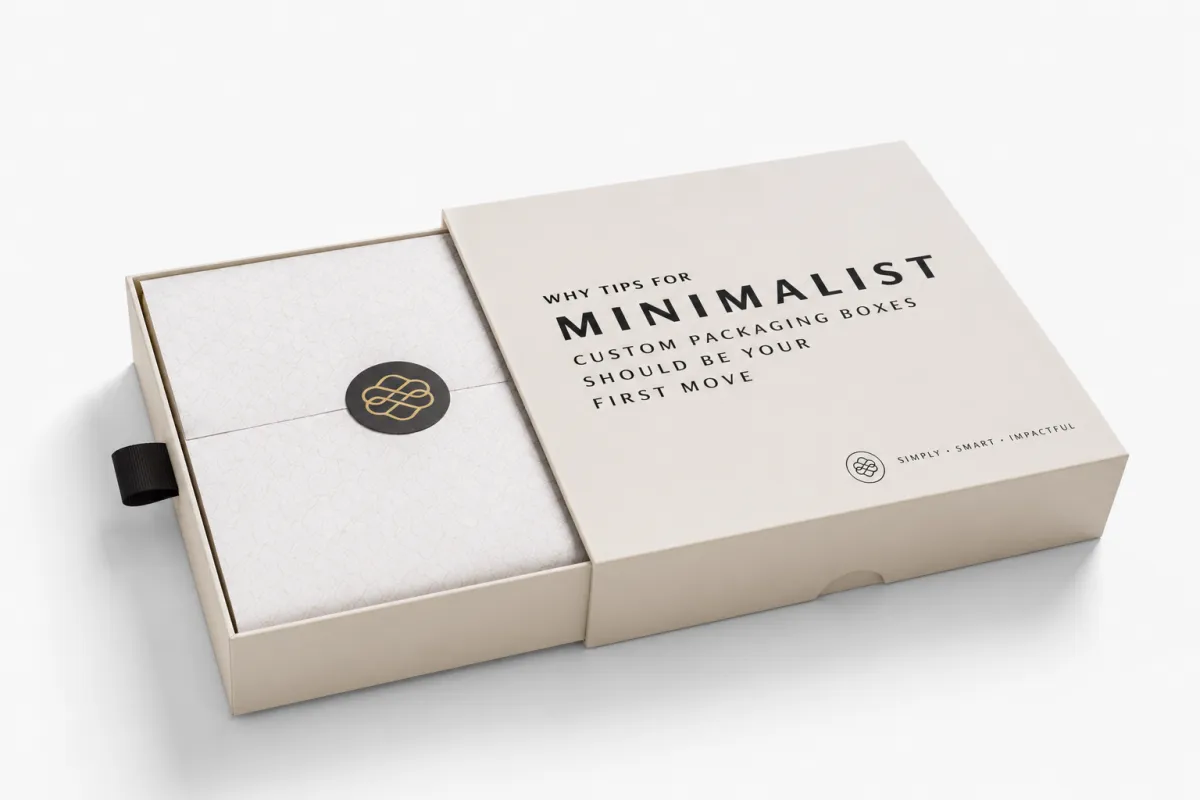
For teams searching for tips for Minimalist Custom Packaging boxes that protect margin while still looking intentional, the hard truth is that most shoppers form a premium judgment in roughly ten seconds. They do this by reading ease, consistency, and durability first, not by counting special effects. If the panel hierarchy is clear, the print contrast is stable, and opening is effortless, confidence rises before pricing does.
Minimalism in packaging is more discipline than minimal content. You are not deleting personality; you are choosing to prioritize the signals that matter: brand mark, product category, legal copy, and structural reliability. That is the part that feels counterintuitive if your team is used to “flashy” work. In practice, less visual noise lowers cognitive load, which is what turns “looks expensive” into “feels expensive” at both thumbnail and shelf scale.
One real case: a team I consulted on ran a six-color, foil, embossed campaign with five insert layers. It looked expensive to reviewers but failed in fulfillment and photo consistency. A later version used one dominant color, controlled typography, and tighter geometry; that box carried the same brand identity and cut rejection rates. The result was paradoxical but obvious: fewer bells, higher perceived value.
The practical test for tips for minimalist custom packaging boxes is simple and brutal: does each element improve opening, recognition, protection, or storage? If not, that element is likely cost and complexity, not value. Minimalism is less a style philosophy here and more a production governance method.
Those principles perform especially well in situations like:
- Rolling out a new SKU and keeping design debt low until repeatability proves itself.
- Reducing unit cost without turning the shell into an obvious budget compromise.
- Strengthening repeat purchase behavior with packaging that customers can recognize quickly.
- Trimming freight burden by reducing weight, assembly steps, and packaging waste.
- Maintaining a retail-friendly look that reproduces cleanly across multiple sales channels.
There is also an operational advantage. A simple print regime and standardized geometry reduce reprint churn, and color drift risk falls because the board and ink behavior are easier to monitor. It is the kind of boring reliability that protects teams when demand spikes and the clock gets ugly.
"Minimal packaging works when every visible choice earns its place. If it does not support selling, shipping, or storage, it is usually clutter."
If you need speed without a geometry redesign, start from a standard form in Custom Packaging Products and design into it. In practice, teams often recover days from engineering approval and meaningful setup cost by avoiding a custom form from day one. For a faster spec-to-quote comparison of available structures and finishes, start from the same catalog in Custom Packaging Products and validate against your carton size and freight lane before requesting samples.
How do tips for minimalist custom packaging boxes move from concept to final design?
Good tips for minimalist custom packaging boxes follow a sequence: product position, structure, then finish. Most production errors appear when design decisions and engineering decisions happen in the wrong order, especially if visual mood is frozen before the dieline is proven.
Start by measuring what the product does, not just how it looks. Gather footprint, height, weight, accessory fit, and expected shipping route. A minimalist shell still needs structural performance targets: no premature edge crush, reliable closure, and enough internal restraint to prevent movement. If a sample rattles or flexes when shaken, the package is not minimal; it is underdesigned.
For many ecommerce SKUs, useful starting clearances are typically 5-10 mm around the product in all directions for inserts and 2-4 mm of additional tolerance for vibration during parcel movement. These numbers are typical ranges, not fixed rules, but they are a practical baseline before CAD and print.
From an engineering perspective, lock down the dieline before final artwork. It sounds procedural, but it is one of the highest-value corrections in real projects. Teams that begin with art and later force folds around it often discover glue tabs, panel offsets, and tolerance gaps too late. Geometry first usually shortens downstream loops.
Content also needs hierarchy discipline. For many ecommerce SKUs, one core claim, one supporting line, and one utility area (barcode, SKU, care line, or regulatory text) are enough. Text over live folds is a predictable failure path; leave at least a 2 mm safe zone from cut and score lines to avoid edge exposure after trimming.
Process choice belongs in this early phase too. Short runs with frequent changes usually align with digital printing, while stable high-volume programs often justify offset for tighter color control and repeatability. That decision usually affects consistency more than typography choice. If brand color is strategic, lock color tolerance windows before finalizing artwork.
Sampling is not a “nice to have.” Flat PDF approvals will not expose glue seam stress, corner crush, or fold springback. Physical samples reveal failure behavior such as hard-press closures, low torsional stiffness, and edge lift—all of which often trigger returns and handling costs down the line.
Use this prepress gate list before production:
- Dieline and fold map signed off by production.
- Bleed, trim, and safe-zone check across all text fields.
- Color targets (Pantone or CMYK) with published tolerances.
- Finish map for matte, uncoated, soft-touch, or varnish zones.
- Final copy placement, including QR, barcode clearance, and regulatory line breaks.
If durability is central to your promise, check standards and handling logic early. The ISTA test standards are practical for parcel-risk behavior, especially impacts, vibration, and compression. They usually expose issues that studio-level reviews miss.
Production process and timeline for minimalist custom packaging boxes
A realistic timeline is the difference between calm execution and launch stress. The best tips for minimalist custom packaging boxes treat concept, proofing, and production as explicit gates. Packaging work does not move in one straight pass; it moves in revisions and confidence checkpoints.
In many ecommerce programs, a practical baseline looks like this: 1–2 days for brief and concept, 2–4 days for dieline and layout, 1–2 for internal review, 3–6 for physical sample, 1–2 for prepress revisions, 7–15 business days for production, then packing and dispatch. Those ranges are practical, not guaranteed, and vary with finish and logistics.
In the same programs, board proof cycles often add a predictable 10–20% time buffer when there are more than 3 revision rounds. That is a common tradeoff in teams that treat prepress quality as optional.
Volume changes cost dynamics in counterintuitive ways. Small runs are lighter on setup time but usually heavier on unit cost. Large runs can lower per-unit price only when the specs are stable. Minimalist structures help here because they create a low-friction path to test, then scale once geometry is validated in live handling.
Most delays come from late content edits. A logo update may be cheap; a last-minute panel rewrite can add extra approval, plate updates, and proof cycles. If your objective is to keep tips for minimalist custom packaging boxes financially disciplined, define and freeze copy before prepress sign-off.
Transport choice changes date certainty as much as cost. Ground is often efficient for predictable domestic replenishment, while urgent campaigns sometimes justify air and split logistics. The gap in freight can be measured, but late scrambling usually costs more than the freight decision itself if it disrupts launch sequencing.
Use this two-phase supplier validation before full production:
- Dieline confirmation plus board specification confirmation.
- Print approval against approved color targets.
- Cut and crease quality checks at representative production speed.
- Glue seam and closure integrity tests after folding.
- Final carton count, cartonization method, and packing workflow verification.
When sustainability claims are used, verify wording carefully. The FSC certification system is the standard for chain-of-custody language, and the EPA sustainable materials guidance can help align claims across procurement and consumer messaging. If your pack uses recycled board or paper inserts, claims should be specific and auditable, not broad promises.
Usually, two reviews are non-negotiable: one before cutting and one after finished sample approval. Teams that skip these are exactly the ones who discover “minor” changes become costly after production commits.
Key factors that make minimalist custom packaging boxes perform
Tips for minimalist custom packaging boxes work when three operating rules hold at once: visual clarity, product protection, and fulfillment compatibility. Miss one and the design starts to collapse under real-world volume.
Material choice is the first lever and often the cheapest mistake to get wrong. Matte kraft communicates crafted restraint; uncoated white can keep edges crisp and modern; recycled board supports sustainability positioning but can reduce contrast if ink strategy is not tuned. For lightweight accessories and small parcels, 250–350 gsm C1S or 300–400 gsm duplex board often works well. Electronics and gifts usually need higher stiffness and edge strength to prevent deformation in transit, often in the 350–500 gsm practical range depending on panel size and expected stacking.
Structure drives actual service quality. Straight tucks, slotted cartons, telescoping lids, and mailer formats each carry different labor profiles and handling risk. Typical flap overlap targets are usually in the 8–12 mm range for dependable closes, and many teams use a 1–3 mm hinge gap during prototyping to prevent hard-binding after repeated openings. Magnetic and rigid formats can feel premium, yet they make sense only when margin, damage tolerance, and shipping profile justify extra work. If freight is a constant pressure, a rigid premium should earn every penny.
Typography is where many teams overdesign unconsciously. A controlled hierarchy beats ornamentation every time. One display family plus one utility family is usually enough. Keep line length tight, size contrast clear, and contrast ratio high for shelf light and mobile thumbnails where subtlety disappears fast.
Internal presentation should not be an afterthought. Tissue, molded pulp, and folded inserts can deliver premium handling cues without crowding outer visuals. In one beauty brand launch I reviewed, a simple interior cradle improved unboxing satisfaction while preserving a clean exterior language. That is tips for minimalist custom packaging boxes in action: structure the inside so the outside stays disciplined.
Field conditions matter more than mockups. A package that photographs beautifully but fails compression, vibration, and drop behavior is not a premium package—it is a logistics problem. A simple structure that survives real parcel stress beats decorative complexity almost every time.
Fulfillment fit is a hidden performance lever. Barcode position, label readability, carton stack profile, and taping compatibility matter as much as color accuracy. A 1 mm mismatch in height tolerance can affect automation touchpoints and increase manual handling time—those are measurable seconds that scale into real labor cost.
Claims credibility is part of performance. If you say FSC-certified, ask for certification confirmation for each material lot; if you state recycled content, publish a concrete percentage; if you claim plastic-free, verify adhesive and coating systems too. Trust is earned by evidence and cross-checking, not by copy alone.
Use this comparison by launch stage, not by taste:
| Option | Best For | Typical Unit Cost | Typical Lead Time | Main Tradeoff |
|---|---|---|---|---|
| Digital printed tuck box | Test launches, small ecommerce runs | $0.85-$1.60 | 6-10 business days | Higher cost per unit, faster revisions |
| Offset mailer box | Mid-volume branded packaging | $0.22-$0.55 | 12-18 business days | Needs stronger volume to make sense |
| Rigid setup box | Gift sets, premium retail packaging | $1.20-$3.80 | 15-25 business days | Higher freight and assembly cost |
| Folding carton with insert | Light products needing structure | $0.30-$0.95 | 10-16 business days | Insert design and testing are critical |
If you are choosing among these options before production, review the structure families in Custom Packaging Products first, then validate your spec with your supplier before final art sign-off. That sequence typically avoids late surprises with cost and lead time.
Step-by-step guide to produce minimalist custom packaging boxes without drama
The execution wins start with sequencing, not style. Strong tips for minimalist custom packaging boxes are impossible without a decision order that keeps the team out of revision purgatory and keeps operators out of panic mode.
Step 1: define the single objective
Pick one primary outcome first: premium perception, shelf clarity, lower freight, faster packing, or better impact protection. Secondary outcomes can be layered later. Trying to optimize six goals in one pass usually creates a fragmented compromise. Be explicit that tradeoffs will exist.
Step 2: audit the current pack
Look at the current box through three practical lenses: damage rate, label/scan failures, and openability complaints. Pull actual support tickets and return data. If complaints mention bent corners, stuck flaps, or “cheap feel,” that is a design signal, not a warehouse complaint. Use those clues before redesigning aesthetics.
Step 3: create a compact style board
Keep the system intentionally narrow: one type family for identity, one primary color, one accent color, one icon language, one material direction. Compact decisions cut committee drift. In teams with too many stakeholders, fewer options are not limiting—they are protective.
If your brand already has recognized cues, preserve them. If it does not, define those cues first, then design outward. Too many teams get the sequence wrong and end up with pretty visuals that fail repeatability in fulfillment.
Step 4: write exact copy before layout
Get every text line approved before art begins: front, flap, care notes, QR prompt, barcode area, and compliance language. A late text edit does not just cost a proof; it changes spacing, line breaks, and sometimes page count per sheet. One word tweak can ripple across dozens of units and trigger tolerance failures if not controlled.
Step 5: choose one finish path
Pick matte, soft-touch lamination, or uncoated treatment and stick with it through first proof. Mixing finish paths can look attractive in a mood board, but it often causes registration, cost, and supplier confusion unless each step has clear rationale. Keep consistency with purpose and the supplier will execute predictably.
Step 6: compare physical samples
Run at least two suppliers when possible and compare fold precision, seam behavior, print density, and repeated open-close cycles. I have seen one supplier pass color depth while another passes edge strength under identical specs; both checks matter. A flat-screen review misses these differences.
Step 7: lock the run specification
Document everything in one run sheet: carton count by SKU, board spec, tolerance allowances, label clearances, and reorder trigger logic. Include who owns sign-offs and how changes are submitted. That document prevents “who approved what” delays when orders ramp.
Step 8: launch with controlled expansion
Do not migrate every SKU in one jump unless your operation has already proven at that scale. Start with one line, monitor early performance, then expand in measured increments. Track review language, damage trend, returns by reason, and packing time per piece. Expansion should follow data, not enthusiasm.
Minimalist designs that are intentionally quiet often become operationally louder in a good way. They stabilize process variance and create repeatable quality, which is exactly what teams need under growth pressure.
Common mistakes that wreck minimalist custom packaging boxes
Most failures in minimalist packs are not design crimes; they are execution omissions. A practical set of tips for minimalist custom packaging boxes is to remove these traps before the cutting knives ever move.
Over-pruning can be as harmful as over-designing. A stripped shell can lose identity and become forgettable. Minimal design still needs identity anchors: a confident mark, reliable spacing, and enough visual cueing to stand out in scan and shelf contexts.
Ignoring print tolerance windows is expensive. Small type near trim, low-contrast color on textured board, and crowded fold margins are defects waiting for production machinery. These issues look fine in mockups and fail in dies because physical processes have tiny but real variations.
Buying the cheapest sample often backfires. A sample with unstable register or color drift may look acceptable, but it usually creates iteration loops and schedule risk. That cheap choice often becomes a hidden cost premium later.
Skipping insert engineering is a major reason for breakage and returns. A premium shell cannot compensate for unstable internals. Fragile SKUs need load paths, controlled cushioning, and anti-movement strategy; otherwise the pack is packaging theater with no protection underneath.
Assuming visual approval equals readiness is another frequent mistake. High-key studio photos can flatten defects. Real ecommerce views include zoomed thumbnails and compressed images where contrast, spacing, and hierarchy become more important than decorative details.
Ignoring delivered-unit economics is how most budgets implode after launch. Factory unit cost rarely reflects true delivered cost once freight, handling, labor variance, and spoilage are included. If you only model production price, you are watching one quarter of the bill.
Skipping warehouse compatibility hurts conversion and fulfillment time. Boxes that stack poorly, obscure barcode placement, or deform under pressure will be flagged by operations immediately, and customers feel those compromises after opening.
Solid tips for minimalist custom packaging boxes are a balance of restraint and strict execution. Every design element has to support either sales clarity, shipping confidence, or trust. If it does neither, it likely has no place in the final file.
Cost and pricing strategy for tips for minimalist custom packaging boxes
At some stage, design taste is not enough. tips for minimalist custom packaging boxes also need a pricing logic that separates emotion from budget reality. Simple does not mean cheap by default, and premium does not have to mean expensive by default.
Break cost into fixed and variable layers. Fixed costs include dieline setup, proof and plate preparation, first-pass correction, and tooling changes. Variable costs include board, inks, coatings, die-cut labor, folding, and packing effort. Once this split is visible, run-size decisions become straightforward and less political.
Digital is usually strongest for short cycles and revisions; offset often wins at higher volume with stable color control. Neither route is universally superior. The right choice depends on demand confidence, tolerance for changes, and required output consistency. If color control is mission-critical, lock your tolerances and test methods before the first file passes approval.
Track cost per delivered unit rather than print price alone. Include freight, expected damage handling, storage, inserts, tape and label overhead, plus returns-related impact. A four-cent manufacturing reduction disappears quickly if packing adds 90 extra seconds for a fragile SKU over a 20,000-unit run.
MOQ strategy can unlock growth or create waste. If demand is uncertain, group SKUs by shared structure and shared stock to reduce setup overhead without flooding inventory. Good packaging boosts conversion speed; dead stock kills margins faster than many teams expect.
Use a clean tier model before design is finalized:
- Entry tier: low MOQ, simple print treatment, one finish.
- Growth tier: mid-volume, stricter color control, higher board consistency.
- Scale tier: larger volumes, offset processing, tighter logistics and fulfillment optimization.
This approach lets teams scale without redesigning core architecture every quarter. Consistency is one of the strongest tips for minimalist custom packaging boxes when operations get busy and product volume changes fast.
Post-production costs are often the gap in planning. Label stock, add-on inserts, QC revisions, and fulfillment exceptions can quickly eat margin. A realistic model usually reserves 8–15% for iterative revisions and 3–7% for fulfillment variance, and that buffer is not pessimism; it is standard operating insurance.
Current practical ranges are often useful as a first signal, not a fixed promise:
- Small test run: about $0.85-$1.60 per unit, depending on footprint and print coverage.
- Mid-run mailer or folding carton: about $0.22-$0.55 per unit.
- Premium rigid box: about $1.20-$3.80 per unit, with inserts and wraps adding cost.
Any quote that ignores size, material profile, finish, and freight is incomplete. That is not a style preference; that is a missing specification model.
Most teams still pick the better-performing option by the full operating total, not the loudest sample. A restrained design usually cuts rework and complaint risk, which improves margins over a few cycles.
Next steps to execute minimalist custom packaging boxes now
Execution is where the quality of these tips for minimalist custom packaging boxes becomes visible. Start by simplifying decisions, then lock the design around product behavior and operational constraints, not around mood-board velocity.
In the next 48 hours, finalize dimensions by SKU, capture current return reasons, and collect direct comments mentioning damage, opening effort, or “cheap feel.” That pass usually points to the first real improvement: structure, substrate, or finish.
In the next five days, produce three mockups: one prioritizing brand lift, one prioritizing protection, and one prioritizing shipping efficiency. Side-by-side testing across teams and operators often reveals a surprise winner that no one proposed in the first design review.
In the next two weeks, lock finish, sample insert performance, and final files, then run fulfillment validation with actual carton movement and barcode scanning. Verify seam integrity, corner stability, and repeated handling after transport simulation before full release. If you skip this, you are basically hoping instead of validating.
After release, track three weekly signals: damage rates, packaging-linked returns, and review language. Terms like clean, premium, stable, and easy to open usually indicate good baseline behavior; words like flimsy, tricky, or confusing point to a specific adjustment round.
One practical takeaway: you are not cutting design down to make boxes plain—you are making each printed and folded decision earn a measurable job. Do that consistently, and minimalism becomes less a trend and more a margin-safe packaging system.
FAQs
What are the most useful tips for minimalist custom packaging boxes when budget is tight?
Lead with structure and copy. Those two decisions carry most of the premium cue with lower production complexity. For constrained budgets, use a smaller run, one finish, and one focused color system, then harden your manufacturing specification so expansion does not create chaos.
How long do minimalist custom packaging boxes usually take from design brief to delivery?
Most standard ecommerce programs land in a 2 to 4 week window, depending on sample speed and revision rounds. Digital runs often move faster than teams expect; offset runs usually require additional proofing and verification steps, so build that buffer.
Can minimalist custom packaging boxes still protect fragile items well?
Absolutely, if shell and board are engineered for load and movement. A restrained exterior can work with strong interior restraint, reinforced corners, and validated compression behavior. If the product is delicate, the inside architecture matters even more than the outside graphics.
How do I avoid minimalist custom packaging boxes looking too cheap or plain?
Keep the system sparse but deliberate. Strong contrast, clear typographic hierarchy, and one tactile cue like soft-touch or matte finish usually outperform multiple decorative elements. Minimal does not mean forgettable if the cues are consistent and intentional.
Should minimalist custom packaging boxes be full color or mostly monochrome?
Many brands perform better with mostly monochrome packaging because consistency holds across photo channels and print lots. Full color helps when brand recognition depends on it or shelf separation is critical. If full color is needed, freeze approvals early and monitor tone drift through proofs.