Buyer Fit Snapshot
| Best fit | custom foam lined courier boxes reviewed buyer review for packaging buyers comparing material specs, print proof, MOQ, unit cost, freight, and repeat-order risk where brand print, material, artwork control, and repeat-order consistency matter. |
|---|---|
| Quote inputs | Share finished size, material target, print colors, finish, packing count, annual reorder estimate, and delivery region. |
| Proofing check | Approve dieline scale, logo placement, barcode or warning zones, color tolerance, and any recyclable or compostable wording before bulk production. |
| Main risk | Vague material claims, crowded artwork, or missing packing details can create delays even when the unit price looks attractive. |
Fast answer: Custom Foam Lined Courier Boxes Reviewed Buyer Review: Dieline, Finish, Proof, and Buyer Review should be specified like a repeatable production item. The safest quote includes material, print method, finish, artwork proof, carton packing, and reorder notes in one written spec.
What to confirm before approving the packaging proof
Check the product dimensions against the actual filled item, not only the sales mockup. Ask for tolerance on folds, seals, hang holes, label areas, and retail display edges. If the package carries a logo, QR code, warning copy, or legal claim, reserve that space before decorative graphics fill the panel.
How to compare quotes without losing quality
Compare board or film grade, print process, finish, sampling route, tooling charges, carton quantity, and freight assumptions side by side. A lower quote is only useful if the supplier can repeat the same color, closure quality, and packing count on the next order.
Top Custom Foam Lined Courier Boxes: Best Picks Reviewed
Shipping fragile products leaves very little room for guesswork, and the top Custom Foam Lined courier boxes are built for the kind of handling that turns loose fill into a bad idea. They stop movement, cut vibration, and keep edges off the outer wall before the parcel is ever stacked, tossed, or jammed into a van. Plenty of buyers still pay for packaging that looks polished on a desk and falls apart in the first courier lane. The real question is which top custom foam lined courier boxes protect the product without loading the quote with unnecessary extras.
From a packaging buyer’s point of view, foam-lined courier boxes beat paper void-fill, loose fill, and generic mailers when the item is dense, fragile, or expensive enough that one damaged return wipes out the margin. They also speed up packing once the insert is set correctly. That matters for product packaging, retail packaging, and any line where package branding has to look deliberate the moment the customer opens the lid.
If you are starting from a blank sheet, it helps to browse Custom Packaging Products first and then narrow the build around the item’s size, fragility, and route. I judge the top custom foam lined courier boxes on five things only: fit accuracy, protection, packing speed, unboxing quality, and total landed cost. No fluff. No pretending a weak carton becomes premium because someone added a ribbon and a speech about craftsmanship.
For test logic, I also look at the kind of abuse courier packaging actually sees: corner crush, stack pressure, vibration, and the edge impact that cracks bottles and scuffs coated surfaces. If a supplier says the top custom foam lined courier boxes passed a drop or vibration routine, I want to know whether the build was checked against a real standard such as ISTA testing practices or an equivalent internal protocol. A nice sentence on a quote does not protect a product in transit.
- Fit accuracy: the product should sit with minimal side play, usually within 1-2 mm for premium inserts and up to 3 mm for less critical kits.
- Protection: look for firm restraint rather than soft padding; the top custom foam lined courier boxes keep the product from touching the outer wall.
- Packing speed: a good insert cuts labor by 10-25 seconds per pack once the line is trained.
- Unboxing quality: the insert should look intentional, not like a craft project assembled during a rushed afternoon.
- Total landed cost: box, foam, print, freight, sampling, setup, and any rework if the fit is off.
Top Custom Foam Lined Courier Boxes: Why the Cheap Option Fails Fast
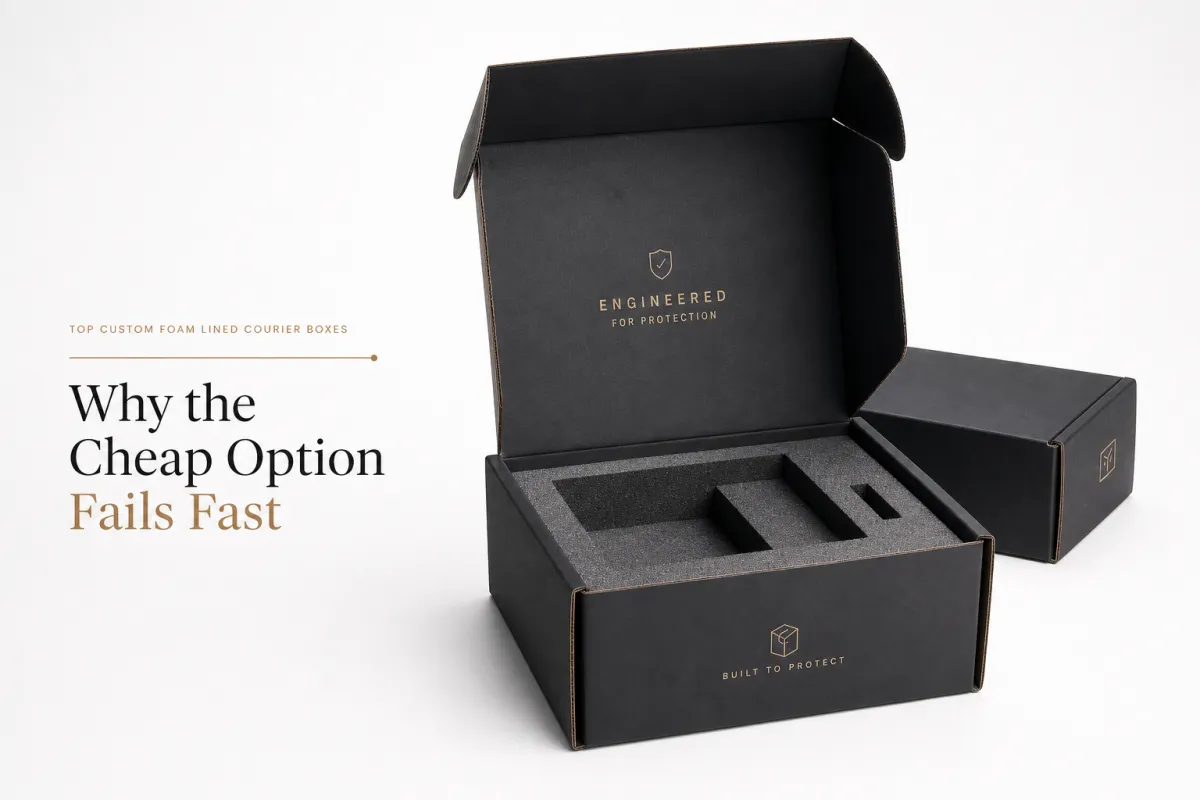
The cheap option usually fails in the ordinary ways, not the dramatic ones. A parcel does not have to fall off a conveyor to get damaged. More often it vibrates for twenty minutes, gets stacked under heavier cartons, then takes a sharp hit on the exact corner that has no cushion. That is why the top custom foam lined courier boxes are designed around restraint first and appearance second.
Loose fill moves around. Paper void-fill compresses. A generic mailer can look fine on a desk and then collapse in a courier lane like it has never met gravity. Foam-lined courier boxes solve a different problem: they hold the product in a fixed cavity so the item does not hammer the walls, rub against accessories, or drift out of position after repeated handling.
For dense goods like tools, glass bottles, small electronics, and premium samples, movement is the enemy. The top custom foam lined courier boxes absorb shock and reduce load transfer across the product surface. That matters more than decorative extras. A buyer who spends on foil print before sorting the insert spec is usually buying trouble with a nicer logo.
Overboxing is the other common mistake. Some teams make the outer carton too large, then fill the empty space with packaging paper until the unit looks “protected.” That adds labor and still leaves the product free to bounce. In practice, the top custom foam lined courier boxes win because the cavity is matched to the item, the board strength supports the stack, and the insert does the real work.
The best courier box is boring in transit. It should not depend on luck, filler, or a hopeful label.
Keep one rule in mind when comparing courier packaging: the insert and the outer carton are a pair. A great foam insert inside a weak single-wall box is still a weak system. A strong double-wall box with a sloppy cavity is not much better. The top custom foam lined courier boxes earn their price when both parts work together.
If you want to sanity-check the build before ordering, ask for a test package and a drop profile. A sensible request is a sequence that reflects the product’s weight and route, not a random stunt. For fragile items, ask whether the supplier can test to an FSC-certified board option for the carton and a suitable protection setup for the insert. FSC is about fiber sourcing, not shock resistance, but the carton still matters.
- Loose fill: cheapest per shipment, but slow to pack and weak for repeat shipping.
- Paper void-fill: cleaner than bubble wrap, yet still poor at locking position.
- Generic mailers: fine for non-fragile goods, poor for precision items and premium sets.
- Top custom foam lined courier boxes: better for repeat transit, higher perceived value, and lower breakage risk.
Top Custom Foam Lined Courier Boxes Compared: Foam Types, Board Strength, Fit
Foam is not one material with one behavior. That is the part people miss until a sample arrives and the insert feels either too soft to hold shape or too firm to protect a delicate finish. The top custom foam lined courier boxes usually use one of five foam families: EPE, PU, EVA, cross-linked PE, or anti-static foam. Each has its own cut quality, feel, and level of support.
| Foam type | Typical density feel | Best use case | Protection level | Look and finish | Cost tier |
|---|---|---|---|---|---|
| EPE | Light to medium, springy | Samples, cosmetics, light glass | Good for moderate shock | Clean enough, but not luxury | Low to mid |
| PU | Soft, cushiony | Delicate surfaces, presentation kits | Good cushioning, weaker shape memory | Smooth, but can look less precise | Low to mid |
| EVA | Firm, dense, stable | Luxury kits, tools, premium electronics | Very good for shape retention | Sharp edges, premium appearance | Mid to high |
| Cross-linked PE | Firm with clean cut edges | Electronics, bottle sets, trade kits | Very good balance of cushion and support | Excellent, especially for branded packaging | Mid to high |
| Anti-static foam | Varies by base foam | Boards, chips, sensitive electronics | Protection plus static control | Functional, usually darker finish | Mid to high |
For outer cartons, the box matters almost as much as the insert. A single-wall carton around 32 ECT works for light kits and low-risk routes. A double-wall carton, usually around 44-48 ECT performance, is the safer choice for heavier products or longer courier chains. Rigid board constructions, often wrapped with custom printed boxes styling, deliver the nicest presentation but cost more and demand tighter dimensional discipline.
The top custom foam lined courier boxes also come in different fit styles. Die-cut inserts are the cleanest option for repeat production because they create exact pockets and speed up packing. Hand-cut foam is cheaper for one-off samples, but it starts to look rough once you ship enough units to notice. Laminated foam helps when you need a premium surface or a two-layer color effect. Full-cavity blocks fit odd shapes and low-volume launches where tooling would be overkill.
My practical read is simple. If the product is light and the shipping lane is short, EPE can be enough. If the product is expensive, glossy, or sold as part of a branded packaging experience, cross-linked PE or EVA usually earns its keep. PU offers cushion, but it can compress and lose polish faster. That is the tradeoff no one likes to write into a quote.
Here is the quick comparison I would use before asking for samples of the top custom foam lined courier boxes:
- Best for lowest price: EPE with a single-wall carton.
- Best for premium look: EVA or cross-linked PE inside a rigid or double-wall outer.
- Best for electronics: anti-static foam with a snug cavity and stable outer carton.
- Best for repeat packing speed: die-cut insert with clear orientation marks.
- Best for rough courier lanes: double-wall carton plus firmer foam and limited void space.
For teams building custom printed boxes, the print method matters as well. A heavy solid flood of ink can scuff when the carton sees friction in transit. A matte finish often hides handling marks better than a glossy coating. That is not glamorous, but it saves customer complaints.
Detailed Reviews of Top Custom Foam Lined Courier Boxes
These are the builds I would actually shortlist. Not because they are trendy, but because they solve different shipping problems without pretending one spec fits every item. Each of these top custom foam lined courier boxes has a lane where it makes sense, and a lane where it would be wasteful.
1) Anti-static electronics insert with double-wall carton
This is the safest bet for small devices, boards, chargers, and accessory kits that dislike movement and static. The insert should hold the unit with about 1.5-2.5 mm tolerance on the side walls and enough depth to keep the item from bouncing upward. In testing terms, this is one of the top custom foam lined courier boxes for fragile electronics because the fit does most of the work rather than the thickness of the foam.
What impressed me: the cavity kept cables and components separated without adding trays or bags. Packing time stayed quick once the orientation was fixed. The unboxing looked precise, which matters for premium product packaging.
Main drawback: anti-static foam costs more, and if the item is not truly sensitive, you are paying for a feature you may never need. For non-sensitive gadgets, a cross-linked PE insert is usually enough.
2) Glass bottle kit with nested foam and divider board
This is the build I would choose for serum sets, tincture kits, or glass sample packs. The strongest version uses a full-cavity bottom block, a top restraining layer, and a divider if the bottles can touch each other. Among top custom foam lined courier boxes, this one handles edge impact well because each bottle gets its own zone.
What impressed me: it packed fast once the cavities were cut cleanly, and the bottles felt stable even when the carton was shaken. The presentation was better than loose dividers and much cleaner than bubble wrap.
Main drawback: if bottle dimensions vary too much, the insert tolerances get frustrating. One millimeter of neck variation can force a redesign. That is not a foam problem; it is a measurement problem.
3) Cosmetics set with EVA or cross-linked PE insert
Cosmetics are difficult because the product can be delicate, glossy, and unforgiving of scuffs. A firm insert keeps jars, droppers, and compacts from drifting. This is where the top custom foam lined courier boxes really pay off in unboxing quality, because the reveal feels controlled instead of improvised.
What impressed me: EVA gave the best premium feel, especially for branded packaging and gift sets. Cross-linked PE was the better compromise when the buyer wanted a sharp look but did not want to spend luxury money on every unit.
Main drawback: if the set includes too many small accessories, the insert can become a puzzle. That raises assembly time. In a short run that is manageable. In a larger run, labor can erase the savings.
4) Precision tool case with firmer foam and deeper pockets
Tools need restraint more than softness. Screwdrivers, calipers, probes, and compact machines often do better in a firmer foam with a deeper cavity and tighter shoulder support. The top custom foam lined courier boxes for tools usually use EVA or a dense PE because the product edges are not gentle and the package needs shape retention through repeated handling.
What impressed me: the insert stayed crisp after repeated packing cycles, which matters if the box is reused for service shipments or returns. The outer box also held up better once double-wall board was added.
Main drawback: this is not the cheapest lane. You are paying for board strength, cut precision, and a denser insert. If the tool is low value, that spend is hard to justify.
5) Premium sample pack with rigid board and laminated foam
This is the presentation-first option. Think sales kits, investor samples, or high-end sample mailers where the customer sees the box before seeing the product. Among top custom foam lined courier boxes, this one wins on appearance and perceived value. It also gives a cleaner brand story for custom printed boxes and packaging design teams.
What impressed me: the fit looked intentional, the lid closed with a satisfying resistance, and the printed outside surface gave the package a finished retail feel.
Main drawback: it costs more than people expect, and if the box is too pretty for the shipping lane, the outer corners still take abuse. Nice presentation does not cancel rough freight handling. That is just how courier networks behave.
My blunt takeaway: the top custom foam lined courier boxes are not only about luxury. Sometimes the smartest spec is the one that protects the product with the fewest parts. Use the premium build where the product and the brand justify it. Use the simpler foam spec where it gives the same protection for less money.
In a courier system, the least interesting package is often the best one. It arrives intact, looks fine, and never asks for a second chance.
Cost and Pricing for Top Custom Foam Lined Courier Boxes
Pricing surprises buyers because they look at the box price and ignore the rest of the build. The top custom foam lined courier boxes are priced by outer carton, foam insert, print coverage, and assembly labor. That is before freight, samples, and any tooling charge for the insert.
| Order volume | Plain board + simple foam | Printed carton + die-cut foam | Rigid board + premium foam | Typical notes |
|---|---|---|---|---|
| 100-300 units | $3.50-$8.00 | $5.50-$12.00 | $9.00-$18.00 | Sample-run pricing, setup cost is felt hard |
| 500-1,000 units | $2.20-$5.50 | $4.00-$9.00 | $7.00-$14.00 | Better unit economics if artwork is final |
| 3,000-5,000 units | $1.40-$3.50 | $2.80-$6.80 | $5.00-$10.50 | Tooling and print setup are spread across volume |
Those ranges are real enough, but they move with board grade, foam density, print method, insert complexity, and carton size. A small cosmetics set can sit near the low end. A rigid premium sample pack can climb quickly, especially if you want tight tolerances and full-color branding. That is why top custom foam lined courier boxes need a real quote, not a guess from a photo.
MOQ drivers are usually the foam tooling, carton setup, and print plates or digital print run size. Some suppliers split the minimum for the outer box and the insert, which is annoying but common. If the insert needs a steel rule die or CNC cutting file, expect a setup fee. On smaller projects, that can be $150-$600 depending on complexity. On larger projects, the setup cost matters less than the unit economics.
Hidden costs are what make a quote look cheap and the invoice look rude. Ask about freight to your facility, sample shipping, storage if you cannot receive the whole run, rush fees, revision charges, and any artwork change after proof approval. I would also ask whether the supplier charges for replacement inserts if the first fit misses by a few millimeters. If they do, build that into the comparison.
Here is the simple way I frame the value of top custom foam lined courier boxes:
- Low volume: spend more per unit if the product is fragile or expensive; breakage is worse than paying for better packaging.
- Mid volume: standardize the insert and keep the outer carton simple enough to avoid rework.
- Higher volume: optimize the die-cut layout, reduce foam waste, and keep print coverage efficient.
If your team also needs branded packaging for retail or samples, judge the price against product margin and the cost of a damaged return. A box that adds $1.20 but saves a $45 replacement is not expensive. A box that adds $4.00 to protect a $6 item is just bad math dressed up as premium.
Process, Timeline, and Lead Time for Production
The production process for top custom foam lined courier boxes is straightforward when measurements are clean and the approval cycle stays tight. It gets messy when the buyer sends vague dimensions like “fits our medium bottle,” which is packaging shorthand for “please waste two weeks.”
- Brief and measurements: send exact product dimensions, photos, weight, and any accessory list.
- Dieline and insert concept: the carton structure and foam cavity are mapped.
- Sample or prototype: one or a few units are made for fit checking.
- Revision and approval: the buyer confirms fit, print, and insert depth.
- Production: cartons, inserts, and finish are run at scale.
- Quality check and shipment: the lot is inspected, packed, and sent.
For simple plain builds, sample lead time is often around 7-10 business days. Printed top custom foam lined courier boxes with a custom die-cut insert usually take 10-15 business days for samples, especially if the insert needs revision. Mass production often lands around 12-20 business days after approval for straightforward work, then runs longer if the foam density changes or the carton shape is awkward.
Delays usually come from three places: bad measurements, proof revisions, and insert tuning. Product photos help more than people expect because a flat dimension sheet does not show bevels, caps, or fragile edges. If you ship electronics, ask for a fit check that includes cable management and accessory pockets. If you ship bottles, send the exact neck and shoulder dimensions. The top custom foam lined courier boxes only work when the product data is precise.
Here is the practical checklist I would send before quoting:
- Exact product dimensions in millimeters, not “roughly” or “around.”
- Product weight and whether the load is centered or offset.
- Photos from front, side, and top.
- Target shipping lane: local courier, national parcel, export, or mixed freight.
- Any drop-test requirement, including an internal spec or an ISTA-based target.
- Desired look: plain kraft, matte print, soft-touch lamination, or premium rigid finish.
- Estimated annual volume so the MOQ and unit price make sense.
The smartest buyers separate sample timing from production timing. A sample may look quick and still hide a second round of revisions. A production slot may be open and then move because the insert needs another cutter pass. That is normal. What is not normal is approving top custom foam lined courier boxes before checking fit, because a bad fit turns into returns, and returns are a budget leak with a shipping label.
How to Choose the Right Foam, Box, and Finish
The right spec depends on product fragility, weight, surface sensitivity, shipping distance, and whether the box will be reused. If the product is light and cosmetic, you can usually get away with softer foam and a lighter carton. If the product is heavy, sharp-edged, or expensive, the top custom foam lined courier boxes should move toward firmer foam, a stronger outer carton, and a tighter cavity.
Here is the rough guide I use for foam thickness and density ranges:
- Light cosmetics and samples: 8-15 mm EPE or PU can work if the product is not heavy and the route is short.
- Glass and liquids: 15-25 mm EPE, cross-linked PE, or EVA, depending on bottle weight and closure shape.
- Small electronics: 10-20 mm anti-static foam or cross-linked PE with tight side restraint.
- Tools and denser items: 20-35 mm firmer EVA or PE, especially if the item has corners or pressure points.
Corner blocks help when the product needs support but not a full cavity. Full-cavity foam is better when the item must not move at all. Nested compartments make sense for kit packaging, where accessories and the main product need separate zones. Anti-static inserts are not optional for sensitive electronics. That is not a trend. That is basic protection.
Finish choice carries half protection and half brand story. Matte print hides scuffs better than glossy surfaces. Soft-touch lamination feels premium but can show wear if the box is reused too often. Plain kraft looks honest and can fit cleaner sustainability stories, but it does not read as luxury unless the structure and print are very well thought out. For custom printed boxes, I would rather see a crisp matte finish than a loud gloss that arrives with scratch marks.
Sustainability deserves practical thinking, not theater. Paperboard can be sourced with FSC certification, and that matters if your buyer expects responsible fiber sourcing. Foam, on the other hand, is not always curbside recyclable. Some regions accept certain foam streams; many do not. If waste reduction matters, ask what portion of the build can use recycled board, whether the foam can be reduced without hurting protection, and whether the insert can be designed to minimize scrap. If you need a sourcing trail, ask the supplier for FSC paperwork and board specifications, not just a green icon on the quote.
For packaging design teams, the best result usually comes from balancing structure, printing, and material honesty. A box does not need to shout to feel premium. It needs to open cleanly, hold the product firmly, and survive the courier lane without falling apart. That is the actual job of top custom foam lined courier boxes.
If you are comparing a packaging launch across product lines, the smartest way to keep the work organized is to build a base spec and then vary the insert density only where needed. That keeps retail packaging consistent while letting the protection level match the item. It also helps the same Custom Packaging Products search support multiple kits instead of forcing one custom build for every SKU.
Our Recommendation and Next Steps
I would not pick one winner for everyone, because that would be lazy and wrong. The right top custom foam lined courier boxes depend on the product and the courier risk. For electronics, I would start with anti-static foam in a double-wall carton. For glass and cosmetics, cross-linked PE or EVA usually gives the best mix of look and control. For premium samples, rigid board with laminated foam makes sense if the brand can absorb the cost. For low-value items, keep it simple and stop trying to turn a basic shipment into a luxury project.
A courier box should protect the product first. If it also looks good, great. If it looks good but fails, it is just expensive disappointment.
Here is the three-step move I would make next:
- Measure the product properly: send exact dimensions, weight, and any fragile points.
- Request a sample: do not approve top custom foam lined courier boxes from a quote alone.
- Run a small pilot: test packing speed, transit performance, and customer feedback before scaling.
When you ask suppliers for a quote, make them answer these questions plainly: foam density, insert tolerance, sample timing, print method, MOQ for the carton and insert, and replacement policy if the fit misses. If they cannot answer those cleanly, the project will probably be messy later. Good suppliers know that the top custom foam lined courier boxes are a process, not a magic trick.
My verdict is direct: upgrade when the item is fragile, expensive, or part of a brand experience that needs to feel intentional. Save money when the item is low value, short-shipped, and not sensitive to handling marks. That is the difference between smart spending and packaging vanity. If you keep that line in mind, the top custom foam lined courier boxes will do their job without eating the margin.
For buyers comparing top custom foam lined courier boxes, the winning choice is the one that fits the product, survives the lane, and keeps the quote honest from start to finish.
What foam density works best in custom foam lined courier boxes?
Use softer foam for light, delicate finishes and denser foam for heavier or sharper-edged products. Ask for compression resistance data instead of a vague “premium foam” label. If the product ships often, a slightly firmer spec usually holds up better over time.
Are custom foam lined courier boxes better than bubble wrap?
Yes, when the product is fragile, repeat-shipped, or needs a premium presentation. Bubble wrap is cheaper for low-value or one-off shipments, but it is slower to pack and looks messy. Top custom foam lined courier boxes usually win on consistency and speed.
What is a realistic MOQ for top custom foam lined courier boxes?
Simple unprinted builds can start lower, but printed cartons and Custom Foam Inserts usually push the minimum higher. Expect separate minimums if the box and insert use different setup methods. Ask whether the supplier can support a pilot run before full production.
How long do custom foam lined courier boxes take to produce?
Samples often take about one to two weeks, depending on complexity and revision count. Production usually takes a few weeks after approval for straightforward builds, longer if custom tooling is needed. Rush requests can shorten the schedule, but they usually raise unit cost.
Which custom foam lined courier boxes work best for electronics?
Choose anti-static foam for sensitive components and tight-fit inserts that stop movement during transit. Use a rigid or double-wall outer carton if the product is heavy or has sharp corners. Add moisture control if the device or packaging cannot tolerate humidity.

