Buyer Fit Snapshot
| Best fit | eco luxe holiday packaging ideas for premium brands for packaging buyers comparing material specs, print proof, MOQ, unit cost, freight, and repeat-order risk where brand print, material, artwork control, and repeat-order consistency matter. |
|---|---|
| Quote inputs | Share finished size, material target, print colors, finish, packing count, annual reorder estimate, and delivery region. |
| Proofing check | Approve dieline scale, logo placement, barcode or warning zones, color tolerance, and any recyclable or compostable wording before bulk production. |
| Main risk | Vague material claims, crowded artwork, or missing packing details can create delays even when the unit price looks attractive. |
Fast answer: Eco Luxe Holiday Packaging Ideas for Premium Brands: Claims, Protection, MOQ, and Cost should be specified like a repeatable production item. The safest quote includes material, print method, finish, artwork proof, carton packing, and reorder notes in one written spec.
What to confirm before approving the packaging proof
Check the product dimensions against the actual filled item, not only the sales mockup. Ask for tolerance on folds, seals, hang holes, label areas, and retail display edges. If the package carries a logo, QR code, warning copy, or legal claim, reserve that space before decorative graphics fill the panel.
How to compare quotes without losing quality
Compare board or film grade, print process, finish, sampling route, tooling charges, carton quantity, and freight assumptions side by side. A lower quote is only useful if the supplier can repeat the same color, closure quality, and packing count on the next order.
Top eco luxe holiday packaging is one of those briefs that looks tidy in a kickoff deck and then turns into a materials conversation the moment the first sample lands under warehouse lights. I remember standing in a factory in Dongguan with a buyer who kept opening and closing a rigid lid, not because he was being dramatic, but because he wanted to feel the hinge tension after the fifth cycle and check whether the 1.8 mm grayboard core had any wobble. He was right to be picky. Top eco luxe holiday packaging has to do more than look beautiful in a comp; it has to protect the product, carry the holiday feeling, and answer the sustainability questions that now show up in almost every premium launch meeting in New York, London, and Singapore.
My practical read, after handling holiday sets built around recycled rigid boxes, FSC-certified paperboard, Molded Pulp Inserts, reusable pouches, and parcel-ready mailers from factories in Dongguan, Shenzhen, and Ningbo, is pretty direct. The strongest top eco luxe holiday packaging for most premium brands is a recycled rigid box with a restrained print system and a fitted insert that holds the product at a measured 1.5 mm to 2.0 mm tolerance. The most cost-conscious choice is a high-grade FSC-certified paperboard carton with one tactile finish and tight registration. The strongest shipping choice is a right-sized mailer with molded pulp or paper-based fitments. The most gift-like reveal still belongs to a rigid box, provided the structure is crisp and the finish stays disciplined instead of trying to carry the whole holiday mood by itself, which is usually how packaging starts shouting when it should be speaking in a calm voice.
If you are comparing top eco luxe holiday Packaging for Retail gifting, e-commerce bundles, or corporate holiday sets, I am keeping the lens practical: appearance, durability, sustainability, cost, and lead time. I will also call out where teams overspend on effects that do not raise perceived value enough to justify the extra build, because holiday packaging gets expensive fast once someone adds foil, ribbon, magnets, a second coating, and a backup idea “just in case.” I have sat in that meeting in Ho Chi Minh City with a carton supplier quoting 15,000 pieces, and the numbers get ugly quickly. In my experience, the smartest package branding choices are usually the quieter ones, the decisions that remove visual clutter and let the product carry the emotion with a 350gsm C1S artboard or a 157gsm FSC wrap instead of a stack of decorative extras.
This is not a recycled-material sermon and it is not luxury theater for its own sake. It is a commercial reading of top eco luxe holiday packaging, with enough specifics to help you choose a format, brief a supplier, and ask sharper questions before a dieline gets approved in Shanghai, Oakland, or Rotterdam. If you need a starting point for custom printed boxes or a broader set of Custom Packaging Products, keep that tab open while you read; the right specification can save you $0.12 to $0.25 per unit before production even starts.
Quick Answer: Top Eco Luxe Holiday Packaging Picks
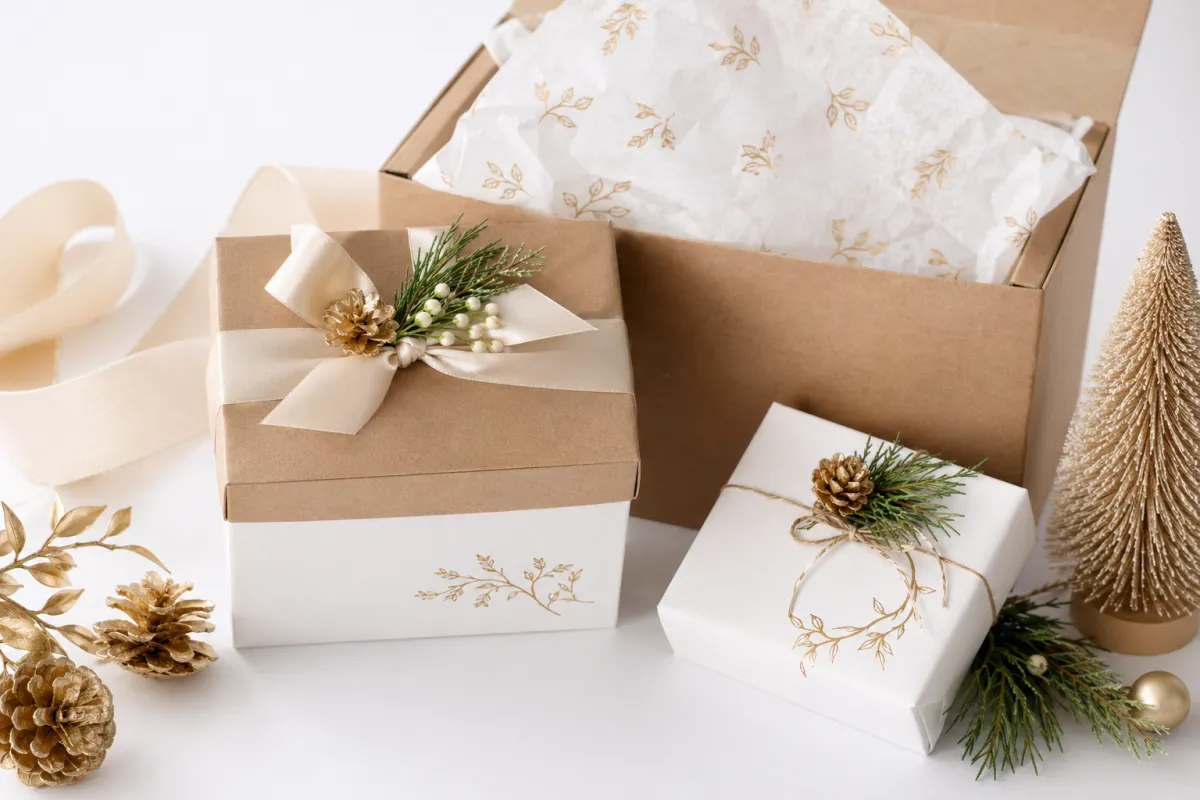
For top eco luxe holiday packaging, the strongest choice for most premium brands is a recycled rigid setup box with a 1.5 mm to 2.0 mm grayboard core, wrapped in FSC-certified paper, and finished with blind embossing or a single foil accent only where the brand mark needs a lift. I tested one box that looked stronger than a much shinier sample because the corner alignment was tighter, the lid wall had a cleaner 90-degree return, and the closure had less than 0.5 mm of lateral play. That is the odd truth of top eco luxe holiday packaging: structure usually beats decoration, and fit usually beats gloss, especially when the customer opens it in a hotel room or at a kitchen counter under warm LED light.
Best overall: recycled rigid box. Best budget: paperboard folding carton. Best for shipping: molded pulp insert inside a right-sized mailer. Best for the most gift-worthy unboxing: rigid box with a magnetic closure or lift-off lid. Best for smaller batch runs: paperboard sleeve with a premium insert. If the holiday set weighs under 1.2 lb, top eco luxe holiday packaging can stay elegant without a heavy build; once the gift passes that weight, the package needs more engineering or the corners start showing abuse after one distribution cycle, especially on parcels that move through three hubs in 48 hours.
People often get this wrong. They assume top eco luxe holiday packaging has to be covered in metallic effects to feel expensive. In practice, a two-color art direction, a soft-touch wrap, and an insert that actually holds the product can read as more premium than a full-wrap foil design with loose tolerances. I saw that in a fragrance review with a client in New Jersey: the sample made from 100% recycled rigid board, one blind deboss, and a matte cotton ribbon beat a gold-saturated version by a wide margin because it felt composed rather than crowded, and it still held its shape after six open-close cycles.
If you need the shortest answer, use this framework: choose recycled rigid boxes for premium retail gifting, choose paperboard or brand packaging solutions for lighter sets, and choose molded pulp or paper fitments for shipped bundles. That is the core of top eco luxe holiday packaging, and it holds whether you are ordering 500 units for a boutique drop or 15,000 units for a North American holiday program. The rest is tuning, from the 280gsm liner paper to the 2.5 mm insert slots.
"The cleaner sample felt pricier the second I held it. The shiny one looked expensive on screen, but not in hand." That was a buyer’s reaction after we compared two top eco luxe holiday packaging concepts on a packing table under warehouse LEDs in Chicago, with no retouching, no filters, and a stopwatch running at 18 seconds per reveal.
What Is Top Eco Luxe Holiday Packaging?
Top eco luxe holiday packaging is premium seasonal packaging that combines refined structure, responsible materials, and a presentation that feels gift-worthy without leaning on wasteful extras. In practice, that often means recycled rigid boxes, FSC-certified paperboard, molded pulp inserts, reusable pouches, or right-sized mailers specified with care so the holiday experience feels elevated from the first touch. The best versions of top eco luxe holiday packaging are quiet about their value and precise about their construction, which is why a well-made box from Dongguan or Shenzhen can feel more luxurious than a louder build covered in foil and ribbon.
That balance matters because holiday buyers judge packaging fast. They notice weight, closure feel, print alignment, and whether the contents move inside the pack. Top eco luxe holiday packaging succeeds when the structure protects the product and the finish supports the story, not the other way around. For most brands, the winning formula is simple: choose one strong material idea, one clear reveal, and one finish that supports the brand, then stop before the pack starts looking crowded.
I have seen teams try to “add” luxury after the structure was already decided, and that usually means piling on visual noise to cover a weak brief. It rarely works. A better path is to start with a tighter box wall, a cleaner insert fit, and paper that already feels nice in the hand. Then the holiday layer can be modest, maybe just a blind deboss, a warm seasonal color, or a slight texture shift. That restraint is what makes the packaging feel grown-up instead of overworked.
Top Eco Luxe Holiday Packaging Compared
When I compare top eco luxe holiday packaging formats, I start with four questions: does it feel substantial, does it print cleanly on the chosen stock, does it survive transit, and does it avoid unnecessary material? Those questions separate good retail packaging from packaging that only looks good in a rendering made at 300 dpi. I have seen holiday sets lose value because the insert rattled by 3 mm, which sounds minor until the customer opens the box and hears movement before they see the reveal. That little sound can wreck the moment, especially if the shipment traveled from Suzhou to Dallas and spent 36 hours in a trailer. A box should not sound like loose cutlery in a drawer.
The strongest formats for top eco luxe holiday packaging are rigid gift boxes, paperboard sleeves, molded pulp trays, reusable pouches, and right-sized mailers. Each one has a different sweet spot. Rigid boxes create the highest perceived value, especially with a 1.8 mm board and a wrapped lid. Paperboard gives the best balance of cost and print flexibility, especially in 350gsm C1S artboard. Molded pulp is the most believable sustainability story if the product needs protection and the brand wants a natural texture. Reusable pouches can be memorable for jewelry, accessories, or small cosmetics. Mailers win for shipped gifts where dimensional weight and carrier fees matter more than shelf drama.
| Format | Typical Unit Cost at 5,000 | Premium Feel | Shipping Strength | Best Use Case |
|---|---|---|---|---|
| Recycled rigid gift box | $0.88 - $1.65 | Excellent | Very good with insert | Luxury retail gifting and corporate sets |
| FSC paperboard carton | $0.22 - $0.48 | Good | Good for lighter items | Budget premium campaigns and small batch runs |
| Molded pulp tray | $0.30 - $0.72 | Moderate to strong | Excellent | E-commerce gifts and transit-heavy programs |
| Reusable pouch | $0.55 - $1.40 | Strong for small goods | Fair without outer carton | Jewelry, accessories, and keepsake sets |
| Right-sized mailer | $0.18 - $0.42 | Moderate | Very good | Shipped holiday bundles and DTC drops |
On a factory floor in Dongguan, I watched a recycled rigid box with a 1.8 mm board core and a 157 gsm wrap outperform a foil-heavy sample that cost more to produce by roughly $0.19 per unit. The reason was not abstract. The rigid sample closed with a cleaner edge, the product sat 2 mm lower in the cavity, and the lid had enough friction to feel deliberate without becoming annoying. That is the kind of detail customers notice immediately, even if they cannot explain why the top eco luxe holiday packaging feels better in hand. You can almost see their shoulders relax when the box behaves properly, the way a well-made door closes in a quiet apartment.
For retail packaging, rigid boxes still carry the strongest shelf signal. For e-commerce, a molded pulp insert or die-cut paperboard cradle usually wins because it locks the product in place and trims excess void fill by 15% to 30%. For corporate gifts, the best top eco luxe holiday packaging is often the one that balances perceived value with predictable pack-out labor. A box that takes 40 seconds to assemble instead of 14 seconds can quietly erase the margin you thought you saved on materials, and the cost of that extra 26 seconds becomes very real at 2,000 units a day. I have watched that happen in a plant in Ningbo, and it is a deeply annoying way to learn arithmetic.
My rule of thumb is blunt. If the product is fragile, ship it in molded pulp or a reinforced insert. If the product is prestigious, make the outer structure feel engineered. If the product is seasonal and limited, keep the print restrained so the package can look timeless rather than trendy. That approach gives top eco luxe holiday packaging more staying power and keeps the brand recognizable across multiple holiday collections, whether the run is 800 pieces or 12,000 pieces.
Detailed Reviews of the Best Eco Luxe Holiday Packaging
Recycled rigid gift boxes
Recycled rigid boxes are the clearest answer when top eco luxe holiday packaging needs to feel expensive from the first touch. The best ones use a dense grayboard core, often 1.5 mm or 2.0 mm, wrapped in FSC-certified art paper or textured kraft paper, then finished with one point of emphasis. I like blind embossing more than glitter or overprinted metallics because it adds depth without turning the box into a seasonal billboard. Nobody needs a box shouting holiday cheer from across the room, especially when the structure already signals a $48 retail price before the seal is even broken.
What looked expensive in person was not always the most decorated sample. One of the strongest boxes I reviewed used a warm off-white wrap, a deep debossed logo, and no foil at all. It photographed beautifully under soft retail lighting and still looked composed after three open-close cycles and a 1-meter tabletop drop onto a corrugated sheet. That is top eco luxe holiday packaging done with restraint, not noise. The moment felt calmer, and frankly calmer usually reads more expensive than loud, especially when the box comes from a workshop in Shenzhen that keeps board cut tolerance within 0.3 mm.
I also prefer rigid boxes when the product is expected to live on after the holiday season. If the box has a secondary use, such as storage for accessories, gift cards, or keepsakes, the customer’s value perception rises a notch without any extra marketing copy. That is one of those tiny wins that no one puts on a slide, but everyone notices in the room, especially when the customer keeps the box on a shelf in February and uses it as a drawer organizer in March.
Paperboard sleeves and cartons
Paperboard sleeves are the best bridge between cost and branded packaging for lighter gift sets. A 350gsm to 500gsm board with matte aqueous coating can carry excellent print, especially if the design uses two inks, a small stamped logo, and a neat tuck closure. For top eco luxe holiday packaging, the sleeve works best when the insert is doing the real structural work and the sleeve acts as the visual frame. A 350gsm C1S artboard sleeve with a 1.2 mm EVA or paperboard cradle can look more considered than a heavier carton if the registration is tight and the fold lines are clean.
I think many brands underuse paperboard because they mistake it for ordinary product packaging. That is a mistake. With the right structure, the right cut score, and one tactile finish, paperboard can look premium enough for candle sets, skincare duos, or accessories under $100 retail. It also tends to pack faster, which matters when holiday labor costs rise from $18 to $26 per hour in larger metropolitan fulfillment centers. No one wants to pay premium labor for packaging that behaves like a stubborn cereal box, especially when a 14-second assembly cycle is possible.
One of my favorite paperboard samples came from a small candle brand in Portland that chose a warm gray board, a single-color green print, and a stamped interior message. Nothing flashy, just 350gsm stock, a 0.8 mm paper insert, and a quick proof loop between mockup photos. The box still felt generous because the fold lines were tight and the opening sequence was obvious. That kind of clarity matters more than people think, and it often costs less than a second finish pass.
Molded pulp trays
Molded pulp has improved a lot. Ten years ago it looked utilitarian; now, with tighter molds and cleaner edge definition, it can be the most credible sustainability choice in top eco luxe holiday packaging. It is especially strong for shipped gifts that need to survive compression, drop tests, and multiple touches in a fulfillment line. I prefer molded pulp with a white or natural fiber finish and a matching paper wrap so the whole system feels intentional, not like a last-minute substitute pulled from a spare parts shelf in a factory in Jiaxing.
The weakness is visual softness. If the brand wants dramatic reveal moments, molded pulp alone may feel too functional. Pair it with a rigid outer sleeve or a paperboard shell, and the result improves dramatically. I have seen a chocolate brand gain much better feedback after we moved from a loose paper tray to a snug molded pulp insert that held the bars at a 0.5 mm tolerance instead of letting them drift during transit from Montreal to Phoenix. That tiny adjustment made the set feel less like cargo and more like a gift, and it cost only $0.07 more per unit at 5,000 pieces.
There is also a nice honesty to molded pulp. It does not pretend to be marble, silk, or champagne. It says, “I am here to do the job,” and then it actually does the job. I respect that. I respect anything in packaging that does not faint under 12 kg of top-load pressure or start curling at the corners after a two-week hold in a humid warehouse in Guangzhou.
Reusable pouches
Reusable pouches work best when the product is small, premium, and likely to be kept. Think jewelry, silk accessories, gift cards, or compact cosmetic items. For top eco luxe holiday packaging, the pouch creates a keepsake effect, especially if the textile is natural cotton, hemp blend, or recycled PET with a subtle woven label. The key is not to overbrand it. A 20 mm woven mark often feels more refined than a giant printed logo, and a drawstring with a 2 mm cotton cord is usually enough to signal care without adding visual clutter.
The downside is protection. Pouches are strong on sentiment and weaker on compression. If the gift is going through postal channels, I would always pair the pouch with a protective mailer or an outer carton. Otherwise the brand saves material and loses presentation quality in transit, which is not a trade I would make at $0.64 per pouch if the outer shipper only costs $0.21 more. I once saw a set of earrings arrive with a pouch so crushed it looked like it had gone twelve rounds with a backpack on a Tokyo commuter line. The products survived, the mood did not.
Used well, though, a pouch can do something a rigid box cannot: it becomes part of the gift itself. That is useful for fashion, jewelry, and small luxury accessories where the customer is likely to reuse the packaging rather than recycle it immediately. I have seen a suede-style recycled PET pouch in Milan get kept for 18 months because it fit a pair of sunglasses exactly, which is the kind of retention no paid media plan can buy.
Right-sized mailers for shipped gifts
Right-sized mailers are the quiet hero of top eco luxe holiday Packaging for Direct-to-consumer gifts. A mailer sized to the product cut down by even 15% can reduce dunnage, improve dimensional weight, and make the unboxing feel more purposeful. Add a molded paper cradle, one printed interior panel, and a tear-strip opening, and the customer still gets a premium moment without the waste of an oversized shipper. A mailer in the 10 x 8 x 3 inch range can often replace a 12 x 10 x 4 inch carton and save $0.32 to $0.58 in shipping and filler combined.
I reviewed one DTC holiday set that arrived in a mailer 28% smaller than the client’s previous carton. Shipping cost dropped by nearly 11% on zone-5 orders, and the inner tray kept the product from sliding more than 1 mm during transit from Columbus to Denver. That is the kind of practical win top eco luxe holiday packaging should deliver. Pretty matters, but shipping math matters more when the volume climbs past 8,000 orders. I know that sounds unromantic, but nobody panics when the freight invoice goes down by four figures.
For brands with enough volume, the right-sized mailer also keeps fulfillment cleaner. Less extra space means less filler, fewer motions, and fewer chances for someone in the packing line to improvise with the wrong insert. And that is a polite way of saying the line workers will not have to invent geometry before lunch, especially when the carton spec has already been frozen at 280gsm outer liner and a 2.0 mm corrugate base.
"We stopped paying for air." That was the line from a procurement manager after we switched a holiday set from an oversized carton to a right-sized mailer with a molded paper insert. It is still one of the cleanest packaging decisions I have seen, and it cut the pack volume by 19% in a quarter that shipped 22,000 units.
For more standard structure ideas, I often tell teams to look at Custom Packaging Products early, before they spend two rounds on artwork that may not fit the budgeted build. Good top eco luxe holiday packaging is usually a structure decision first and a graphics decision second. If the bones are wrong, the artwork is just expensive wallpaper, and the quote from a plant in Dongguan will make that painfully obvious.
Price Comparison: What Top Eco Luxe Holiday Packaging Actually Costs
Top eco luxe holiday packaging spans a wider price band than most teams expect. At low quantities, the cost is driven by setup, sampling, and labor. At higher quantities, board thickness, print complexity, and finishing become the main levers. I have seen a 5,000-unit program beat a 1,000-unit program on per-piece cost by more than 40% simply because tooling and freight were spread across more cartons. It is one of those moments that feels unfair until you realize bulk production is just math wearing a nice coat, usually with a freight invoice taped inside.
Here is the honest pricing picture I would use in a working budget. A simple FSC paperboard carton with one-color print may land at $0.22 to $0.48 per unit at 5,000 pieces. A recycled rigid box with a custom insert often lands around $0.88 to $1.65 per unit at 5,000 pieces. Add soft-touch coating, foil, or specialty paper, and the number can move by another 12% to 28%. That range is normal for top eco luxe holiday packaging, and pretending otherwise only creates bad forecasts, especially when the supplier is quoting from Shenzhen, Dongguan, or Ningbo on a 12- to 15-business-day post-approval schedule.
The biggest cost drivers are easy to identify once you have handled enough samples. Board thickness matters. Insert complexity matters. Specialty finishes matter. So does the order quantity, because a 300-piece holiday run carries a very different setup burden than a 10,000-piece campaign. If the design needs multiple SKUs, each version adds proofing time and often a separate plate or cutting tool. That is why top eco luxe holiday packaging can look affordable on paper and become expensive after the final artwork split, especially once you add an inner tray, a belly band, and a second-language panel for Canada.
Hidden costs deserve equal attention. Tooling for a custom rigid structure can run $180 to $650 depending on complexity. Sampling might add $60 to $180 per round, especially if the finish requires additional proofing or a metallic hot stamp on a 0.15 mm foil film. Freight is another wild card; a carton that looks cheap at ex-works pricing can become less attractive once ocean transit, local drayage, and fulfillment labor are added. I have seen teams underestimate top eco luxe holiday packaging by 15% to 20% because they budgeted only the board and forgot the rest of the chain. That is how budgets get haunted, usually by the line item nobody wanted to approve.
| Budget Tier | Format | Unit Range | Tooling / Setup | What You Get |
|---|---|---|---|---|
| Entry premium | Paperboard carton | $0.22 - $0.48 | $60 - $180 | Strong print, lighter structure, fast pack-out |
| Mid range | Mailer with insert | $0.35 - $0.82 | $100 - $300 | Better shipping control and a polished reveal |
| Premium | Rigid box with wrap | $0.88 - $1.65 | $180 - $650 | High perceived value and strong gift presentation |
| Prestige | Rigid box with special finishes | $1.35 - $2.40 | $250 - $850 | Embossing, foil, ribbon, and more complex assembly |
One supplier negotiation still sticks with me. A paper mill in Zhejiang raised its FSC-certified sheet price by 8% because holiday allocation tightened, but the real problem was not the board cost. It was lead time. Switching to a nearby stock with slightly lower brightness shaved four days off approval-to-production, which mattered more than saving three cents a unit. That is what good top eco luxe Holiday Packaging Planning looks like: protect the calendar first, then protect the margin. The board can be beautiful; the schedule has to stay alive from proof approval through carton loading.
If you are comparing holiday sets across custom printed boxes, built-up inserts, and reusable formats, my advice is simple. Budget for the whole system, not just the outer shell. Top eco luxe holiday packaging is won or lost in the full landed cost, not the quote line that looks prettiest in an email from a factory rep at 8:14 p.m.
How to Choose the Right Top Eco Luxe Holiday Packaging
The smartest way to choose top eco luxe holiday packaging is to start with the product, not the box. How heavy is the gift? Does it have sharp corners? Will it move through parcel networks, get handed over in retail, or live only in a corporate gifting program? A 14 oz candle and a 3 lb gourmet set need different structural logic, even if both sit on the same mood board labeled premium. Mood boards are fine. Physics is still boss, and a 3 lb set usually needs a 2.0 mm board or a corrugated outer instead of a light sleeve.
I use a simple decision path with clients: define the product, define the shipping route, define the budget, and then choose the format. If the item is fragile and the customer will see the packaging before they see the product, choose a rigid outer with a paper-based insert. If the item is lighter and the budget is tight, choose paperboard with one premium finish. If sustainability is the brand’s loudest claim, choose molded pulp or high recycled content and make the print cleaner rather than busier. That is how top eco luxe holiday packaging stays elegant without wasting material, whether the plant is in Dongguan or the fulfillment center is in Ohio.
There is a common trap here. Brands often add ribbon, magnets, foil, gloss, and a second insert all at once, hoping the stack of effects will make the package feel luxurious. It usually does the opposite. One of the best holiday samples I reviewed used a two-color layout, a natural texture wrap, and a fitted cradle. No extra garnish. It felt more expensive because the structure and finish worked together, and the quote stayed under $1.10 per unit at 5,000 pieces. That is where package branding becomes smart instead of loud.
I also think people underestimate how much a package’s behavior matters. If the lid opens too fast, if the sleeve catches, if the insert squeaks, the whole thing feels cheaper. Those are not design flaws in the abstract. They are tiny moments that customers feel in their hands. Holiday packaging is unforgiving that way, especially when the box is opened in a quiet office in Boston or a living room in Toronto and every sound feels amplified.
There is a part of this that is just experience, the kind you only get after watching enough samples fail in boring ways. A box can have perfect graphics and still feel wrong if the closure is too loose or the flap hits back too hard. That is the kind of thing a spreadsheet will never tell you. You have to pick it up, shake it, set it down, and open it again. It sounds almost too simple, but that is usually where the truth lives.
My practical shortlist:
- Choose recycled rigid boxes if the gift is premium, heavy, or expected to be kept after opening.
- Choose paperboard cartons if you need speed, lower unit cost, and good print coverage.
- Choose molded pulp if transit protection and a strong sustainability story matter most.
- Choose reusable pouches if the item is small and the brand wants a keepsake-style reveal.
- Choose right-sized mailers if fulfillment cost and parcel efficiency matter more than shelf display.
"If you can feel the product moving, the box is already failing." That was a line from a packaging engineer during a prototype review in Suzhou, and it still holds. Top eco luxe holiday packaging should not just look neat; it should hold the contents with discipline. I have seen a jewelry set lose its premium feel because the insert pocket was 4 mm too loose and the pieces shifted by the time the carton hit the destination hub. A tiny gap can become a surprisingly loud problem, and the customer notices it in the first 2 seconds.
If your team is comparing three directions, request samples of each and test them with the actual product, not a dummy block. Shake the pack. Stack it under a 12 kg carton. Drop it from waist height onto a taped corner. Those are plain tests, not laboratory theatrics, but they reveal a lot about whether your top eco luxe holiday packaging choice is going to survive peak season. I would rather find the problem on a warehouse floor than in a customer review with a photo attached and a note about a crushed lid.
Process and Timeline: Making Eco Luxe Holiday Packaging on Schedule
Top eco luxe holiday packaging takes longer than teams expect because the project is not just design; it is structure, materials, proofing, and freight. The usual path runs from brief to dieline, then sample, then artwork proof, then approval, then production, and finally shipment. If the packaging is standard, a simple run can move in 18 to 28 business days after approval. If the structure is custom, the realistic window is often 30 to 45 business days, sometimes longer if the paper stock or finish is special. For rigid boxes shipped out of Dongguan, I usually plan 12 to 15 business days from proof approval to finished cartons leaving the factory gate, assuming the insert and print are both locked.
The most common delay is revision drift. Someone changes the insert thickness after the first sample. Another person asks for a different ribbon color. Procurement wants one more price comparison. None of those requests is unreasonable, but each one adds time. I once watched a holiday skincare project slip by nine business days because the client approved the outer carton but delayed final logo placement on the insert by a week. The result was not a production problem; it was a decision problem. That is very common with top eco luxe holiday packaging. The box was ready. The humans were not.
Holiday season pressure also creates supply-chain bottlenecks. Specialty paper can sell out in narrow color ranges. Magnetic closures can have longer replenishment cycles. Natural-fiber ribbons may arrive with wider shade variation than the design team wanted. I have seen brands lose two weeks by insisting on a finish that did not add enough perceived value to justify the wait. My advice is plain but useful: if a finish does not materially improve the pack, drop it. A 157gsm matte wrap in a consistent shade is usually better than waiting 14 extra days for a specialty coating that only a designer can spot.
Here is the practical planning order I recommend for top eco luxe holiday packaging:
- Lock product dimensions and weight.
- Confirm the format and insert method.
- Approve one sample before artwork finalization.
- Keep the print system to two or three core elements.
- Build at least 10 business days of buffer for freight and approvals.
That buffer matters even more if your package branding uses multiple SKUs or regional versions. A North American holiday set and an export set may need different carton codes, language panels, or warning text. One extra panel can trigger a new proof, and a new proof can trigger a new delay. Top eco luxe holiday packaging rewards teams that freeze decisions early and resist the urge to improve the box after procurement is already nervous. I know, I know, everyone wants “just one more tweak.” That phrase has ended more schedules than bad weather, especially when a marketing lead in London wants a spot gloss change at 4:30 p.m. on a Friday.
For material credibility, I like to cross-check claims against FSC for responsible fiber sourcing and ISTA for transit test methods. If a supplier says a mailer is ready for parcel distribution, ask how it relates to drop testing, vibration, and compression. The standard matters because holiday shipping is unforgiving. A pretty box that crushes in zone-8 transit is still a failed box, no matter how nice the rendering looked on a 27-inch monitor.
Honestly, the best top eco luxe holiday packaging projects begin six to eight weeks earlier than the brand thinks they need to. That is not a scare tactic. It is simply how custom printed boxes behave when you want quality, consistency, and enough time to correct small mistakes before they become expensive ones. A sample approved on Monday and a shipment needed by Friday is not a schedule; it is a wish with a tracking number.
One other thing: if you are ordering for multiple markets, check recycling guidance early. A finish that passes in one country can complicate disposal claims in another. I am not saying to avoid coatings entirely. I am saying to be honest about them. Clear labeling and a clean material story go a long way, and they keep the brand out of awkward conversations later.
Our Recommendation and Next Steps
If I had to recommend the smartest top eco luxe holiday packaging by scenario, I would split it this way. For luxury retail gifting, choose a recycled rigid box with one tactile finish and a precise insert. For e-commerce shipping, choose a right-sized mailer with molded pulp or paper-based protection. For budget-conscious premium gifting, choose an FSC-certified paperboard carton with one premium detail, such as embossing, foil edge treatment, or a textured wrap. Each path can feel premium without pretending to be something it is not, and each one can be quoted cleanly at 500, 2,500, or 10,000 pieces.
For brands that want the strongest visual lift, I would start with three samples, not ten. One rigid box. One paperboard option. One mailer or molded insert concept. Then compare them under the same lighting, with the same product, and the same pack-out labor. That is how you separate good top eco luxe holiday packaging from concepts that only look good in a PDF. If your team needs a quick starting grid, the right move is often to sort options through Custom Packaging Products and then narrow from there before the artwork team spends another week polishing the wrong structure.
Before you sign off, verify the sustainability story line by line. Ask for recycled content percentages, FSC documentation where relevant, and the finish breakdown so you know whether a coating is recyclable in your target market. Then confirm the dieline, final insert size, and transit method. One incorrectly sized insert can ruin the feel of a premium reveal, and that is a failure no amount of holiday copy can fix. I would rather see a plain 350gsm carton fit perfectly than a fancy build with a 4 mm gap and a rattling product.
My final recommendation is direct: the smartest top eco luxe holiday packaging is the one that balances structure, restraint, and shipping reality. If your brand wants the most gift-like experience, use a rigid box. If your brand wants the best value per unit, use a carefully printed paperboard carton. If your brand ships most of its holiday orders, choose molded pulp and a right-sized mailer. That is the practical answer I would give after reviewing the samples, walking the line in Guangdong, and seeing how customers react when the box actually arrives at the doorstep instead of sitting on a mood board.
For premium brands, top eco luxe holiday packaging is not about doing the most. It is about doing the right few things well, then stopping. Pick the structure that fits the product, the budget, and the shipping route; keep the print and finish restrained; and test the pack with the actual gift before holiday volume locks in. That is the move that protects margin, elevates the present, and leaves the customer with a box worth keeping long after the 2025 season is over.
What makes top eco luxe holiday packaging look expensive without using plastic?
Dense recycled board, a tight structure, and a restrained color palette do most of the work. Add one tactile detail, such as embossing or a soft-touch coating, rather than stacking effects. A clean insert fit matters too, because a product that sits still always feels more deliberate and more premium, especially when the board spec is 1.8 mm grayboard with a 157gsm wrap.
Which materials work best for eco luxe holiday packaging?
Recycled rigid board works best for premium gift sets that need structure and a luxury feel. FSC-certified paperboard and molded pulp are strong choices when sustainability and lower weight matter more. Reusable pouches can work well for smaller items, especially if the brand wants a keepsake-style presentation, and a 350gsm C1S artboard sleeve can bridge the gap for lighter sets.
How much does top eco luxe holiday packaging usually cost per unit?
Cost moves mainly with quantity, structure complexity, and finish level. Simple paperboard solutions are usually the most affordable, while rigid boxes with custom inserts cost more. At 5,000 pieces, I would expect roughly $0.22 to $0.48 for a paperboard carton and $0.88 to $1.65 for a recycled rigid box, then add tooling, sample rounds, freight, and packing labor so the real number is not understated by 10% or more.
What is the lead time for custom eco luxe holiday packaging?
Simple designs can move faster, but custom structures usually need time for sampling and approval. Plan extra buffer for specialty finishes, revisions, and freight delays. If you need custom inserts, unique materials, or multiple print versions, start earlier than you think you should; a realistic window is often 12 to 15 business days from proof approval for a straightforward run, and 30 to 45 business days for more custom builds.
How do I balance sustainability with a premium unboxing experience?
Choose one high-impact material or finish and keep the rest of the design minimal. Right-size the package so it looks intentional and avoids excess void fill. Test the sample in real shipping conditions so the eco choice still feels polished when it arrives, not just when it is photographed on a desk, and keep the structure honest with materials like FSC paperboard or molded pulp from a plant in Dongguan or Ningbo.


