The toy cuffed knit Beanies Material Sample guide is useful because the problems it exposes are rarely dramatic. More often they are small and expensive: a cuff that looks clean but collapses after a few stretches, a yarn that feels soft at first and then pills fast, or a logo that sits straight on the table and tilts once the beanie is folded and worn. Those flaws are easy to miss in photos and hard to forgive in bulk.
A sample should do more than confirm color. It should tell a buyer how the fabric behaves, how the opening recovers, whether the crown holds its shape, and whether the decoration still looks balanced after handling. In other words, the sample is a mechanical test disguised as a product sample. That distinction matters, because knit headwear is shaped by variables that a flat spec sheet cannot fully capture.
What makes this category tricky is the number of decisions that look minor on paper. A change in stitch density can alter warmth and drape. A deeper cuff can make branding easier, but it can also shift the whole silhouette upward on the head. A softer yarn can improve comfort and reduce complaints, yet it may also lose structure sooner. Those trade-offs are where buyers either save money or create avoidable revisions.
Why the toy cuffed knit beanies material sample guide catches fit problems fast
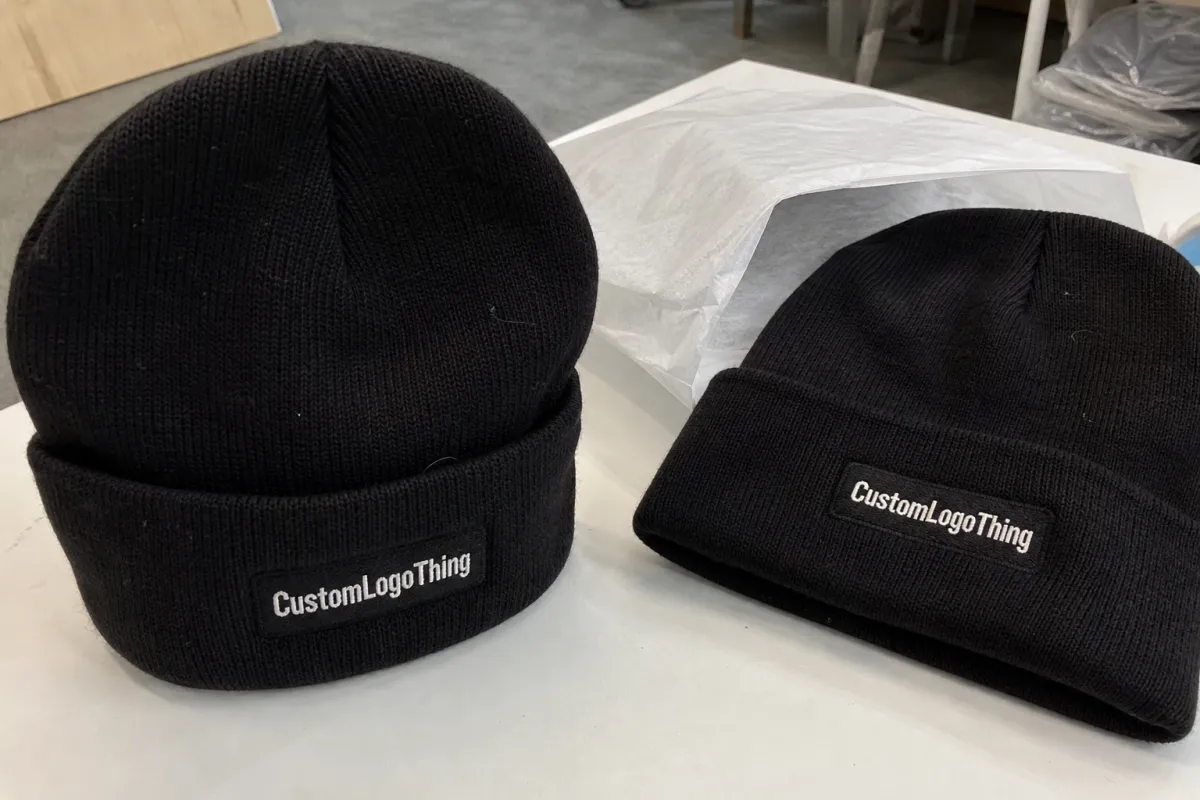
A single sample can reveal fit issues faster than a dozen back-and-forth emails. The reason is simple: knitwear behaves like a system. Yarn, gauge, cuff depth, seam finish, and label placement all interact once the beanie is stretched, folded, and worn. A piece that looks premium on a table may still feel too shallow on the forehead, too tight at the fold, or oddly loose at the crown.
That is why a production-minded sample review should focus on movement. Stretch the cuff, let it recover, fold it twice, wear it for a few minutes, then check whether the opening relaxes unevenly. A beanie that stays neat in a static photo can still drift out of shape once the knit is asked to perform. This is especially common with softer yarns and loose gauges, which often look comfortable but need tighter control to keep the finished form consistent.
Three checks usually tell most of the story:
- Material behavior — how the yarn feels, rebounds, and resists pilling.
- Visual consistency — whether stitch lines, color, and trim match the intended look.
- Wear comfort — whether the beanie still feels balanced after a few minutes on the head.
A sample that only looks good in one position is not a reliable approval piece.
Buyers often underestimate the cuff because it seems like a styling detail. It is not. The fold changes tension, adds weight, creates the branding surface, and alters how the opening grips the head. If the cuff is too short, the piece can feel casual but unfinished. If it is too tall, the beanie may look structured while becoming less forgiving at the band. Small differences matter here because a few millimeters can shift the entire fit profile.
How a cuffed knit beanie sample is built
The sample process starts with yarn, and the yarn choice sets the tone for the rest of the build. Acrylic is common because it is predictable, widely available, and usually easier to price. Cotton offers a familiar, breathable hand, though it tends to show less natural spring than synthetic options. Wool gives warmth and a more traditional feel, but it also brings higher cost and more careful handling. Blends sit in the middle and are often selected to balance softness, recovery, and budget.
After yarn selection, the factory sets the machine gauge, stitch count, and density. That step is not just technical detail; it determines whether the final piece will look crisp, relaxed, dense, or slouchy. A tighter knit usually gives better shape retention and makes the cuff feel more deliberate. A looser knit can feel softer and less formal, but it may sag earlier or twist under repeated wear. For that reason, the best sample is the one built with the same structure intended for bulk production, not a visually similar substitute.
Finishing comes next. Depending on the target look, the piece may be steamed, trimmed, washed, brushed, or lightly blocked. Labels can be sewn into the side seam, attached to the cuff, or converted into a woven patch. Each option changes the handfeel and the way the cuff lies against the forehead. Even thread thickness at the label can alter the fold line more than many buyers expect.
One production rule applies across all of these steps: the sample should mimic the real order as closely as possible. If the final run will use a specific yarn lot, a double-fold cuff, and a woven label, then the sample should reflect those same choices. Anything less can create a false sense of confidence. A beautiful prototype that is built differently from the order it represents is useful for concept discussion, but weak for sign-off.
Yarn, gauge, and finish details that change the result
Yarn is where tactile judgment starts. Buyers often focus on softness first, but that is only one part of the picture. Warmth, weight, pilling resistance, and recovery all affect how the beanie will perform after repeated handling. If the item is meant for retail, school use, or a giveaway that will be worn outdoors, the material needs enough resilience to avoid looking tired after a short stretch of use. For longer-life programs, some teams request test data tied to common textile methods such as ASTM or AATCC protocols for pilling or colorfastness.
Gauge matters just as much. It is the density of the knit, and it controls how firmly the fabric holds together. Tighter gauge usually improves structure and helps the cuff keep its shape. Looser gauge creates a softer drape and can feel more casual, but it may also allow the beanie to grow or roll unevenly. Neither is universally better. The right answer depends on whether the product needs a polished retail presentation or a softer, lower-cost promotional feel.
Finish details are easy to dismiss until they change the sample in a way the buyer cannot ignore. A brushed finish can make the yarn feel warmer and fuller, but it can also reveal pilling sooner. Washing can soften the hand, though a poorly controlled wash step may shrink the body or distort the opening. Blocking can improve alignment, but only if the shape is set correctly before drying. Even a label stitch line can move the cuff when the piece is folded. That is why inspection should happen in hand, not just through a camera.
Details worth checking by hand
- Cuff height and whether it stays even after folding.
- Seam behavior at the opening and crown.
- Recovery after the cuff is stretched several times.
- Handfeel near the forehead, where comfort is most noticeable.
Material comparison is most useful when all other variables stay steady. If one sample uses a different color, a different label, and a different gauge, the buyer is no longer comparing yarns; they are comparing three or four changes at once. Clean sampling isolates the variable under review. That discipline saves time later, because the team can say with confidence whether the issue is the fiber, the knit density, or the finishing method.
Sampling process and timeline from swatch to approval
The sample timeline usually begins with artwork, measurements, yarn direction, and decoration notes. From there, the mill or factory sources material, knits the first version, and ships it for review. If the first pass is close, the next version may only require a small measurement correction or a branding adjustment. If the first pass misses the target badly, the process slows down quickly.
Delays are usually practical, not mysterious. Stock yarn moves faster than custom yarn. A single woven label is easier than a multi-layer patch. A standard knit structure is quicker than a shape that needs special cuff control. Freight method also matters. Air shipment can get a sample on a desk in days, while slower parcel routes can add a week or more, especially if the package crosses multiple sorting points.
The best sampling schedules account for revision time upfront. A factory might quote five to seven days for the first sample, then another three to five days for corrections, but those numbers only hold if the buyer answers comments quickly and the spec is clear. If the cuff depth is ambiguous or the logo file is not fully dimensioned, the timeline slips. Most slowdowns come from incomplete information, not from the knitting itself.
Packaging should protect the sample before it presents the sample. Knit pieces travel better in corrugated cardboard outer cartons with kraft paper wrapping, because that keeps friction and crushing down. If a buyer wants a lower-impact presentation, it is reasonable to ask whether the carton is FSC certified, made with recycled materials, or contains post-consumer waste content. Those details matter more than a loose “eco” label. If biodegradable packaging is requested, it still has to survive moisture and transit pressure, or the material claim becomes irrelevant.
For transit stress and packaging performance, distribution standards are useful references because they treat the carton as part of the product path, not just the outer shell. That mindset helps prevent crushed cuffs, bent labels, and scuffed knit surfaces before the sample ever reaches review.
Cost, MOQ, and pricing drivers for sample requests
Sample pricing reflects setup effort more than raw material cost. A stock-yarn visual sample is usually the lowest-cost option because the factory can work from existing material and standard knitting parameters. A production-accurate sample costs more because it requires the exact gauge, the intended cuff, the right decoration method, and sometimes a dedicated setup run. If custom yarn or unusual finishing is involved, the fee rises again because sourcing and trial work take time.
The same logic shapes MOQ discussions. For samples, factories may treat the request as part of a development pipeline if they expect a larger order to follow. For one-off work, the sample fee may stand alone. The buyer should ask whether the fee is credited back on production and whether that credit depends on a minimum order quantity. If the answer is vague, the total project cost is probably not fully defined.
| Sample type | What you review | Typical fee | Best use |
|---|---|---|---|
| Stock-yarn visual sample | Basic shape, color direction, logo placement | $18-$35 plus freight | Early concept checks |
| Production-accurate sample | Exact cuff, gauge, label, and finish | $35-$75 plus freight | Final approval before order |
| Comparison set | Two or three yarn options with the same knit | $60-$140 total | Material selection |
| Revised pre-production sample | Corrections after the first review | $25-$60 plus freight | Last sign-off |
There are hidden costs, and they are usually the ones that create friction. Extra revisions, color matching, packaging changes, and outbound freight can push the real spend higher than expected. A clean quote should separate sample fee, revision fee, freight, and any refundable deposit. It should also say whether the sample is packed for internal review or for presentation, since those are different jobs.
Price should never be assessed without asking what the buyer gets for it. A cheap sample that does not match production can cost more than a higher-fee sample that removes uncertainty early. The value is in reduced revisions and fewer surprises once bulk knitting starts.
Step-by-step review checklist before you approve
A clear review sequence makes approvals easier to defend. Start with the material, move to measurements, then test recovery, and only after that inspect branding and packaging. That order matters because a bad yarn choice makes every later decision less useful. There is no reason to debate label position if the opening already feels wrong.
- Check the fiber feel. Decide whether the handfeel matches the target use.
- Measure the sample. Confirm height, width, cuff depth, and opening size.
- Stretch the cuff. See how fast it recovers and whether it grows loose.
- Review branding. Confirm logo size, patch position, and stitch balance.
- Inspect packaging. Make sure the presentation matches the buyer’s plan.
A written spec sheet keeps everyone aligned better than scattered comments. The sheet should list the intended fiber, knit density, exact measurements, logo placement, and packaging instructions. If the buyer wants a retail-ready sample, the board grade, wrap style, and any recycled or FSC-based requirements should be spelled out too. That way the sample reflects the final product, not a loose approximation shaped by assumptions.
It helps to test the piece after a short period of handling. Fold it, stretch it, set it down, and check whether the cuff returns to its original line. This simple step often exposes issues that look minor at first and become visible only after the knit has been moved around a few times. A good approval survives handling, not just inspection.
Common mistakes that create bad approvals
Approving by appearance alone is the most common mistake. A sample can look neat in a photo and still fail in recovery, seam comfort, or cuff stability. If the opening relaxes too quickly, the whole product can feel low quality even if the yarn itself is acceptable. That kind of failure often shows up only after the order is already moving forward.
Vague specifications create unnecessary drift. If the buyer skips exact measurements, fiber content, or color references, the factory has to interpret the brief. Those interpretations may be reasonable and still wrong for the intended market. A winter retail beanie does not need the same body density as a low-cost event giveaway, and a difference of a few millimeters can change the silhouette enough to matter.
Another frequent mismatch appears when the sample method does not match the production method. A hand-finished or heavily manual sample is not a fair preview of a more automated bulk run. The same problem shows up with decoration. A woven label, an embroidered mark, and a patch all affect stretch and weight differently, so the final build should be the one under review, not the closest-looking substitute.
Small embellishments matter. A label, patch, or embroidery thread can shift the way the cuff sits more than a buyer expects. That is why the sample must reflect the final structure instead of only the general appearance.
If the factory cannot explain how the sample will translate into bulk production, the approval is not finished.
One more mistake deserves mention: treating packaging as an afterthought. For knit goods, presentation and protection are linked. A crushed carton can flatten a cuff; a loose wrap can scuff the knit surface; poor moisture protection can change the way the piece feels when unpacked. Sampling should verify those risks before any larger run begins.
Expert tips for cleaner sampling and next steps
Start with the hardest risk. If cuff stretch is the main concern, resolve that before polishing the logo or packaging insert. If handfeel is the real issue, compare yarns before locking the rest of the build. Fixing the most unstable variable first keeps the process from wandering.
Keep one master spec sheet, one image reference set, and one approval owner. That sounds basic, but it prevents the comments from splitting in different directions. Multiple reviewers can still weigh in, but one person should collect feedback and make the final call. Otherwise the sample becomes a moving target.
Ask for a production-ready sample whenever the project allows it. It gives the clearest read on structure, cuff behavior, and decoration balance. If the supplier can only send a visual sample first, treat that as a rough checkpoint rather than a final answer. The point of sampling is to reduce uncertainty before bulk work starts, not after.
Use the toy cuffed knit Beanies Material Sample guide as a working tool for material selection, cost review, timeline planning, and final sign-off. A good sample will not erase every risk, but it should narrow the field enough that the order can move forward with fewer surprises and better control.
FAQ
What should a toy cuffed knit beanies material sample include?
It should show the actual yarn type, cuff construction, measurements, and any branding details that will appear in production. It should also be easy to inspect for stretch, recovery, stitch consistency, and finish quality under normal handling. If packaging or labeling matters, ask for those details too so the sample reflects the final presentation, not just the knit itself.
How do I compare yarn options for a cuffed knit beanie sample?
Compare softness, warmth, weight, pilling resistance, and how well the yarn holds the cuff shape after stretching. Ask for the same knit structure across yarn options so you are judging the fiber, not a different construction method. If possible, keep color and decoration consistent so the material difference is easier to see and feel.
How long does the beanie sample process usually take?
Timing depends on yarn sourcing, factory capacity, and whether the first sample needs revisions before approval. Simple stock-material samples can move quickly, while custom yarn or special decoration usually adds extra days or weeks. Clear specs and fast feedback are the easiest ways to keep the timeline from stretching out.
What affects pricing and MOQ for toy cuffed knit beanies?
Price is shaped by yarn choice, knit complexity, decoration method, and whether the order uses stock or custom materials. MOQ often reflects setup time and the economics of producing a consistent knit at scale, not just the number of pieces requested. Always ask whether sample fees, revisions, and freight are included so the quote is easy to compare.
How do I avoid approval mistakes on a cuffed knit beanie sample?
Use a written checklist for measurements, handfeel, cuff stretch, color, and branding so nothing gets approved by memory alone. Test the sample in real handling conditions instead of relying on photos, since knit behavior changes when worn and folded. Keep one clear decision-maker if possible so revisions do not bounce between conflicting opinions.


