A useful toy Woven Label Beanies material sample guide is less about choosing the prettiest prototype and more about ruling out problems early. A beanie sample has to answer practical questions: does the knit feel right, does the label stay readable when the cuff stretches, does the stitch line hold its shape, and does the overall piece still look deliberate after it has been handled a few times? If any of those answers is shaky, the sample is telling you to revise before production makes the mistake expensive.
Buyers often focus on the artwork first, then discover the physical build changes the result more than expected. A glossy woven label can overpower a soft knit. A loose weave can blur small type. A label placed a few millimeters too close to a seam may look centered in the proof and crooked on the finished beanie. That is normal manufacturing behavior, not a surprise. The point of sampling is to expose it while changes are still cheap.
For merchandise programs, school orders, fashion drops, and licensed goods, the sample should do two jobs at once. It has to show the product honestly, and it has to reflect the price point honestly. A beanie that looks premium in a flat lay but feels flimsy in hand will cause friction later. A well-made sample does the opposite: it removes doubt.
Toy woven label beanies material sample guide: what to inspect first
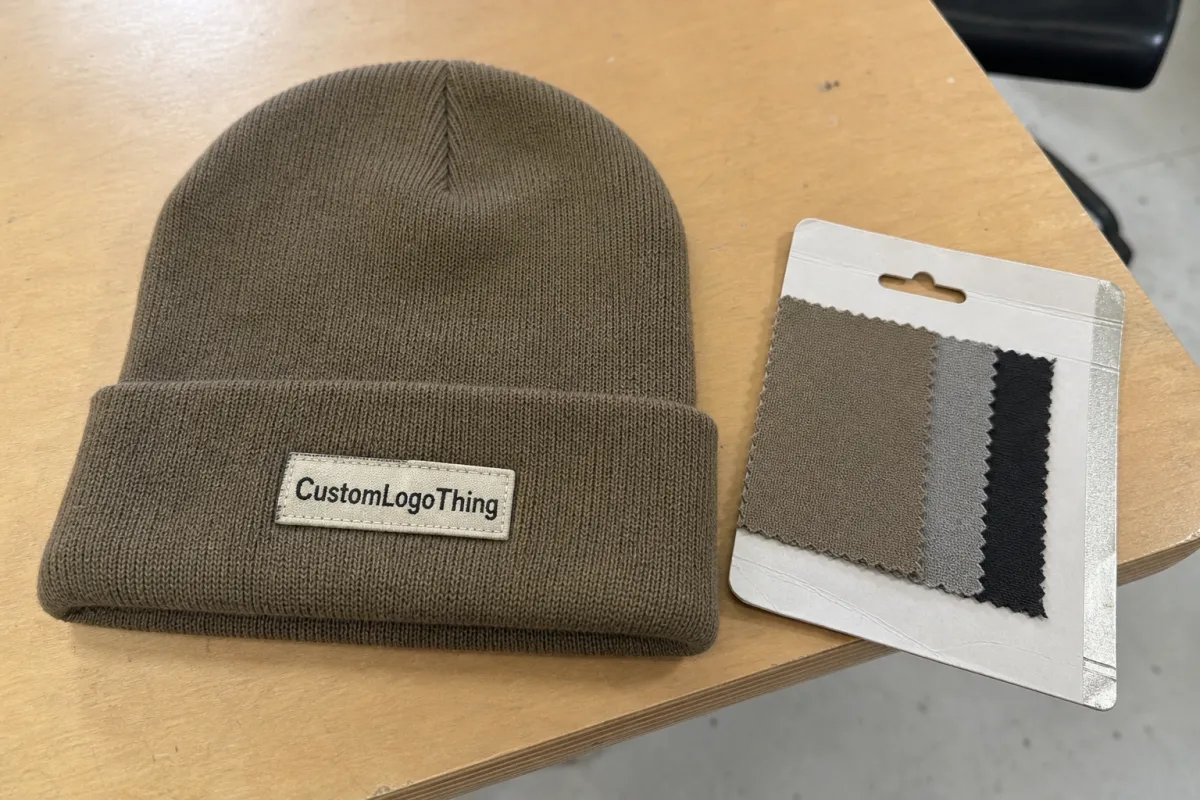
Start with the label, because the label is where small mistakes become visible fastest. The beanie body can look acceptable in a render, but the woven label is where text edges, logo contrast, thread density, and border finish either sharpen or disappear. A label with weak contrast can make the whole piece feel underdeveloped. A label that is too shiny can draw attention away from the knit body and make the product feel busy rather than balanced.
Use the sample as a physical object, not a screen image. Hold it at arm’s length, then bring it closer, then crumple and smooth it once or twice. That simple routine reveals more than a mockup file ever will. You are checking readability, hand-feel, stitch stability, fold behavior, and whether the label still sits cleanly on a stretchy surface after handling.
The sample should also tell you whether the product matches the intended market. A youth promo beanie, a retail fashion piece, and a licensed character item can all use similar construction, yet each one needs a different visual weight. Strong contrast may help one line and hurt another. Softer thread tones can feel premium in one context and washed out in another. That judgment is easier in the hand than on a quote sheet.
“A beanie sample that still reads cleanly after stretching, folding, and a little handling is usually more reliable than one that only looks perfect in a staged photo.”
There is a second reason to inspect first in person: buyer teams often approve from the wrong level of detail. They zoom in on the artwork and miss the seam placement. Or they discuss color and ignore the edge finish. The sample needs a full checklist. Exact label size. Exact placement. Exact stitch type. Exact body material. Exact backing. Those details decide whether the production run matches the approved piece or just resembles it.
How the beanie body, woven label, and stitching work together
A sample should be read as a system, not as separate parts. Knit gauge, yarn density, label weave tightness, backing choice, and seam placement all affect the final look. A thick rib knit can make a small label disappear. A smoother acrylic body can make the same label feel much crisper. That is why a label that looks right on paper may look wrong once it is stitched into the actual product.
Stitching deserves more attention than it usually gets. A centered label on a flat sample may shift once the cuff is folded or the fabric stretches. Even a 5 mm placement difference can be minor on a spec sheet and obvious in the hand. If the label sits on a seam, or too close to the fold line, it can pucker after a few wears. The issue is not decorative taste. It is fit and tension.
Thread density affects legibility at scale. A higher-density weave typically supports sharper text and more precise logo edges. A looser weave can soften the artwork, which may suit a relaxed brand voice, but it also raises the risk of blurred micro-details. That tradeoff becomes obvious on a sample long before it shows up in a full order. For small logos, thin lines, or fine typography, ask to compare two densities side by side if possible.
Comparing the sample to an approved reference beanie helps a lot. Put them beside each other and judge drape, cuff height, label scale, and overall proportion. Human eyes are better at spotting differences than absolutes. A sample that feels “off” may be only slightly off in one place, but that slight difference is often enough to change the retail impression.
That same system view helps avoid a common mistake: approving the label in isolation. A label can look excellent on its own and still fail once it is integrated into the beanie body. The border might be too stiff for the knit. The backing might create a visible bump. The thread finish might catch the light in a way that fights the fabric texture. Good sampling catches those interactions early.
Material choices that change feel, color, and durability
Most beanie programs still begin with a short list: acrylic, cotton, wool, or a blend. Acrylic remains common because it is cost-friendly, keeps color fairly consistent, and gives a predictable hand-feel across batches. Cotton breathes better and feels more natural, but it usually has less stretch recovery and can show shape changes sooner. Wool has the warmest story and a more premium tactile profile, though it raises price and can shrink or felt if care instructions are ignored. Blends sit between those extremes and are often chosen to balance cost, hand-feel, and wash behavior.
The label material matters too. A satin-like finish can look elevated, but a tighter weave generally keeps text clearer and resists fraying at the cut edge better. For small logos or fine type, ask for a denser construction and compare it to the standard option. The difference is modest on a screen and obvious in the hand. A supplier may call both versions “premium,” but the sample will show which one actually supports the artwork.
Color matching deserves more scrutiny than it gets. Thread that looks close in a digital proof may read warmer, cooler, or duller once it is woven and placed on the beanie under warehouse light. That is why physical references matter. Check the sample under natural light and indoor light. If the brand has strict color expectations, keep a physical standard nearby and compare the label against that standard rather than relying on memory or a monitor.
Durability is not only a fiber question. Pilling, snagging, and fade resistance matter because a sample can look clean on day one and still age badly after normal handling. For retail products, packaging becomes part of the durability conversation. A loose fold in a thin mailer may be acceptable for a giveaway, but a higher-value beanie may need a protective inner pack so the label and knit surface arrive in the same condition they left.
If the program includes recycled-content claims, ask suppliers to state exactly what is recycled and where it is used. That applies to the beanie body, the label, and the pack. Packaging language should be specific, especially if the outer wrap uses FSC certified paper, recycled materials, or biodegradable packaging. General claims invite confusion. Clear material statements reduce it. For reference on responsible paper sourcing, the FSC site is a useful starting point: FSC.
On the production side, a buyer should also ask whether the proposed fiber blend changes the label behavior. Some yarns are more forgiving with stitch placement. Others make the label appear more rigid because the knit has less give. That can affect comfort, not just appearance. If the sample feels scratchy where the label sits, the issue may be the backing, the thread finish, or the thickness of the label itself, not the beanie body.
Cost, pricing, MOQ, and quote questions buyers should ask
A practical sample guide should help buyers read price pressure before it turns into a surprise. Cost is usually driven by label size, thread count, number of colors, backing type, sewing labor, setup time, and freight or courier charges. The sample itself may be inexpensive. The landed total rises once revisions and shipping are added.
| Option | Typical sample cost impact | Typical production add-on | Best fit |
|---|---|---|---|
| Standard acrylic beanie + simple woven label | $18-$35 before freight | $0.06-$0.10 per unit | Promotions, school programs, high-volume basics |
| Cotton or cotton-blend beanie + mid-density label | $25-$45 before freight | $0.10-$0.18 per unit | Lifestyle brands, softer hand-feel, better retail presentation |
| Wool blend + high-density woven label | $35-$65 before freight | $0.14-$0.25 per unit | Premium lines, colder-weather ranges, smaller logos |
| Complex label with backing, fold, or multi-color detail | $30-$55 before freight | $0.12-$0.22 per unit | Fine text, brand marks, layered spec sheets |
MOQ changes the math. Smaller orders spread setup, weaving, sewing, and handling across fewer units, so the per-piece price is higher. A run of 100 or 200 beanies may be perfectly workable for a test, but it will not price like 1,000 units. That is not a defect in the quote. It is the reality of low-volume production. The useful question is where the cost jumps occur and what triggers them.
Ask direct questions before approving a quote. What is included in the sample price? Does it cover one revision or several? Are artwork changes billed separately? Is the first courier included? Does the price change if the label needs denser weave or a different backing? If the answer is vague, the quote is incomplete.
It also helps to keep the label spec in one place. A clean product reference such as Custom Labels & Tags gives the buyer, designer, and supplier the same baseline for size, weave, and finish. That reduces the chance of one team approving a style while production is built from a different idea.
Shipping and packaging deserve the same discipline. A simple fold and protective sleeve may be enough for some samples, while others need a rigid mailer or corrugated cardboard outer box to preserve the hand-feel and shape. If the sample crosses borders or moves through multiple handling points, ask whether the outer pack should be tested against basic ISTA-style handling expectations: ISTA. The goal is not to overpackage everything. It is to make sure the sample that arrives is the sample you intended to judge.
Another cost detail that gets missed: revision time often costs more than material changes. A supplier may be able to swap thread shades or adjust backing without much delay, but repeated artwork changes can move the job back in the queue. In a seasonal schedule, that matters more than the actual fee. A cheaper quote that creates three revision cycles is rarely the better buy.
Process and timeline: from artwork proof to sample approval
The order of operations is usually straightforward, even if the calendar is not. First, send artwork. Then the supplier confirms label size and placement. After that comes the proof, weaving, sewing or knitting the sample, and finally a physical review. The important part is that each stage can pause for clarification. One missing vector file can delay the sample longer than the machine time itself.
- Send clean vector artwork with readable type sizes.
- Confirm beanie body material, label size, and stitch method.
- Approve the proof only after checking contrast and placement.
- Ask for the sample to be made on the real body fabric, not a substitute.
- Review the piece in person or under consistent photo conditions.
- Lock the spec package before asking for production pricing.
Typical bottlenecks are predictable. Artwork corrections slow the first step. Thread matching can add days if the supplier needs a better shade. Sample queue time matters too, especially in seasonal periods. Then shipping enters the picture. Even a perfect sample can sit in a courier network long enough to alter the schedule, which is why internal approval time and supplier lead time should always be tracked separately.
You can speed up the cycle without lowering the standard. Provide exact dimensions instead of approximate ones. Send the target price range so the supplier does not build a spec that is expensive for no reason. Decide on backing and edge finish early. If your team wants a second reference, ask for it in the same round rather than reopening the file later. Fewer open questions mean fewer delays.
The strongest sample approvals usually come from good preparation. Vector art that is clean at actual size. Type that remains readable after weaving. Placement dimensions measured from a fixed seam or fold point. Clear color references. A note on the intended finish for the label edge. None of that is glamorous, but it is what keeps the physical sample aligned with the brief.
If sustainability is part of the brief, the packaging spec should be written with the same precision. Use FSC certified kraft paper, recycled materials, or biodegradable packaging where they make sense. Ask for the exact component that carries the claim. A supplier who says the pack is “eco” without identifying the paper, wrap, or insert is not giving a usable specification.
Common mistakes that make sample decisions misleading
The biggest mistake is approving from renderings alone. Digital mockups are useful for layout, but they do not show edge finish, stitch tension, or how a woven label behaves on curved knit fabric. A mockup can make a weak label look sharp. The sample tells the truth.
Lighting creates another trap. Natural light, warehouse light, and phone flash can make the same beanie look like three different products. If the team compares sample photos shot in different environments, the review becomes more about photography than product. Use one lighting setup, or compare samples in person under the same light source.
One-off samples can also mislead buyers if nobody tests wear, wash, or stretch recovery. A label may survive one photo session and still fail after a few hours of handling. That is especially true on stretch fabrics, where the cuff moves every time someone puts the beanie on or takes it off. If the label is too rigid, too glossy, or too close to a seam, those weak points show up quickly.
Apples-to-apples comparison is another easy miss. Different sample sizes, different yarn lots, or different label placements can make a fair comparison impossible. When a buyer says one sample “looks better” without controlling for those variables, the result is mostly subjective. Keep the build constant and change only one detail at a time. That gives the review actual value.
Best practice: use a simple approval sheet and score feel, readability, placement, color match, edge finish, and wash confidence. It sounds plain because it is. Plain checklists are often what keep a launch from drifting.
Before final approval, ask for two density options or two backing options if the artwork includes fine text or thin lines. A small shift in weave density can rescue a logo that otherwise reads muddy. If the brand wants a more responsible material story, tie the claim to a real component and keep the language specific. “Recycled” is not enough on its own. Recycled what, exactly, and where?
One more practical point: do not let the sample process become endless visual tweaking. After the second or third round, the issue is often the spec, not the sample maker. Tighten the tech pack, confirm the budget, and make a decision. That discipline matters more than chasing one more shade variation or a slightly different fold line.
Seen this way, the sample is not a formality. It is the first proof that your design, materials, and price target can coexist in the same product. If they cannot, the sample should make that obvious before production begins.
What should a toy woven label beanies material sample include?
It should include a finished beanie with the exact label size, placement, and stitch method planned for production. Ask for a clear note on yarn fiber, label construction, and any backing or finishing used on the sample. If a full finished piece is not possible yet, request a labeled swatch plus a production-ready proof so you can still judge scale and text clarity.
How many sample rounds are normal for woven label beanies?
One round is enough for simple designs with clean artwork and standard materials. Two rounds are common when text is small, the label uses multiple colors, or the team wants to compare finishes. More than two rounds usually means the buyer should tighten the spec before production rather than keep adjusting visuals.
Does sample pricing usually include shipping?
Not always. Buyers should ask whether courier fees, export handling, and re-sends are included in the quoted sample price. Some suppliers bundle the first shipment, while others separate build cost from freight and revision charges. The quote should state every included item clearly so the landed sample cost is easy to compare.
How long does the sample process usually take?
Simple samples can move quickly, but proofing, weaving, sewing, and shipping often stretch the timeline beyond the first estimate. Artwork revisions and thread matching are the most common reasons for delays. Buyers can shorten the cycle by sending vector art, exact sizes, and color references up front.
What is the best way to compare two beanie samples fairly?
Use the same lighting, the same wear test, and the same reference checklist for both samples. Check label readability, hand-feel, seam placement, stretch recovery, and wash performance rather than only the overall look. Compare them against one approved reference beanie so the final decision is based on function as well as appearance; that is the cleanest way to use the toy woven label Beanies Material Sample guide without guessing.


