Trade Show Bucket Hats Reorder Plan for Bulk Buyers
A bucket hat can look identical in a product photo and still land very differently in the real world. Under booth lighting, a softer fabric can read duller than expected, a brim can curl more tightly after packing, and a logo that was centered on screen can sit a touch high once it is stitched onto a curved panel. That is why a Trade Show Bucket Hats reorder plan is less about ordering extras and more about protecting a working standard.
For event buyers, the pressure is familiar. The first run solved the brief. The second run has to do that again, on schedule, with no drama, because show dates do not shift just to accommodate production uncertainty. A repeat order should preserve the shape, finish, and logo position that already proved itself on the floor. The best reorders are boring in the right way: same headwear profile, same decoration logic, same packout, same result.
That sounds simple until the details start moving. A change from 260 gsm cotton to 220 gsm cotton changes drape. A small shift in brim width changes how the hat balances on the head. Even a tiny adjustment in thread density can make embroidery look flatter or more raised than the original sample. Buyers who treat those details as interchangeable usually discover the difference only after cartons are opened.
Why a repeat bucket-hat run protects booth consistency
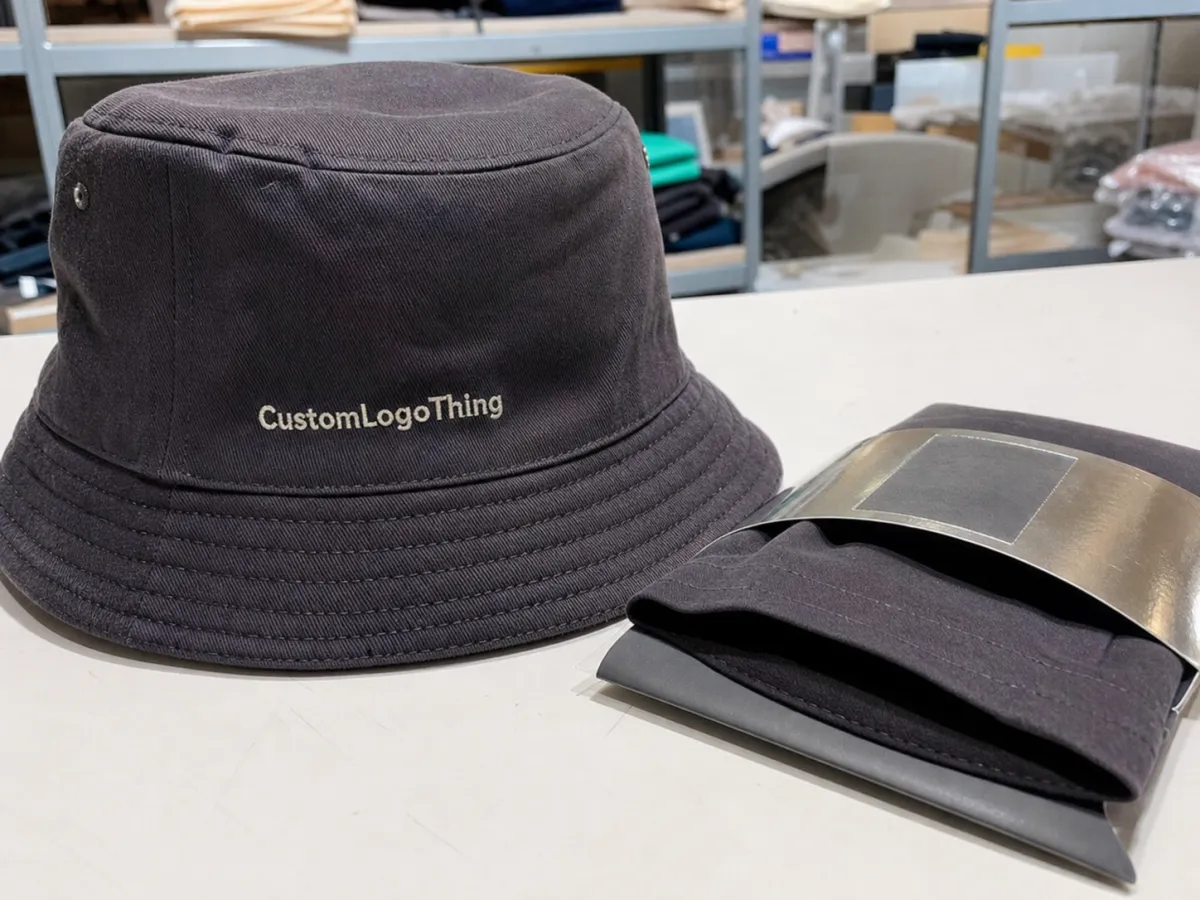
Trade show apparel has a strange job. It has to be visible from a distance, comfortable enough to wear for hours, and durable enough to survive travel, storage, and the occasional last-minute handoff at the loading dock. Bucket hats do all of that while occupying a prominent spot in photos. Because they frame the face, small differences in structure show up quickly. A brim that sits flatter than the original, or a crown that feels taller, changes the whole visual read of the booth team.
That matters even more when the hats are part of a recognizable campaign. If the first order built brand recall, the repeat order needs to carry the same visual cue. In practice, people remember silhouette faster than they remember specs. They notice whether the hat keeps its shape, whether the logo sits low enough to feel intentional, and whether the fabric has the same softness or crispness they saw before. A reorder that misses any of those details may still be technically correct and still feel off.
There is also a scheduling benefit that often gets underestimated. Once a supplier has the prior purchase order, approved artwork, and packing notes, the order no longer needs to be engineered from scratch. That cuts down on back-and-forth, and it reduces the risk of a late correction after materials have already been reserved. On event work, time saved before production is usually more valuable than a tiny change in per-unit cost.
The cleanest repeat order is the one that protects the parts buyers actually see: shape, logo placement, hand feel, and how the hat lands in the carton.
A repeat run should not be treated as a refresh unless the brand truly wants one. If the original style solved the problem, the reorder should preserve the original logic and only change what is necessary.
Choose the right build for a repeat promotional order
Bucket hats are a category, not a single spec. Cotton twill, washed cotton, nylon, polyester, and canvas each behave differently in production and on the head. Cotton twill is still the most common promotional starting point because it balances price, structure, and decoration compatibility. It handles embroidery well and tends to hold a familiar midweight shape. Washed cotton has a softer, more lived-in finish, but that relaxed look comes with more variation in dye and surface texture. Nylon and polyester are lighter, quicker to dry, and easier to pack, which makes them useful for outdoor activations or travel-heavy campaigns. Canvas brings more body and a premium feel, though it can raise both cost and lead time.
The right build depends on what the hat has to do. A standard indoor trade show giveaway usually works well in cotton twill around 240-300 gsm. That range gives enough substance for the hat to sit neatly without feeling heavy. For summer events or outdoor promotions, a lighter synthetic body may be the better call because it packs flatter and tends to dry faster after wear. If the hat is being used more like a retail accessory than a giveaway, buyers often move toward a heavier fabric or a more carefully washed finish to make the product feel intentional rather than purely promotional.
Shape deserves as much attention as fabric. Crown depth changes how the hat sits on different head sizes. Brim width changes the look in profile and determines how much space the logo has to breathe. Eyelets, lining, chin cords, and sweatband construction all affect wearability. On repeated orders, those features matter because customers and staff already know what felt right from the first run. A taller crown may look sharper in a mockup but can sit awkwardly in person; a brim that is too stiff can feel more like a prop than something people will actually wear.
Packability is another practical factor. Some hats are meant to fold flat and recover quickly. Others keep their dome better and should be packed to preserve structure. If the first run arrived folded a certain way and looked right on the table, repeat that method unless there is a clear reason to change it. A new fold can make the same hat look cheaper, more creased, or less ready for display even when the product itself is unchanged.
| Construction | Best Use | Reorder Notes | Typical Price Impact |
|---|---|---|---|
| Cotton twill | Standard trade show giveaways and team wear | Easy to match if crown, brim, and color specs are documented | Moderate, often the most balanced option |
| Washed cotton | Lifestyle branding and softer visual presentation | Wash variation and dye lot drift need careful approval | Moderate to slightly higher |
| Nylon / polyester | Outdoor events, travel kits, fast-dry use | Lightweight shells can change embroidery behavior | Often lower on basic builds |
| Canvas | Premium retail displays and heavier-feel branding | Check brim stiffness and fold recovery before approval | Higher, especially with premium trims |
If the goal is an exact repeat, keep the same fabric family, the same decoration method, the same brim width, and the same packing method. If the goal is a controlled improvement, change only one variable at a time. Anything more makes it hard to tell whether the update improved the product or simply changed it.
Decoration specs that keep the logo consistent
The decoration method is where many reorders drift. Bucket hats can be embroidered, patched, printed, or finished with woven labels, and each option behaves differently on a curved surface. Embroidery is durable and familiar, but dense stitching can pull on the fabric if the logo is too large or if the underlay is too aggressive. Woven patches are better for fine detail and smaller type because they give the design a flatter, cleaner face. Printed patches can handle color variation more easily, while direct print works best on simpler graphics with a softer hand.
On a repeat order, the safest route is to remove ambiguity from the proof. The logo size should be listed in a real measurement, not just described as "medium" or "left chest style" with a hat involved. Placement should be tied to a seam, panel edge, or brim seam so the operator has a fixed point of reference. Thread colors should be specified by Pantone, thread chart, or a clearly approved reference. If the first run placed the logo 1.75 inches above the brim seam, that dimension should be carried forward exactly unless the buyer wants a revision.
It helps to review the old file with a skeptical eye. Thin strokes, small counters, and complex gradients may survive on a screen but become muddy once translated into thread or patch construction. If the logo has been reused across multiple show seasons, make sure the production team is working from the final approved version, not a cached artwork file that happens to be close. A single outdated file can create a mismatch across a full shipment.
Quality control should also cover the less glamorous parts of the order. Ask for a pre-production proof that shows logo size, placement, fold, and carton count. If possible, request a placement photo on the actual hat style rather than relying only on a flat mockup. On bucket hats, curved panels distort decoration in ways that a flat art file cannot fully predict. A flat proof can be useful, but it is not enough to catch every issue.
Packaging instructions deserve the same level of specificity. Inner pack count, carton marking, fold direction, and label placement all affect how quickly the shipment can be received and distributed. A hat packed in neat 12-piece inner units is easier to count and hand out than one tossed loosely into master cartons. For show work, that is not a small detail. It changes the pace of setup when the team is already juggling badges, signage, and booth materials.
For teams that care about transit discipline, standards groups such as ISTA are useful references for shipping test expectations, and FSC can matter if cartons, inserts, or hangtags need certified paper sourcing. Those details are not decorative. They protect the shipment and reduce avoidable friction once the product leaves production.
Cost, MOQ, and unit pricing for repeat runs
Repeat orders are easier to quote than first runs, but the price still depends on the same core variables: fabric, decoration, quantity, packaging, and lead time. The basic math rarely changes. A simpler decoration method keeps the setup lighter. A more complex patch or a custom-woven label adds labor and material cost. Special trims, such as chin cords, contrast binding, or retail hangtags, also push the price upward. Even a small shift in packout can move a job into a different cost bracket because labor is often hiding inside the packing line rather than the garment itself.
MOQ should always be checked against the exact spec being reordered. A standard cotton twill hat with basic embroidery may be available at a lower minimum than a washed cotton style with a patch and custom labeling. Buyers sometimes assume that a previous order size guarantees the same production floor on the next run. That is not always true. A fabric change, decoration change, or packaging change can move the job into a higher minimum. It is better to confirm that early than to discover it after budget approval.
Unit pricing usually improves with volume, but the reduction is not always linear. The jump from 250 to 500 pieces can lower the per-unit cost enough to matter, yet freight and setup fees may blur the advantage if the delivery window is tight. A quote that only lists base unit cost can be misleading. The real question is landed cost: product, decoration, packing, freight, duties if applicable, and any rush charges. That is the number that determines whether the order fits the event budget.
Directional pricing for repeat promotional bucket hats often falls into these ranges, depending on spec:
- Simple embroidered cotton twill: about $2.80-$4.75 per unit at mid-volume.
- Patch decoration on washed cotton: about $3.50-$6.25 per unit, depending on patch size and stitch detail.
- Lightweight polyester or nylon: about $2.40-$4.60 per unit for straightforward artwork.
- Premium canvas or retail-packed builds: about $4.50-$7.50 per unit when trims and presentation matter.
Those are working ranges, not promises. A quote near the low end can still be the expensive option if shipping is rushed or packing is unusually labor-intensive. For a trade show Bucket Hats Reorder plan, the lowest headline price is not automatically the best value. Consistency and arrival timing are part of the cost.
One practical caution: if a quote looks dramatically cheaper than the previous run, check whether anything important was removed from the spec. Sometimes the lower price simply reflects thinner fabric, a simpler logo treatment, or a different packout that would change the presentation on the booth table.
Process and lead time for the next production run
A repeat order should move in a straight line. The first inquiry should include the original order number, the approved artwork file, quantity, color, ship-to address, target delivery date, and any notes from the previous run. If photos of the original hats are available, send them. A photo can reveal things a spec sheet leaves out, such as the exact tilt of the embroidery, the curve of the brim, or the way the hat folds in transit.
Once the supplier confirms the spec, the proof should show every detail that can affect the final output: fabric type, logo size, logo placement, color references, pack count, carton count, and special labeling. If the proof does not show those details clearly, the order is not ready. That sounds strict, but it saves time later. Most expensive mistakes in repeat production happen because someone assumed a prior decision was still understood.
Lead time depends on the slowest link in the chain. Artwork clean-up can add time if the file needs tracing or if a patch has to be rebuilt. Material availability matters too, especially for less common colors or specialty fabrics. Decoration method has its own pace: embroidery is often faster than custom patch construction, while woven or printed patches may require their own production window. Shipping is the final variable. Air freight can rescue a tight schedule, but it adds cost quickly. Ground or ocean freight is more economical if the calendar has room.
For a standard repeat run, 12-20 business days after proof approval is a realistic planning range, with transit time added on top. Faster is possible, but only if the materials are on hand and the artwork is already finalized. The delays that cause the most damage are rarely dramatic factory failures. They are usually ordinary but preventable: missing vector files, vague packing instructions, an unapproved color change, or a last-minute revision after the quote has been accepted.
Build in a cushion before the show. Even two extra days can matter once cartons have to be received, counted, sorted, and staged. A shipment that lands on time but not early enough can still create pressure during booth setup, especially if the hats are part of a larger branded package that also includes shirts, bags, or lanyards.
Next steps to lock in the trade show bucket hats reorder plan
The easiest way to speed up a reorder quote is to gather the source information before you ask for pricing. The old order number helps. So does the final artwork file, the quantity, the color reference, the ship-to address, and the target delivery date. If you still have the previous hat spec, include that too: fabric, decoration method, logo size, and pack count. Those details let the production team confirm whether the next job is a true repeat or a spec change that needs fresh pricing.
Be specific about the objective. If the old hat is the one you want again, say that plainly. If you want the same logo on a different body fabric, a wider brim, or a different folding method for shipping, identify the change at the start. That avoids the common problem where a buyer thinks they are asking for a simple reorder while the supplier is pricing a revised product.
A useful reorder plan also asks one extra question: what should stay untouched? Sometimes the answer is obvious; sometimes it is not. Maybe the logo must stay fixed, but the packaging can change. Maybe the body can shift from cotton twill to nylon, but the crown depth should remain the same. Defining those boundaries keeps the production conversation focused and prevents accidental drift.
A small quantity test can help too. If the original run was successful but there is any uncertainty about a new fabric or decoration method, a short confirmation sample may be cheaper than discovering a mismatch after the full order is underway. That is especially true when the next shipment has to support a date-certain event. The cost of a sample is minor compared with the cost of replacing a full carton of hats that do not match the first run.
Use the trade show bucket hats reorder plan to keep the next shipment aligned with the first one, and the job becomes what it should be: predictable, controlled, and ready for the booth instead of the back room.
How early should I start a trade show bucket hats reorder plan?
Start as soon as the event date is fixed. Even a repeat order still needs proof approval, material confirmation, scheduling, and shipping time. If the decoration is complex, the quantity is large, or the delivery window is tight, assume more lead time rather than less. Repeat work is faster than new development, but it is not instant.
Can a bucket-hat reorder match the previous run exactly?
Usually very closely, yes, if the supplier has the original PO, approved artwork, and production notes. Small differences can still happen in dye lot, stitch tension, brim recovery, or packaging fold. A good proof should define acceptable tolerances so everyone knows what counts as a match before production starts.
What affects bucket hat unit cost on repeat orders?
Fabric choice, decoration method, logo complexity, packaging, and quantity all affect the final unit cost. Freight, duties if applicable, and rush charges should be reviewed separately so the buyer sees the full landed cost rather than only the base price.
What should I send for the fastest reorder quote?
Send the old order number, final artwork, quantity, colors, ship-to address, and target delivery date. A photo of the previous hat helps confirm the structure, decoration placement, and overall finish, especially if the order has been repeated before with small variations.
Can I change the color or logo size on a reorder?
Yes, but any change should be quoted as a revised spec because it can affect MOQ, setup, and lead time. If the goal is a true trade show bucket hats reorder plan, keep the core construction stable and request only the changes that are necessary for the next event.