Trade show inventory has a habit of failing at the worst possible time. One weather shift, one stronger-than-expected registration surge, and suddenly the box of giveaways that looked generous on Monday is empty by Thursday. A trade show Jacquard Knit Beanies reorder plan is less about merchandising flair and more about avoiding the familiar scramble that happens when a product proves useful faster than the spreadsheet predicted.
Beanies are especially sensitive to that kind of demand because they do double duty. They work as a practical cold-weather item, but they also travel well, sit in a suitcase without crushing, and get worn instead of discarded. That gives them a longer tail than a glossy promo item or a one-use flyer. If the first run performed well, the next one should preserve the parts that made it work: the handfeel, the stretch, the logo clarity, the fold, and the way it packed.
Repeat orders also protect margin. Rush production, art corrections after approval, and last-minute packaging changes can add more cost than many teams expect. Once a reorder becomes a rescue mission, freight choices narrow and the factory has to interrupt its normal line to fit the job into a shorter window. A clean reorder file keeps the process steadier and the quote easier to defend.
Trade Show Jacquard Knit Beanies Reorder Plan for Booth Season
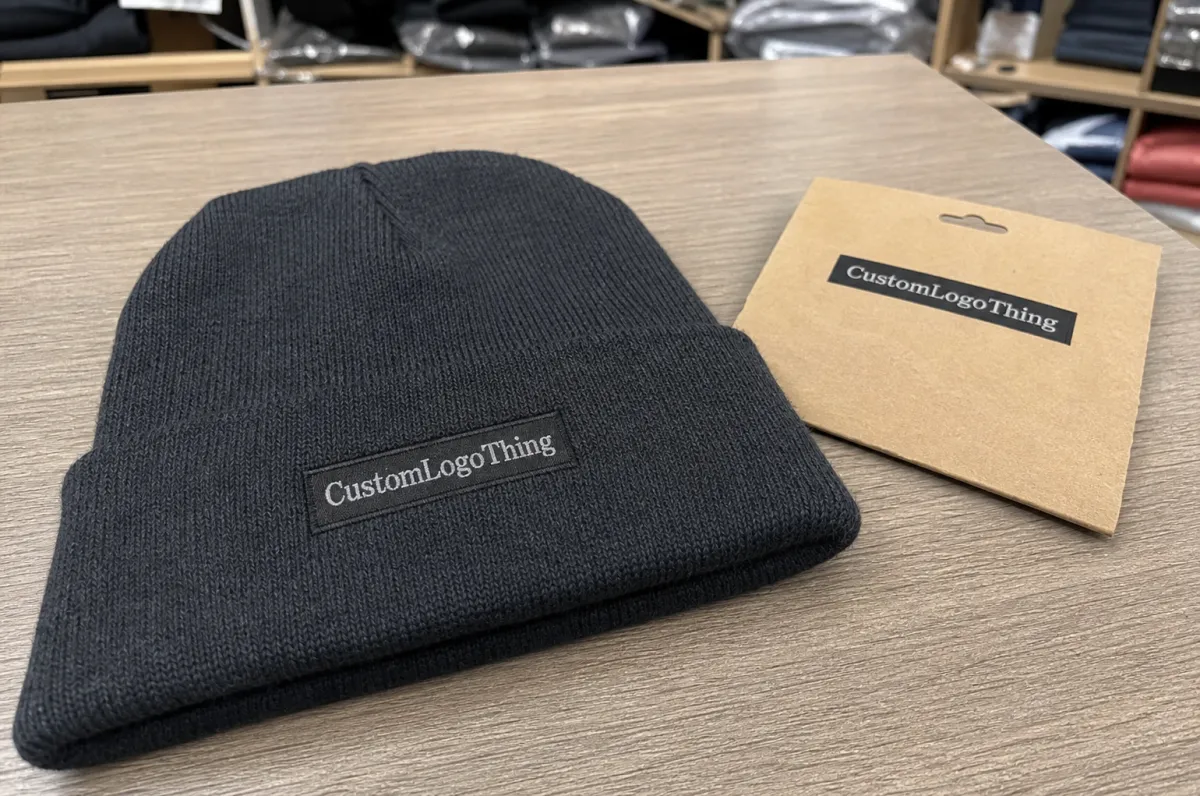
A good beanie reorder starts with a simple question: did the first run do its job? If attendees wore it on the floor, took it back to the hotel, and packed it in a carry-on, the answer is probably yes. That is the point of a trade show giveaway that feels more like a useful accessory than a disposable handout. The product should survive the booth environment and keep the logo visible after the event ends.
For that reason, the smartest reorder is usually the least dramatic one. Keep the same knit structure unless there is a concrete reason to alter it. Preserve the same cuff height if the logo is centered there. Keep the same fold if the first carton packing method made intake easier for the booth team. Change only what actually needs changing, because every new variable creates another chance for a mismatch between the old sample and the new run.
The best buyers treat the approved sample like a contract, even when the paperwork does not say that out loud. They compare the production piece against the old sample, not against memory. That matters because memory is unreliable on product details. A logo can look slightly larger in a photo, a cuff can feel lower after a few months, and a color can seem brighter in one setting than it did at approval. The sample tells the truth.
- Protect continuity: keep the same knit gauge, cuff size, and logo placement whenever possible.
- Prevent drift: use the last approved sample and production notes as the baseline, not a fresh guess.
- Plan for fluctuation: weather, event timing, and registration numbers can change quantity needs quickly.
One practical observation from repeated event buying: the item that gets remembered is usually the one that fits well enough to wear immediately. If the beanie is too loose, the logo may sit awkwardly. If it is too tight, people stop wearing it after the aisle. The reorder has to protect that balance, because usefulness is what turns a branded accessory into an item that keeps circulating long after the show.
Jacquard Knit Construction That Holds Up in Handouts
Jacquard knitting builds the logo into the fabric itself, which gives the piece a more integrated look than surface decoration. That is one reason it holds up well in event settings. The design does not peel, crack, or lift off after a few wears. It stays part of the structure. For a trade show item, that is a real advantage, because people handle the beanie quickly under bright lighting and then stuff it into a tote, pocket, or suitcase.
Material choice drives the feel more than many first-time buyers expect. Acrylic remains common because it is warm, relatively economical, and consistent across larger runs. Acrylic blends can improve softness or drape. A wool blend may feel richer, but it can add cost and may require more careful handling during knit and finishing. Recycled yarn options are more common than they were a few years ago, but the buyer still needs to check whether the recycled content changes the handfeel, the shade of the yarn, or the price point. Sustainability claims should be tied to a real specification, not a vague label.
Knit gauge matters just as much. A tighter gauge usually gives sharper logo edges and cleaner color separation, which helps if the design includes small lettering or thin outlines. A looser gauge can look softer and more casual, but it also increases the risk that fine details will blur. That is why repeat orders should begin with the last production sample, not a redesigned mockup that looks good on screen but was never knit in real yarn.
There are a few physical checks that separate a reliable run from a risky one. The cuff should fold evenly and recover after stretching. The seam should lie flat enough that it does not create a ridge under the logo area. The yarn tension should stay consistent from one piece to the next, because a visible tension change can make one batch look slightly narrower or longer than another. If the beanies are going to a show floor, the buyer usually wants uniformity more than novelty.
Be careful with design density. Three-color jacquard can look clean if the shapes are bold, but it can become muddy if the artwork has too much fine type or too many thin borders. Large, blocky marks usually survive knit production better than small text. If the original run had a simplified logo for that reason, the reorder should preserve the same logic unless the spec is being revised on purpose.
There is also a packaging side to construction. Individual polybags can protect the knit from dust and simplify counting, but they add material cost and more waste. Bulk packing is cheaper and often easier for distribution teams that hand items out quickly from a booth counter. The right choice depends on how the beanies will be received and distributed, not on a generic assumption that one format is always better.
"A beanie either fits the event workflow or it does not. If the handoff, the box count, and the logo read all work together, the rest is manageable."
That is why a disciplined reorder process matters. It keeps the fabric, the proportions, and the presentation aligned from one production run to the next.
Color Matching, Sizing, and Packaging for Repeat Orders
Color is one of the easiest things to underestimate in a reorder. Pantone references help, but yarn does not behave exactly like ink on paper. A color that looked right in a proof can shift slightly once it is knit into a larger surface area, and the surrounding colors can change how the eye reads it. A gray base may look cooler under LED booth lighting than under warehouse light. A red logo can feel deeper when it sits next to black yarn and flatter when paired with a lighter body color.
That is why repeat buyers should ask for the previous yarn reference, not just the artwork file. If the mill source changes, the shade can change too, even if the Pantone target is nominally the same. The safest path is to compare the old production sample against the proposed reorder under more than one light source. Factory lighting, office lighting, and event lighting do not show the same truth.
Sizing deserves equal attention. A one-size beanie may be acceptable for a general audience, but the actual fit still has to be tested for stretch, crown depth, and cuff behavior. A tighter opening can create a more polished look. A more generous stretch range may work better for teams that expect the beanies to fit over thicker hair, larger heads, or just a wider mix of attendees. If the original order was designed to fit most adults comfortably, the reorder should not quietly shrink the silhouette just because the artwork happens to be the same.
Packaging should follow the same logic. Some event teams need every piece bagged and labeled because they are shipping to multiple locations or assigning items to regional reps. Others want bulk cartons with clean size marks so they can move inventory quickly into a booth closet. Carton count, fold direction, and label placement all matter because they reduce receiving friction. A warehouse team does not want to improvise, and a show team does not want to reopen boxes to count what should already be obvious.
If the first run included custom inserts, barcode stickers, or a specific carton sequence, those details need to be carried forward. It is common for a buyer to remember the beanie art but forget the packing logic that made the first event smooth. That omission turns into extra work later, usually at the exact moment no one has time to renegotiate details.
For repeat orders that move between marketing, procurement, and event operations, the file should be simple to read. The old proof, the final artwork, and the carton instructions should live together so every reviewer is looking at the same version. Internal confusion is expensive. It usually creates a second round of approval without adding any real value.
Pricing, MOQ, and Quote Variables That Move Cost
Beanie pricing is driven by a short list of variables that tend to behave predictably: quantity, number of knit colors, yarn type, cuff treatment, packaging format, and whether the order is a true repeat or a revised version. The more the request departs from the last approved spec, the more likely the cost will move. New artwork, altered sizing, or a different fold usually means more setup and more proofing.
MOQ should be read as a production threshold, not as a marketing tactic. A factory needs enough quantity to justify charting, setup, yarn allocation, and finishing. On small runs, those costs get divided across fewer units, so the unit price is higher. At larger quantities, the same setup gets spread out and the price usually becomes more efficient. In practice, a straightforward repeat order in the low hundreds often lands in the low-to-mid single digits per unit before freight, while higher volumes can pull that number down. Add more knit colors, a custom label, or individual packaging, and the price climbs again.
That is why quote requests should be precise. The previous order number matters. So does the final logo file, the target quantity, the ship date, and any packaging requirement that cannot change. If the supplier has to chase those details one at a time, the quote cycle slows down and the chance of an error rises. Buyers lose time not because the process is difficult, but because the order brief is incomplete.
Freight can also distort the picture if it is ignored too late. A lower unit price does not help much if the cartons need to move on an expensive expedite service to hit the event date. Reorder planning works best when product cost and transit cost are considered together. A few dollars saved on the piece can disappear quickly if the box count, destination, or receiving hours are not aligned with the shipping method.
| Reorder type | Typical price behavior | Lead time pressure | Best use case |
|---|---|---|---|
| Exact repeat with same yarns and fold | Usually the most efficient unit cost | Moderate if proof is already on file | Same booth program, same audience, same packing need |
| Minor artwork or color update | Often adds setup cost and a small unit lift | Higher, because proofing takes longer | Brand refresh, sponsor change, or updated logo line |
| Rush reorder with revised packaging | Usually the most expensive path overall | Highest, especially near event deadlines | Late booth confirmation or an unexpected demand spike |
A 500-piece reorder and a 5,000-piece plan do not behave the same way, even if the artwork is identical. The larger order spreads setup costs more effectively, while the smaller order usually carries more weight from the same prep work. A useful reorder plan accounts for that curve before the request goes out.
Lead Time, Approval, and Production Steps
The repeat-order process is usually simple on paper: file review, yarn confirmation, digital proof, sample check if needed, knitting, finishing, inspection, and packing. The difference between a smooth order and a stressed one is usually not the number of steps. It is how many of those steps have already been resolved on the earlier run. A true reorder should feel familiar because most of the decisions were already made.
Lead time depends on whether the buyer is repeating the prior spec or changing it. A clean repeat with no artwork change can often move in about 12-18 business days after proof approval. If the order needs a new chart, revised color matching, or fresh sample approval, that window can move closer to 18-25 business days. Those are planning ranges, not promises. Factory load, quantity, and finishing complexity can shift the calendar quickly.
The approval stage is where many delays start. A proof sitting in an inbox for three days can matter more than a slight production variation. The clock usually starts only after written approval, and a reorder that is meant for a trade show has very little room for indecision. If multiple departments need to sign off, that process should be set before the proof arrives. Otherwise, the job sits still while the deadline keeps moving.
Inspection should not be treated as a formality. A buyer should look for yarn tension variation, loose threads, cuff symmetry, logo placement, and carton count accuracy. If the order includes multiple colors or sizes, sample pieces should be checked from more than one carton. One clean top sample does not prove the rest of the shipment is equally consistent. A proper check catches the small problems before they become a receiving issue.
Shipping needs its own buffer. Trade show freight is subject to routing delays, building receiving rules, and narrow delivery windows. If the beanies are traveling with other event materials, cartons should be labeled clearly and packed to survive handling under pressure. The receiving team may be short on time, short on space, and working from a stack of crates that all look similar. The more organized the carton markings are, the less likely the order gets buried in the wrong pile.
A practical sequence for repeat buyers usually looks like this:
- Confirm the last approved spec and order number.
- Send the final artwork file and any color references.
- Approve the proof quickly, or note changes in writing.
- Lock the ship date against booth and warehouse deadlines.
- Build a transit buffer for receiving and final distribution.
That may sound basic, but basic is often what keeps the job on schedule. The orders that get messy usually fail in the handoff between approval and production, not in the knit itself.
What Repeat Buyers Look for in a Supplier
Repeat buyers rarely choose a supplier on price alone. They want predictability. A supplier that can review the old spec, identify where the design may cause knit problems, and flag packaging gaps before the order starts is usually worth more than a slightly lower quote that comes with more risk. Early problem detection saves both time and money.
That kind of discipline shows up in small ways. Clear spec sheets. Responsiveness on color questions. Proofs that match the prior sample instead of drifting from it. Realistic timelines instead of optimistic ones. The best suppliers do not pretend that every reorder is identical; they explain what can stay the same and what needs another look.
Consistency matters because the beanie is part of the brand presentation. If the cuff height changes, if the logo shifts upward, or if the yarn tone is off by just enough to notice, the item no longer feels like part of the same program. Attendees do not usually articulate that difference, but they notice it. A repeat order that matches the original closely tends to disappear into the event in the best possible way.
Seasoned buyers also value suppliers who understand the difference between a retail run and an event run. Trade show merchandise tends to move through procurement faster, ship on shorter timelines, and require more practical packaging. A factory that handles that distinction well will usually ask better questions: How will the beanies be distributed? Who signs off on the proof? Does the old carton count still work? Those are useful questions because they reduce surprises later.
"The best reorder is the one nobody has to explain twice. If the spec is clear and the sample matches, everyone can move on."
That attitude is reasonable. It reflects a buyer who has already paid for inconsistency once and does not want to do it again.
Next Reorder Checklist for a Fast, Clean Purchase
Before requesting the next quote, gather the last order number, final artwork, preferred quantity, required ship date, and any packaging notes from the previous run. If the first order included folded polybags, inserted cards, or specific carton labeling, those details should be listed up front. Waiting to mention them after the proof comes back usually slows everything down.
Check the inventory you already have on hand. It is easy to over-order because the event feels urgent, but not every booth needs a mountain of product. It is equally easy to under-order if the team assumes the first batch will stretch farther than it does. The best quantity is usually based on actual giveaway volume, staff needs, expected traffic, and a small cushion for unplanned demand.
The approval path should be clear before the supplier sends anything. Marketing may want to confirm the logo, procurement may want the price, and events may care most about the ship date. If those three functions are not lined up, the proof can sit for days while the deadline gets tighter. A smooth reorder starts with internal alignment, not just a clean factory file.
Most repeat orders go well because the team treats them like repeatable manufacturing jobs rather than creative experiments. The spec is locked. The sample is referenced. The shipment window is realistic. That is the practical core of a Trade Show Jacquard Knit Beanies reorder plan, and it is usually enough to keep the job on time without adding noise.
In other words, the strongest plan is the one that respects how these products are actually made: yarn by yarn, proof by proof, carton by carton. When the details stay stable, the order stays manageable.
FAQ
How do I reorder trade show jacquard knit beanies if the artwork changed slightly?
Send the previous order reference with the updated logo file so the supplier can compare the old knit spec to the new version. If the change affects stitch count, color placement, or logo scale, expect a new proof before production starts. Small design edits can have a bigger knit impact than they appear to have on screen.
What minimum order quantity should I expect for a jacquard knit beanie reorder?
MOQ usually depends on the number of knit colors, the yarn setup, and how custom the original design is. Smaller runs generally carry a higher per-piece price because setup labor is spread across fewer items. Larger runs usually improve unit cost, especially when the order repeats an existing spec and does not need fresh sampling.
Can you match the same knit density and colors from a previous run?
Usually yes, if the prior spec, Pantone references, and production notes are available. Exact matching is strongest when the reorder uses the same yarn blend, gauge, and finishing method as the original order. Even then, buyers should approve against a sample under real lighting, because yarn and print do not always read the same way in every environment.
How long does a reorder usually take from proof to ship?
A true repeat can often move in about 12-18 business days after proof approval. A revised version with new art or different packaging usually needs more time, often closer to 18-25 business days. Quantity, factory load, and finishing complexity can move those ranges, so shipping buffers still matter.
What information helps get a quote faster for a trade show reorder?
The fastest quotes usually come from complete requests: the last order number, final artwork, target quantity, preferred packaging, and the required delivery window. Include any details that should stay unchanged, such as cuff height, fold style, or label format. The more the supplier can compare the old run to the new request, the quicker the quote tends to move.