Buyer Fit Snapshot
| Best fit | Valentines Day Mailers for Brands projects where brand print, material claims, artwork control, MOQ, and repeat-order consistency need to be specified before quoting. |
|---|---|
| Quote inputs | Share finished size, material target, print colors, finish, packing count, annual reorder estimate, ship-to region, and any compliance wording. |
| Proofing check | Approve dieline scale, logo placement, barcode or warning zones, color tolerance, closure strength, and carton packing before bulk production. |
| Main risk | Vague material claims, crowded artwork, missing packing details, or unclear freight terms can make a low unit price expensive after revisions. |
Fast answer: Valentines Day Mailers for Brands: Film, Print, MOQ, and Carton Packing should be specified like a repeatable production item. The safest quote records material, print method, finish, artwork proof, packing count, and reorder notes in one written spec.
Production checks before approval
Compare the actual filled-product size with the drawing, then confirm tolerance on folds, seals, hang holes, label areas, and retail display edges. Reserve space for logos, QR codes, warning copy, and material claims before decorative graphics fill the panel.
Quote comparison points
Review material grade, print process, finish, sampling route, tooling charges, carton quantity, and freight assumptions side by side. A quote is only useful when the supplier can repeat the same color, closure quality, and packing count on the next order.
Valentines Day Mailers for Brands: Smart Poly Ideas
I have watched valentines day mailers for brands do something a plain brown carton almost never manages: they make a customer pause for three full seconds before opening, and that tiny pause can change the way the entire order is remembered. I still think about one February launch in a 45,000-square-foot fulfillment center outside Charlotte where a blush-pink poly bag with a crisp white logo got more compliments than the actual product, a $78 knit sweater, and the packing team kept laughing because the packaging had become the star of the show. On a line moving 1,200 orders per shift, that first touch is where the memory starts.
Valentines day mailers for brands work best when the package is treated like a real part of the supply chain, not a seasonal decoration slapped on after everyone has already missed the deadline. Whether you are shipping apparel in a 10 x 13 inch mailer, beauty sets in a gusseted bag, or subscription kits wrapped in a festive outer layer, the outside of the shipment does a lot of emotional work before the customer sees the product. In practical terms, that usually means a 55 to 75 micron film, a self-seal strip with a 0.5 inch closure zone, and a print that survives two or three conveyor touches without scuffing. Honestly, that is the whole reason they matter so much: they do not just carry an order, they carry the mood of the order.
That is why I keep coming back to valentines day mailers for brands when a client wants February orders to feel more deliberate without rebuilding an entire carton program. If you want to compare formats, our Custom Poly Mailers page shows the basic structure, while our Custom Packaging Products hub is useful when a brand is weighing mailers against inserts, cartons, and labels. I have sat in more than one meeting where somebody said, with a straight face, “Can we make this feel special but also not turn the warehouse into a small war zone?” and, yes, that is exactly the right question, especially when the launch window is only 12 business days away. For teams building seasonal poly mailers, that balance between design and operations is usually the whole brief.
Valentines Day Mailers for Brands: Why They Stand Out
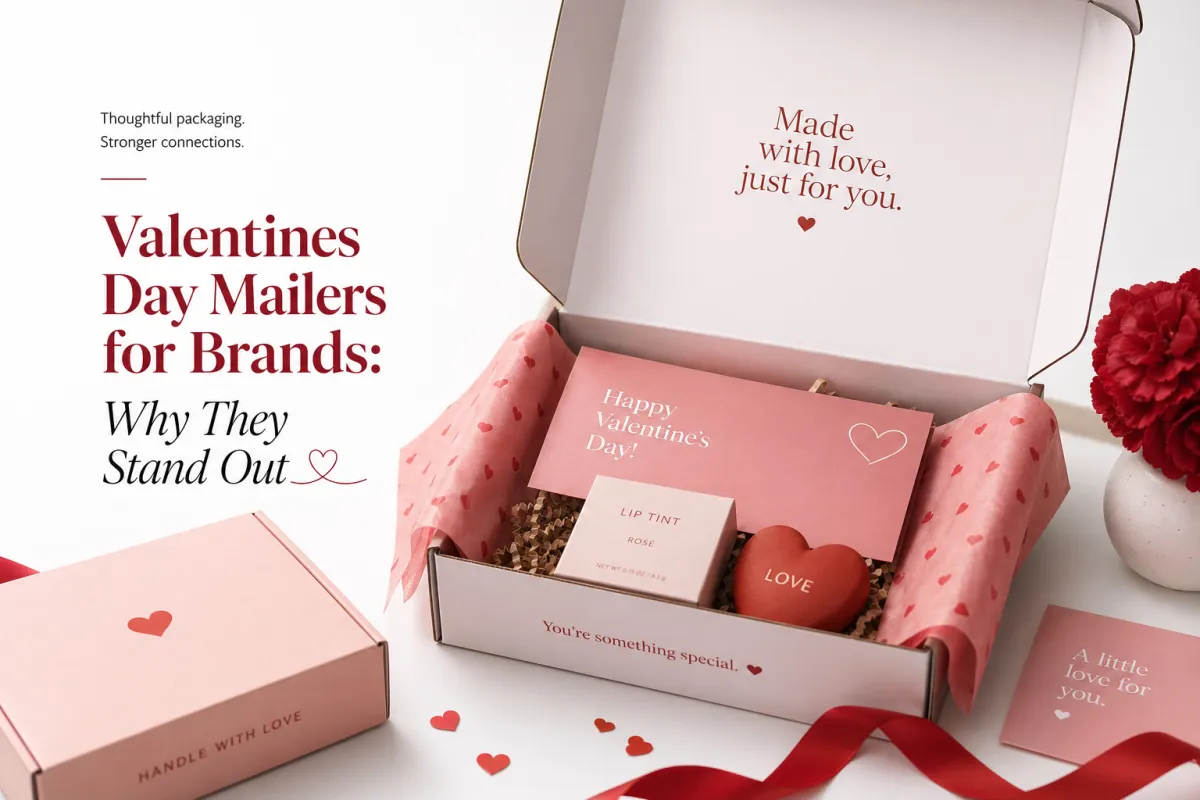
The reason valentines day mailers for Brands Stand Out is simple: the package arrives before the product does, and the customer touches it first. I remember standing on a packing floor in a softgoods plant outside Charlotte where a buyer kept pulling the same 12 x 15 inch pink mailer from the stack because the finish felt more premium than the sweatshirt inside; she told me later that the bag had become the giveaway, not the garment, and that is a very real kind of value. She also said, with zero irony, that her retail team had never fought over a poly bag before, which felt like a win and a minor personality crisis at the same time. The bags were printed on a 70-micron co-extruded film with a matte overprint, and that detail made the hand feel closer to a gift bag than a shipping sleeve.
Valentines day mailers for brands can be Custom Poly Mailers, branded shipping bags, or festive e-commerce mailers that carry a seasonal message without changing the whole fulfillment flow. For apparel, beauty, accessories, and smaller subscription kits, the format works especially well because the unboxing experience matters almost as much as puncture resistance and clean delivery. If the film is 55 to 75 microns, the seal is dependable, and the art is thoughtful, the package can carry romance without looking flimsy. If the film is too thin, though, it can feel like the bag is already having a bad day before it even leaves the dock, especially after it sits under a 48 x 40 pallet of shoes for 36 hours.
I think most people get the balance wrong on the first try. They either lean so hard into hearts and glitter that the bag looks like gift wrap from a mall kiosk, or they make it so subtle that the mailer could ship in any season and lose the whole point. The strongest valentines day mailers for brands sit right in the middle: clear enough to feel special, restrained enough to feel like the brand still owns the voice. That middle ground is harder to hit than it looks, which is probably why I have seen so many drafts with three different reds, one metallic pink, and a surprise cursive font that nobody asked for.
There is also a practical difference between a one-off promotion piece and a recurring branded shipping system. If you run a single February capsule, valentines day mailers for brands might be a short seasonal run with limited artwork and a precise ship window, but if you ship DTC every day, the same look can become a repeatable format with a refreshed pattern or colorway each year. That decision gets easier once you know your median order size, your top three SKUs, and the way your warehouse stacks cartons on a 48 x 40 pallet. I have watched teams skip that homework and then act surprised when the “cute” mailer does not fit the top-selling hoodie, a 3.2-pound fleece, or the return insert that was never mentioned in the first brief.
Here is the part I always tell clients: the best valentines day mailers for brands protect the shipment first and decorate it second. The adhesive strip should close cleanly, the opacity should block a bright label from showing through, and the outer surface should hold print without scuffing after two or three touches from a sorter or driver. If it cannot survive the lane, it is not good packaging, no matter how pretty the artwork is. A package that arrives bruised after a 300-mile carrier route through Atlanta or Dallas is not romantic; it is just annoying.
“If the outer bag feels like a gift and still survives a 300-mile carrier route, you have done your job properly.” That was how a buyer at a Midwest beauty brand put it after a launch week that moved 18,000 units through a single automated pack line running two shifts a day.
For brands that want proof, not just theory, our Case Studies page shows how different packaging choices changed customer feedback, order speed, and repeat purchase behavior across several categories. That kind of evidence matters more than mood boards when the mailers have to fit into real production. I am all for a good mood board, but a pallet full of crushed bags in a warehouse near Memphis will humble anybody quickly.
How do valentines day mailers for brands work in shipping?
Valentines day mailers for brands start their journey at pick and pack, where the operator folds or places the product, removes excess air, and seals the bag in a few seconds. The adhesive closure matters more than people think, because a weak strip or misaligned flap can turn a beautiful design into a return risk, especially on thin film under 2.5 mil. Once the mailer leaves the dock, the artwork, the gauge, and the closure all have to work together through sorting belts, parcel hubs, and the last 12 feet to the doorstep. In a facility shipping 6,000 to 8,000 units per day, that closure gets tested more often than the design team expects.
When I was visiting a contract packer in Georgia, I watched a team process 6,400 units of a seasonal beauty launch in just under four hours. The print was a light blush gradient on a 70-micron co-extruded film, and it looked elegant right up until a stack got dragged across a metal table with a rough corner. That one scratch taught the brand why a slightly tougher outer finish mattered more than a deeper ink load, which is exactly the kind of lesson valentines day mailers for brands can reveal fast. It was one of those moments where everyone stared at the bag for a second and then at the table, like the table had personally insulted the project.
Printed mailers also support direct-to-consumer campaigns because they reinforce the offer before the customer reads the insert. A seasonal message on the outside can signal “giftable,” “limited,” or “special drop” even if the product page has already done the selling. That is why valentines day mailers for brands often function like a second headline in the funnel, carrying the campaign through the last mile with one glance at the package on the porch. A customer may forget a banner ad in 15 minutes, but they will notice a blush-pink bag sitting on the doormat at 7:40 p.m.
If you use a custom outer mailer, the entire shipping surface becomes part of the story. If you use a standard mailer plus an insert card, you get more flexibility and often lower unit cost, but the message is delayed until the customer opens the bag. Both approaches can work, and I have seen brands use each one successfully depending on whether the February goal is acquisition, retention, or a short-lived upsell tied to a 48-hour flash offer. Personally, I like the approach that matches the actual campaign objective instead of the one that sounds nicest in a brainstorm.
From a shipping standpoint, the details are straightforward but unforgiving: self-seal closure, tear resistance, opacity, and moisture protection all matter. A bag that looks fine in a studio can still fail in a wet depot in Portland or a cold van in Minneapolis if the film is too thin or the welds are weak. That is why valentines day mailers for brands should always be tested like shipping components, not just designed like promo graphics. If you want to go deeper on shipping performance, the testing guidance at ISTA is a useful place to start, especially for parcel vibration and drop assumptions.
The mailer also plays a marketing role. Color, texture, and the first impression are doing real work long before a customer gets to the ribbon, tissue, or thank-you note. For valentines day mailers for brands, that means a 1.5-second glance at the outer bag can influence perceived value as much as a homepage banner or a paid social ad. I have seen a plain mailer do its job perfectly and still get ignored online, while a seasonal printed bag got posted three times before the product itself ever showed up in a story.
Key Factors That Shape Valentines Day Mailer Design
Material choice sets the tone for valentines day mailers for brands more than any color swatch does. Virgin poly gives you a clean print surface and a crisp hand feel, recycled content supports a better sustainability story, and co-extruded film can improve puncture resistance while keeping the outside layer smooth for ink adhesion. In practical terms, I have seen 60-micron co-extruded bags outperform thinner stock when a warehouse loads them against heavier footwear boxes or bundled apparel, and I have also seen thin stock buckle the second someone stacks too much on top of it. Packaging, as it turns out, is not impressed by wishful thinking, whether the bags are coming from Ningbo, Shenzhen, or a converter in Monterrey.
Size is the next decision, and it should be driven by the SKU, not by the artwork. A 9 x 12 inch bag may be perfect for a folded tee and insert card, while a 14 x 19 inch bag might be needed for a hoodie that ships with a tissue wrap and a return label. If you size valentines day mailers for brands too large, you create empty air, higher postage, and a less polished unboxing moment; too small, and the seam tension can distort the print or split the seal. I have had more than one client hold up a mailer and say, “It feels fine,” only for the shipping test to disagree in the least polite way possible, usually by tearing at the corner after the second drop.
Design choices matter just as much. A soft blush palette can feel romantic, a deep red and cream palette can feel gift-ready, and a minimal layout with one sharp logo can feel premium if the brand already has strong recognition. The trick is to make valentines day mailers for brands look intentional on a warehouse conveyor, not just on a design board. Typography should stay readable at 10 to 12 feet away, because that is roughly how a sortation clerk sees the bag when it moves past at speed. I also like to keep the copy short; the bag is not a poster, and if it reads like one, it usually starts acting like one too.
Production details deserve equal attention: print method, minimum order quantity, lead time, and whether the job needs a stock size or a custom dimension. Flexographic print works well for large runs with strong color blocks, while digital can be useful for shorter seasonal batches or more complex artwork with gradients and fine detail. For valentines day mailers for brands, I usually ask clients to choose the method that matches their volume, not the one that looks fanciest on paper. Fancy on paper is nice; moving 9,000 cleanly printed bags through a dock in Atlanta or Los Angeles is nicer.
Sustainability comes up in almost every meeting now, and it should. Brands want seasonal packaging that does not leave a bad taste after February, and that means thinking about recycled content, source verification, and the rest of the supply chain, not just the printed front panel. If your program includes paper inserts or cartons alongside valentines day mailers for brands, the certification work at FSC can help frame the paper side of the package responsibly, especially when buyers ask where the fiber came from. I have had clients relax a little when they can point to actual sourcing documentation instead of vague “eco” language that sounds nice and proves nothing.
I have had more than one supplier negotiation turn on one tiny spec: the dart depth, the seal width, or the exact gauge tolerance. At a Shenzhen meeting years ago, a converter showed me two samples that looked identical until we measured them with calipers; one was 58 microns and the other was 72, and that 14-micron gap explained why one bag wrinkled on the fold while the other held a tighter print surface. That is the sort of detail that separates decent valentines day mailers for brands from the ones that actually feel polished in hand. The factory floor is full of these tiny truths, and I swear half the job is just paying attention long enough to catch them.
For a quick reference, here is how valentines day mailers for brands usually break down at the quoting stage.
| Option | Typical Unit Price | Best For | Notes |
|---|---|---|---|
| One-color stock-size poly mailer | $0.14-$0.18 at 10,000 units | Budget-conscious DTC shipments | Fastest to print, simple branding, strong value when the order volume is stable |
| Full-surface seasonal print on custom size | $0.22-$0.35 at 5,000 units | Apparel, beauty, and giftable orders | More setup, stronger shelf and doorstep impact, better for a February campaign |
| Premium co-extruded film with richer art coverage | $0.30-$0.48 at 3,000 units | Higher AOV brands and subscription boxes | Better feel, stronger durability, more room for special copy or subtle finishes |
Those numbers are not a promise from every supplier, but they are the kind of factory-side ranges I see often enough to be useful. If the order is larger, the unit cost usually drops; if the mailer is custom sized, the tooling or setup can add a few hundred dollars before the first box is printed. That is why valentines day mailers for brands should always be quoted with size, gauge, print coverage, and pallet count in the same brief. If somebody sends a quote request that just says “pink bags, maybe fancy,” I know we are all about to have a longer day than necessary.
Valentines Day Mailers for Brands: Cost and Pricing Basics
When people ask me what drives the price of valentines day mailers for brands, I start with the obvious and then move to the hidden costs. Material thickness, print coverage, number of colors, bag size, order volume, and any custom tooling all affect the quote, but freight, setup, and storage can change the real spend more than the decoration does. A bag that costs $0.19 at the factory in Guangdong can land very differently once you add drayage from the port, carton packing, and the cost of moving 20 pallets to a fulfillment center in New Jersey. That freight bill has a way of showing up with all the charm of a brick.
Lower quantities always raise the unit price, and that is where seasonal packaging can surprise a brand that only thinks in terms of art cost. A 2,000-unit run of valentines day mailers for brands might cost nearly twice as much per bag as a 10,000-unit run because the press setup, plate cost, and labor do not scale down linearly. That is not a penalty; it is simply how production works when a line has to be cleaned, loaded, and registered for a short-run job. I have seen teams act offended by this, as if the press should care about their launch date more than the math.
Here is how I usually explain budget tiers to clients. A simple one-color branded mailer sits in the lowest band, full-surface seasonal graphics move into the middle band, and premium finishes or specialty structures rise into the top band. If you are trying to decide between a polished but plain mailer and a more expressive holiday piece, valentines day mailers for brands should be measured against the campaign goal, not just the invoice total. A cheap bag that supports the wrong story is still expensive if it misses the moment, especially if the campaign is supposed to peak during a 5-day shipping window.
One of my favorite examples came from a wellness brand that shipped 8,000 units in pink poly bags with a single white logo and a 3-line promo message. Their final spend was lower than a foil-stamped carton program by almost 23 percent, yet social tagging went up because the package felt like a February special instead of a standard shipment. That is the sort of tradeoff that makes valentines day mailers for brands attractive when the team wants a seasonal win without redesigning the entire supply chain. I still remember the ops manager saying, “I wanted less drama, and somehow the bag gave us more love on Instagram.” Fair enough.
If you want to estimate total spend correctly, add decoration, freight, setup, storage, and any split-shipment charge to the base price. A lot of teams forget that a seasonal run may need to be stored for 60 or 90 days before the launch, and warehouse space is never free. For valentines day mailers for brands, I suggest budgeting with a 10 to 15 percent cushion so the campaign does not get squeezed by last-minute freight or reprint issues. That cushion is the difference between calm planning and someone sending a panicked 7:12 p.m. email with three exclamation points.
There is also a marketing math question underneath the packaging math. If a mailer adds $0.12 to a shipment but helps lift repeat purchase rate by even 2 percent, the payback can be stronger than a small paid-ad tweak. I do not say that every season because not every brand will see the same response, but valentines day mailers for brands often earn their keep when they support giftability, sharing, or a limited-edition drop. That is a nicer outcome than burning money on a design everyone forgets before the tape is even cut.
For brands comparing options side by side, I always recommend running the packaging cost against customer lifetime value, expected order volume, and margin on the featured SKU. That keeps the decision grounded. If you know the average order value is $64 and the gross margin is 54 percent, a mailer that costs a few cents more can still make sense if it improves retention or reduces the need for extra promotional inserts. Honestly, I would rather see a brand spend a little more on something customers actually notice than save pennies and end up with a bland bag nobody remembers.
Step-by-Step Process and Timeline for Valentines Day Mailers
The first step with valentines day mailers for brands is goal setting, because the target changes everything that follows. A giftability campaign needs more visual warmth, a loyalty program might need subtle branding and a thank-you line, a launch could call for bold seasonal graphics, and an upsell campaign may rely on a bag that clearly signals a limited-time offer. Before anyone opens Illustrator, the team should decide what the bag must do in the hand, on the shelf, and at the doorstep, ideally while the order calendar is still 6 weeks out.
Next comes artwork development, and this is where dielines, safe zones, copy hierarchy, and seam placement matter. If a logo lands too close to the fold, the printed result can look off by 4 or 5 millimeters once the bag is inflated or stacked. For valentines day mailers for brands, I always want a proof that shows the final placement at full size, not just a flat mockup in a 2D file, because real-world folding changes the visual balance. I have seen a design that looked perfect on a laptop turn into a weird little trapezoid in production, and nobody deserves that emotional arc.
Sample approval is where a lot of projects either stay on schedule or drift by two weeks. A physical sample tells you whether the film feels too slick, whether the blush tone reads pink or peach under warehouse light, and whether the adhesive strip closes with enough pressure. On one apparel job in a Dallas-area facility, we approved a second sample because the first bag looked great in daylight but washed out under 4,000K LEDs in the packing area, and that one decision saved the brand from reprinting 15,000 units. The warehouse team was relieved, and honestly, so was I.
After approval, production scheduling begins. Depending on the print method, mold needs, and factory queue, the lead time may be 12 to 15 business days from proof sign-off for a straightforward run, or 20 to 30 business days if the job requires custom dimensions, multiple inks, or special packing. Valentines day mailers for brands should be ordered early enough that there is still breathing room for a corrected proof, because nobody wants to approve artwork in a panic the week carrier volumes spike. That week always seems to arrive like an unwanted surprise guest on a Friday afternoon.
The warehouse rollout matters just as much as the printing stage. Your fulfillment team needs to know which SKU gets which mailer, how cartons are labeled, and where the seasonal bags sit in relation to the daily inventory flow. I have seen a beautifully printed February mailer shipped on the wrong order line because the receiving team had two nearly identical cartons and no clear pallet label. One clear packing list can save a lot of embarrassment. One slightly better warehouse map can save a lot of grumbling too, which is nice because nobody wants to start Valentine’s season with a spreadsheet-induced headache.
Here is a realistic countdown I use when I am helping clients plan valentines day Mailers for Brands:
- Week 1: Define the campaign goal, exact bag size, and target order volume.
- Week 2: Finalize dielines, copy, and artwork direction.
- Week 3: Review the digital proof and request a physical sample if needed.
- Week 4-6: Run production, QC, carton packing, and freight booking.
- Week 7: Receive inventory, inspect one carton from every pallet, and prepare the warehouse rollout.
That timeline is conservative, and I prefer it that way. February always arrives faster than the calendar suggests, and a seasonal packaging job that starts late tends to pay more in freight and stress than it should. If valentines day mailers for brands are tied to a launch date, a Valentine gifting window, or a bundle promotion, the order should be moving while the campaign copy is still being finalized. I have watched teams wait for a perfect headline and then lose the production window entirely, which is a frustrating way to learn that time is also part of the budget.
Common Mistakes Brands Make With Seasonal Mailers
The biggest mistake I see with valentines day mailers for brands is overdesigning the bag until the message becomes noisy. When every inch of the outer surface tries to say “romance,” “promotion,” “brand,” and “limited edition” at once, the design loses the clean read that makes a package feel premium. A strong seasonally branded mailer can survive with one clear message, one logo, and a restrained pattern that still looks good on a conveyor belt. I once reviewed a concept with four callouts, two gradients, and a tiny script note that needed a magnifying glass. It was, politely, a mess.
The second mistake is ordering too late. That forces rushed proofs, higher freight, and fewer material choices, which usually means the brand settles for whatever film is sitting closest to the line. In my experience, valentines day mailers for brands get most expensive when a team waits until the last two or three weeks before launch, because the factory has to reshuffle existing jobs and the carrier line gets tighter by the day. It is amazing how quickly “we have time” becomes “can you air freight this by Friday?”
Ignoring fit creates trouble fast. If the mailer is too large, product shifts in transit and the customer opens a bag full of empty space; if it is too tight, seams stretch, printed edges distort, and the whole thing can look wrinkled before it leaves the warehouse. With valentines day mailers for brands, a fit test with the top three SKUs is usually better than trusting a single dimension on a quote sheet. I prefer actual product in actual mailers, because the numbers on paper do not wrinkle, but the bags absolutely do.
Another common issue is choosing a cheap film that looks acceptable on a screen but fails in real fulfillment conditions. The problem may not show up in the first 100 units, either; it appears after 2,000 pieces have rubbed against each other in a carton or traveled through a cold, dry truck bay. I have seen gorgeous valentines day mailers for brands arrive with scuffs on the red ink because the gloss layer was too soft for the route they had to survive. Nothing kills the mood faster than a seasonal print that looks like it fought a gravel road and lost.
Finally, some brands treat the mailer like decoration only. That is a mistake. It still has to close, resist tears, hide the contents, and hold its shape through sortation, drop testing, and manual handling. The packaging industry spends a lot of time on details for a reason, and if you want a deeper look at best practices, the resources at Packaging.Org are helpful for understanding materials, sustainability, and packaging system design.
One more thing: do not forget the customer journey inside the bag. A seasonal outer mailer that opens into a messy bundle of inserts, stray tissue, and loose labels can feel less premium than a plain bag with a clean interior. Valentines day mailers for brands work best when the inside experience matches the promise on the outside. The outer shell gets the click, but the interior is what decides whether the brand feels thoughtful or just loud.
Expert Tips for Better Valentines Day Mailers for Brands
The best valentines day mailers for brands usually outlive the holiday by a few weeks because they are designed with subtle seasonal cues instead of date-specific graphics. A soft palette, a small heart motif, or a warm copy line can carry the same mood into late February and even early March without making leftover inventory feel stale. That flexibility matters when you order 6,000 or 12,000 units and do not want the final pallet sitting idle after the peak window closes. I like packaging that can survive a calendar shift without looking like it missed the memo.
I strongly recommend building a reusable template that can be refreshed each year with a new color, a one-line message, or a limited-edition artwork panel. One cosmetics client I worked with kept the same 10 x 14 inch format for three seasons, then swapped only the print and one corner panel, which cut design time by almost half and made approvals much easier. That kind of structure is one reason valentines day mailers for brands can become a repeatable part of the calendar instead of a one-time project. Reusability is underrated; so is not reinventing the bag every February just because everyone in the room is feeling creative at the same time.
Test two or three sizes before committing to a full run, especially if the catalog mixes tees, candles, and small accessories. A sample that works for a flat product may be awkward for a boxier one, and the wrong closure style can change pack speed by 10 or 15 seconds per order. I have seen a packing line gain more from a better mailer size than from a more expensive printer, which surprises people until they watch the team process 1,000 orders in a shift. There is nothing glamorous about saving 12 seconds per order, but on a live line that kind of change feels like finding free money in the couch cushions.
One production-floor habit has saved me more than once: ask for print proofs under both natural light and warehouse lighting. A blush pink that feels perfect in a studio can drift toward beige under cooler LEDs, and a dark red can look deeper near a window than it does under fluorescent fixtures. For valentines day mailers for brands, those lighting changes are not small; they are the difference between a polished brand color and a disappointed brand manager. I have watched someone approve a sample in a showroom and then go silent when we moved it under warehouse lights. That silence is never a great sign.
Also plan the unboxing sequence, not just the outer shell. If the customer opens the mailer and the first thing they see is a folded tissue square, a clean insert card, and a thank-you note aligned to the top right corner, the package feels intentional even at 30 miles an hour on a fulfillment line. That is the kind of detail that makes valentines day mailers for brands feel like part of the product experience rather than a container around it. It is also the kind of detail customers remember when they are deciding whether to buy again.
If you want a sense of how different packaging decisions play out in practice, our Case Studies page is a solid place to compare outcomes across apparel, beauty, and promotional programs. Seeing what happened in real client projects is often more useful than any mockup deck when you are deciding how valentines day mailers for brands should fit into your own operation. Real numbers, real shipments, real headaches - that is usually where the useful answers live, whether the goods are leaving a plant in Georgia, Ohio, or southern California.
What to Do Next Before You Order
Before you request quotes, audit your SKUs, confirm the bag sizes, gather your logo files, and set a realistic budget range. If you know the most common folded garment size, the average insert count, and the carton quantity your warehouse receives each week, a supplier can quote valentines day mailers for brands faster and with fewer mistakes. I like to see artwork files in vector format, preferred Pantone references, and a note about whether the mailers need to ship flat or nested in cartons. The more complete the brief, the less time everybody spends playing detective over tiny details that should have been in the first email.
Then build a simple timeline with artwork due dates, proof approvals, production windows, and warehouse receipt dates. Even a one-page schedule can prevent a seasonal project from sliding by 5 business days because someone waited to approve the proof after a team meeting. For valentines day mailers for brands, that 5-day delay can be the difference between a planned campaign and a scramble. I have seen the scramble, and it is never charming, especially when the freight booking is already locked for a Thursday pickup in New Jersey.
Compare at least two material or print options before you commit. One option may be lighter and cheaper, while the other may feel stronger or print more cleanly under tight registration. If you are sourcing valentines day mailers for brands for apparel, beauty, or accessories, I would rather see a brand choose the option that survives the handling path than the one that saves a few cents and creates 200 damaged orders. Damage claims are a terrible place to discover that “cheap” was a little too optimistic.
Finally, look at the bag in the hand, on the packing line, and at the doorstep. That three-point check sounds simple, but it catches most of the problems that lead to reprints or customer complaints. A good seasonal mailer should feel right when someone squeezes it, move cleanly when an operator seals it, and still look sharp when it lands on a porch after a 2-day transit. If it passes those three moments, you are probably in good shape.
If you are preparing a brief for valentines day mailers for brands, include the exact size, estimated unit count, target ship date, and whether you want subtle or expressive artwork. That short list gives a supplier enough detail to quote accurately and helps you avoid the endless back-and-forth that usually slows down a seasonal project by 1 or 2 weeks. I cannot promise it will prevent every headache, but it will absolutely prevent a few unnecessary ones, especially if the first samples are coming from a factory in Shenzhen or a converter near Guadalajara.
FAQs
What size should valentines day mailers for brands be for apparel orders?
Choose a mailer size that matches your most common folded garment dimensions with 1 to 2 inches of room for inserts or tissue. If you sell multiple apparel categories, test the top 2 or 3 SKUs first so you do not end up with a bag that works for tees but crushes hoodies. Oversized mailers can raise postage and make valentines day mailers for brands feel less polished than they should. I have seen a brand save a little on packaging and then lose it right back in postage, which is one of those tiny business tragedies nobody puts on the slide deck.
How far in advance should brands order Valentine poly mailers?
Plan early enough to cover artwork, proofing, production, and freight to your fulfillment site, which often means starting several weeks before launch. Seasonal packaging usually needs more lead time than a standard mailer because the artwork approvals and print scheduling are tighter. If valentines day mailers for brands are tied to a fixed in-hand date, add extra time for a revised proof or a freight delay. I would rather see a bag arrive early and sit politely in storage than arrive late and force everyone into a panic.
Are valentines day mailers for brands more expensive than plain poly mailers?
Usually yes, because custom print, seasonal color coverage, and art development add cost. The exact difference depends on quantity, material thickness, size, and how much of the surface is printed. At larger volumes, the unit price often drops enough that valentines day mailers for brands can still fit comfortably into a campaign budget. The trick is remembering that the cheapest line item is not always the cheapest outcome.
Can seasonal mailers still be used after Valentine's Day?
Yes, if the design uses subtle romantic cues instead of a hard date or a very specific holiday message. A flexible layout can keep valentines day mailers for brands in use through late winter or early spring, which helps reduce leftover inventory that feels too time-bound. I have seen brands extend the life of a design simply by keeping the copy general and the pattern light. That is a lot easier than staring at a pallet of dated bags in March and pretending it is fine.
What should brands check before approving a custom poly mailer proof?
Verify artwork placement, logo legibility, color accuracy, and any copy that might get distorted by a fold or seam. Also check the bag dimensions, closure style, and material specification so the final product performs correctly in shipping. For valentines day mailers for brands, a proof should match the intended print method and final packing layout before anyone signs off. I always tell people to imagine the proof on a real conveyor, not just in a pretty PDF, because the conveyor is the part that gets the final vote.
Valentines day mailers for brands work best when they are designed with a factory mindset and a customer mindset at the same time. If you want the look, the seal, and the shipping path to all hold up together, start with your SKU list, your target carton count, and the actual in-hand date you need, then choose a size and film spec that can carry the campaign without making the warehouse groan. That is the sweet spot: enough warmth to get noticed, enough discipline to keep the line calm, and just enough personality that the package feels like it belongs to a real brand with real people behind it.


