Buyer Fit Snapshot
| Best fit | Valentines Packaging Mailers for Jewelry projects where brand print, material claims, artwork control, MOQ, and repeat-order consistency need to be specified before quoting. |
|---|---|
| Quote inputs | Share finished size, material target, print colors, finish, packing count, annual reorder estimate, ship-to region, and any compliance wording. |
| Proofing check | Approve dieline scale, logo placement, barcode or warning zones, color tolerance, closure strength, and carton packing before bulk production. |
| Main risk | Vague material claims, crowded artwork, missing packing details, or unclear freight terms can make a low unit price expensive after revisions. |
Fast answer: Valentines Packaging Mailers for Jewelry: Film, Print, MOQ, and Carton Packing should be specified like a repeatable production item. The safest quote records material, print method, finish, artwork proof, packing count, and reorder notes in one written spec.
Production checks before approval
Compare the actual filled-product size with the drawing, then confirm tolerance on folds, seals, hang holes, label areas, and retail display edges. Reserve space for logos, QR codes, warning copy, and material claims before decorative graphics fill the panel.
Quote comparison points
Review material grade, print process, finish, sampling route, tooling charges, carton quantity, and freight assumptions side by side. A quote is only useful when the supplier can repeat the same color, closure quality, and packing count on the next order.
Valentines Packaging Mailers for Jewelry: Smart Basics
The first time I handled valentines packaging mailers for jewelry on a packing line in Dongguan, a 2 mm bracelet slipped into a mailer that was 12 mm too wide, rode the conveyor edge for about 40 feet, and came back with a scratched clasp that cost the brand $18.40 to replace plus $6.90 in postage. I still remember staring at it like the mailer had personally insulted me, because the product had sold for $32 and the packaging mistake erased nearly 80 percent of the margin on that order. That is why valentines packaging mailers for jewelry matter more than most brands admit. They are not decorative afterthoughts. They are the first physical proof that the product packaging and package branding were planned by someone who understands how delicate jewelry behaves in transit, whether the shipment leaves a warehouse in Shenzhen, a contract packer in Los Angeles, or a fulfillment center outside Chicago.
I have seen brands spend $2.50 on a gift tag and then cheap out on the mailer by choosing a thin 40 micron film because the sample looked fine under studio lights. Bad trade. The customer sees the outside first, not your intentions, and a Valentine's order has maybe 6 to 8 seconds to feel special before the label and the seal are inspected. During a seasonal rush, valentines packaging mailers for jewelry have to do two jobs at once: protect a tiny object that can shift with a single bump, and hold a romantic unboxing moment that feels intentional instead of thrown together at 11 p.m. with a label printer and too much caffeine. Honestly, I think that second part matters more than people admit, because nobody falls in love with a package that looks rushed, especially not one that spent 14 hours in a courier cage in Atlanta or Memphis.
Jewelry sellers get burned on this more often than they expect. Romance sells, but crushed corners, loose inserts, and scuffed plating do not, and a single return can wipe out the profit from 3 to 5 clean orders if you are selling a $24 chain or a $38 pendant set. I watched a boutique brand in a Shenzhen packing room lose half a day because their 5 x 7 mailer looked lovely in the mockup, but the inner card kept sliding 18 mm to the left during sealing on a line running about 420 units per hour. The finished pack looked crooked, and a small alignment error turned into a return-rate problem. Returns are expensive in both money and trust, and the warehouse team got cranky too, which is what happens when pretty packaging turns into a tiny logistics disaster with a 3 p.m. cutoff.
"It looked cute on screen, but the actual mailer folded like a taco after the first courier sort." That was a client in Los Angeles, and she had every reason to be annoyed after paying $0.31 per unit on a 5,000-piece run that still failed a drop test from 1 meter onto concrete. Cute is not a spec, and neither is "we'll fix it later" (which is usually code for "someone else will suffer").
Valentines Packaging Mailers for Jewelry: Why the Right Mailer Matters
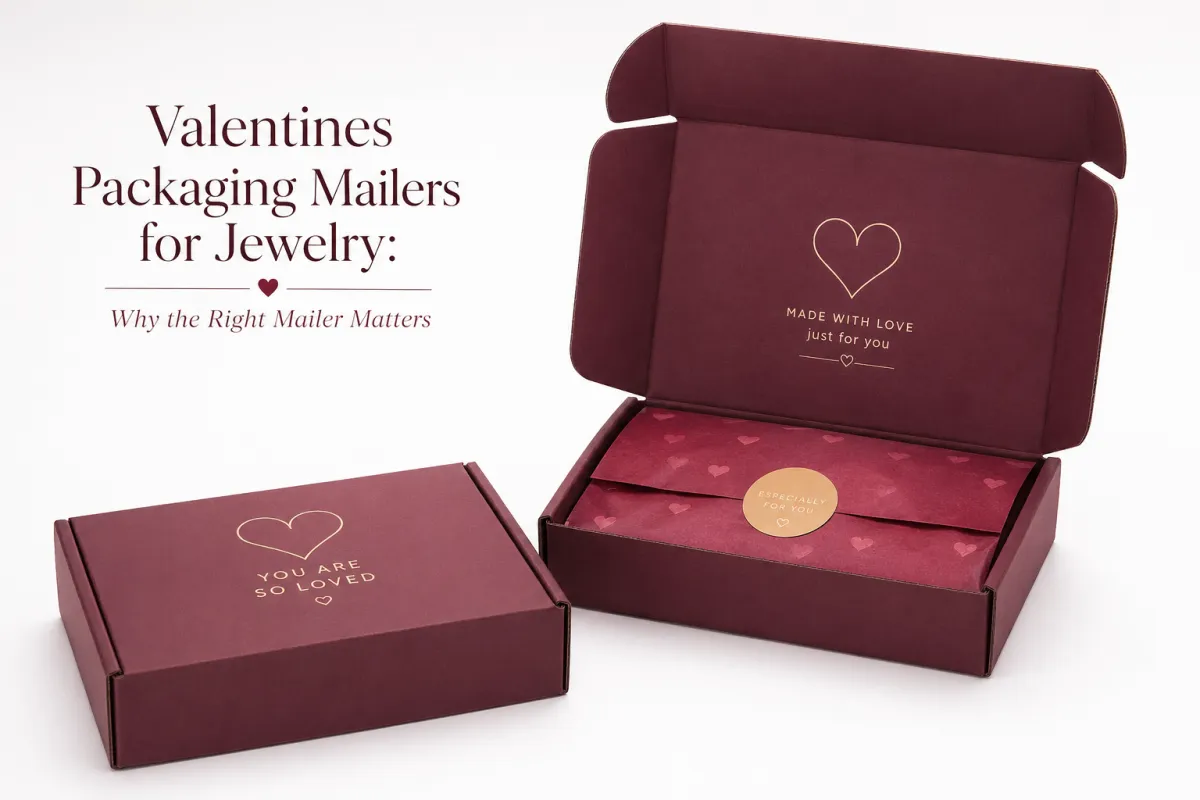
Valentines packaging mailers for jewelry sit in a strange middle ground. They are lighter than Custom Printed Boxes, faster to pack than a rigid gift set, and cheaper to ship than a full presentation box with foam, which is why a 6 x 9 mailer often beats a rigid carton when the product is a flat necklace card or a pair of studs. Even so, they still need enough structure to stop a necklace from pinballing around inside a slim pouch or bending a ring card at the corners. That balance matters because jewelry is light, but the damage from movement is real. A plated ring can rub. A stone can snag. A clasp can bend. One bad impact can turn a $38 sale into a support ticket, a refund, and a review that lingers longer than anyone wants, especially if the parcel rides through a regional hub in Dallas or Louisville on a wet Friday.
What these mailers are really doing is managing risk without killing the gift feel. In practical terms, valentines packaging mailers for jewelry usually mean a slim mailer with an adhesive closure, some kind of inner protection, and print that ties the shipment back to the brand with a color callout or a foil accent. For some brands, that means a soft pink poly mailer with a matte finish and a 350gsm C1S insert card. For others, it is a padded envelope with a printed heart pattern and a branded seal sticker cut on a 35 mm round roll. The point is not to force every product into one shape. The point is to match the mailer to the item, the route, and the price point, whether the run is 500 pieces for a pop-up in Austin or 10,000 pieces for a February campaign across the U.S. and Canada.
I learned that lesson on a factory floor in Dongguan while a production manager showed me three failed samples side by side under 5,000K inspection lights. One had beautiful print and weak adhesive that lifted after a 90-second dwell test. One had a strong seal but no inner cushioning, so the earring backs rattled against the seam. One had both, but it was 22 percent oversized, so the jewelry bounced around like a loose screw in a toolbox. He pointed at the third sample and said, in plain English, "Pretty is cheap if the item arrives damaged." He was right, and I have carried that sentence around for years because it saves time, money, and one very tired customer service team in every production cycle from proof approval to final carton count.
That is why valentines packaging mailers for jewelry should be judged on the whole experience, not just the artwork on the outside. The mailer has to survive sorting belts, van loading, porch drops, and the customer opening it with scissors or fingernails in a kitchen lit by 2700K bulbs at 7 p.m. If the seal fails, the story fails. If the print smears, the brand looks careless. If the size is sloppy, the whole pack feels like a panic purchase. And yes, I have seen a package arrive with the sticker half-peeled and the jewelry card hanging out like it had escaped prison, all because a 40 mm adhesive strip was pressed for 1 second instead of 5 during packing.
Brands that treat valentines packaging mailers for jewelry as part of a broader retail packaging system usually make better decisions. They ask a simple question: does this piece protect the product, express the brand, and ship at a sane cost? That is the right lens. Not everything needs a heavy box. Not every piece needs foam. Every piece still needs a plan, and if the plan is "hope," the freight bill from a rush air shipment out of Hong Kong or Shanghai will usually punish that idea hard.
How Valentines Packaging Mailers for Jewelry Work
Valentines packaging mailers for jewelry work because each layer has a job. The outer layer protects against scuffs, moisture, and dirt over a 3 to 7 day transit window. The seal keeps the contents closed during transfer from pack-out to final delivery. The inner layer, when you add one, prevents the piece from sliding, twisting, or pressing against the edge of the mailer. For a small pendant or a pair of studs, that may be enough. For a heavier cuff bracelet or a gift set with a card, you may need a stiffer mailer or an insert that locks the item in place. I have seen brands learn that the hard way, usually right after launch in February, which is not my favorite kind of lesson.
Here is the simple breakdown I use when I spec valentines packaging mailers for jewelry with a client in Chicago, Shenzhen, or Dongguan:
- Outer shell: Usually 60-80 micron co-extruded poly, or a kraft-padded structure if the brand wants more texture and a 25-30 percent stiffer hand feel.
- Seal closure: A 40 mm to 50 mm adhesive strip is common, and glue strength matters more than the copy on the mockup; I ask for a peel test that holds after 3 pulls.
- Inner protection: Tissue, a folded card, a small insert, or a bubble layer if the jewelry has sharp points, snag-prone prongs, or a display tray.
- Brand face: Print coverage, color consistency, and finish need to match the rest of the package branding, down to the Pantone target and the uncoated paper insert.
Compared with boxes, valentines packaging mailers for jewelry are less rigid and usually cheaper to move through the carrier network, especially if the dimensional weight stays under 0.5 lb for domestic parcels. Compared with plain padded envelopes, they can look more intentional and deliver better branded packaging with a cleaner front panel and better print alignment. Compared with a basic poly mailer, a jewelry-specific mailer usually gives you a more precise insert fit and a better unboxing moment. If you are shipping flat items like earrings, chains, or a slim bracelet card, that is often the sweet spot. If you are shipping layered sets, heavy stones, or presentation pieces with a display tray, then custom printed boxes may still be the better call, especially for retail displays in boutiques from Miami to Toronto.
On the packing table, the flow matters just as much as the structure. A team member drops the jewelry into the insert, adds tissue or a thank-you card, aligns the pack inside the mailer, peels the seal, and presses for 3 to 5 seconds across the full closure line. If the fit is tight, the item stays centered. If the fit is sloppy, the customer gets a lopsided box-in-bag situation that feels cheap no matter how romantic the art is. I have watched people try to "fix" a loose pack with extra tape and a second sticker, usually after a 6 a.m. start on a Monday. That creates a worse problem and a very confused customer who receives a package that looks patched rather than prepared.
That is why I keep coming back to valentines packaging mailers for jewelry as a system, not a single item. The mailer, the insert, the label, the thank-you note, and the closure are all part of the same customer touchpoint. If one part is underbuilt, the whole package feels weak. If all of them work together, even a $24 necklace can feel like a premium gift, whether the pack-out happens in a 2,000-square-foot studio in Brooklyn or a 20,000-square-foot warehouse in Jiangmen.
For brands that want to browse options quickly, I often point them to Custom Packaging Products first, then narrow to Custom Poly Mailers if the jewelry is flat enough to ship safely in a slim format.
Key Factors That Shape Valentines Packaging Mailers for Jewelry
If you want valentines packaging mailers for jewelry to perform well, start with the specs. Pretty art comes later. The first thing I check is material thickness. A thin 40 micron film may look fine in a sample photo, but it can crease easily and feel flimsy in the hand after just one fold test. For many jewelry orders, 60 to 80 micron poly gives a better balance of flexibility and durability. If you need more stiffness, you can move into a kraft-backed or lightly padded format, but the shipping cost will rise by about $0.08 to $0.22 per parcel depending on carrier and zone.
Opacity matters too. Nobody wants the customer to see a shadow of the product through the mailer unless that is the intentional design. A 100 percent opaque outer layer protects privacy and makes the package look cleaner in photos, storefront stacks, and delivery handoffs. Tear resistance is another one. I have seen a courier sorter snag a corner and rip open a mailer that was only 10 percent too thin for the job. It took one rough belt at a hub in Atlanta and the whole shipment looked cheap before it left the facility. That kind of failure is maddening because it is so preventable with a better substrate and a real sample test.
Seal strength is where suppliers love to save $0.01 and brands pay for it later. Ask for strip width, adhesive type, and a peel test. A strong seal should hold after a firm press, but it should not make the pack impossible to open. Moisture resistance is also worth checking. A mailer that is fine in a dry warehouse can still soften at the seam if it sits on a damp truck floor for 6 hours or gets loaded after an overnight rain in Seattle. I have had people shrug at that and then act shocked when a seam lets go. Strange, really, because the weak strip was visible in the sample from day one.
On the branding side, valentines packaging mailers for jewelry can lean romantic, playful, or luxury-focused. I have seen blush pink with satin white type work beautifully for a DTC charm brand in Los Angeles, while black with hot-foil rose accents fit a higher-end line better for a studio in Brooklyn or a manufacturer in Guangzhou. The trick is consistency. If the mailer says "premium" and the insert says "budget," the customer notices. If the color match drifts by a few Delta E points, the entire branded packaging system feels off. People may not know why it feels off, but they will absolutely feel it when the package lands on a vanity table next to a candle, a mirror, and a ring dish.
One supplier in Shenzhen tried to sell me a thinner film at the same price as a heavier one, then acted offended when I asked for a cross-section sample and the adhesive data sheet. That is normal, by the way. Suppliers negotiate. You should too. Ask for the film spec in writing, the adhesive spec in writing, and the print method in writing. Screen print, gravure, and digital print do not behave the same, and the wrong process can make a delicate script font blur on a 6 x 9 mailer or leave a foil line broken at the fold. I would rather annoy a supplier for five minutes than annoy a customer for five weeks.
For testing and material claims, I like to reference ISTA shipping test methods and FSC sourcing standards. One helps you understand how packages hold up in transit. The other helps you sort real paper claims from the greenwashed nonsense that shows up in mockups all the time. And yes, I still get sent sample sheets that say "eco" with no backing, no fiber traceability, and no factory address beyond "industrial area." That label is not a plan, and it does not belong on valentines packaging mailers for jewelry if the brand wants credibility.
Three more details deserve attention before you approve any valentines packaging mailers for jewelry:
- Size fit: Measure the finished jewelry plus insert, tissue, and card. A 3 x 4 inch earring card does not belong in a 7 x 12 mailer unless you enjoy sliding and corner crush.
- Print coverage: Heavy ink coverage can crack on flexible film if the coating is wrong, especially on fold lines and seal edges after a 48-hour cure window.
- Add-ons: Small thank-you cards, ring boxes, and tissue folds change the internal dimensions more than people expect, often by 4 to 9 mm in one direction.
When all three are aligned, valentines packaging mailers for jewelry feel thoughtful rather than improvised. That is the difference between a seasonal shipment and a repeatable system. It also keeps your team from playing packaging Tetris at the packing bench, which nobody enjoys for long, especially when the line is pushing 300 orders before lunch and the Valentine cutoff is 4 p.m.
Valentines Packaging Mailers for Jewelry: Cost and Pricing Basics
Pricing for valentines packaging mailers for jewelry comes down to five levers: material, print complexity, order quantity, custom sizing, and finish. If the supplier is quoting you a magical low number with no detail, assume they trimmed something important. I have seen a quote drop by 14 percent only to discover the adhesive strip was narrower, the film was thinner, and the print was limited to one side instead of both. Cheap is easy. Cheap and consistent is the hard part, and the hard part is usually the one you end up paying for anyway, sometimes through a reprint in Ningbo or a rush freight bill out of Guangzhou.
For a clear sense of the market, here is a practical comparison I use during client budgeting. The numbers are realistic for small to mid-sized runs, though every supplier, freight lane, and finish choice can move them a bit. These figures assume a standard proof cycle, a single-color or two-color print, and packaging manufactured in regions such as Shenzhen, Dongguan, or Zhejiang.
| Mailer Option | Best For | Typical Spec | Unit Cost at 1,000 | Unit Cost at 5,000 |
|---|---|---|---|---|
| Standard poly mailer with custom print | Flat earrings, chain bracelets, slim carded items | 60 micron film, one-color print, 40 mm seal | $0.42-$0.68 | $0.18-$0.31 |
| Padded jewelry mailer | Heavier pieces, mixed sets, more protection | Kraft outer, bubble or paper pad, printed face | $0.58-$0.92 | $0.28-$0.49 |
| Rigid mailer | Higher-end presentation with better edge protection | 300-400 gsm board, scored fold, custom print | $0.90-$1.40 | $0.45-$0.78 |
| Custom printed boxes with outer mailer | Gift sets and premium launches | Box plus protective outer shipper | $1.25-$2.10 | $0.65-$1.20 |
The pattern is simple. Small orders cost more per unit because setup is spread across fewer pieces. Bigger orders cut the unit price because the press time, plate Cost, and Prep labor get diluted. At 500 pieces, a custom jewel mailer can feel expensive. At 5,000 pieces, it starts looking sensible, and I have seen a quote of $0.15 per unit for 5,000 pieces on a simple two-color poly mailer when the supplier already had the film in stock and the artwork used a standard 6 x 9 dieline. That is why I tell brands to stop ordering like they are panic shopping and start ordering like they know their Q4 and Valentine's forecast. A forecast is not glamorous, but it beats guessing with your budget.
Here is my budgeting rule for valentines packaging mailers for jewelry: spend on the parts the customer physically touches, save on the parts they barely notice. I would rather see a stronger seal strip, a cleaner print finish, and a better-fit insert than a weird second ink color nobody asked for. If your artwork is simple, one or two print colors are usually enough. A solid blush background with crisp black type can outperform a busy pattern that costs 18 percent more to print and looks muddy in real life under warehouse lighting or on a phone camera.
For a brand running a seasonal campaign, a good starting point is this: budget $0.22 to $0.35 per unit for a 5,000-piece run of valentines packaging mailers for jewelry if the structure is simple, then add more only if your product needs padding, foil, or custom sizing. If your launch is smaller, expect to pay closer to $0.55 to $0.95 per unit. That is not a rip-off. That is the reality of smaller production, especially if the run is handled in a contract factory in Dongguan or a short-run printer in Los Angeles with hand-finishing at the end.
I have walked too many factories where a client wanted champagne taste on a lemonade budget. It never ends well. If you need to hold the line on cost, simplify the art, keep the size standard, and use a structure that already exists in the plant. That is how you make valentines packaging mailers for jewelry profitable instead of cute-but-annoying, and it is usually how you keep lead time inside a 12 to 15 business day window instead of stretching into February 8th with no cartons on the dock.
Step-by-Step Process and Timeline for Valentines Packaging Mailers for Jewelry
Production for valentines packaging mailers for jewelry is not complicated, but it does punish laziness. The cleanest projects follow a simple path: art, sample, approval, production, quality check, freight booking, delivery. Skip a step and the schedule starts wobbling. Miss two, and your Valentine launch becomes a customer service exercise with refunds, apology emails, and a warehouse team in Medellin, Los Angeles, or Shenzhen wondering why the cartons arrived after the launch email went out. I have seen good products buried under bad timing, and the real tragedy is that the packaging issue was fixable from the start.
- Confirm dimensions. Measure the jewelry, any insert, and any card. Write down the exact finished size in millimeters, not "about postcard size," and note the thickest SKU if you have more than one style.
- Lock the structure. Decide on poly, padded, or rigid. This choice affects print method, seal type, and shipping cost, and it also changes the packing rhythm by 5 to 10 seconds per order.
- Prepare artwork. Use the correct dieline, keep fonts readable at 6 to 8 pt, and convert colors before proofing so the pink does not shift in print from the screen version.
- Request samples. A physical sample tells you more than a PDF ever will. Check feel, closure, and fit with the actual jewelry card, tissue, and any 350gsm C1S insert.
- Approve production. Once the proof is signed off, ask the supplier to confirm lead time, packing count, carton spec, and whether the run will happen in Shenzhen, Dongguan, or another plant.
- Book freight early. Air is faster, sea is cheaper, and both get ugly when you leave the booking to the last week before Valentine's Day.
For a typical run, sampling usually takes 5 to 7 business days if the artwork is ready and the structure is standard. Production often takes 12 to 15 business days from proof approval for a straightforward order of valentines packaging mailers for jewelry, especially if the film, adhesive, and print plates are already in place. Add another 5 to 12 business days for freight depending on route and customs. If you need foil, custom sizing, or unusual finishing, add buffer. Real buffer. Not the imaginary kind people put into spreadsheets and then pretend will save them later when a port delay or weather hold slows the last mile.
One problem I keep seeing is file readiness. A brand sends a Canva file in RGB, the supplier converts it, the pink shifts, and suddenly the client wants three more proofs. I watched that eat 4 business days on a February run, and nobody looked smart after that, especially not the person who forgot bleed on a 6 x 9 layout. If you are serious about valentines packaging mailers for jewelry, hand off print-ready files in the right color space, with bleed and safe zones already built in. A polished concept is nice, but a print-ready file is what actually ships, often through a factory in Guangzhou or a fulfillment partner in the Inland Empire.
Another useful habit is to plan backward from your launch date. If your shipping window starts on the 8th, you do not want production finishing on the 7th. You want cartons in warehouse hands before that, ideally by the 28th or 29th of the prior month if customs is involved. I like to leave at least 10 days of cushion for seasonal campaigns because courier delays do not politely check your marketing calendar first. They show up anyway, usually at the least convenient moment possible, like a snowstorm in New Jersey or a backlog in a regional sort center in Texas.
The short version: valentines packaging mailers for jewelry should be in motion long before the first order drops. If you wait until the week before your campaign, you are gambling with freight, revisions, and warehouse stress. That is a bad bet, and I have seen brands lose thousands of dollars because they treated packaging like a last-minute accessory instead of a core item that needs the same discipline as product sourcing or paid media.
Common Mistakes Brands Make With Valentines Packaging Mailers for Jewelry
The most common mistake with valentines packaging mailers for jewelry is choosing something cute that fails in transit. Cute is not enough. I have seen pink mailers with weak adhesive split open after a single sort belt, and I have seen gorgeous print on a flimsy film wrinkle so badly that the brand looked like it had cut corners on purpose. The customer never knows your supplier story or your inland freight schedule. They only know what arrived at the door, and if the package arrives looking tired, that becomes the brand story whether you like it or not.
Here are the errors I see most often, usually in the first prototype round or after a rushed proof approval:
- Oversizing the mailer: A piece that slides around looks cheap and can rub the finish during a 2 to 4 day shipment.
- Overprinting the design: Too much copy or too many colors can make a small format feel crowded and muddy, especially on matte film.
- Skipping samples: A digital proof cannot show seal feel, tear resistance, or real color behavior on film under warehouse light.
- Ignoring the insert: If the jewelry card is loose, the whole pack shifts and the presentation falls apart in the last 10 seconds of unboxing.
- Underestimating lead time: Seasonal ordering without buffer is how teams end up paying rush freight rates or missing the launch entirely.
One factory visit in Ningbo still sticks in my head. A brand had ordered 8,000 valentines packaging mailers for jewelry with a soft pink background and a tiny silver script. On screen, it looked elegant. On the actual line, the silver printed too thin, the pink ran one shade warmer than expected, and the final packs looked beige under warehouse lighting at 4300K. The brand had to approve a reprint, and that delay cost them nearly $1,900 in extra freight and labor. That is not a theory. That is a real invoice, and a very unpleasant one, especially when the original quote had been built around a 14-day production window.
Weak contrast is another silent killer. If the artwork is delicate, make sure the text still reads at arm's length. If the logo is metallic, check how it behaves on the exact substrate. If the finish is matte, remember that low-gloss surfaces can mute color by a few points and make pale blush tones look dusty instead of romantic. I have had clients swear the Pantone was wrong when the real issue was the substrate absorbing light differently than the mockup. Packaging is rude like that sometimes; it refuses to look like the monitor, especially if the sample room in Guangzhou has cooler lights than the studio in Los Angeles.
"We thought the mailer was the easy part," a brand owner told me after a rework. "It turned into the most expensive part of the launch." I hear that line more often than I should, and every time I do, I know somebody skipped the sample stage, skipped the seal test, or skipped the fit check on the actual jewelry card.
Do not repeat that mistake. Treat valentines packaging mailers for jewelry like part of the sale, not a side quest. If the piece is fragile, test the pack with the real item. If the item has a sharp edge, add protection. If the brand is premium, the closure and print need to feel premium too. Otherwise, the whole thing looks like budget retail packaging pretending to be luxe, and the customer can tell the difference in less than a minute.
Expert Tips and Next Steps for Valentines Packaging Mailers for Jewelry
My advice is blunt: request a physical sample before you approve anything. I have visited enough factories in Shenzhen, Dongguan, and Ningbo to know that paper proofs lie and real samples do not. Hold the mailer. Press the seal. Drop the packed item from 1 meter onto a clean floor and then inspect the corners. If the closure opens or the piece shifts, the spec is wrong. That one test tells you more than a stack of polished sales slides, and it costs less than a single return or a second round of freight.
For valentines packaging mailers for jewelry, I usually recommend this short action plan, especially if the campaign will ship from a U.S. warehouse or a China-based factory on a tight February calendar:
- Confirm your top 3 SKU dimensions in millimeters.
- Choose a structure that fits the heaviest piece, not the lightest one.
- Request pricing at 500, 1,000, and 5,000 units so you can see the real breakpoints.
- Approve artwork early and keep revisions under control.
- Ask for a sample with the actual insert, tissue, or card you plan to ship.
If you need a cleaner decision path, start with the product first and the decoration second. A lot of brands reverse that order. They fall in love with a pink gloss mockup, then discover their ring box is 8 mm too thick or their necklace card needs another 14 mm of headroom. I would rather see a plain but well-fitting mailer than a pretty piece that fails the first courier handoff in a depot outside Philadelphia or a fulfillment center in Phoenix. That is why I keep saying valentines packaging mailers for jewelry should be designed around the item, the route, and the customer experience together.
Also, check the print finish under real light. A satin finish can soften reflections and make the mailer feel more expensive. Matte can look elegant, but it may dull reds and blush tones if the ink system is weak or the coating is too absorbent. High-gloss can make color pop, but it also shows scuffs faster during pack-out and line handling. I have argued with suppliers over this more than once, and the winning choice was usually the one that matched the brand story and the shipping reality instead of the prettier sample photo from a showroom in Shanghai or a sample room in Seoul.
Finally, if you are comparing suppliers, ask for the same three things from each one: film spec, adhesive spec, and turnaround time in business days. That keeps the conversation honest. It also makes it easier to compare quotes for valentines packaging mailers for jewelry without getting distracted by fluffy language and fake urgency. If the supplier cannot answer those basics, keep walking. There are better factories, better conversations, and better ways to spend the budget than fixing a mistake that should have been caught before proof approval.
My closing advice is simple. Order early, test hard, and keep the structure honest. Valentines packaging mailers for jewelry can absolutely protect delicate pieces and still feel romantic, but only if you make the right decisions before production starts and give the factory enough time, usually 12 to 15 business days from proof approval for a standard run, to do the work properly.
How Do You Choose Valentines Packaging Mailers for Jewelry?
Choose valentines packaging mailers for jewelry by starting with the finished piece, not with the artwork. Measure the jewelry card, any insert, the closure area, and the thickest version of the product, then compare those measurements against the mailer structure you want to use. If the item is flat, a slim poly or padded format may be enough. If the item has sharp edges, a heavier stone, or a display tray, you need more protection and a stricter fit. I like to think of it as a small engineering problem with a romantic surface, because that is exactly what it is once the parcel leaves the pack table in Dongguan, Shenzhen, or Los Angeles.
From there, check the seal strength, print clarity, and finish under real warehouse light. If the mailer is for a Valentine's campaign, the color should feel warm and intentional, but the structure still has to survive belts, bins, and porch drops. That is the real balance for valentines packaging mailers for jewelry: enough beauty to create a gift moment, enough durability to keep the product safe, and enough cost discipline to protect margin. If those three pieces line up, the package does its job and the customer feels cared for the second they pick it up.
What size valentines packaging mailers for jewelry should I use?
Measure the finished product plus any insert, tissue, or card before choosing a mailer size. Leave enough room for protection, but do not oversize it so the jewelry shifts around during transit. I always test the exact size with the most common SKU and the bulkiest SKU, because one size rarely fits every piece perfectly. A 2 mm pendant and a chunky ring box do not deserve the same mailer, no matter how much the spreadsheet wants to pretend otherwise. For most earring cards, a 6 x 9 inch format is a safer starting point than a loose 7 x 10 bag.
Are valentines packaging mailers for jewelry better than boxes?
Mailers are usually lighter, cheaper to ship, and faster to pack for small, flat, or flexible jewelry items. Boxes work better for higher-end sets, fragile display pieces, or products that need a more rigid presentation. The right choice depends on protection, shipping cost, and the unboxing experience you want to create. If the jewelry is delicate but flat, valentines packaging mailers for jewelry can be the smarter move; if it needs structure, a box may save you trouble later. A $28 pair of studs often fits a mailer well, while a $120 gift set with a tray usually deserves a box and an outer shipper.
How much do custom valentines packaging mailers for jewelry cost?
Price changes based on material thickness, print coverage, quantity, and whether you need custom sizing. Small runs cost more per unit, while larger orders usually lower the unit price significantly. Ask for quotes at multiple quantities so you can compare the real cost breakpoints instead of guessing. I like to compare 500, 1,000, and 5,000 units because the jump between those numbers tells you almost everything You Need to Know. On a simple run, pricing can fall from about $0.68 at 1,000 units to $0.19 at 5,000 units if the factory already has the film and the print is only one color.
How long do valentines packaging mailers for jewelry take to produce?
Sampling usually comes first, followed by final approval, production, and freight booking. Lead time depends on artwork readiness, material availability, and how many rounds of revisions you need. Build extra time into the schedule if you are launching for a seasonal rush, because shipping delays never send a warning. If you are working with valentines packaging mailers for jewelry on a Valentine timeline, early approval is the difference between calm and chaos. A straightforward order often takes 12 to 15 business days from proof approval, then another 5 to 12 business days for freight depending on route.
What should I check before ordering valentines packaging mailers for jewelry in bulk?
Check print quality, seal strength, size fit, and whether the mailer protects the jewelry without crushing the presentation. Confirm the final artwork files, color expectations, and any special finish requirements before production starts. Ask for a production sample or proof if the order is large enough that a mistake would be expensive. That checklist saves money fast, and it keeps valentines packaging mailers for jewelry from turning into an expensive do-over. I would also add one more thing: make sure the team who packs the orders has actually handled the sample, because they will notice problems the sales deck never will, especially if the insert is 2 mm too wide or the closure tape peels in under 5 seconds.
What is the best takeaway for planning valentines packaging mailers for jewelry?
Pick the structure that fits the jewelry, test it with the real item, and lock the files early enough that the factory can ship without rush work. If you keep the fit tight, the seal strong, and the artwork honest, valentines packaging mailers for jewelry will do what they are supposed to do: protect the piece, make the opening feel considered, and keep margin intact. That is the whole job, and it is a lot easier when you treat the mailer as part of the product rather than a last-minute wrapper.


