The vitamin Brand Paper Shopping Bags Material guide starts with a simple truth: the bag is part packaging, part carrier, and part brand proof. It needs to hold weight without folding into itself, print cleanly without looking loud or cheap, and survive a few rounds of handling without showing every scuff. In supplement retail, that matters more than most teams expect because the bag is often the last physical touchpoint before the product goes home with the customer.
Material choice affects more than appearance. Paper grade changes stiffness and print clarity. Basis weight changes how the bag carries load. Coating changes scuff resistance and the way the surface reads under store lighting. Handle construction and reinforcement decide whether the bag feels reassuring in the hand or fragile from the first lift. If one piece is off, the whole presentation slips.
For vitamin brands, the right spec usually sits in the middle, not at the extremes. Heaviest is not always best, and the most natural-looking stock is not always the one that performs best. A well-built midweight bag can outlast a heavier but poorly engineered one, especially when the fold lines, glue pattern, and handle anchors are matched to the actual fill weight.
Vitamin brand paper shopping bags material guide: what the material has to prove
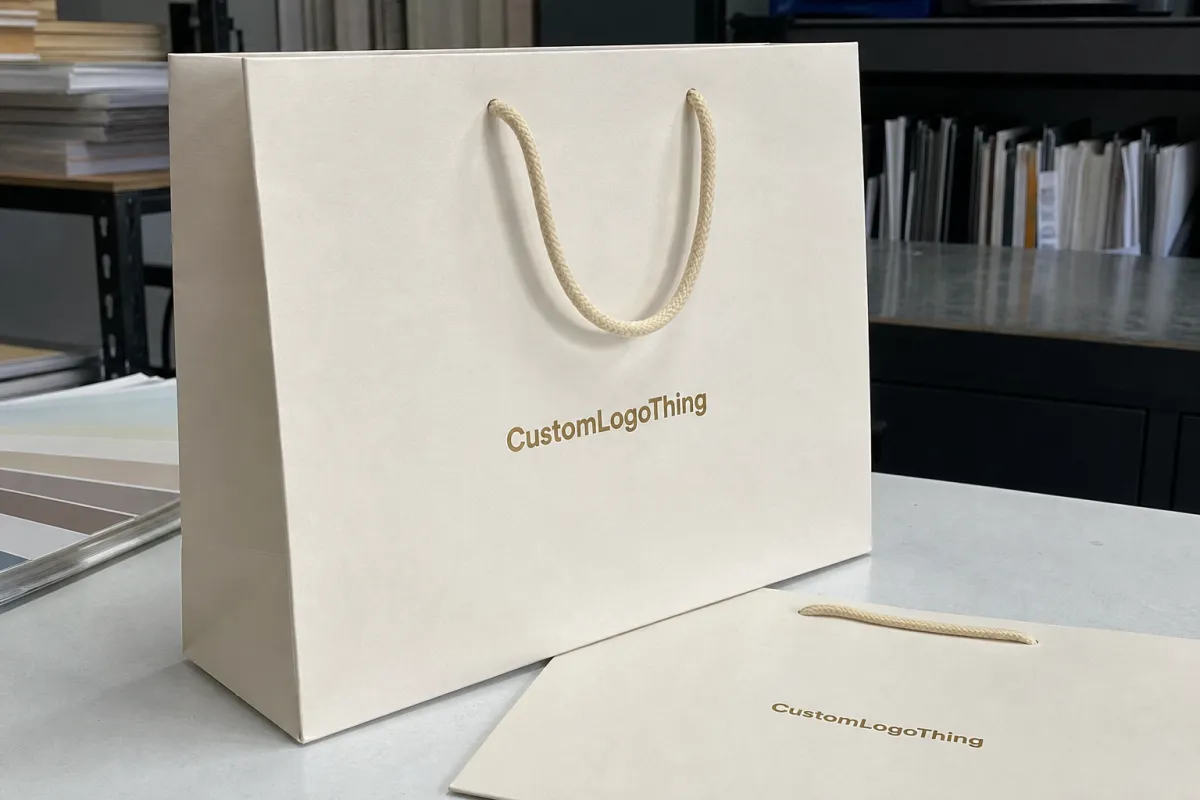
Supplement packaging sits in a narrow lane. It has to feel clean enough for a pharmacy counter, premium enough for a wellness launch, and practical enough to carry glass bottles or bundled kits. That means the bag should be judged as a working object, not just a print surface.
The first test is structure. Bottles are dense, and dense products punish weak sidewalls and shallow bases. The second test is print behavior. Small logos, regulatory text, and restrained layouts need a sheet that holds detail without feathering or dulling the artwork. The third test is handling. Customers fold bags under an arm, set them in a car, and reuse them at home. A bag that looks fine only when untouched is not doing its job.
Most buyers end up weighing six elements together:
- Paper grade for stiffness, tone, and print fidelity.
- Basis weight for load support and shape retention.
- Finish for surface feel and scuff resistance.
- Handle style for comfort and carrying strength.
- Reinforcement at the mouth and base.
- Adhesive system for seam strength and temperature stability.
For brands making sustainability claims, the material story has to hold up in production, not just in marketing copy. FSC-certified paper can support responsible sourcing claims, but coatings, inks, and glues still need to fit the intended disposal pathway. A paper bag can be called recyclable in one build and much harder to recover in another if heavy lamination or mixed-material handles enter the design.
Recycled content can also be useful, but it is not automatically the right answer. Post-consumer fiber often brings a more muted surface, which can be fine for natural wellness labels and a problem for designs that rely on crisp typography or clean white space. The practical question is whether the sheet still prints sharply, folds cleanly, and carries the product without collapsing at the gusset.
That trade-off shows up often in real buying decisions. A lower-cost sheet may look acceptable on screen, yet wrinkle faster, show handling marks sooner, or absorb ink unevenly. The result is a bag that weakens the shelf story instead of supporting it.
Paper stock, liners, and finishes that change performance
Four paper families show up often in vitamin packaging: kraft paper, white SBS, CCNB, and textured specialty stock. Each creates a different expectation before a customer even reads the label.
Kraft paper reads honest, grounded, and less decorative. It suits brands leaning toward natural ingredients, clinical simplicity, or refill-friendly messaging. White SBS gives sharper contrast and a more polished retail impression, which is useful when the bag needs to sit beside premium cartons and glass packaging. CCNB is often the budget-aware middle ground for larger runs where the artwork does not depend on a bright, ultra-clean surface. Textured specialty stocks bring more tactile interest, but they work best when the rest of the identity is restrained.
The outer sheet is only half the story. Liners and reinforcement can carry a lot of the real performance. A turned-in mouth, a base card, or a sidewall patch can keep the bag square after filling and reduce the bowing that makes a bag feel underbuilt. For glass bottles, multi-bottle bundles, or heavier subscription sets, those details are structural, not decorative.
Finishes change both durability and perception. Matte aqueous coating is a common choice because it gives controlled sheen, decent rub resistance, and a paper-forward feel. Gloss lamination creates brighter color and stronger edge protection, but it can shift the bag toward a more cosmetic look. Soft-touch gives a richer hand feel and a quieter appearance, though it may show handling marks faster than expected. Uncoated surfaces feel natural, yet they are less forgiving if the artwork uses dark blocks or fine type.
That is why the “best” finish depends on the use case.
- Pharmacy counters: crisp logo print, moderate scuff resistance, and easy handling.
- DTC kits: stronger structure and carton-friendly dimensions.
- Subscription programs: neat fold behavior and lower visual clutter.
- Retail launches: a surface that still looks clean after repeated touching.
If a brand wants to say the bag is paper-forward or recyclable, the finish has to be reviewed early. A coating that feels fine in a sample can become a problem once the team checks recycling guidance, local collection rules, or the actual material mix. Water-based coatings often fit better than full lamination in those cases, but the choice still depends on print coverage, handling, and shelf expectations.
Handle strength, fold behavior, and shipping protection
Handle style is a structural decision wearing a design costume. Twisted paper handles are common because they balance cost, grip, and strength well. Rope handles feel more elevated and usually carry weight more comfortably, though they raise unit cost. Ribbon handles are often chosen for gift-like presentation, but they are rarely the right answer for heavy supplement kits. Die-cut handles keep the silhouette clean, yet they need careful reinforcement if the bag will carry dense product.
The bag body has to support the handle rather than fight it. A strong handle attached to a weak mouth panel still fails. A good base with weak sidewall folds still sags. The details that matter most are the gusset geometry, base spread, mouth reinforcement, and the way the load is transferred from the handle into the paper stack.
Fold behavior deserves more attention than it usually gets. Bags ship flat, get opened at a retail counter or fulfillment table, then are expected to spring back into shape. If the paper is brittle, the crease can crack. If the coating is too stiff, the mouth may not recover cleanly. If the sheet is too soft, the bag loses its square profile the first time it gets filled. A sample that looks fine on the table can still fail once the cartons are packed and handled at scale.
Shipping protection matters too. The bag does not travel alone. It moves inside a master carton, then gets stacked, stored, and distributed with other packaging. If the shipper is underbuilt, the bags can arrive with crushed corners, warped handles, or scuffed print even when the bag spec itself is solid. That is why compression strength and pack-out details should be checked alongside the bag specification.
A premium-looking bag that buckles under real weight teaches the buyer not to trust the brand. A slightly simpler bag that opens squarely, carries cleanly, and resists scuffing often feels more expensive where it matters.
Before approving a run, ask for three checks: lift testing with the full intended fill weight, seam pull checks at the handle and base, and carton compression checks on the packed shipper. If the product travels through parcel delivery or mixed freight, a lab can also use ISTA or ASTM-based distribution testing to see how the bag behaves under vibration, stacking, and handling stress.
Production steps and lead time: from sample to carton
Good production starts with the dieline, not the press. The artwork has to fit the bag structure, and the structure has to support the product. Once dimensions are confirmed, the team reviews bleed, trap, handle placement, reinforcement points, coating choice, and carton pack-out. A missing measurement at this stage can stall the whole order later.
- Spec definition: bag size, paper grade, handle type, finish, and print coverage.
- Artwork prep: dieline fit, color references, and proof corrections.
- Sampling: physical check of feel, stiffness, fold behavior, and color tone.
- Production: printing, die-cutting, handle assembly, and gluing.
- Packing: carton count, master carton specs, and receiving window.
Delays usually come from a few familiar places. Color approval takes longer than expected. A handle style needs to be sourced or changed. A specialty finish behaves differently than the sample suggested. The biggest setbacks often happen after sample sign-off, when the buyer decides the finish should be softer or the handle should switch from paper to rope. That kind of late change is common, but it moves the schedule.
Lead time depends on complexity. A stock-style bag with light customization may be ready in about 7-12 business days after approval. Semi-custom work often lands around 12-18 business days. Fully custom bags with premium finishing, custom handles, or heavier reinforcement can run 18-30 business days or more. For launches, it is smart to leave extra room for sampling, revision, and packing confirmation.
One practical production issue is alignment across the rest of the kit. If the bags ship with cartons, inserts, or labels, receiving dates need to make sense together. Bags that arrive too early can be stored badly. Bags that arrive too late get handled too quickly. Either mistake can leave a permanent crease in a load-bearing fold or a mark across the front panel.
That is also why sample review should be physical whenever possible. A flat proof cannot show how the bag stands, how the handle feels under weight, or how the finish reacts to repeated contact. Those are the details that separate acceptable from durable.
Cost, pricing, and MOQ trade-offs that affect the quote
Most bag pricing comes down to six levers: paper grade, print coverage, coating, handle material, reinforcement, and packing format. A full-coverage dark print with soft-touch coating and rope handles will almost always cost more than a simple one-color kraft bag with twisted paper handles. That does not make the premium build wrong. It just means the budget is going into different features.
MOQ changes the unit-cost curve in a predictable way. Smaller runs spread setup costs over fewer bags, so the unit price rises. Larger runs lower the per-unit cost because make-ready, tooling, and finishing are absorbed more efficiently. The useful question is not which quote is lowest. It is which quote fits the launch volume, the product margin, and the brand position without hiding extra cost in omissions.
| Material / Build | Typical look | Common use | Indicative unit impact* |
|---|---|---|---|
| Kraft paper, aqueous coat, twisted paper handle | Natural, clean, understated | Clinical wellness, eco-led lines | $0.22-$0.35 at 5,000 units |
| White SBS, matte coat, reinforced base | Bright, crisp, premium retail | Pharmacy counters, hero SKUs | $0.28-$0.48 at 5,000 units |
| CCNB, full-color print, paper handle | Practical, balanced, cost-aware | Subscription kits, broad retail use | $0.18-$0.30 at 5,000 units |
| Textured specialty stock, soft-touch, rope handle | High-touch, gift-like, elevated | Premium wellness and launch sets | $0.45-$0.85 at 5,000 units |
*Directional ranges only. Size, print coverage, freight terms, and carton pack-out can move these numbers up or down.
Some quotes look cheaper because they leave out important details. Reinforcement may not be included. The finish may be priced separately. The sample may be based on a lighter handle spec than the one the brand actually needs. That is why line-item pricing matters. Compare the full build, not just the headline number.
There are also moments when spending more is the better choice. Higher-margin products, retail launches, gift sets, and premium wellness lines can justify a better carrier because the bag becomes part of the sale rather than an afterthought. In those cases, the most expensive element is often not the better material but the cost of replacing a weak first impression later.
Common mistakes that make the bag look cheap or fail early
The first mistake is choosing a finish for the mockup rather than the shelf. Soft-touch and gloss can look excellent in a render and still show scuffs, fingerprints, or edge wear under store lighting. Dark coverage can be especially unforgiving if the bag gets touched often. A finish that photographs well is not automatically the one that survives retail handling.
The second mistake is under-specifying the load path. Weak handle anchoring, low basis weight paper, or a glue line that softens in heat can all produce a bag that bows before it breaks. The failure usually starts small: a handle leans, the base sags, a gusset crease opens. By the time the bag actually tears, the brand image has already taken the hit.
The third mistake is over-designing the artwork. Too many claims, oversized logos, and crowded type make the bag feel busier than the product it carries. Simpler layouts often read as more premium because the material, the color, and the negative space can do their work. On paper bags, restraint is often the stronger signal.
“Eco-looking” is not a performance spec. A kraft finish can still be weak, a recycled sheet can still scuff fast, and a paper bag can still be the wrong fit for a heavy glass bottle program.
Skipping real-world testing is another common miss. The bag should be tested with the actual fill weight, the actual carton size, and the actual distribution method. A store handoff and a parcel-delivered subscription kit create very different stresses. If the bags will travel through vibration, stacking, or drop events, that is where weak construction tends to show itself.
Finally, teams sometimes chase sustainability language without checking the mechanics. Recycled materials can be a strong choice. Post-consumer fiber can help a brand story. But if the paper cannot hold shape, the coating prevents recovery, or the look turns dull beside the product, the message may not land as intended. The material needs to support both the claim and the product.
Expert sourcing tips for a more premium retail presentation
Ask for physical swatches and finished samples, not just a PDF proof. Paper has tone, stiffness, and surface character that a screen cannot show. A cream white SBS may read warmer than expected. A kraft stock may look more rustic in the hand than it does in a photo. Those differences matter because customers notice them quickly, even if they cannot explain why one bag feels more expensive than another.
Match the bag’s visual weight to the product line. Clinical supplements usually benefit from clean branding, calm contrast, and a quieter finish. Premium wellness products can handle richer texture, deeper tones, and a more gift-like presentation. The point is not to make the bag louder. It is to make the packaging system feel coherent from carton to carrier.
Compare at least two construction options before locking the spec. A reinforced base against a standard base. Twisted paper against rope. Matte aqueous against soft-touch. The price gap may look modest, but the handling difference can be large, especially for heavy bottles or multi-item kits.
One useful rule: if the bag sits beside amber bottles or minimalist cartons, the finish should support that language rather than compete with it. A reflective surface can pull attention away from the product. A cleaner sheet with controlled sheen usually does more for the brand story and makes the bag feel intentional instead of decorative.
Reuse is worth thinking about as well. A bag someone keeps becomes a moving impression, not a one-time wrapper. That is one reason premium wellness brands often treat the shopping bag as part of the retail experience. It extends the design beyond the checkout counter without needing extra copy or a louder logo.
For brands trying to make the bag feel premium without overbuilding it, the most reliable sweet spot is a midweight sheet, controlled print coverage, and handles sized to the real fill weight. That combination is rarely flashy on a spec sheet. In practice, it usually looks and performs better than a more complicated build that was chosen for the rendering instead of the customer’s hand.
Next steps: sample, compare, and approve the right spec
Before approving production, confirm six things: product weight, bag dimensions, handle type, paper grade, finish, print method, and carton pack-out. Those details determine whether the bag works as a retail carrier or ends up as a fragile accessory that only looked right in the mockup. If one of them is vague, the quote will be harder to trust.
Then request two samples: one with the intended spec and one with a plausible alternative. The comparison is often more revealing than a long discussion. A slightly heavier sheet may stand better. A different coating may resist scuffing more effectively. A stronger handle attachment may add very little to the cost while improving the bag’s feel immediately.
- Confirm the full filled weight, not just the empty bag spec.
- Check seam strength at the handles and base.
- Review the bag under store lighting and shipping lighting.
- Compare carton pack-out and receiving volume.
- Validate the finish against your sustainability claims.
That sequence keeps the buying process grounded. Narrow the material first, then review the quote, then validate the timeline. It prevents the most common mistake in packaging procurement, which is approving a surface finish before the structure has been proven.
For vitamin brands, the right paper shopping bag is not a side accessory. It protects the product, supports the margin, and shapes how the brand is remembered. A solid vitamin brand Paper Shopping Bags material guide helps teams make those choices with fewer assumptions and better evidence, which is usually where good packaging decisions begin.
What paper stock is best for vitamin brand paper shopping bags?
Choose a stock that balances stiffness, print clarity, and load support for the actual bottle or carton weight. White SBS often gives the cleanest premium result, while kraft can suit natural or clinical wellness lines. If sustainability messaging matters, confirm the substrate, coatings, and adhesives still fit the disposal path you plan to claim.
Should supplement shopping bags use lamination or a water-based coating?
Use lamination when scratch resistance and stronger color depth matter most. Use aqueous or other water-based coatings when you want a softer finish and a more paper-forward feel. Always weigh the finish against scuff risk, recycling goals, and the way the bag will be handled in stores or during shipping.
How strong should the handles be for vitamin packaging?
Size handle strength around the full filled weight, not the empty bag. Twisted paper and rope handles can both work well, but the attachment points need reinforcement. If the bags carry glass bottles or bundled kits, ask for pull-test results before approval.
What MOQ should I expect for custom paper shopping bags?
MOQ varies by paper type, print complexity, and whether the build needs custom tooling. Higher MOQs usually lower the unit cost because setup and finishing expenses spread across more bags. Ask for tiered pricing at several quantities so launch volume and replenishment volume can be compared cleanly.
How long does the process take from sample to delivery?
Simple custom bags can move quickly, but artwork approval and sample review often set the real timeline. Special finishes, custom handles, or heavier reinforcement can add days or weeks. Build buffer into the schedule if the bags are tied to a product launch, seasonal promotion, or retail rollout.


