Buyer Fit Snapshot
| Best fit | Void Fill with Logo projects where brand print, material claims, artwork control, MOQ, and repeat-order consistency need to be specified before quoting. |
|---|---|
| Quote inputs | Share finished size, material target, print colors, finish, packing count, annual reorder estimate, ship-to region, and any compliance wording. |
| Proofing check | Approve dieline scale, logo placement, barcode or warning zones, color tolerance, closure strength, and carton packing before bulk production. |
| Main risk | Vague material claims, crowded artwork, missing packing details, or unclear freight terms can make a low unit price expensive after revisions. |
Fast answer: Void Fill with Logo: Artwork Proof, Packing Count, and Landed Cost should be specified like a repeatable production item. The safest quote records material, print method, finish, artwork proof, packing count, and reorder notes in one written spec.
Production checks before approval
Compare the actual filled-product size with the drawing, then confirm tolerance on folds, seals, hang holes, label areas, and retail display edges. Reserve space for logos, QR codes, warning copy, and material claims before decorative graphics fill the panel.
Quote comparison points
Review material grade, print process, finish, sampling route, tooling charges, carton quantity, and freight assumptions side by side. A quote is only useful when the supplier can repeat the same color, closure quality, and packing count on the next order.
The space inside a shipping box is rarely neutral. Products slide, rub, tilt, and take punishment in places buyers never see. Void fill with logo turns that empty volume into two things at once: protection and a branded reveal. That combination sounds simple, but the tradeoffs are real. A box That Travels Well and opens well usually took more thought than the customer ever knows, and a lot of teams still underestimate how much the inside of the package does.
Most teams start with the carton, the label, the tape. Fair enough. The interior often gets treated like dead air, a technical problem to solve as cheaply as possible. That misses the point. The first surface a customer touches is frequently the material wrapped around the product, tucked beside it, or crumpled underneath it. Void fill with logo uses that overlooked moment to do real work, not just decorative work.
Cosmetics, accessories, candles, glass jars, subscription kits, small electronics, and premium samples all live in that awkward middle ground: too valuable to gamble on loose packing, too small to justify overbuilt foam. For those categories, the right fill keeps the item from moving and signals that the shipment was planned with care. That is the practical appeal of void fill with logo.
I have seen brands spend heavily on outer cartons and then Pack Fragile Items with whatever was cheapest that week. The result is predictable. The outside says premium; the inside says rushed. Customers notice the mismatch, even if they cannot name it. It kind of sticks in the mind.
What void fill with logo actually is, and why it works
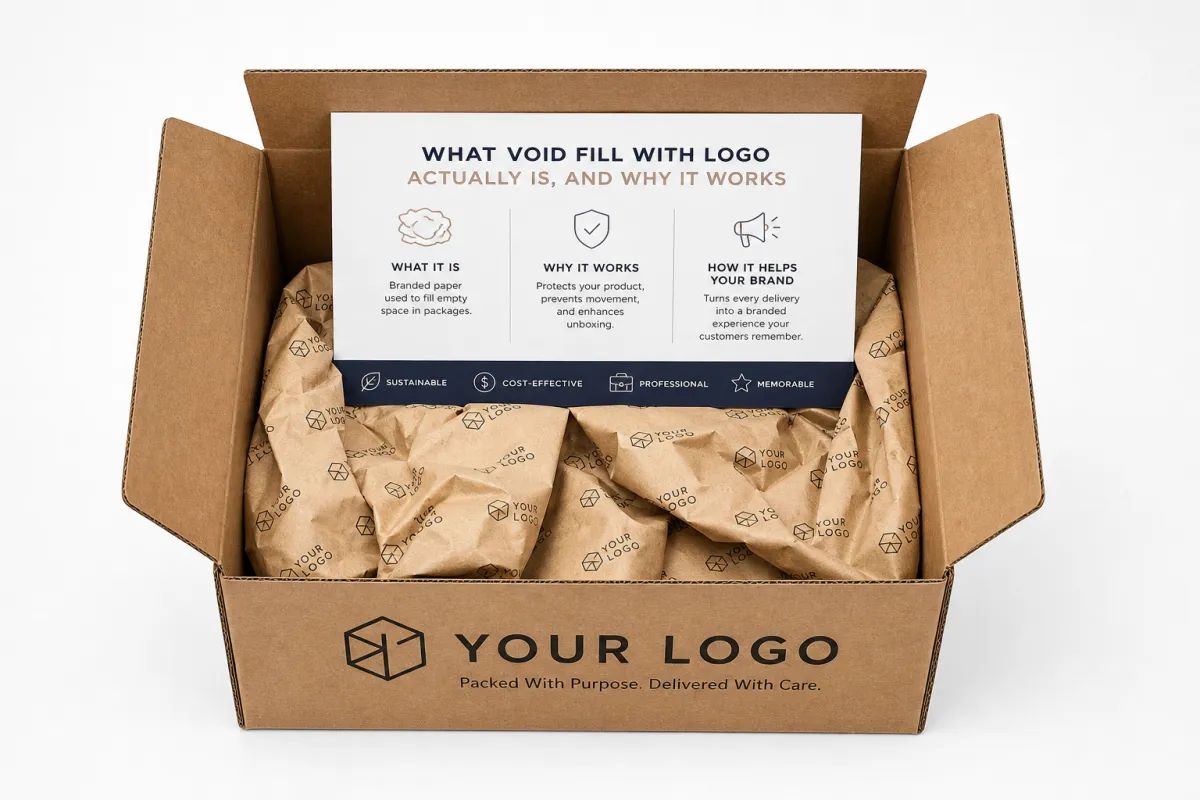
Plainly put, void fill with logo means branded packing material used to occupy empty space around a product in transit. The material can be paper, tissue, air pillows, molded pulp, or another cushioning format. Branding may be printed directly on the material or built into the shape itself. Decoration is secondary. Stabilization comes first.
The physics are unglamorous. A gap in a box lets momentum build. Momentum becomes contact. Contact becomes scuffs, chipped corners, dented lids, and rattling that sounds minor until the returns pile up. In high-volume shipping, even a tiny rate of movement can become expensive fast. Void fill with logo interrupts that chain before the damage starts.
Packaging is read in sequence. Exterior carton, shipping label, then the interior reveal. That inside layer carries more emotional weight than many brands admit. A clean interior can make a modest product feel thoughtful. A sloppy one can make a premium product feel cheap. The logo matters because it tells the customer the inside of the box belonged to the brand from the start. Void fill with logo uses that cue without forcing a loud exterior print.
Kraft paper fill is common because it is cheap enough to scale, easy to source, and adaptable to odd shapes. Printed tissue reads softer and more gift-like, though it offers less structural support. Air pillows work for light items and high throughput, but the branding surface is limited. Molded pulp and molded paper can protect better, especially for fragile goods, though tooling and lead time usually move the cost up. Each option behaves differently in hand, in transit, and under a fulfillment line.
Material weight changes the story more than many buyers expect. A 17 gsm tissue sheet, a 60 gsm paper sheet, and a 90 gsm kraft sheet do not feel alike, do not cushion alike, and do not project the same tone. A skincare brand sending a $68 serum wants a different interior than a hardware supplier shipping replacement parts. Void fill with logo works best when the substrate matches the product, not when it merely looks polished in a mockup.
The simplest rule is also the most useful: use void fill with logo when the box has spare space, the product can move, and the customer will see the inside of the package. That describes a lot of ecommerce shipments. It also describes the awkward category where presentation and protection have to share the same square inch.
Plain exterior cartons are another reason brands choose this approach. Some companies want a restrained outside and a more expressive inside. Others ship through retail channels where the outer box must stay generic. In both cases, void fill with logo becomes the signature element that survives the entire trip without demanding a full printed carton.
Protection still has the final vote. Branded fill that looks good but fails to stop motion is just expensive clutter. Branded fill that controls the load, cushions the product, and adds a sharp reveal earns its place quickly. That is why void fill with logo keeps showing up in packaging programs that care about both damage rates and brand memory.
How void fill with logo works inside the box
The job starts with mechanics. Void fill with logo reduces travel, absorbs small impacts, and helps keep product surfaces from rubbing against the carton wall. It does not need to be heroic to be useful. It needs to hold the item in place, keep corners from knocking together, and stop the package from sounding like loose change when it moves.
Most shipping damage begins the same way: a product gets room to accelerate. A conveyor bump, a short drop, a corner tilt in a delivery van. That little burst of motion is enough to send glass against board, coated finishes against kraft, or metal edges against a printed insert. Once the product has momentum, the box is only a container for the damage. Void fill with logo changes the geometry so the product cannot pick up speed.
The logo appears during opening, not during transit. That timing matters. Exterior packaging has to survive abrasion, moisture, stacking, and handling. Interior branding only has to look clean at the reveal. That difference gives void fill with logo a practical advantage: the print can be lighter, the placement can be simpler, and the brand cue still lands at the right moment.
Fit matters more than most spec sheets admit. Box dimensions, product weight, insert design, and fill volume all interact. A lightweight object with a few centimeters of empty space may only need enough fill to stop sliding. A heavier item or something with a fragile coating may need tighter pack-out, corner restraint, or a rigid insert plus branded fill. There is no single formula that fits every shipment, which is inconvenient and true.
A useful starting point is to measure movement, not guess at it. If the product can shift more than a few millimeters in any direction, the pack-out deserves a second look. For light goods, a small amount of movement may be tolerable. For glass, painted surfaces, and high-value items, tolerance gets much tighter. Void fill with logo only helps if the package actually controls the load.
Brand tone should show up in the fill style. A clean, repeat logo on natural kraft often fits premium natural brands or eco-focused labels. A bolder pattern works better for subscription boxes, launch kits, and brands that want the reveal to feel energetic. Void fill with logo should sound like the brand voice without shouting over the product.
Some categories depend heavily on the interior experience. Cosmetics, candles, watches, small tech accessories, and seasonal gift sets often live or die on that opening moment. The exterior box may be plain, but the interior still has to carry intent. That is one reason void fill with logo has become common in premium direct-to-consumer packaging.
Testing should match the route, not the fantasy. ISTA publishes test methods that simulate real shipment stress better than a desk-level drop from an office chair. A box can look secure under bright lights and still fail once it rides a belt, gets stacked, or lands at an angle in transit. Void fill with logo needs to survive actual handling, not only the sample table. If the package is going through parcel carriers, treat the pack-out like a shipping system, not a design object.
In practice, the best programs do a little ugly work early. They tape up rough prototypes, shake them, drop them, and open them again. Nobody posts those photos. They should, honestly, because that is where the useful answers are.
Key factors that change void fill with logo cost and quality
Price is shaped by material, print method, number of colors, coverage area, order volume, and whether the format needs tooling. Void fill with logo is rarely priced as one simple line item. Suppliers usually fold together substrate cost, print setup, proofing, spoilage allowance, and packing logistics. Buyers who expect a neat paper-plus-ink quote tend to get surprised.
Small runs cost more per unit. A 500-piece order carries the same setup burden as a 10,000-piece order, only divided across far fewer items. The math is harsh but predictable. In many cases, the unit price for void fill with logo falls sharply once the order reaches a practical production scale. That drop can justify buying a little extra if storage is easy and the material has a long shelf life.
Print coverage shifts the price quickly. A small one-color repeat on kraft paper is usually calmer on cost than full-coverage artwork or multi-color registration. Each added color means more setup, more risk of misalignment, and more time on press. Bold branding is still possible. It just has to earn its keep. void fill with logo can be restrained and effective at the same time.
Appearance and performance do not always travel together. Materials that look refined may cushion less. Materials that protect better may feel less premium. That tradeoff is normal. A fragrance brand shipping fragile bottles needs different behavior from a clothing brand shipping small accessories. Void fill with logo should fit the product economics first and the art direction second.
Setup fees and sample charges can catch buyers off guard. A supplier may quote a low unit price, then add plates, proofs, packaging charges, or special handling. Samples often run from $25 to $150 depending on complexity, while molded formats can bring tooling costs that sit much higher. None of that is unusual. It just needs to be visible early if void fill with logo is supposed to stay inside margin.
| Material option | Best use case | Typical unit range at 5,000 pcs | Notes |
|---|---|---|---|
| Printed kraft paper | General ecommerce, premium natural brands | $0.10-$0.24 | Good balance of fill, branding, and recyclability; one-color print keeps costs calmer. |
| Printed tissue | Gift sets, cosmetics, apparel, lighter items | $0.12-$0.30 | Looks refined, but offers less structural support than kraft; best for light pack-outs. |
| Branded air pillows | Lightweight shippers, high-volume fulfillment | $0.06-$0.16 | Efficient for fill volume; branding space is limited and usually more subtle. |
| Molded paper or pulp | Fragile goods, premium inserts, stronger protection | $0.18-$0.45 | Can require tooling and longer lead times, but protection usually improves. |
Those figures are ranges, not promises. Paper grade, print coverage, supplier location, and order quantity move them quickly. A recycled-content requirement, FSC claim, or food-contact concern can move them again. The right supplier will tell you that before the spec is locked. FSC chain-of-custody guidance matters here because a recycled-looking material and a documented claim are not the same thing. FSC is the place to verify the paperwork before a packaging promise becomes a marketing problem.
Money should go where it does real work. Spend more on structure and visible print quality if the product is fragile or expensive. Spend less by reducing print coverage, simplifying artwork to one color, and using standard sizes that fit multiple cartons. Void fill with logo becomes easier to defend when one material solves more than one problem. That is the difference between a packaging flourish and a packaging system.
Step-by-step process and timeline for void fill with logo
Start with the product and the box, not the artwork. Measure the item, measure the carton interior, and calculate the empty volume that needs to be controlled. Skip that step and void fill with logo turns into a guessing game. Guessing is expensive once production begins.
Choose the substrate next. Kraft, tissue, air pillows, and molded paper each behave differently under load and inside a fulfillment line. A shipment that needs more structure may call for paper-based fill or a molded component. A lighter item with a softer presentation may only need tissue. A high-throughput operation may prefer air pillows. Void fill with logo should follow the pack-out, not the mood board.
Print style comes after the material choice. A repeating logo, a short line of copy, or a simple two-tone pattern can be enough. The interior of the box is not a billboard. Too much artwork tends to disappear once the material folds, wrinkles, or compresses around the product. Simple usually reads cleaner. That is especially true for void fill with logo on kraft paper or tissue.
The approval flow usually runs through brief, quote, proof, revision, sample, production, and line testing. Proofing deserves attention because errors hide easily when artwork is viewed on a screen but show up fast when repeated across a roll or stack. Vector files help. Low-resolution JPEGs create trouble. With void fill with logo, the repeat pattern needs to look right at scale, not just in a presentation deck. A mockup can be persuasive and still be wrong.
Typical timing looks like this:
- Brief and measurement: 1-2 business days if the product data is ready.
- Quote and proof setup: 2-5 business days.
- Sample or prototype: 3-7 business days for simpler jobs, longer if tooling is involved.
- Production after approval: often 10-20 business days for standard printed fill.
- Shipping and inbound receiving: separate from production, and easy to forget until the warehouse asks where the pallet went.
Molded pulp tooling adds time. Revisions can add more. A launch date that feels generous in a meeting can feel tight once artwork, approvals, sampling, and freight all enter the calendar. Start early if void fill with logo has to support a fixed launch. Packaging schedules tend to look shorter every time someone new joins the thread.
Delays usually come from a few familiar places: missing artwork, late approvals, and box dimensions changing after the sample has already been approved. Those problems sound obvious because they are obvious. They still happen constantly. A short internal checklist helps. If the carton interior shifts even slightly, the fill volume and fit should be checked again. Void fill with logo only stays efficient when the spec stays stable.
One practical habit helps more than most people expect: freeze the carton before you freeze the print. If the box changes after the fill is approved, everything downstream gets messy. That includes the carrier test, the warehouse setup, and the cost per order. Packaging teams spend a lot of time cleaning up that one mistake.
Common mistakes with void fill with logo
The first mistake is picking branded fill for appearance alone. If void fill with logo does not keep the product from moving, it is decorative clutter with a price tag. That kind of mistake frustrates operations, increases damage, and produces a nice-looking package that still fails.
Overprinting causes its own mess. Busy graphics get folded, crushed, or hidden once the fill is packed around a product. A strong repeat logo or a short brand line usually reads better than paragraphs of copy. Nobody needs an essay on tissue paper. Customers want the item protected and the inside of the box to feel deliberate. Void fill with logo should be visible without looking noisy.
Material mismatch causes a quieter sort of failure. Light tissue around heavy glass looks elegant until the bottle shifts and the corner chips. Heavy molded material around a tiny accessory can send cost upward without a meaningful gain in protection. Fill should match mass, fragility, and carton size. That is where void fill with logo either saves the shipment or wastes the budget.
Sustainability claims can wobble if the material choice and the marketing claim do not agree. A premium-looking fill may conflict with a recycled-content promise or a curbside-recyclability statement. Ask for documentation if the claim matters. Confirm chain-of-custody if FSC is part of the story. Attractive language on a spec sheet does not prove a claim. Void fill with logo should support the environmental message, not create a second one to explain.
Operational friction is the last trap. If the fill jams the line, slows packers, or forces manual rework on every order, the labor cost starts climbing fast. A design that adds 15 seconds per order across 2,000 orders a day changes the economics in a hurry. Good branded fill has to fit the pace of fulfillment. If it does not, the warehouse will reject it long before finance does. Void fill with logo has to be packer-friendly.
If the fill looks pretty but the product still rattles, that is not branding. That is expensive confetti with a logo on it.
Quality control gets overlooked too. Printed paper fill can drift if roll tension shifts or the cut width varies. Tissue may show ink density differences from one batch to the next. A good program defines acceptable alignment, color tolerance, and fill performance before production starts. Void fill with logo should be consistent enough that the inside of the box feels intentionally made, not merely assembled.
Presentation and protection are related, but they are not the same job. A box can open beautifully and still fail a drop test. That is why the sample has to be tested, not admired. Void fill with logo works best when the spec is built from the product outward, not from a pretty mockup backward.
Another common miss is assuming the same fill spec works for every SKU. It rarely does. A candle in a straight-sided jar behaves differently from a boxed accessory, and both behave differently from a bottle with a pump top. If the damage pattern changes, the fill should change too. Otherwise the brand is just repeating the same packaging mistake with a logo on it.
Expert tips to get better protection from void fill with logo
Build the protection first, then add branding. That order saves money and keeps confidence honest. If the product needs corner stabilization, use an insert or denser fill to solve that problem before print enters the conversation. Then add void fill with logo as the brand layer. The reverse order looks polished in a deck and weak in the warehouse.
Keep the graphic simple. One clear logo, one short line, or one repeating pattern usually does the job. Buyers sometimes try to cram in claims, QR codes, seasonal copy, and multiple taglines. The result looks like an ad that got flattened inside the carton. Void fill with logo works best as a supporting element. It should frame the product, not compete with it.
Test the pack-out under real handling. A shake test can reveal obvious movement. A controlled drop test shows more. The question is not whether the first sample looks good under studio light. The question is whether the item stays centered, avoids abrasion, and survives a normal courier route. Void fill with logo has to be judged in motion, not only in stillness.
Match the fill style to the brand category. Premium brands usually do well with natural kraft, white space, and quiet repeat printing. Eco-focused brands often want recycled fiber, minimal ink, and documentation they can defend. Playful brands can handle louder color and stronger patterns. Industrial brands usually need protection first and visual polish second. Void fill with logo is not one-size-fits-all, and it shows the moment a brand pretends otherwise.
Watch the warehouse. A fill that needs to be torn, folded, or stuffed by hand on every order turns into labor debt. Standardized sheet sizes, pre-cut forms, and pre-measured fills make pack-out faster. High-volume ecommerce teams like repeatable formats for a reason. Void fill with logo should be easy to use on the line, not just easy to approve in a meeting.
A practical threshold helps here: if branding adds more than 10-15% to packaging cost, ask what the material replaces. Does it reduce returns? Does it remove another insert? Does it lift perceived value enough to justify the spend? If the answer is yes, the premium may be justified. If not, the brand may just be paying for a prettier version of the same problem. Void fill with logo needs a place on the P&L, not only on the sample bench.
Customer perception matters more than teams sometimes admit. Shoppers notice overstuffed cartons, mixed materials, and Packaging That Feels wasteful. They also notice cheap-looking interior materials on expensive products. The strongest void fill with logo choices usually sit in the middle: enough branding to feel designed, enough restraint to feel smart, enough protection to reduce damage.
From a technical standpoint, the best outcomes usually come from a boring formula: stable dimensions, one clear print spec, a realistic transit test, and a warehouse team that does not have to improvise. Boring is good here. Boring means repeatable, and repeatable means the numbers actually mean something.
Next steps: test, sample, and roll out void fill with logo
Start with one SKU. Not the whole catalog. One product, one carton size, one fill spec. That keeps the test clean and makes it easier to see whether void fill with logo improves the package or simply makes it look more finished.
Order a sample pack and inspect three things: logo visibility, fill performance, and hand feel. Then simulate a real shipment. Move the box around. Drop it within reason. Open it the way a customer would. If the item stays centered and the presentation still looks sharp, void fill with logo is doing its job.
Compare the numbers before rollout. Look at damage rate, pack speed, and landed cost. A modest material premium can make sense if damage drops enough to offset it. A slow pack-out can erase that benefit fast. Packaging choices should be measured like any other operational decision. Void fill with logo belongs in that same conversation.
Create a short internal checklist so the process stays repeatable:
- Box interior dimensions
- Product weight and fragility level
- Target fill volume
- Print method and logo placement
- Approval owner and deadline
- Sample test result and go/no-go decision
The list looks plain because it is plain. Plain is useful. Plain prevents mistakes. Once the spec is stable, scaling void fill with logo gets easier, and the fulfillment team stops improvising under pressure.
Think of the project as a packaging spec, not an art exercise. Measure, test, quote, sample, approve, then roll out. That order is boring in the best way. Boring packaging operations usually make money. Done properly, void fill with logo protects the product, strengthens the brand, and stops the box from arriving like a rattling apology.
If you need a clean decision rule, use this one: choose void fill with logo only after the product has passed a simple pack-out test and the branded material still controls movement at the lowest practical cost. If it does not cut damage, improve unboxing, or replace another component, keep shopping. If it does all three, you have a packaging choice worth scaling.
What is void fill with logo used for?
It fills empty space so products do not slide, rattle, or get damaged in transit. It also adds a visible brand moment when the customer opens the box. Void fill with logo works best when protection and presentation need to happen at the same time.
Is branded void fill more expensive than plain fill?
Usually yes, because printing and setup add cost. The price gap shrinks as order volume goes up. Void fill with logo can still be worth it if it replaces another insert, reduces damage, or improves the unboxing experience enough to justify the spend.
Which materials work best for void fill with logo?
Kraft paper and recycled paper are common when you want a natural look and decent cushioning. Air pillows can work for lighter products, but branding space is more limited. Molded pulp or specialty paper options fit better when protection matters more than decoration. The best void fill with logo choice depends on product weight, fragility, and pack-out style.
How long does custom void fill with logo take to produce?
Proofing and sampling usually take a few days to a week, depending on revisions. Production often starts after approval and can take one to three weeks for standard items. Shipping time is separate, so plan ahead if the launch date is fixed. Custom void fill with logo orders with tooling or complex print setups can take longer.
Can void fill with logo replace tissue paper or inserts?
Yes, if the main job is light branding and basic stabilization. No, if the product needs serious cushioning or a custom hold-down insert. Many brands use both: an insert for protection and void fill with logo for presentation.


