Wedding Pom Pom Beanies Bulk Order Planning for Buyers
Beanie favors tend to have a longer life than paper favors because guests can wear them during the weekend, pack them for later trips, or trade colors with friends before the reception is over. That usefulness is exactly why wedding pom pom Beanies Bulk Order Planning should begin with the real event list, not only the polished RSVP number in a spreadsheet.
A custom pom beanie can work as a cold-weather favor, a welcome bag piece, or a premium gift for the wedding party, but the order only runs smoothly when quantity, decoration method, yarn feel, packaging, and delivery timing are handled early. The target is not just a cute winter hat. The target is a consistent product with clean decoration, predictable cost, sensible packing, and cartons that arrive while there is still time to count, sort, and distribute them.
Wedding Pom Pom Beanies Bulk Order Planning Starts With Guest Count Reality
Paper goods can be counted almost one-for-one. Apparel favors need more room. Guests swap items, a relative gets added after travel plans change, vendors may be included in the gifting list, and a few pieces are often held back for parents, the couple, or post-event thank-you packages.
Build the quantity in layers. Start with confirmed guests, then add the wedding party, parents, officiant, planner, photographer, videographer, musicians, transportation lead, and any other person who will be part of the event experience. After that, add a practical overage. For larger orders, 5% may be enough. For smaller weddings, 8% to 12% is often safer because one missed household can change the count quickly.
Pom pom beanies make the most sense for ski lodge weddings, mountain weekends, outdoor receptions, late-night after-parties, destination welcome bags, and colder coastal events where a warm item will actually be used. They also photograph well. A matching cuff and tonal pom create a quiet, coordinated group look; a contrast pom can pull in forest green, champagne, burgundy, navy, or ivory without making the hat feel like a costume piece.
Bulk ordering also protects consistency. If 20 hats come from one source, 40 from another, and 15 more are added later, the knit shade, pom diameter, cuff height, embroidery thread, label placement, and folding style may all shift. One coordinated order keeps decoration placement, thread color, patch material, packaging, and carton labeling under the same production plan.
Practical rule: set the event date, must-arrive date, target budget per piece, and intended use before requesting final pricing. A favor for every guest is costed differently than a premium gift for 18 bridesmaids, groomsmen, and immediate family members.
The real deadline may not be the ceremony date. If the beanies need to be inserted into welcome bags, the deadline is the packing day. If they ship to a planner, hotel, or venue, the deadline may be the receiving window written into the delivery instructions. Good planning leaves time for unpacking, counting, replacing damaged cartons if needed, and moving the goods to the right room before guests arrive.
Product Details That Make Wedding Beanies Feel Gift-Ready
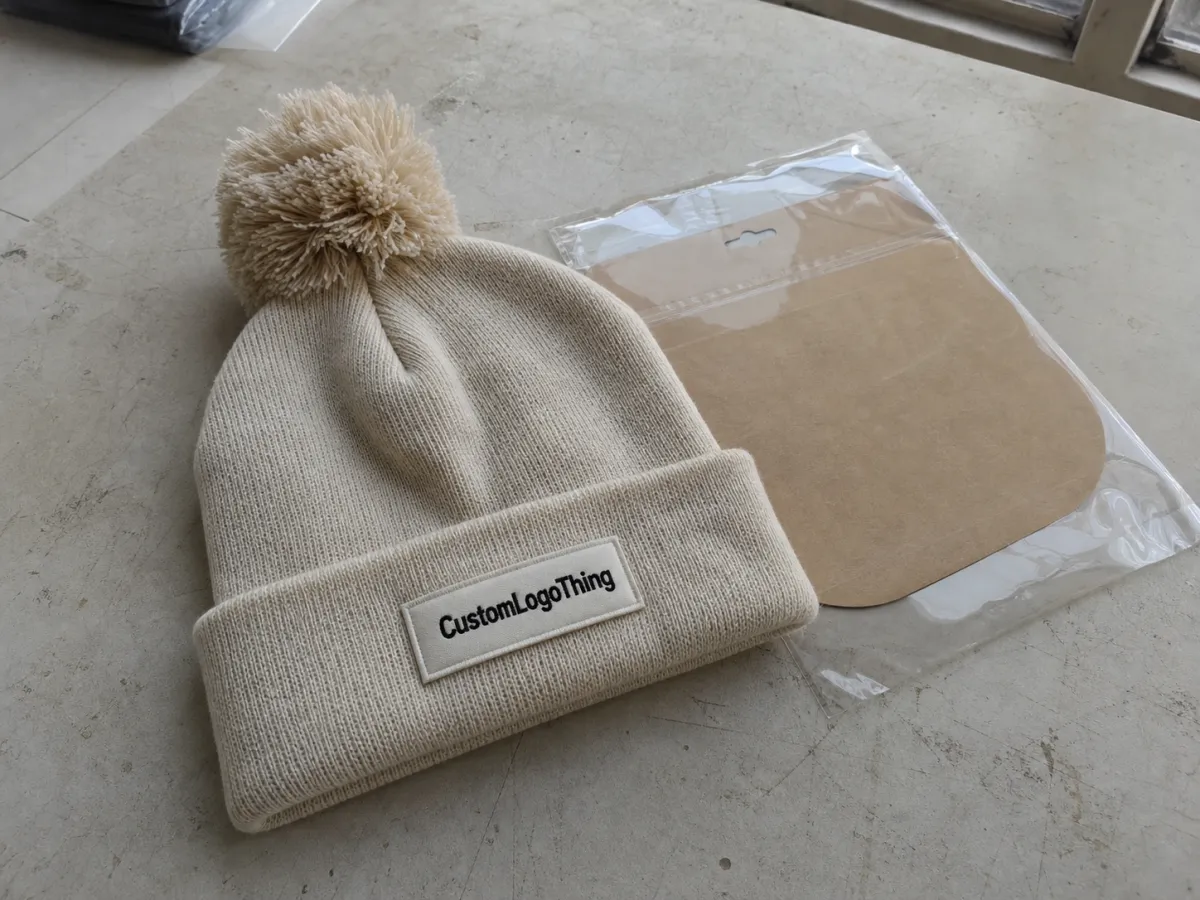
The basic product is usually a knit cuff beanie with a pom pom, but the details determine whether it feels like a thoughtful gift or a last-minute giveaway. The cuff gives the decorator a stable area for embroidery, patches, or labels. The pom adds the soft winter styling couples often want in photos and welcome displays.
Acrylic knit is the common workhorse for bulk wedding beanies because it is soft, color-consistent, easy to care for, and generally cost-effective. Acrylic blends can give a slightly nicer hand feel, especially when the beanie is meant as a premium wedding party gift rather than a large guest favor. Heavier rib knits feel more structured and boutique-like, though the rib texture may limit fine decoration because the surface moves under thread or patch edges.
Pom choice changes the finished personality. A matching yarn pom gives a clean tonal result. A contrast yarn pom can bring in a wedding accent color without changing the entire hat. Faux fur poms feel more elevated for lodge, alpine, or après-ski styling, but they usually cost more and need more careful packing so the poms are not crushed flat in transit.
Decoration should be selected with the beanie style, not after it. Direct embroidery works well for initials, short names, small icons, and compact monograms. Woven or embroidered patches are better for crests, multiple colors, and artwork that needs a defined border. Leatherette patches fit rustic, western, lodge, and outdoor wedding themes. Clamp labels are understated and can look retail-ready when the couple wants subtle branding on the cuff edge instead of a large front mark.
Small lettering is where many attractive designs fail. Thin script fonts, crowded dates, tiny coordinates, and detailed venue sketches may look beautiful on invitations, but they often lose clarity on a curved cuff or small patch. Bold initials, a simplified crest, one short line of text, or a clean venue-inspired mark will usually reproduce better.
- Simple embroidery: best for 1 to 3 initials, short names, or a small icon.
- Woven patch: useful for fine crest details and artwork with 2 to 6 colors.
- Leatherette patch: strong for rustic styling, initials, and clean line art.
- Clamp label: subtle, retail-style, and lower profile on the cuff edge.
Packaging can add polish without making fulfillment complicated. A neat fold, individual poly bag for transport protection, printed belly band, or small hang tag can all work. If sustainability is part of the event brief, ask about paper bands, limited plastic use, and responsible paper options. The FSC is a useful reference point for responsibly sourced paper packaging, especially if tags or bands are included in the presentation.
Specifications to Confirm Before You Request a Quote
A clean quote starts with clean specifications. Before asking for pricing, gather the estimated quantity, knit color, pom style, decoration method, artwork size, number of thread or patch colors, packaging requirements, ship-to location, and in-hands date. Missing one of those details can change cost, production time, or both.
Sizing is usually straightforward because most adult knit beanies are one size fits most, but that phrase still deserves a check. Ask about stretch, cuff height, overall length, and whether the style fits shallow, standard, or slouchy. If children are part of the wedding party or family gift list, confirm youth sizing early. Youth beanies are not always available in the same knit color, pom style, or decoration area as the adult version.
Color planning is one of the easiest ways to protect both budget and schedule. Stock knit colors are usually faster and more economical than custom-dyed yarn. Custom yarn can be attractive for highly specific palettes, but it often carries higher minimums, longer lead times, and more approval steps. For most wedding favor orders, a well-chosen stock color is the practical route.
Decoration area has real limits. Cuff height, rib texture, seam position, pom scale, and patch size all affect whether a crest, initials, or short phrase will look clean. A 2.25-inch wide patch may hold a monogram nicely, while a longer phrase may need to be stacked, shortened, or moved to a tag. Direct embroidery also needs enough stable cuff area to keep the needle path clean.
Vector artwork is ideal. AI, EPS, or production-ready PDF files help decorators create cleaner proofs and reduce redraw time. JPG or PNG references can be enough for a first quote, provided everyone understands that final production art may need cleanup before digitizing, patch weaving, debossing, or label production.
Digital mockups are useful for confirming placement and scale. Physical samples may be worth the time and cost for larger orders, premium wedding party gifts, or projects where thread color, leatherette tone, faux fur shade, or patch texture must coordinate closely with the wedding palette. Not every order needs a sample, but high-touch gifting often benefits from seeing one finished piece before the full run begins.
| Specification | Why It Matters | Typical Buyer Choice |
|---|---|---|
| Beanie color | Affects stock availability, timeline, and palette match | Ivory, black, navy, heather gray, forest green, burgundy |
| Pom style | Changes visual tone, cost, and packing needs | Matching yarn, contrast yarn, or faux fur |
| Decoration | Controls setup, clarity, and unit cost | Embroidery, woven patch, leatherette patch, clamp label |
| Packaging | Impacts labor, freight volume, and guest presentation | Folded bulk pack, poly bag, belly band, printed tag |
| In-hands date | Determines production and shipping schedule | Usually 1 to 3 weeks before event use or welcome bag packing |
Pricing, MOQ, and Unit Cost Factors for Bulk Beanie Orders
Pricing depends on the blank beanie, quantity, decoration method, number of artwork locations, patch or embroidery complexity, packaging, freight, and rush requirements. A simple embroidered cuff beanie is not priced the same way as a faux fur pom beanie with a woven crest patch, individual belly band, and sorted cartons for hotel delivery.
MOQ means minimum order quantity. It is the smallest quantity that can be produced efficiently once setup, proofing, decoration, and packing are considered. MOQ can vary by beanie style, stock status, custom color needs, patch type, and production workflow. Stock styles with one decoration location usually allow more flexible minimums than custom-dyed yarn or specialty patches.
Direct embroidery can be efficient for initials, short names, or simple monograms. Patches may carry more upfront work because tooling, weaving, cutting, or debossing has to be prepared, but the finished look can feel more premium. Woven labels and clamp labels may become more economical at higher quantities, especially when the artwork is compact and repeatable.
Unit cost usually drops as quantity increases because setup, digitizing, patch tooling, proofing, and packing preparation are spread across more pieces. Ask for tiered pricing at your target quantity plus one or two quantity breaks. If your estimate is 140 beanies, pricing at 144, 150, 200, and 250 can show whether a small increase gives better value.
Realistic pricing depends on the final specifications, but decorated bulk beanies often fall from the mid-single digits to the mid-teens per piece. A basic stock acrylic beanie with simple embroidery may sit toward the lower end. Faux fur poms, specialty patches, complex crest art, individual tags, and rush freight push the number higher. Freight should be quoted early as well; bulky knit goods take more carton space than flat favors.
- Use stock beanie colors whenever the wedding palette allows it.
- Keep decoration to one location, usually the front cuff.
- Avoid oversized patches that fight the cuff height.
- Choose a standard pom unless the pom is central to the design.
- Build freight into the quote instead of treating shipping as a late add-on.
For buyers comparing custom favor costs across several categories, the Wholesale Programs page is a useful starting point because it frames bulk ordering around quantity, decoration, and repeatable specifications rather than one-off retail purchasing.
Process and Timeline From Artwork Approval to Delivery
The order path looks simple on paper: inquiry, specification review, quote, artwork preparation, digital proof, approval, sampling if needed, bulk production, quality check, packing, and shipment. The part buyers sometimes miss is that the timeline does not truly begin until the key decisions are approved.
Quantity, product color, decoration art, placement, shipping address, and payment terms all have to be settled. If the beanie color changes after proofing, the decoration may need another review because thread contrast and patch visibility can shift. If the ship-to location changes from a home address to a mountain resort or hotel, transit planning may change as well.
Plan backward from the must-arrive date. If welcome bags are packed on a Thursday, the beanies may need to arrive the prior Monday. If a venue only accepts deliveries during a specific receiving window, label the cartons clearly and confirm whether a delivery appointment is required. Destination events need extra room because missed receiving instructions can create as much trouble as production delays.
Typical timing varies by stock availability, decoration queue, patch production, sample approval, packaging labor, transit method, and holiday shipping volume. A stock beanie order with simple embroidery may move faster than a woven patch order that requires a separate patch production step. Rush service may be possible, but it depends on blank inventory, artwork readiness, production capacity, and carrier performance.
Proofing deserves careful attention. Check spelling, initials, date format if used, thread or patch colors, logo orientation, and whether the design sits centered on the cuff after folding. A beanie is not a flat postcard. The cuff fold, seam, rib texture, and natural stretch of the knit can change how centered artwork feels once the item is worn.
Late revisions add pressure. A font change may require new digitizing. A patch color change may require a new sample. A quantity jump may require more blanks than the original inventory hold. Early decisions are easier to correct because the production calendar still has room.
Packaging and shipping protection matter more on larger orders. ISTA publishes standards related to packaged-product performance during distribution. A wedding beanie order usually does not need formal lab testing, but the principle still applies: packed goods should be protected against compression, moisture, handling, and transit movement, especially if faux fur poms, paper bands, or sorted cartons are involved.
Ordering Mistakes That Add Cost or Delay
The most common mistake is ordering exactly to the RSVP count. Beanies are tangible favors. People ask for extras, a few pieces get pulled for photos, one may be damaged, and a parent may want several after the event. Running short by six pieces feels worse than having six clean extras boxed for keepsakes or thank-you packages.
Overly delicate artwork causes another set of problems. Fine script, tiny dates, thin line drawings, and full venue illustrations often come from stationery files, and those files are not automatically suitable for knitwear. A crest that looks elegant at 5 inches on an invitation may become muddy at 2 inches on a ribbed cuff. Simplification is not a downgrade; it is how the mark stays readable.
Do not choose the decoration method before confirming the actual beanie style. Cuff height, rib texture, pom scale, and seam placement all influence the best approach. A thick rib knit may work beautifully with a patch but less cleanly with detailed direct embroidery. A short cuff may not carry a tall leatherette patch without looking crowded.
Color matching also needs honest expectations. Yarn, embroidery thread, faux fur, leatherette material, woven patch thread, and printed tags all reflect light differently. A champagne thread, ivory yarn, and cream paper band may coordinate nicely without being identical. Exact cross-material matching is not always realistic, especially under mixed indoor and outdoor lighting.
Shipping assumptions create avoidable trouble. Hotels, venues, planners, and destination locations may require delivery windows, carton labels, purchase order references, or room-name markings. If 12 cartons arrive without an event name on the label, receiving staff may not know where to place them. Ask for carton labeling early if the order is not going to a home or office.
Waiting for final RSVPs before starting the quote slows everything down. A better approach is to quote an estimated range, approve artwork early, and adjust quantity before the production deadline when possible. For wedding Pom Pom Beanies Bulk Order planning, a flexible quantity range is far better than a late start with perfect numbers.
Next Steps to Place a Clean Wedding Beanie Order
A clean order starts with a short, specific checklist. Confirm the event date, must-arrive date, estimated quantity, preferred beanie color, pom style, decoration idea, budget range, packaging preference, and delivery destination. If something is undecided, say so. A quote can still be built around options as long as the open questions are clear.
- Set the must-arrive date based on welcome bag packing, venue receiving, or planner handoff.
- Estimate quantity with a 5% to 12% overage depending on order size.
- Choose stock color preferences and one backup color if timing is tight.
- Send monogram, crest, invitation artwork, venue sketch, or mood board references.
- Decide whether packaging should be bulk folded, individually bagged, tagged, or banded.
- Ask for tiered pricing if the guest count may change after RSVPs.
Also decide who receives the beanies. All guests, wedding party only, family gifts, welcome bags, and premium after-party favors are different buying scenarios. The right quantity, unit cost, packaging level, and decoration detail all change with the audience. A gift for 24 VIPs may justify a faux fur pom and leatherette patch; a 250-piece guest favor may be smarter with a stock acrylic knit, compact embroidery, and simple folded packing.
Custom Logo Things can help with product selection, decoration method guidance, quote comparison, production-ready artwork review, proofing, bulk manufacturing coordination, packing details, and shipping planning. If you already have a crest or invitation mark, send it. If all you have is a color palette and a general direction, that can be enough to start narrowing beanie styles and decoration methods.
The FAQ page can answer general ordering questions, but a wedding favor order usually deserves a project-specific quote because date, quantity, artwork, packaging, and freight all work together. The strongest orders are usually the ones where the buyer shares constraints early: the true deadline, the budget ceiling, the color priorities, and any delivery rules from the venue or planner.
For wedding Pom Pom Beanies Bulk Order planning, the fastest path is to share the date, quantity range, artwork, ship-to ZIP code, and budget target so the quote can be built around real production requirements instead of guesswork. From there, the order can move through proofing, approval, production, packing, and delivery with fewer surprises.
FAQ
How early should I start planning a bulk order of wedding pom pom beanies?
Start as soon as the wedding date, location, and approximate guest count are known. Artwork proofing, product availability, decoration, packing, and freight all need room in the schedule. If the beanies will go into welcome bags or ship to a venue, plan around the packing date or venue receiving window rather than the ceremony date.
What MOQ should I expect for custom wedding beanies with pom poms?
MOQ depends on the beanie style, decoration method, and whether the order uses stock colors or custom materials. Stock knit beanies with one decoration location usually allow more flexible minimums than custom-dyed yarn, specialty patches, or complex packaging.
What affects the unit cost of wedding pom pom beanies in bulk?
The main cost drivers are quantity, blank beanie quality, pom type, embroidery or patch complexity, number of decoration locations, packaging, freight, and rush timing. Larger quantities usually lower the unit cost because setup, proofing, and production preparation are spread across more pieces.
Can we put our wedding date, initials, or crest on pom pom beanies?
Yes, but the cleanest results usually come from bold initials, simple monograms, short text, or simplified crests sized properly for the cuff or patch area. Very thin script, tiny dates, and detailed venue illustrations may need to be simplified so they reproduce clearly on knit fabric.
What should I send to get an accurate quote for wedding beanie favors?
Send the estimated quantity, event date, must-arrive date, ship-to ZIP code, preferred beanie color, pom style, decoration idea, artwork file if available, and packaging preference. If the guest count is not final, request tiered pricing so you can compare costs at the current estimate and the next quantity breaks.


