The wedding Unstructured Dad Hats material sample guide exists for one reason: a cap that looks perfect in a listing can still fail in real life. Once it sits on a head, in daylight, near white dresses, linen napkins, and a camera flash, every small flaw gets louder. Weak fabric reads cheaper. A flat brim looks awkward. A color that was “close enough” on screen suddenly feels wrong.
That is why samples are not a paperwork step. They are the shortest path to spotting problems with hand-feel, drape, crown softness, brim balance, stitch density, and shade accuracy before a bulk order locks in. Wedding headwear leaves very little room for noise. The palette is usually restrained: ivory, stone, sand, soft black, muted blush, maybe one thread color that ties back to florals or stationery. If the hat fights the rest of the setting, it shows immediately.
There is also a production truth that buyers learn fast: a material that looks premium as a swatch can behave very differently once it is sewn into a curved, unstructured crown. That is not a defect in the sample process. It is the sample process doing its job.
A swatch tells you color. A finished sample tells you whether the hat belongs in the wedding photos.
Why Material Samples Prevent the Most Expensive Hat Mistake
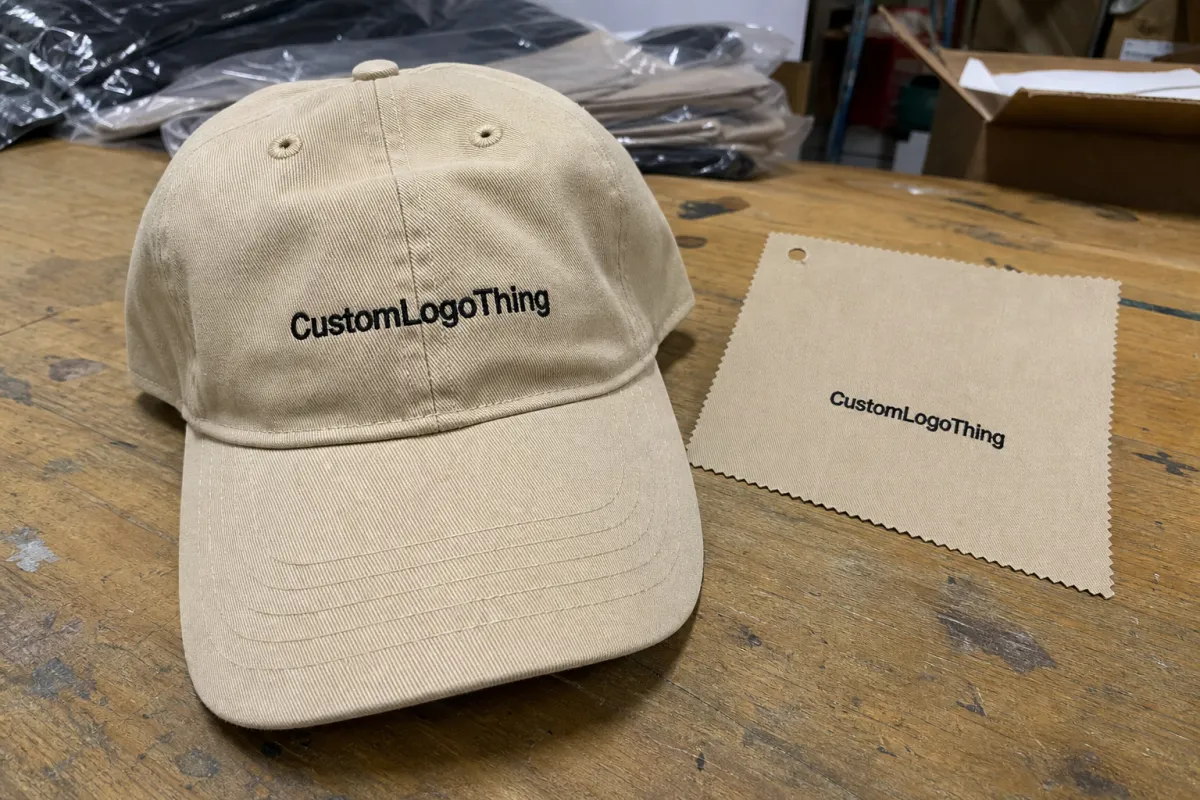
The easiest mistake is treating a dad hat like a blank canvas with no constraints. It is not. Unstructured crowns are supposed to collapse naturally, and that looseness is what makes them feel modern and relaxed. But softness also exposes weak cloth, bad stitching, and a brim that sits too stiff or too flat. The sample phase catches those problems before they become a hundred-box problem.
Photos conceal more than they reveal. They do not show whether the surface has fuzz, whether the cloth catches light unevenly, or whether the embroidery threads sink into the crown instead of sitting cleanly on top. A well-made sample clarifies whether the hat reads as quiet and premium or thin and promotional. For wedding favors, that difference is not subtle.
The sample also improves the brief itself. Once a buyer sees the actual fabric families together, decisions get sharper. A beach wedding may need something light, airy, and relaxed. A formal evening event usually benefits from a cleaner cloth with less visual texture. The right sample narrows the field before the order size, closure style, label treatment, and embroidery placement are finalized.
Packaging is part of that inspection too. A sample that arrives in a crushed carton tells you little about the cap, but it does tell you something about handling. Corrugated cardboard, kraft paper, and low-scratch packing are practical signs that the supplier understands transit risk. If the vendor can document recycled content, FSC-certified cartons, or biodegradable packing materials, that is a useful signal rather than a marketing flourish. For a general standard on transit damage prevention, ISTA is a helpful reference. For forest-product sourcing, FSC explains chain-of-custody basics.
What a Sample Kit Actually Shows on a Dad Hat
A useful sample kit should give you enough material to compare, not just enough to impress. One swatch is rarely enough. A proper kit usually includes fabric samples, thread options, at least one stitched cap, and, ideally, a few notes about structure, closure style, and any wash or finishing treatments. If a supplier can only show color on a flat card, you still do not know how the hat will behave once it is sewn.
Here is what each piece tells you:
- Flat swatches show color, weave, and surface texture.
- Sewn samples show crown slouch, brim curve, and stitch behavior.
- Thread cards help you test contrast against ivory, sand, tan, and off-white.
- Sweatband samples tell you whether the inside will feel comfortable after a long wear.
Review the fabric in more than one light source. Washed cotton can look smooth in a straight-on photo and reveal uneven fuzz under side light. Brushed twill often feels softer but can read more casual than expected. Chino twill tends to look cleaner and slightly more polished, though it can feel a little firmer. A blended fabric may improve durability or shape retention, but it can also change the hand-feel in a way that surprises buyers who expected pure cotton.
The interior matters more than many people think. A soft sweatband, neat seam finish, and low-profile backing keep the hat wearable. Guests may wear these for photos, dinner, and the rest of the night. If the inside scratches, binds, or feels stiff at the forehead, the cap will spend more time on a chair than on a head.
Check the dull details too: seam alignment, thread tails, stitching tension, and the edge of the brim. Those are not glamorous checks, but they are where quality usually shows up. Wedding buyers often focus on embroidery color first. That is understandable. The problem is that embroidery can look fine while the base hat feels cheap, and the base hat is what people touch.
Fabric, Crown, and Finish: What to Compare First
Start with the fabric family. It sets the tone for almost everything else. Washed cotton gives the softest, most relaxed look. Chino twill feels cleaner and slightly more polished. Brushed cotton sits in the middle, casual without looking sloppy. Blends can add stability, but they may also change drape and surface appearance enough to matter in photos.
| Option | Typical sample cost | What it tells you | Best for | Watch-outs |
|---|---|---|---|---|
| Blank swatch pack | $15-$35 plus shipping | Color, weave, texture | Early fabric comparison | No shape or embroidery behavior |
| Stitched sample hat | $35-$85 | Fit, slouch, crown shape, thread appearance | Most wedding orders | May not reflect final bulk trimming unless specs are exact |
| Custom prototype | $75-$150+ | Special wash, exact shade, custom closure or label | Highly specific wedding palette or branded event | Longer lead time, sometimes no refund |
| Approved bulk sample credit | $0-$85 net, depending on supplier | How the vendor handles sampling costs | Larger orders | Not every factory credits sample fees back |
Then look at structure. Unstructured does not mean shapeless. A good cap should collapse naturally but still hold an intentional silhouette. If the front panel caves too much, embroidery can pucker or twist. If it is too stiff, the hat stops feeling like a dad hat and starts acting like a promo cap with a softer name. Both are wrong for most wedding settings.
Finish is where a hat either looks refined or looks like a compromise. Low-gloss fabric usually photographs better because it avoids harsh highlights. Clean embroidery backing keeps the inside from scratching. Consistent color matters more than chasing a tiny price drop. If the sample feels abrasive or oddly rigid, bulk production usually magnifies that, not fixes it.
There is a practical comfort test that many buyers skip. Put the sample on, wear it for ten minutes, and then take it off. If the forehead area feels hot or the rear closure digs in, that discomfort will show up after a full event. A wedding hat should behave like apparel, not a prop.
Cost, Pricing, MOQ, and Quote Basics
A good sample guide should help you judge the whole cost stack, not just the price of a single cap. The number on the first quote rarely tells the full story. Sample fee, shipping, embroidery setup, digitizing, special dye work, closure upgrades, and the production minimum all belong in the comparison. Leave one of those out and the “cheapest” option often becomes the priciest by the time the final proof is approved.
For simple custom dad hats, realistic bulk ranges often land around $3.25-$6.25 per unit at 1,000+, $4.50-$7.50 at 500 units, and $6.50-$10.00 at 100 units. Those are working ranges, not promises. They move with embroidery coverage, fabric choice, label type, closure style, and whether the order uses washed cotton, chino twill, or a specialty blend. Small orders carry setup weight. Large orders dilute it. That is the math.
Use this checklist during quoting:
| Quote Item | What to Ask | Why It Matters |
|---|---|---|
| Sample fee | Is the fee refundable on bulk? | Protects you if the sample is only for approval |
| Shipping | Does the sample ship by air or ground? | Changes timing and total cost |
| Digitizing | Is embroidery digitizing included? | Prevents surprise setup charges |
| MOQ | What is the lowest order size for this exact fabric? | Some materials have a higher minimum than the hat itself |
| Revisions | How many sample revisions are included? | Stops the “one more tiny change” spiral |
Do not overvalue the cheapest sample. A low sample fee can be misleading if the swatch does not match the final cloth, or if the vendor quietly swaps in a similar-looking material. That risk is especially high with wedding neutrals. Ivory, cream, stone, sand, and washed tan can look nearly identical on a screen and very different under daylight or warm indoor lighting. Small color differences are exactly what guests notice in photos.
Ask how the sample is packed. Corrugated cardboard resists crush damage better than a thin mailer. Kraft paper keeps surfaces from scuffing. FSC-certified cartons are a nice sign, and post-consumer content can be a useful sustainability marker if it is documented rather than implied. None of that excuses a poor hat, but it does show whether the supplier understands presentation and transit quality.
Process and Lead Time From Sample Request to Bulk Approval
The best sample process is almost boring. That is a compliment. You request fabric options and specs, receive swatches or mockups, review a stitched sample, approve it only after checking it in person, and then move into bulk production. The sequence matters. If the order is already locked before the sample is approved, the whole exercise turns into damage control.
- Request options. Ask for the actual fabric families you are considering, not a random substitute.
- Confirm specs. Lock crown depth, brim curve, embroidery size, closure type, and sweatband preference.
- Review the sample. Check it in natural light and indoor light, because wedding venues change color perception fast.
- Approve only what you see. If the sample misses the palette, do not assume it will improve later.
- Release bulk production. Move to final quantity only after the approved version is documented clearly.
Delays usually come from the same places. Color matching is one. Embroidery proofing is another. Courier time is obvious, but it still counts. Then there are the small changes that sound harmless and consume days: moving a logo 3 millimeters, switching thread sheen, or asking for a slightly softer crown after approval has already started. One revision can stay small. Three revisions rarely do.
As a rough planning guide, a simple sample request can move in 5-10 business days. Custom fabric sourcing, special washes, or exact shade matching can push that to 10-15 business days before the sample even arrives. Bulk production is usually faster than development, but only after the sample is signed off. Rushing the approval step does not save time if the result needs to be remade.
If the event date is fixed, keep one rule in mind: the sample is there to stop avoidable waste. It is not extra caution for cautious people. It is the cheapest place to catch a bad fabric, a wrong closure, or a color that photographs badly. When a wedding deadline is tight, that matters more, not less.
Common Ordering Mistakes That Make Hats Look Cheap
The most common mistake is trusting a screen image to judge texture. A picture cannot tell you how the fabric drapes, how much the crown collapses, or whether the brim edge feels soft or cardboard-stiff. It also cannot show whether stitching will sit cleanly on the chosen cloth. A cap that looks polished online can arrive with a limp front panel, an awkward curve, or a finish that reads far less expensive in real light.
Overbranding is another problem. Too much embroidery, too many colors, or a logo placed too high can make a wedding favor look like promotional merchandise. Guests usually want something they can wear again. Smaller, cleaner artwork tends to age better and photograph better. That is especially true for relaxed hats, where the shape already carries a lot of personality.
Color drift causes more regret than most buyers expect. Ivory, cream, stone, sand, and off-white all shift under different lighting. A cap that looks warm outdoors can go muddy under amber indoor lights. Compare the sample against the dress fabric, table linen, or a neutral white surface if that is all you have. Simple checks save real money.
Fit is not a side issue. Crown depth changes how the hat sits on different heads. Closure style affects comfort and adjustability. A beautiful fabric can still look wrong if the fit rides too high or folds oddly at the back. If two samples feel different in hand, assume production will exaggerate that difference rather than smooth it out.
- Do not trust a screen alone. Texture matters.
- Do not over-decorate. Clean embroidery reads more expensive.
- Do not ignore lighting. Reception light changes color perception fast.
- Do not skip fit checks. Crown depth and closure style affect the whole silhouette.
What To Do Next After the Sample Arrives
Score the sample against a short checklist. Keep it honest. Does the color match the wedding palette? Does the fabric feel soft without feeling limp? Does the crown hold a relaxed shape instead of collapsing? Is the embroidery crisp? Does the inside feel comfortable against the forehead? Would someone actually wear it again after the event?
Then test it under two kinds of light: daylight and indoor light. That second view catches more mistakes than most buyers expect. A pale tan cap can look elegant outdoors and muddy under warm reception lighting. A muted blush can appear delicate in one setting and strangely dusty in another. Wedding hats live or die on that shift.
If one detail is off, change one variable at a time. Adjust the thread, not the thread, fabric, and closure all at once. Too many moving parts make it impossible to know what fixed the issue. Production is less forgiving than mood boards. Clean decisions beat emotional tinkering every time.
Take photos of the approved sample and share them with whoever needs signoff: planner, brand lead, couple, or procurement contact. That gives everyone the same visual reference. Freeze the spec sheet. Confirm the quantity. Keep the final hat true to the approved sample, not to a memory of what it was supposed to be. That is the practical value of the wedding Unstructured Dad Hats material sample guide: it turns a subjective accessory into a controlled product decision.
What is a wedding unstructured dad hats material sample guide used for?
It helps buyers compare fabric feel, structure, and color before placing a bulk order. It also reduces the most common wedding-headwear mistake: approving something that looked good online and feels wrong in person.
Which fabric samples should I request for wedding unstructured dad hats?
Start with washed cotton, chino twill, and brushed cotton. Those three cover most of the common looks. If the wedding palette is ivory, sand, stone, or off-white, ask for close color matches too. And do not accept loose swatches only; ask for at least one finished sample hat so you can judge structure.
How much do sample hats usually cost?
Sample pricing can range from a low single-hat fee to a higher custom-prototype charge, depending on decoration and fabric complexity. Shipping, embroidery setup, and special dye matching can add to the total. Some suppliers credit the sample fee back on the bulk order, but not all of them do.
How long does the sample and production process usually take?
Simple sample requests can move quickly, but custom materials and exact color matching add time. After approval, bulk production depends on MOQ, decoration method, and the factory schedule. Ask for both sample lead time and final turnaround so nobody gets surprised later.
What should I check before approving the final sample?
Check color in natural light, fabric softness, crown shape, brim feel, and embroidery clarity. Make sure the hat matches the wedding mood, not just the spec sheet. Then confirm that the approved sample matches the exact closure, stitching, and finish you want in bulk.


