Buyer Fit Snapshot
| Best fit | Batch Packaging Optimization Cycle projects where brand print, material claims, artwork control, MOQ, and repeat-order consistency need to be specified before quoting. |
|---|---|
| Quote inputs | Share finished size, material target, print colors, finish, packing count, annual reorder estimate, ship-to region, and any compliance wording. |
| Proofing check | Approve dieline scale, logo placement, barcode or warning zones, color tolerance, closure strength, and carton packing before bulk production. |
| Main risk | Vague material claims, crowded artwork, missing packing details, or unclear freight terms can make a low unit price expensive after revisions. |
Fast answer: Batch Packaging Optimization Cycle: Artwork Proof, Packing Count, and Landed Cost should be specified like a repeatable production item. The safest quote records material, print method, finish, artwork proof, packing count, and reorder notes in one written spec.
Production checks before approval
Compare the actual filled-product size with the drawing, then confirm tolerance on folds, seals, hang holes, label areas, and retail display edges. Reserve space for logos, QR codes, warning copy, and material claims before decorative graphics fill the panel.
Quote comparison points
Review material grade, print process, finish, sampling route, tooling charges, carton quantity, and freight assumptions side by side. A quote is only useful when the supplier can repeat the same color, closure quality, and packing count on the next order.
What is batch packaging optimization cycle? It is the repeatable method packaging teams use to group jobs, reduce changeovers, and keep output steady without turning the floor into a churn of resets and rescue work. A lot of the waste happens before tape ever touches board: approvals, staging, material checks, routing decisions, and the small handoffs that nobody budgets for, but everybody pays for anyway. In custom packaging, a 3 mm carton shift, a revised insert geometry, or a finish change can push an otherwise clean plan into rework, scrap, and late freight in a hurry.
From a packaging buyer's perspective, the real question is not whether the line can run. It is whether the line can run consistently enough to protect a launch date and preserve the brand promise behind it. That is where what is batch packaging optimization cycle stops sounding like internal operations jargon and starts acting like a control system for product packaging, retail packaging, and branded packaging. When the cycle is managed well, delay variance drops, carton damage falls, inventory stabilizes, and requests for variation in Custom Printed Boxes stop creating near-term panic.
At Custom Packaging Products, we often see teams invest in machine speed while underestimating what happens before the run starts. Pre-run support can quietly consume 20% to 40% of short-run time, depending on SKU complexity and the number of approvals sitting in the queue. Teams also see practical thresholds in real programs: smaller pilot jobs under 500 pieces are usually approval-heavy, while repeated campaigns above 2,000 to 5,000 pieces often show clearer scheduling leverage if materials and finishes are clustered. I have watched one plant shave eight minutes off cycle motion and then lose twenty-two minutes in staging because the board arrived in the wrong sequence. That is the trap. Once what is batch packaging optimization cycle is treated as a structured practice instead of a one-off scheduling trick, the gains show up in labor, material efficiency, and complaint rates.
If you are building a practical program, review the step-by-step cycle process and then tie it back to your FAQ clarifications so everyone from sales to line lead is using the same decision logic.
What Is Batch Packaging Optimization Cycle?
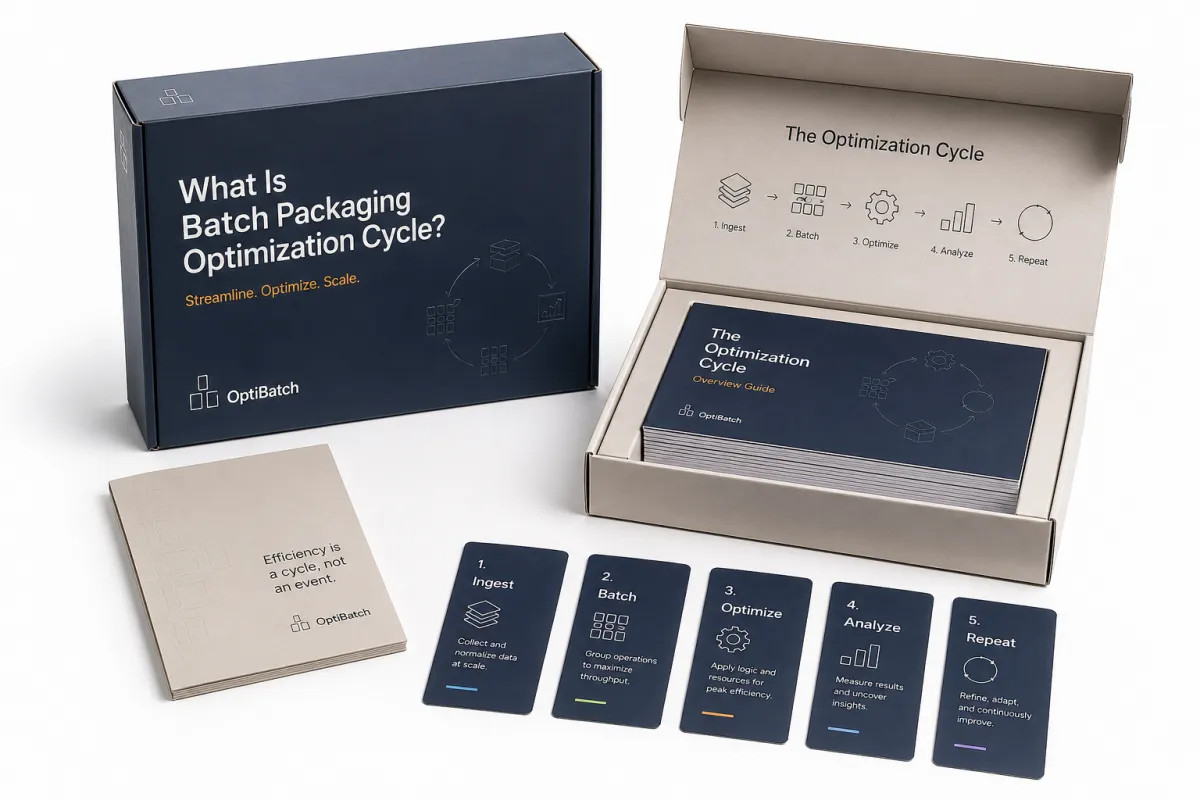
What is batch packaging optimization cycle in plain language? It is a repeatable framework for grouping packaging jobs so teams can reduce setup loss, smooth labor demand, and keep quality patterns consistent from one run to the next. Instead of treating every order like a separate island, the plant clusters compatible jobs by size, material, print process, assembly complexity, and delivery window. That lowers tool changes, staging errors, and the scrap caused when operators have to relearn a setup from scratch.
Consider a simple comparison. A packing operation may spend 90 seconds per unit or order on the actual pack motion, while a tooling change may take 25 minutes, insert staging another 15 minutes, and artwork verification 10 more. What is batch packaging optimization cycle works by removing friction around the pack run, not by squeezing a few seconds from the packing stroke alone. That distinction matters in customization-heavy workflows, where a minor spec tweak can trigger hidden labor that never appears cleanly in a quote. In practice, the biggest gains usually come from setup reduction, not from the pack motion itself.
For custom packaging, the cycle matters because variation compounds quickly. A straightforward folding carton behaves differently from a tuck-end box with spot UV, layered inserts, and mixed kitting requirements. If jobs bounce between incompatible formats, waste climbs in a way that looks small on Monday and expensive by Thursday. A disciplined what is batch packaging optimization cycle keeps compatible styles together so teams stay in productive mode longer and spend more time making saleable cartons than reconfiguring the line.
The method reaches beyond the floor, too. It influences cost, lead time, and how customers read your brand promise. On-time delivery and stable finish quality create a launch rhythm that feels controlled; missed dates and shifting specs do the opposite. In that sense, what is batch packaging optimization cycle sits at the point where pricing, speed, and packaging credibility meet. It also shapes production planning, because a better batch can free capacity that would otherwise disappear into avoidable rework.
From a packaging buyer's perspective, the recurring mistake is treating the lowest quote as the safest choice. A batching plan that creates hidden rework, storage stress, or freight pressure can turn the "cheap" option into the expensive one before the first pallet ships.
One useful correction: what is batch packaging optimization cycle is not a one-time initiative with a neat finish line. It is continuous, because every run produces hard evidence on setup duration, throughput, defect rate, and scrap. That evidence feeds the next plan, then the one after that. The strongest teams treat the process like a living schedule engine, not a static document they dust off when a bottleneck gets embarrassing.
How Does the Batch Packaging Optimization Cycle Work?
The cycle starts before any carton reaches the line. Order intake, forecast review, and SKU classification shape everything that follows. A strong what is batch packaging optimization cycle begins by separating jobs that can share a setup from those that must remain isolated because of tooling, food-contact requirements, artwork constraints, or material differences. The goal is not the largest batch possible. The goal is the safest batch with the lowest operational risk.
Planning comes next. Teams sort work by dimensions, substrate family, print method, insert architecture, and required delivery date. This is where most avoidable waste appears. Matching board grade, glue sequence, and finish across jobs can consolidate setup time; forcing together jobs with different coating profiles or folding behavior often backfires. A practical what is batch packaging optimization cycle keeps the grouping rules simple enough that supervisors can apply them quickly and consistently, even on a noisy production day.
Material staging follows, and this is where many operations stall even when the plan looks excellent on paper. Boards, labels, film, inserts, trays, and documentation must arrive in sequence and in usable quantities. A well-designed batch can still freeze when corrugated arrives late or print lots are stacked in the wrong order. A sound what is batch packaging optimization cycle folds staging into the first plan, so delays are surfaced before they become stoppages. In many facilities, sequencing labels, inserts, and cartons in dedicated pre-run kits can save 10 to 30 minutes before first-piece approval on a typical shift.
During production, compatible jobs move in controlled sequence and the line stays in a stable state longer. Carriers use route consolidation for the same reason: fewer transitions, fewer idle moments, better use of capacity. Packaging teams see that as lower changeover time, steadier labor spend, and less scrap from setups that had to be restarted too often. That is why batch packaging optimization often looks simple in a spreadsheet and far more consequential on the floor.
Quality checks are embedded through the cycle, not parked at the shipping gate. If a team finds defects at hour five in a 10,000-unit run, the remedy is manageable; if detection happens after shipment, costs spread across freight, returns, replacement stock, and customer trust. A serious what is batch packaging optimization cycle adds in-process validation for dimension control, seal integrity, print placement, and structural resistance so corrections happen before volume compounds.
After dispatch, review closes the loop. Downtime, scrap, labor variation, and on-time completion are logged against the original plan. If the run finishes 10% to 20% slower than expected, leadership needs to know whether the miss came from staging gaps, supplier delays, format fragmentation, or sequencing noise. That post-run comparison is what turns what is batch packaging optimization cycle into an improvement engine instead of a recurring headache.
Why batching works in practice:
- Changeovers fall when jobs are clustered by setup logic, which matters because each reset can consume 10 to 45 minutes depending on format and equipment.
- Labor planning improves because operators stay on a sequence of similar tasks long enough to settle into rhythm.
- Scrap trends drop when the number of first-piece anomalies declines across each run.
- Data quality improves because each cycle creates cleaner inputs for the next planning decision.
A mindset shift explains why this matters. One-time optimization targets one order. A cycle asks how each order can inform the next. That is where what is batch packaging optimization cycle becomes strategic. A single good schedule helps; dozens of good schedules compound into a different operating reality.
Cost and Pricing Factors in Batch Packaging Optimization
Pricing becomes concrete when teams map the actual drivers in what is batch packaging optimization cycle: scrap, labor intensity, setup cost, inspection time, and expediting pressure. A late-night correction or weekend overtime can raise labor by 25% to 50%, depending on shift rules and local wage premiums. A short run with only 2% extra waste can erase margin fast, especially in custom packaging contracts with tight bids and even tighter assumptions.
Counterintuitive outcomes are common. Slightly more complex cartons can still reduce total cost when grouped with similar jobs and run in a stable sequence. Unit price does not depend only on paper weight or ink coverage. It also depends on how confidently the operation executes what is batch packaging optimization cycle under real constraints. That is a messy sentence, but the reality is messier.
Batch size always introduces tradeoffs. Small runs reduce carrying cost and increase agility for specification changes. Large runs lower cost per unit through setup dilution, yet they can lock up cash and raise obsolescence risk if design, regulatory, or product dimensions shift unexpectedly. That is why what is batch packaging optimization cycle should be evaluated by total operating outcome, not one throughput metric alone.
For buyers of custom packaging, pricing usually breaks down like this:
- Short-run custom printed boxes: generally higher unit cost because setup is amortized across fewer pieces.
- Mid-size batches: often deliver the strongest balance of cost efficiency and flexibility across repeating campaigns.
- Large batches: usually produce lower unit spend, while increasing tied-up inventory and potential write-off exposure.
As a planning guide, a 500-piece folding carton run can cost far more per unit than a 5,000-piece equivalent even with identical material specs. Setup, proofing, and waste do not scale in a straight line. A capable what is batch packaging optimization cycle spreads fixed effort across practical volume without creating the storage side effects that erase the savings.
| Batch Size | Typical Setup Efficiency | Inventory Impact | Unit Cost Tendency | Best Fit |
|---|---|---|---|---|
| Small batch | Low to moderate; setup cost is spread thin | Very low carrying cost | Highest per unit | Pilot launches, frequent artwork changes, fragile demand |
| Mid-size batch | Better balance of setup and output | Moderate carrying cost | Often best overall value | Repeat orders, seasonal retail packaging, steady SKUs |
| Large batch | High output efficiency | Higher storage and obsolescence risk | Lowest per unit, if demand holds | Stable demand, long product life, minimal design changes |
There is a hidden cost layer that quotes rarely highlight: shipment damage. A weak batch plan can stack cartons too tightly or stage them badly, and the result appears later as crushed corners, scratched print, or warped inserts. These defects often fail to show up in the quoted unit cost, then surface in claims, replacements, and retailer friction. In that way, what is batch packaging optimization cycle also acts as a damage-prevention discipline.
To keep pricing defensible, compare direct production costs with total operational cost. Direct includes board, ink, labor, and machine utilization. Total operational cost adds storage occupancy, rework, expedited freight, and return handling. A saving of $0.03 per unit can vanish if a two-day delay adds one extra transport leg and one customer escalation. Evaluating what is batch packaging optimization cycle through both finance and operations reveals the true margin.
For teams that need standards-backed alignment, bodies like the ISTA framework offer packaging test methods that help match production choices to distribution outcomes. If a batch plan accelerates output but increases transit defects, the numbers are not actually improving performance.
Step-by-Step Batch Packaging Optimization Cycle Process
Breaking what is batch packaging optimization cycle into clear steps helps teams move from discussion to execution. Most facilities follow the same logic: collect baseline data, cluster compatible work, pre-stage materials, run the sequence, inspect results, and feed those findings into the next schedule. The structure is simple enough to explain in one page, yet it is annoyingly hard to sustain unless someone owns it.
1) Collect the baseline data
Start with order history, SKU spread, defect statistics, setup duration, and delivery commitments. Guessing at changeover time creates false plans; measuring creates correction power. Capture a few complete runs with real values: average setup minutes, scrap rate, rework volume, and on-time delivery ratio. Those numbers give what is batch packaging optimization cycle an empirical beginning, not a wish list.
2) Segment by compatibility
Group work by substrate family, print process, size class, finish, assembly method, and compliance burden. A coated paperboard carton and a heavy-duty corrugated shipper do not belong in the same setup block simply because both are called "boxes." Similar labels can hide very different operational behavior. The better the segmentation quality, the less hidden stoppage appears in execution.
What is batch packaging optimization cycle works best when job families stay similar enough for operators to flow without cognitive friction, especially during shift transitions.
3) Map the timeline backward from ship date
Lead-time risk usually spikes in predictable zones: artwork review, die-line updates, material replenishment, and preproduction checks. Building the timeline backward from shipment creates realistic handoff windows and protects early-stage tasks from compression. In custom packaging, one late proof review can move an entire schedule by days, not hours. A durable what is batch packaging optimization cycle must defend intake and approval stages, not just machine uptime.
4) Stage materials before the run begins
Pre-kitting often decides whether a batch feels smooth or chaotic. Labels, inserts, cartons, films, pallets, and paperwork all need to be staged in sequence and verified before run start. One missing insert tray can halt flow longer than a planned setup. Efficient staging makes what is batch packaging optimization cycle faster by removing forced pauses and search-time delay.
5) Run a pilot before scaling
Do not assume a new grouping rule survives contact with every SKU family. Pilot one product family, run it, and compare expected versus actual cycle performance. In many plants, a pilot across 1 to 3 compatible families is enough to reveal repeatable friction points. Small losses reveal hidden structure: a five-minute gap repeated hourly, an unnoticed inspection checkpoint, a recurring label misread. A pilot turns theory into measured reality and saves the organization from scaling bad logic across an entire plant.
6) Capture the post-run review
The review should be short, fact-based, and repeatable. Ask: What was setup duration? How much waste occurred? Did we hit ship readiness? Which complaints came in around print placement, glue failure, or carton fit? This step converts one batch into a better batch. Without it, what is batch packaging optimization cycle becomes a plan document, and plans without review calcify old errors.
A practical cycle checklist:
- Define the job family and compatibility rules up front.
- Verify artwork, materials, and tooling status before booking the line.
- Lock sequence by due date and setup similarity.
- Measure actual run results against baseline expectations.
- Update the next schedule from observed performance, not assumptions.
The update step deserves attention. A plan that ignores the last run’s outcomes becomes history repeated. If one carton style repeatedly needs 12 extra minutes of setup, the next run should absorb that cost explicitly, or the same shortfall returns. When teams do this, what is batch packaging optimization cycle stays useful. When they do not, they leave performance gains on the table and then act surprised when the same bottleneck shows up again.
Key Factors That Shape Performance and Timeline
Several variables influence how well what is batch packaging optimization cycle performs, and complexity is the first to expose them. A basic tuck carton is straightforward. A multi-insert structure with tamper evidence and manual assembly behaves like a different process family. Complexity also lives in touchpoint count, inspection gates, and the number of suppliers coordinating input.
Supplier reliability is equally critical. A delayed board shipment, adhesive delay, or missing printed component can collapse an otherwise strong schedule. A cycle can look sound in planning software and still fail if one order arrives 48 hours late. Line speed does not rescue missing upstream timing, so timeline visibility is a core variable, not a dashboard accessory.
Machine profile changes the optimization math. Fast-change equipment may absorb variety with limited disruption. Older lines or mixed-use tools often require wider buffers and stricter staging discipline. In those environments, what is batch packaging optimization cycle is less about headline speed and more about controlling variation and rework risk. For context, line-ready windows can be highly variable, but a practical benchmark is often 60 to 70% of planned time absorbed by productive run and 30 to 40% by setup, review, and quality gates.
Workforce capability has a measurable effect. Operators with deeper setup experience often detect drift sooner, catch print defects early, and recover from minor jams with less waste. Cross-trained teams sustain sequence transitions better and keep the process stable across shifts. Predictability rises when people understand not only what is done, but why it is grouped that way.
Available floor space can make or break the cycle. Finished cartons, inserts, and pallet staging all require controlled movement and temporary holding points. If storage is undersized, operational friction moves upstream into the line itself and the cycle degrades into a queue-management exercise. Respecting physical footprint is not a facilities issue alone; it is a scheduling decision with direct throughput cost.
Standard operating procedures hold the system together over time. Without them, each supervisor writes their own rulebook and comparisons across teams become unreliable. SOPs should govern material naming, staging sequence, inspection checkpoints, escalation triggers, and data logging format. If that discipline exists, what is batch packaging optimization cycle survives role changes and shift turnover.
For brands balancing efficiency with sourcing integrity, FSC can help connect paper sourcing choices to chain-of-custody requirements. That linkage matters when teams want both operational control and credible sustainability messaging.
Sustainability is not a side story in this process. Less scrap means less waste heading to landfill, and fewer reprints and transport inefficiencies reduce waste in motion as well. The U.S. EPA's focus on source reduction and waste prevention aligns directly with what is batch packaging optimization cycle because both disciplines reward high output from fewer inputs. The EPA guidance on packaging and waste at EPA reinforces that point with broader policy context.
Common Mistakes That Undermine Optimization
The most common failure is treating superficially similar jobs as if they are genuinely compatible. Matching external dimensions may suggest they can be grouped, but glue chemistry, board thickness, compliance stickers, or testing requirements can be very different. The line then absorbs hidden downtime and teams blame the cycle instead of the segmentation logic.
Another frequent error is optimizing around machine speed alone. A run can look efficient when measured at one station and still create expensive downstream effects in warehousing, inspection, or transport. If output outruns storage, operational flow breaks and defects migrate later in the path. What is batch packaging optimization cycle should be judged by full-system flow from order release to customer receipt.
Incomplete data is another performance killer. Teams often track output but neglect setup drift, scrap reasons, or delay sources. That leaves planners with one-story meetings and no way to separate bad scheduling from weak execution. Measuring the same variables run after run makes what is batch packaging optimization cycle sharper with every iteration.
Skipping review after each cycle causes slow erosion. A process without recurring analysis becomes a static calendar, and static calendars repeat the same flaws. If a missing insert repeats, if dieline checks repeatedly slip, if one setup always stretches by 14 minutes, the following cycle should incorporate the lesson immediately.
People adoption can also determine success or failure. Some operations keep batching rules locked inside planning tools without practical explanation, making the sequence look arbitrary to operators. A schedule accepted as arbitrary gets bypassed under pressure. Visibility and explainability help people commit to sequence rules even when priorities shift mid-shift.
Watch for these warning signs:
- Setup time trends upward while the published schedule remains "efficient."
- Average scrap appears acceptable, yet certain families repeatedly spike.
- Finished goods accumulate because the batch design exceeds available storage.
- Operators keep asking why two materials are scheduled together.
- Lead time misses persist despite high apparent utilization.
These symptoms usually point to one fix: reclassify, do not just force more volume through the same structure. Tighten data quality, adjust compatibility logic, and remove assumptions that no longer hold. That is the unglamorous but reliable side of what is batch packaging optimization cycle: it asks for honest answers about how work actually flows.
Expert Tips and Next Steps for a Stronger Batch Packaging Optimization Cycle
Build a lightweight scorecard and use it every time. Keep it to five measures: setup time, material waste, on-time completion, rework count, and cost per unit. A concise scorecard used every run beats an ornate dashboard no one opens. Shared numbers reveal which batching choices reduce friction and which ones only create the appearance of control.
Begin with one product family and scale gradually. Repeating one line of Custom Printed Boxes is often a useful first case because similar structures expose improvements quickly. Once the rules cut waste without damaging quality, add a second family, then a third. A staged rollout keeps what is batch packaging optimization cycle durable instead of turning it into a one-week experiment that dies in the inbox.
Packaging design can be adjusted for batching efficiency before operations is forced to compensate. If the structure can use a single board grade and a consistent glue logic without hurting shelf impact, setup complexity drops and execution gets easier. In that sense, what is batch packaging optimization cycle belongs to both engineering and operations teams, not just planners.
Make review meetings data-first and specific. Which family created the highest setup drift? Which insert profile produced the most rework? Which due-date promise drove the largest premium on labor? Those questions matter far more than checking a box that says the plant was "busy." Busy does not equal efficient; it only means the floor was active.
There is a pricing discipline teams should adopt early: compare each new batch proposal against the most recent baseline before approval. If waste is down 8% and staging is faster by 12 minutes, forecasts and quotes should reflect that improvement. If performance worsens, the data should trigger correction before expansion. In a healthy what is batch packaging optimization cycle, each run either validates the logic or shows what needs to change.
Want to move from theory to action quickly? Pair your cycle with the right product base in Custom Packaging Products, then validate with the next-step framework above and keep the plan anchored in measurable evidence.
Actionable next steps:
- Pick one clear bottleneck to measure in the next batch.
- Record current setup time, waste, and on-time completion before any change.
- Group only jobs sharing tooling, material, and quality criteria.
- Run a controlled pilot and compare actual results to the planned baseline.
- Adjust sequencing rules before the next release window.
The sequence above looks straightforward because the payoff comes from repetition, not complexity. Packaging operations improve faster when planning, execution, and review form a tight feedback loop. That loop is the heart of what is batch packaging optimization cycle, and it explains why teams in custom, branded, and retail packaging keep returning to it for dependable speed and quality.
If you are putting this into practice, start with one family of SKUs, one metric, and one honest post-run review. The next batch should not simply be faster; it should be easier to explain. That is the clearest sign the cycle is working.
So, what is batch packaging optimization cycle? It is the disciplined way to turn packaging work into a repeatable system: pair the right jobs, remove avoidable resets, measure outcomes, and use actual results to refine the next run. For teams shipping custom packaging continuously, this cycle is not an add-on. It is a core operating choice for reducing waste, protecting timelines, and building a packaging process people can trust.
What is batch packaging optimization cycle in simple terms?
It is a repeatable process for grouping packaging work into efficient combinations so teams lower changeover losses, scrap, and delay risk. The goal of what is batch packaging optimization cycle is to make each run more predictable while preserving quality and custom finish. It works best when teams treat each completed batch as data, not as a one-off event.
How does batch packaging optimization cycle reduce costs?
It reduces setup time, labor waste, and material scrap by aligning jobs with compatible tooling and similar handling requirements. A well-executed what is batch packaging optimization cycle also lowers rush handling, rework, and downstream congestion when scheduling is tied to real results. Savings become clear when measured against total operational cost instead of isolated per-unit speed.
What affects the timeline of a batch packaging optimization cycle?
Material availability, artwork approvals, tooling transitions, and batch size shape timeline reliability. Complex packaging structures usually demand more setup and inspection, stretching what is batch packaging optimization cycle duration from planning to dispatch. A realistic timeline comes from mapping dependencies from launch planning through post-run review and then updating the schedule with measured delays.
What are the most common mistakes in batch packaging optimization?
Teams often group jobs that look similar but differ in material behavior, adhesion needs, inspection burden, or compliance requirements. Another pattern is focusing on speed alone while ignoring storage capacity, quality failures, and review discipline. Many plans fail because the team does not measure outcomes after each run and adjust what is batch packaging optimization cycle with real evidence.
How do you start optimizing a packaging batch process?
Begin by tracking baseline metrics such as setup duration, waste rate, and on-time completion. Run a small pilot using one product family, then compare planned outcomes with actual results. Use those observations to update batch rules, staffing, and timeline assumptions before expanding what is batch packaging optimization cycle across the wider operation.


