Buyer Fit Snapshot
| Best fit | Carbon Neutral Packaging Initiative projects where brand print, material claims, artwork control, MOQ, and repeat-order consistency need to be specified before quoting. |
|---|---|
| Quote inputs | Share finished size, material target, print colors, finish, packing count, annual reorder estimate, ship-to region, and any compliance wording. |
| Proofing check | Approve dieline scale, logo placement, barcode or warning zones, color tolerance, closure strength, and carton packing before bulk production. |
| Main risk | Vague material claims, crowded artwork, missing packing details, or unclear freight terms can make a low unit price expensive after revisions. |
Fast answer: Carbon Neutral Packaging Initiative: Production Spec, Color Control, and Delivery Risk should be specified like a repeatable production item. The safest quote records material, print method, finish, artwork proof, packing count, and reorder notes in one written spec.
Production checks before approval
Compare the actual filled-product size with the drawing, then confirm tolerance on folds, seals, hang holes, label areas, and retail display edges. Reserve space for logos, QR codes, warning copy, and material claims before decorative graphics fill the panel.
Quote comparison points
Review material grade, print process, finish, sampling route, tooling charges, carton quantity, and freight assumptions side by side. A quote is only useful when the supplier can repeat the same color, closure quality, and packing count on the next order.
What is Carbon Neutral Packaging initiative? Strip away the glossy label and you get a measured packaging footprint, a reduction plan, and a way to balance the remaining emissions with verified offsets or removals. The phrase sounds neat. The reality is not neat at all. Fiber has to be sourced, board has to be converted, ink has to be laid down, boxes have to move through warehouses and carriers, and every handoff leaves a trace. For brands investing in branded packaging, that trace matters because a claim with records behind it lasts longer than one built on vibes.
I have sat through enough packaging reviews to know this: most teams do not fail because they care too little. They fail because the system is hard to see. A mailer that looks simple on the shelf may pass through pulp mills, corrugators, printers, fulfillment centers, parcel networks, and sometimes returns processing before anyone opens it. If you are asking what is carbon neutral packaging initiative really trying to solve, the short answer is that it makes that hidden trail measurable instead of pretending it is invisible.
The idea keeps showing up in sustainability briefs, procurement meetings, and package branding conversations for a reason. It lets a brand say, with evidence, "We measured the footprint, cut what we could, and accounted for the rest." That is far stronger than a green adjective slapped onto a carton and left to fend for itself. Numbers travel farther than slogans. They just do.
Companies exploring Custom Packaging Products usually run into the same practical tension. Packaging cannot be perfect. The better question is whether Custom Printed Boxes or mailers can be cleaner without pushing up shipping costs, forcing weak offsets, or locking the business into oversized packaging that burns money on volume and freight.
What Is Carbon Neutral Packaging Initiative?
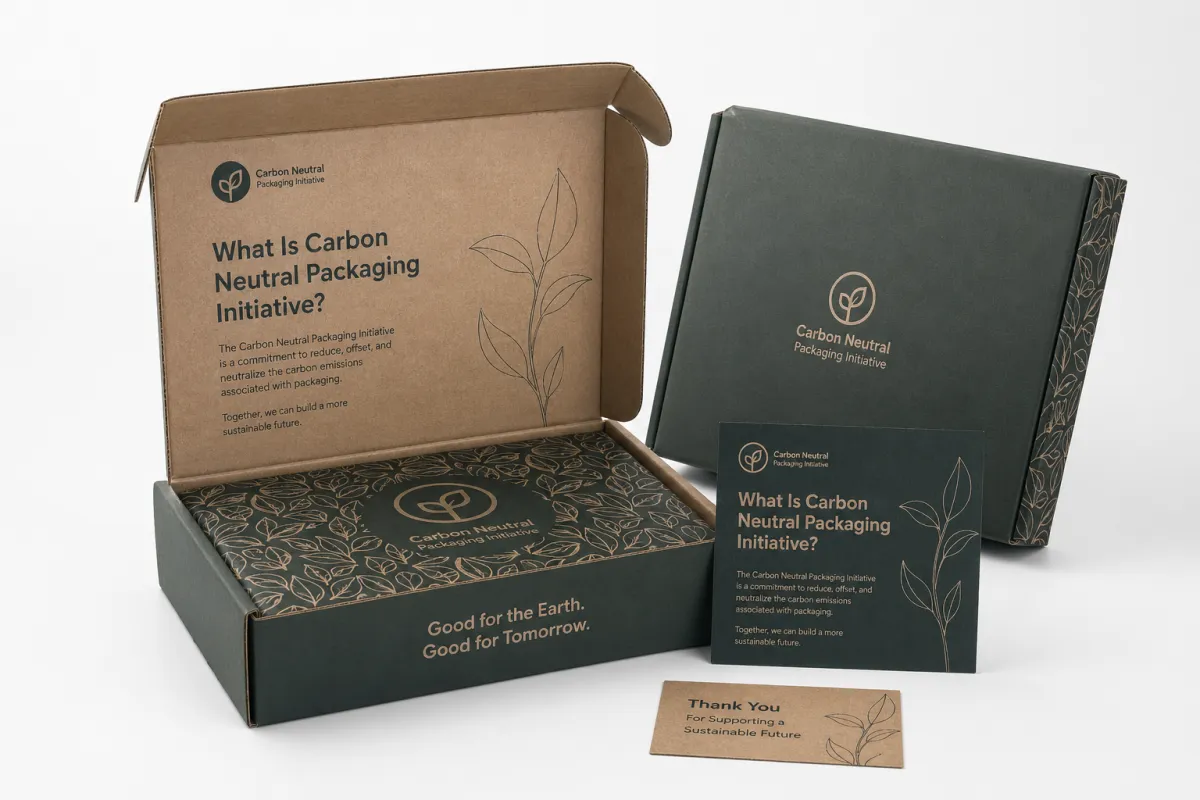
Here is the direct answer to what is carbon neutral packaging initiative: it is a packaging program that measures emissions from materials, printing, converting, transport, and sometimes end-of-life assumptions, then balances the remaining emissions through defined offsets or removals. The aim is not to pretend packaging leaves no mark. The aim is to make the mark visible and bring the net result to zero, or as close as practical for the system being measured.
Buyers often mix up three separate ideas. Carbon reduced means emissions fell compared with a previous version. Recyclable means a material can be recovered in some systems, though that says nothing about total carbon. Carbon neutral means the measured footprint has been balanced through a disciplined process. Those labels can sit next to each other on a shelf tag and still mean very different things. Mixing them up is how brands end up with claims that look polished and mean very little.
For a procurement team, what is carbon neutral packaging initiative also has commercial value. Retailers want cleaner documentation. Wholesale buyers may ask for it. Shoppers may not know the math, but they can spot the difference between a claim backed by records and a claim built on wishful thinking. If the brand can explain its boundary, methodology, and credit source, the story holds.
There is also a design side that gets skipped too often. A carbon neutral packaging initiative is easier to defend when the box is already efficient: right-sized, lighter, printed with controlled ink coverage, and built from materials with supplier data behind them. A carton that ships half empty or arrives padded with excess inserts makes the claim harder to defend and more expensive to support. Waste has a way of showing up twice, once in carbon and again in freight.
The part that gets ignored because it feels less glamorous than a badge: what is carbon neutral packaging initiative is a process, not a sticker. It needs data, supplier input, calculation rules, and ongoing review. If the numbers change, the claim should change too. That is not bureaucracy. That is the difference between a credible program and a decorative promise.
"A carbon neutral claim is only as solid as the boundaries behind it. If you cannot explain what was counted, what was left out, and what was offset, the claim is brittle."
For brands building package branding into a launch, that is useful, not discouraging. The process often begins with one SKU family, one box specification, and one shipping lane. That scale keeps the work manageable. It also keeps sustainability from turning into a long argument over vocabulary instead of a practical packaging decision.
Is a Carbon Neutral Packaging Initiative the Right Move for Your Brand?
If your first instinct is branding optics, pause for a second. A carbon neutral initiative can strengthen brand narrative, but only if operations can keep up. In the packaging reviews I have seen, the first win is often internal: procurement, logistics, and design finally agree on one language of measurement. That shared carbon accounting baseline usually improves sourcing decisions too.
The alternative is worse. You may launch attractive packaging and still carry hidden penalties in materials, transport, and returns handling. A what is carbon neutral packaging initiative effort helps teams see the full lifecycle emissions picture, from pulp or polymer to warehouse, and onward through every pallet handoff. If your current process hides those costs, a structured pilot is usually the next sane move.
There is a quieter benefit as well. Once the footprint is visible, teams stop arguing in abstractions. A designer can see that a lighter insert matters. A sourcing lead can see that one paper grade changes the footprint more than another. That clarity is kinda rare, and it tends to improve the quality of the whole packaging program.
How a Carbon Neutral Packaging Initiative Works
A sound what is carbon neutral packaging initiative workflow follows four steps: measure, reduce, calculate, then compensate. Reverse that order and the math gets flimsy. Start with measurement. That means collecting dimensions, weights, print specs, supplier data, and freight details so the footprint rests on actual inputs rather than a guess dressed up as certainty.
The biggest emission sources usually come from raw materials, converting, printing, warehousing, and transport. A corrugated shipper made with virgin fiber does not behave the same as one made with recycled content. A carton covered in dense ink and specialty finishes usually carries more upstream impact than a restrained print design. Long-haul freight, air shipping, and extra handling steps can add more than many teams expect. That is why what is carbon neutral packaging initiative often ends up being a supply chain project wearing a marketing coat.
What gets counted depends on the boundary. A careful program often includes the packaging material itself, the energy used to convert it, the printing process, inbound freight to the converter, outbound freight to the brand or warehouse, and sometimes the last-mile leg if the brand wants a broader footprint. Anything unverified should stay out. Inflated assumptions may make the result look greener, but they also weaken the claim.
Reduction comes next, and this is where the smartest money usually goes. A brand that cuts box weight by 12%, lowers ink coverage, shifts to a lighter paper grade, or improves packaging design to reduce shipped volume has already changed the outcome before offsets enter the picture. In many lanes, a 10% reduction in outer carton volume translates into meaningful transport savings because freight charges and emissions are tied to cube and mass, not intent.
Only after the footprint is calculated does the offset or removal purchase happen. The stronger programs use verified standards, and the records show that the credits were retired against the claim. When people ask what is carbon neutral packaging initiative means in practical terms, this is the answer: a controlled accounting process supported by evidence, not a vague promise in a pitch deck.
Offset quality matters more than many brands want to admit. Project type, verification standard, permanence, leakage risk, and matching the purchase amount to the actual footprint all matter. A bargain project with weak documentation can be a false economy. A slightly higher price can buy cleaner records and fewer headaches later. Carbon claims have a way of punishing sloppiness.
For a reference point, guidance from organizations like the EPA helps brands think about Scope 3 accounting, while packaging testers and logistics teams often use ISTA methods when they evaluate shipping performance. The carbon claim itself is not an ISTA test, yet the broader packaging system usually needs that level of discipline.
Put simply, what is carbon neutral packaging initiative only works when upstream design and downstream accounting match. A smaller, lighter, cleaner-to-move package makes the balancing step easier and usually cheaper.
Carbon Neutral Packaging Initiative Cost and Pricing Factors
Cost is where many brands get surprised, mostly because they wanted a single answer to what is carbon neutral packaging initiative and there is no single answer. A lightweight mailer for 5,000 units and a rigid gift box with foil stamping, inserts, and air freight are not the same financial problem. They barely belong in the same conversation.
The main drivers are straightforward. Box size affects material use. Material choice affects both carbon and unit price. Print complexity changes press time, ink coverage, and waste. Volume changes setup cost and per-unit pricing. Freight distance changes transportation emissions and often the cost of balancing them. If the program includes verified offsets or removals, the market price for those credits becomes part of the bill too.
One-time setup costs differ from ongoing costs. Setup can include footprint calculation, data collection, method review, and claim language approval. Ongoing cost usually covers updated emissions calculations, offset purchases, and annual verification or reporting if the brand wants a clean program record. In other words, what is carbon neutral packaging initiative can be inexpensive to launch and moderate to maintain, or the reverse, depending on how much of the system gets standardized.
One tradeoff gets missed repeatedly: premium recycled substrates may cost more up front, yet they can lower the footprint and reduce offset spend later. Cheaper materials may improve the purchase order and worsen the freight profile, the claim quality, or the balancing cost. Cheap at the dock is not always cheap once shipping and credits enter the picture. Packaging has a talent for moving costs around instead of removing them.
Hidden costs usually show up where teams forget to budget. Data collection takes time. Supplier reporting takes time. Third-party claim review takes time. If the brand wants a clean record, someone has to manage it. That overhead is real, which is why a carbon neutral initiative should sit beside packaging sourcing, not hang off the side like an afterthought.
| Packaging Option | Typical Unit Price Range | Footprint Pressure | Offset Burden | Best Use Case |
|---|---|---|---|---|
| Lightweight kraft mailer | $0.18-$0.28 | Low | Lower | Apparel, small accessories, subscription inserts |
| Standard corrugated shipper | $0.42-$0.85 | Medium | Moderate | Retail packaging, e-commerce orders, general product packaging |
| Custom rigid box | $1.10-$3.80 | High | Higher | Premium gifting, cosmetics, high-touch branded packaging |
| Heavy print, inserts, specialty finish | $2.00-$6.50 | Very high | Highest | Luxury launches, display-ready package branding |
Those ranges are not fixed rules. They move with quantity, paper grade, print coverage, dimensions, and the market price of credits. The pattern still holds. A smarter what is carbon neutral packaging initiative begins by reducing the package footprint, because that lowers emissions and the amount needed to neutralize them.
It also helps to separate packaging cost from program cost. A brand may spend a little more on custom printed boxes made from lighter board, then spend less on offsets and freight. That is not a contradiction. It is the logic of the system.
Step-by-Step Process and Timeline for a Carbon Neutral Packaging Initiative
A practical what is carbon neutral packaging initiative rollout often takes four to six weeks for a pilot if the team already has decent data. Week one is scope. Which SKU family is included? Which packaging formats matter? Which shipping lanes should be counted? If that part is fuzzy, everything else starts to wobble.
Week two is data gathering. The team collects carton dimensions, board weights, material specs, print coverage, supplier sheets, freight invoices, and order volume. Cleaner data means less time spent arguing over assumptions. If supplier-side specs exist, use them. Guessing the material weight because it "looks right" is a fast route to bad numbers.
Week three is footprint calculation. At that point, the packaging engineer, procurement lead, and sustainability owner should all be looking at the same worksheet rather than three separate spreadsheets with three different assumptions. A decent calculator will estimate emissions from materials and transport and show where the largest levers sit. That is the moment what is carbon neutral packaging initiative becomes a design discussion instead of a PR discussion.
Week four is reduction planning. The team decides whether to trim box dimensions, change materials, lower print coverage, or revise shipping rules. This is often the most valuable stage because it changes the baseline before offsets are purchased. The more disciplined the reduction step, the less expensive the balancing step tends to be.
Launch comes after that. Claim language should match the method. No hazy "eco-friendly" phrasing. No overpromising. If the program covers packaging material, conversion, and shipping, say that. If it covers only one box family, say that too. Clear claims protect the brand from embarrassment and keep the accounting honest.
Who needs to be involved? At minimum: packaging engineering, procurement, sustainability, brand, and someone who can review claims or legal language. Small teams may cover multiple roles, and that is fine. The process still needs an owner. Without one, the initiative tends to drift into "someone thought someone else handled it," which is a very expensive sentence.
These documents shorten the timeline:
- Bill of materials for each packaging SKU
- Dimensions and finished weights
- Print specifications and finish details
- Supplier declarations or spec sheets
- Shipping lanes and freight history
- Previous packaging revisions, if available
When teams ask what is carbon neutral packaging initiative supposed to look like on a calendar, the answer is usually simple: if the data is decent and approvals move normally, a pilot can go live in about a month. A multi-SKU rollout takes longer because every packaging family needs the same level of review. That is not a flaw. It is what happens when a brand decides not to invent the numbers.
Another practical metric: once teams align on method, they often discover hidden margins. A 15% reduction in overrun waste, for example, can lower both material spend and carbon footprint estimates in one sweep. The best what is carbon neutral packaging initiative teams track these changes side by side, not just after launch.
Common Mistakes in Carbon Neutral Packaging Initiatives
The most expensive mistake in what is carbon neutral packaging initiative projects is buying offsets first and asking questions later. That is backwards. It turns a serious accounting process into a marketing gamble. If the footprint is wrong, the offset is wrong. If the offset quality is weak, the claim is fragile.
Vague language causes trouble too. Brands say "carbon neutral" without defining the system boundary, the time period, or the verification standard. That is how confusion begins. Is the claim for the packaging materials only? Does it include inbound freight? Is it based on one SKU or the full line? If the answer is fuzzy, the claim is fuzzy.
Bad data habits create their own mess. Old shipping numbers get reused because they are easy. Material weights are estimated because someone is busy. Every SKU gets treated as if it has the same footprint, which is rarely true. Once those assumptions stack up, the result may look tidy on paper and shaky in reality. Not a strong position for a sustainability statement.
Low-quality offsets remain a common trap. Some projects are cheap because the documentation is thin. Others are respectable in theory but poorly matched to the actual emissions profile of the packaging program. A solid what is carbon neutral packaging initiative should use verified carbon credits with retirement records and a paper trail that survives questions. If the records are messy, the claim is messy.
Design mismatch causes another problem. A brand keeps adding heavy inserts, oversized cartons, specialty finishes, and thick padding, then wonders why the offset bill keeps rising. Because physics is not polite. Packaging design has to support the sustainability goal. Otherwise the brand pays to neutralize inefficiency instead of removing it.
That is why what is carbon neutral packaging initiative works better when packaging engineering gets involved early. The team can reduce material use, right-size the package, and keep the visual identity intact without turning the box into a carbon sponge.
Review fatigue is another failure point. Teams assume the claim can sit untouched after launch. It cannot. Suppliers change. Freight lanes change. Volume changes. A tiny packaging revision can shift the footprint enough to matter. A good program treats the claim like a living record, not a one-time decoration.
The simplest rule is the one ignored most often: if you cannot explain your process in a minute, it is probably too vague to trust. Buyers, retailers, and customers all respond to clarity. Clever wording cannot rescue a weak foundation.
Expert Tips for Building a Better Carbon Neutral Packaging Initiative
Start with reduction. Always. If a brand asks what is carbon neutral packaging initiative supposed to optimize, the answer is not offsets. The answer is fewer emissions overall. A smaller, lighter, better-designed box usually saves money and cuts carbon faster than a credit purchase can.
Run a pilot on one packaging line before rolling it out across every SKU. That one move catches most of the real-world issues: missing data, supplier delays, claim wording problems, and cost surprises. If the pilot is clean, scaling becomes much easier. If the pilot is messy, at least the mess stays contained.
Use supplier-side data wherever possible. Spec sheets from the paper mill or converter are better than guessing board weights from a sample sitting in the office. It sounds obvious. People still skip it. Then the calculator produces a number that looks precise and is built on a guess. That is not precision. That is theater.
Choose offsets or removals with strong verification, clear retirement records, and a direct match to the amount you actually need to cover. Some brands fit better with a verified forestry project. Others may prefer durable carbon removal. The right choice depends on budget, claim language, and the brand's risk tolerance. There is no one-size-fits-all answer, which is inconvenient and true.
Keep the customer experience in view. A carbon neutral claim should support the packaging story, not clutter it. If the box looks premium but the sustainability language is clumsy, the package branding moment weakens. That matters even more for custom printed boxes, where structure, print, and message need to move together.
Some practical moves help more than glossy promises:
- Reduce box dimensions before changing graphics
- Limit unnecessary specialty finishes that add weight and cost
- Use recycled content where it does not damage function
- Standardize a few packaging formats instead of one-off builds
- Document every assumption so future audits are easier
For brands comparing packaging systems, the best results usually come from pairing a right-sized structure with cleaner materials and disciplined shipping choices. That approach makes what is carbon neutral packaging initiative easier to manage because the footprint starts lower.
One more point: transparency is not weakness. Saying "we measured the packaging line and offset the remaining emissions" is stronger than saying "we are fully green" with no proof. Buyers can hear empty language from a distance, and they usually do not appreciate being treated like they will not notice.
If you want a reliable reference point for packaging materials and fiber sourcing, the FSC site is useful for understanding certified fiber claims. That does not replace a carbon plan, but it helps when the packaging strategy includes paper-based product packaging or retail packaging built from certified sources.
How to Start a Carbon Neutral Packaging Initiative
If you are asking what is carbon neutral packaging initiative and want to launch one, start with a single SKU family. Do not try to solve the entire catalog on day one. Pick a product line with clear specs, predictable volume, and manageable shipping lanes. That creates a clean baseline and keeps the project from ballooning before it starts.
Next, gather the packaging facts before changing anything. Measure the current carton dimensions, finished weight, print coverage, insert count, material grade, and freight profile. That baseline matters because it shows where the emissions sit. Without it, the team is guessing with confidence, which is a popular habit and a useless one.
Then build a simple procurement decision tree: reduce material use first, compare material options second, and only then choose offset or removal options. This order protects the budget. It also prevents the team from paying to neutralize waste that could have been designed out.
A launch checklist should include:
- Supplier data and bill of materials
- Footprint calculation method
- Approval owner for the claim language
- Offset or removal source and retirement records
- Annual review date for updates
Good programs also set a 30-day pilot window. That leaves enough time to test costs, logistics, and claim review without locking the brand into a permanent direction too soon. A pilot is the least expensive way to learn where the weak points are. Usually there are a few.
For many brands, the smartest first step is a packaging refresh that supports the sustainability claim. A cleaner structure, better material choice, and tighter visual system all help. If you are sourcing branded packaging solutions, build the carbon conversation into the quote process instead of treating it like a side note.
The larger point is simple: what is carbon neutral packaging initiative works best when it becomes part of the operating system. Not a one-time badge. Not a seasonal campaign. A repeatable way to design, source, ship, and account for packaging with fewer surprises and fewer bad assumptions.
That is what makes the claim durable. Not the language. The process.
FAQ
What is a carbon neutral packaging initiative in simple terms?
It is a packaging program that measures the carbon footprint of materials, production, and shipping, then reduces and offsets the remaining emissions. The goal is not to pretend packaging has no impact; the goal is to document the impact and bring the net result to zero or as close as possible. That is the practical version of what is carbon neutral packaging initiative.
How much does a carbon neutral packaging initiative usually cost?
Cost depends on volume, material weight, shipping distance, and the quality of offsets or removals used. A simple lightweight mailer can be far cheaper to neutralize than a heavy custom box with complex printing and long freight routes. If you are asking what is carbon neutral packaging initiative pricing looks like, expect a wide range tied to the format and the quality of the data.
How long does a carbon neutral packaging initiative take to launch?
A basic pilot can be set up in a few weeks if the team already has packaging specs, supplier data, and shipping information. A full multi-SKU rollout takes longer because the footprint has to be calculated and approved for each packaging family. In practice, what is carbon neutral packaging initiative timelines move faster when the data is clean.
What makes a carbon neutral packaging claim credible?
Clear boundaries, reliable data, verified offsets or removals, and consistent claim language are the big four. If the brand cannot explain what was measured and how it was balanced, the claim will look sloppy quickly. Credibility is the whole point in what is carbon neutral packaging initiative work.
Can small brands run a carbon neutral packaging initiative?
Yes. Small brands often move faster because they have fewer SKUs and shorter approval chains. The smart move is to start with one packaging line, learn the cost structure, and expand once the process is stable. Small teams can do what is carbon neutral packaging initiative well, sometimes better than larger teams, simply because decisions happen faster.
If you want the short version, what is carbon neutral packaging initiative is a disciplined way to measure packaging emissions, reduce the easy waste, and balance what remains with verified credits or removals. Done well, it sharpens packaging design, strengthens branded packaging, and gives customers a story That Holds Up under scrutiny. Done badly, it becomes a polished label on top of weak math. So the actionable takeaway is simple: choose one SKU family, measure it honestly, trim the waste first, and only then publish a claim you can defend line by line.


