Buyer Fit Snapshot
| Best fit | Compostable Packaging projects where brand print, material claims, artwork control, MOQ, and repeat-order consistency need to be specified before quoting. |
|---|---|
| Quote inputs | Share finished size, material target, print colors, finish, packing count, annual reorder estimate, ship-to region, and any compliance wording. |
| Proofing check | Approve dieline scale, logo placement, barcode or warning zones, color tolerance, closure strength, and carton packing before bulk production. |
| Main risk | Vague material claims, crowded artwork, missing packing details, or unclear freight terms can make a low unit price expensive after revisions. |
Fast answer: Compostable Packaging: Quote Scope, Sample Proof, MOQ, and Lead Time should be specified like a repeatable production item. The safest quote records material, print method, finish, artwork proof, packing count, and reorder notes in one written spec.
Production checks before approval
Compare the actual filled-product size with the drawing, then confirm tolerance on folds, seals, hang holes, label areas, and retail display edges. Reserve space for logos, QR codes, warning copy, and material claims before decorative graphics fill the panel.
Quote comparison points
Review material grade, print process, finish, sampling route, tooling charges, carton quantity, and freight assumptions side by side. A quote is only useful when the supplier can repeat the same color, closure quality, and packing count on the next order.
People often ask what is compostable packaging after they have already held a mailer, pouch, or food tray that looks a lot like standard packaging. That is the trap. The surface can look familiar while the end-of-life path depends on composting conditions most buyers never see. Getting a real answer means looking past the label and into the material structure, the disposal route, and the performance needs that actually matter on a shelf or in transit.
For Custom Logo Things, this topic sits right between branded packaging, packaging design, and production reality. A package can support a cleaner story for eco-friendly packaging, but only if the claim is accurate and the format fits the product. Compare retail packaging, custom printed boxes, and flexible pouches long enough and one thing becomes obvious: there is no magic universal answer. Moisture, heat, sealing, shelf life, and local compost access all decide the outcome.
That is why what is compostable packaging is not just a materials question; it is a systems question. The material, the print system, the closure, the local composting infrastructure, and the label language all need to line up. When they do, compostable packaging can be a useful part of a product packaging strategy. When they do not, confusion shows up fast and nobody enjoys cleaning that up.
What Is Compostable Packaging? A Quick Reality Check
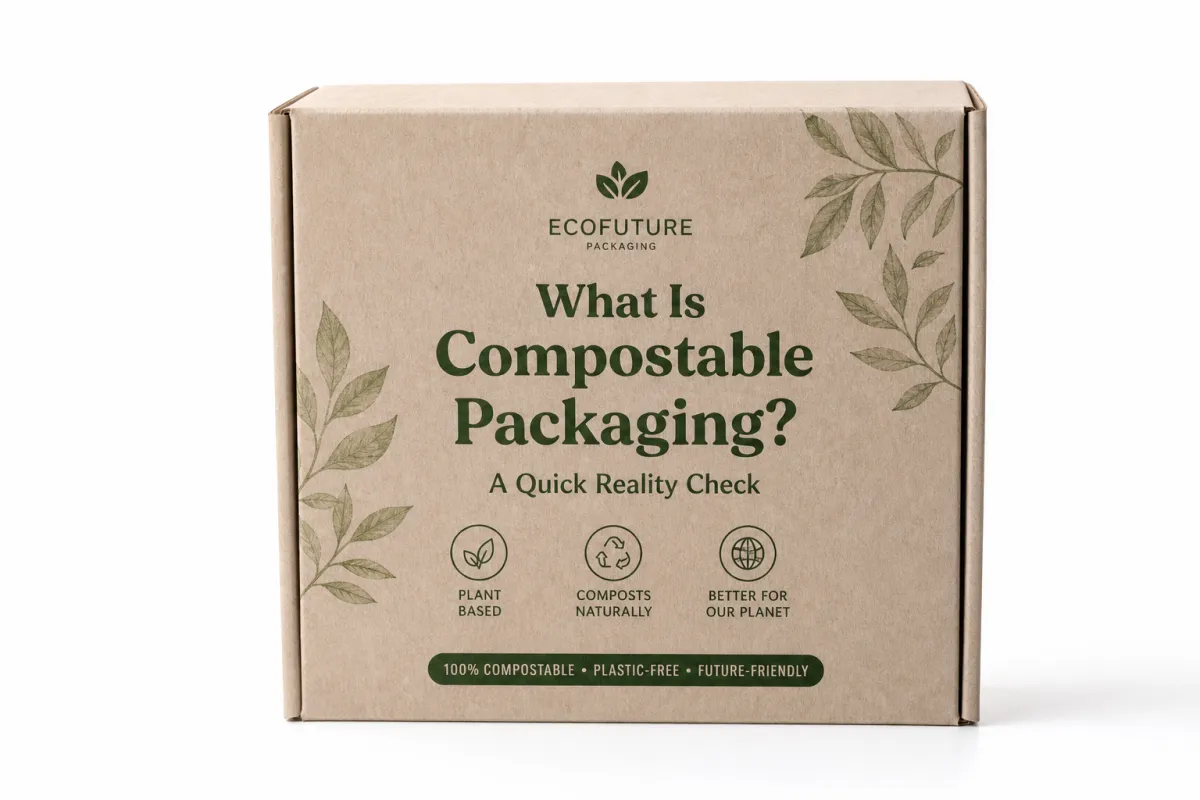
What is compostable packaging, in plain terms? It is packaging designed to break down under composting conditions into carbon dioxide, water, biomass, and non-toxic residue, leaving no harmful contamination in the finished compost. Simple on paper. Messy in practice. A package is not compostable just because it starts from plants, and it is not compostable just because the marketing copy says so with a straight face.
The first distinction buyers need to keep in mind is simple: what is compostable packaging is not the same question as what is recyclable packaging. Recycling depends on collection, sorting, and reprocessing into new material streams. Composting depends on microbial activity, oxygen, heat, and moisture. A compostable mailer may be a terrible recycling candidate, while a recyclable carton may never belong in a compost pile. Different systems. Different rules. Mixing them up creates bad claims and annoying customer service emails.
Another common confusion is with biodegradable. Biodegradable is a loose term and often a lazy one. It can mean almost anything over a long enough timeline. Compostable should be tied to a recognized test method or standard. In packaging, that usually means ASTM D6400, ASTM D6868, EN 13432, or a third-party certification path such as BPI or OK compost, depending on the market and the package structure. In Europe, EN 13432 is the standard buyers usually hear first; in North America, ASTM-based certification tends to come up more often.
If you are still asking what is compostable packaging, the answer gets clearer once you stop looking at just the resin or fiber content. A molded fiber tray with water-based inks and compost-safe adhesive is a very different animal from a multi-layer pouch with a decorative laminate, a barrier layer, and a metalized finish. Both can look attractive on a retail shelf. Only one may actually deserve a composting claim.
Brands like the idea for a reason. A credible compostable format can strengthen package branding, reduce confusion for sustainability-minded shoppers, and support a cleaner message around carbon footprint. The claim has to be honest, though. A weak claim is worse than no claim at all. If the customer cannot dispose of it properly, the whole story falls apart at the bin.
Practical rule: if you cannot explain where the package goes after use, and what conditions make it break down, you probably do not have a clear compostable packaging plan yet.
Product fit still comes first. A package needs to do its job before it gets to do anything noble. Grease resistance, stiffness, moisture protection, and heat tolerance all matter. A food tray, a coffee pouch, and a shipping mailer ask very different things from the material. The structure should follow the product, not the other way around.
How Compostable Packaging Breaks Down in the Real World
To understand what is compostable packaging in real terms, you have to understand composting itself. Composting is not just “letting something rot.” It is a controlled biological breakdown driven by heat, oxygen, moisture, and microbial activity. Industrial composting facilities actively manage those conditions. The pile or tunnel gets aerated, temperature stays in range, and the material gets screened and turned so microbes can actually do their job. That is why a package can perform well there and still barely change in a backyard pile.
In a controlled facility, a compostable material softens, fragments, and eventually converts into smaller compounds that become part of the finished compost. Home composting is slower and less predictable. Temperature swings are common, oxygen can be limited, and moisture often drifts too low or too high. A material certified for industrial composting may not be appropriate for home composting unless it is specifically designed and labeled for that use. Same word. Very different outcome.
Material family matters too. Common compostable packaging materials include plant-based films, molded fiber, paperboard with compost-safe coatings, and biopolymer blends designed for composting. Each has strengths and limits. Molded fiber is strong for stiffness and shape. Compostable films can work for flexible formats if the seal structure is right. Thickness, additives, inks, and coatings all change how quickly the package can break down.
Construction is often the real issue, not the base material. A single-layer film behaves very differently from a multi-layer laminate. Add a barrier layer for moisture or oxygen, then a hot-seal coating, then a printed top layer, and you may have a package that looks compostable on paper but takes far longer to degrade in practice. That is why what is compostable packaging can never be answered by material family alone. You need the full bill of materials.
Temperature and oxygen are the quiet dealmakers here. A compostable pouch in a cool, dry, oxygen-starved environment will not behave the same way as the same pouch in a hot, aerated industrial compost stream. The package may be technically compostable and still fail the disposal test if the system is wrong. That mismatch is one of the most common reasons brands get frustrated after launch.
If you want a plain-language reference for home composting behavior, the EPA has useful guidance on household compost systems at EPA's composting guidance. It is a useful reality check because it shows just how different backyard conditions are from industrial facilities.
The takeaway is straightforward. What is compostable packaging is not a magic label that makes every package vanish. It is a carefully defined material and construction choice that only works when the conditions match the claim. That applies to branded packaging, food-service packaging, and even custom printed boxes with compostable components. If the disposal path is fuzzy, the claim is too.
What Determines Whether Compostable Packaging Performs
When buyers ask what is compostable packaging, they usually mean, “Will it actually work for my product?” Good question. Compostability is only one piece of the puzzle. Performance still has to cover moisture resistance, heat tolerance, seal strength, product protection, and shelf life. A material can pass a compostability standard and still be a lousy fit if it cannot survive transport or storage.
Moisture is a big one. Many compostable structures are more sensitive to humidity than traditional plastic films. Dry product, dry warehouse, dry packaging, and things look fine. Add oils, sauces, or condensation, and the design needs more care. Heat matters too, especially for food trays, hot-fill uses, or packages that travel through warm warehouses. A structure that works for cold, dry goods may fall apart conceptually fast for a greasy or heated item.
Closures and seals get ignored all the time. The film or fiber may be compostable, but if the adhesive, label, zipper, or tear strip is not aligned with the claim, the structure becomes harder to explain and sometimes harder to certify. I see this a lot with sustainable packaging concepts that look clean in concept sketches and then get ugly once the details show up. The small pieces matter. Packaging is rude like that.
Standards and certifications help buyers separate tested claims from vague marketing. ASTM D6400 and EN 13432 are widely recognized benchmarks for compostable plastics and related structures. For compostable paper and fiber formats, certifications from recognized bodies can help verify that inks, coatings, and adhesives are also under control. If a supplier cannot explain the standard, the environment, and the test method, that is a warning sign. A serious compostability claim should be documentable.
Regulatory expectations vary by market, so the same package may be fine in one region and out of bounds in another. Some jurisdictions are stricter on claim language, and some composting systems will not accept certain labeled packaging at all. This is why what is compostable packaging always needs a location check. The disposal path matters as much as the material, and local acceptance can change the answer in a hurry.
End-of-life access is the practical bottleneck. A package can be beautifully designed and fully compliant on paper, but if the customer has no access to industrial composting, the value drops. That is especially true for retail packaging sold nationally, because waste infrastructure changes from city to city. Brands often underestimate how much customer education is needed. If people are gonna toss it in the wrong bin, the best material in the world will not save the outcome.
For brands that also care about fiber sourcing and paper-based components, FSC certification standards can be part of the broader materials conversation. FSC does not make a package compostable on its own, but it can support responsible sourcing for paperboard, inserts, and secondary packaging.
Print systems matter more than many teams expect. Heavy ink coverage, metallic effects, and non-compost-safe coatings can complicate what is compostable packaging should mean on the finished item. If the packaging design relies on decorative layers that do not belong in compost, the claim gets weaker and the cleanup gets harder. I have watched teams spend weeks arguing about a matte finish while the zipper spec was the actual problem.
The real question is not just “Is it compostable?” It is “How will it perform, and under what conditions?” That is the question a good packaging buyer should keep asking, especially before placing an order for Custom Logo Packaging or a new retail launch.
How to Choose Compostable Packaging: Step-by-Step
Choosing the Right structure starts with the product, not the claim. If you are trying to figure out what is compostable packaging for your line, begin with a packaging audit. Write down the product’s needs in plain terms: grease resistance, puncture resistance, stiffness, barrier protection, shelf life, hot-fill tolerance, or tamper evidence. Once you know the job, material selection gets easier.
Step one is to define the disposal path before you define the artwork. That sounds backwards to some teams, but it keeps you from repainting the box later. If the package will be sent to industrial composting, the design, label language, and certification package should support that route. If the local market only has limited compost access, the claim may need to be narrower or the structure may need to change. The first question is not “What looks green?” It is “Where will this actually go after use?”
Step two is to compare materials using supplier documentation, not broad promises. Ask for the exact structure, the compostability standard, any exclusions, and the recommended use case. A good supplier should be able to tell you whether the closure, barrier, and print system are part of the claim. If they cannot explain that clearly, you do not yet have a solid answer to what is compostable packaging for your product.
Step three is to run a small pilot. In packaging work, a sample can look kinda great and still fail after real transit, real humidity, or real dwell time on a shelf. Pilot product packaging should include actual fills, actual seal settings, and actual handling conditions. Test for droop, seal failures, scuffing, and label adhesion. For shipping formats, think about vibration, crush, and drop performance too. If the package will move through ecommerce, pair that test with basic ISTA-style transport thinking so the material choice reflects real shipping stress, not just bench-top success.
Step four is to line up labeling and instructions. If your packaging says compostable, customers need to know whether that means industrial composting, home composting, or a more limited option. Confusing language creates support issues and weakens trust. The package should tell the truth in a way a shopper can understand in a few seconds. No chemistry lecture required.
Step five is to update the supply chain conversation. Procurement, operations, and marketing should all see the same claim language before launch. That is especially important if the package is part of custom printed boxes, flexible pouches, or a broader branded packaging system. The material, the claim, and the channel all need to match.
For brands planning to expand beyond one SKU, it is often smart to start small. Order one product line, one format, or one region first. That gives the team time to see how what is compostable packaging behaves in the market before committing to a bigger rollout. If you need a place to compare packaging formats, our Custom Packaging Products page is a useful starting point for thinking through materials and use cases.
In practice, the best decisions are not the flashiest ones. They are the ones that balance product protection, disposal reality, and a claim you can stand behind. That is the difference between a nice sustainability idea and packaging that actually holds up.
Common Mistakes to Avoid with Compostable Packaging
The biggest mistake is treating compostable and biodegradable like interchangeable terms. They are not interchangeable, and using them that way is one of the fastest routes to customer confusion. If someone asks what is compostable packaging, the answer should be specific about the composting environment, the standard, and the tested scope of the claim. Anything less is too vague for a packaging label.
Another common error is assuming home compost and industrial compost mean the same thing. They do not. Home compost piles are cooler, smaller, and less controlled. Many materials that perform well in a commercial facility will struggle in a backyard bin. If your customers are likely to compost at home, the packaging must be designed and certified for that use, not just assumed to work because it is plant-based or fiber-based.
Overbuilt construction is another trap. Teams sometimes add a compostable base material, then pile on heavy lamination, decorative layers, or incompatible closures. The result may look premium, but it becomes harder to verify, harder to explain, and sometimes slower to break down. The cleaner the structure, the easier it is to defend the claim. That does not mean plain or dull; it means intentional.
Vague labeling is risky too. If the package says “eco-friendly packaging” without telling the customer how to dispose of it, the message falls apart at the bin. People need short, direct instructions. If the package belongs in industrial compost, say that. If it only works in certain facilities, say that too. A clear claim is usually better than a broad claim.
Price-only thinking causes its own damage. I understand why buyers focus on unit cost, especially during a launch or a large rebrand. But what is compostable packaging worth if the package fails to protect the product, forces a redesign, or creates compliance headaches? The cheapest piece is not always the cheapest decision. Total cost includes waste, rework, testing, and claim risk.
There is also the hidden mistake of ignoring the rest of the package system. Labels, adhesives, liners, windows, and zippers can all affect the final compostability story. A buyer might approve the film and miss the closure. A designer might choose a paper look and overlook the coating. These little misses are common because each team sees only part of the structure.
Here is a useful rule of thumb: if you cannot describe the package in one sentence without hand-waving, it is probably not ready for market. The best compostable packaging claims are simple because the structure has been simplified on purpose. Complexity usually creates doubt.
And finally, do not assume every customer wants the same disposal path. Some will compost properly. Others will not have access. Others will toss the item in recycling even when it does not belong there. That is why what is compostable packaging should always be paired with customer education and honest expectations.
Expert Tips for Smarter Compostable Packaging Decisions
Start with one format, not five. That is my first recommendation for anyone trying to figure out what is compostable packaging for a real brand launch. One SKU gives you enough data to learn without spreading your testing budget too thin. Once the first package performs well, you can roll the logic into other product packaging formats with more confidence.
Simplify the construction wherever possible. Fewer layers usually make compostability easier to communicate and easier to verify. They can also reduce print complications and cut down on supply chain surprises. That does not mean stripping away everything useful. It means being disciplined about every feature you keep. If a zipper, window, or fancy coating does not improve performance or customer use, question it hard.
Use plain-language disposal guidance. Shoppers do not need a chemistry lesson. They need to know where the package goes and what conditions apply. A short line on the carton or pouch can do more for customer trust than a long sustainability paragraph. If you want to support the claim, make the instruction visible, not buried.
Test with real-world stress, not just spec sheets. That includes humidity changes, transit vibration, shelf time, and storage conditions. A supplier data sheet is useful, but it is not a substitute for a real pilot. Packaging often behaves differently once it sits in a warehouse for a few weeks or gets boxed with a heavier product. The same is true for Custom Logo Mailers and flexible retail packs.
Align marketing, procurement, and operations early. That sounds basic, but it is where many programs stumble. Marketing wants a clean sustainability story. Operations wants a package that runs on the line. Procurement wants a reasonable price. If those teams do not meet before launch, the claim and the supply chain can drift apart. When they sit together early, the package usually gets stronger and simpler.
Use the right language in the right place. For example, a compostable tray made from molded fiber can support a strong sustainability story, while a print-heavy laminate pouch may need a more cautious description. A good packaging design balances appearance with claim integrity. That balance separates well-made branded packaging from a green-looking package that cannot stand up to scrutiny.
If you are comparing formats across categories, it can help to review the broader custom packaging products selection and think about what each structure is actually asking the waste stream to do. The goal is not just to sound sustainable. The goal is to create a package that is easy to understand, practical to use, and honest about its disposal path.
What Is Compostable Packaging? Cost, Pricing, and Tradeoffs
Cost is where many teams slow down, and for good reason. Once you ask what is compostable packaging in a buying context, price becomes part of the answer. Compostable materials often cost more than standard plastic structures, especially at lower volumes or with custom tooling. The unit price is only one piece of the picture, and it is usually not the most useful one by itself.
The main pricing drivers are material choice, thickness, print coverage, certification needs, order volume, and whether the structure is stock-based or fully custom. A simple molded fiber insert is one kind of cost conversation. A high-barrier compostable pouch with custom print is another. If the package needs special adhesives, labels, or third-party verification, the budget climbs. That is normal, not a red flag by itself.
| Format | Typical Use | Approximate Unit Cost | Notes |
|---|---|---|---|
| Molded fiber tray | Food service, inserts, trays | $0.18-$0.45 each at moderate volumes | Strong shape and good brand story, but less flexible for moisture-heavy products |
| Compostable flexible pouch | Dry goods, snacks, supplements | $0.12-$0.32 each depending on size and print | Performance depends heavily on seal design and barrier requirements |
| Compostable mailer | Ecommerce, apparel, soft goods | $0.22-$0.60 each | Good for branded packaging, but thickness and print coverage affect cost quickly |
| Paper-based carton with compost-safe coating | Retail packaging, dry consumer goods | $0.30-$0.90 each for custom runs | Excellent presentation, but coating and finishing choices matter a lot |
Those numbers are broad, but they help with planning. A buyer asking what is compostable packaging should compare total value, not just the line item on the quote. If the material protects the product better, lowers claim risk, and improves customer experience, the slightly higher unit cost may be worth it. If it needs frequent replacements or creates returns, the cheap option gets expensive fast.
Hidden costs matter too. Artwork revisions, new labels, testing, pilot runs, and customer-facing instruction changes can all add to the project. If the claim language changes, the packaging copy often has to change too. That affects brand assets, sales materials, and sometimes e-commerce content. None of this is a reason to avoid compostable packaging. It is a reason to budget honestly.
There is also a tradeoff in durability. Some compostable formats are less forgiving than conventional plastic under heat, moisture, or long storage. That does not make them bad. It means the design has to match the product. A coffee pouch and a baked-goods tray need different levels of barrier and stiffness. A brand that understands this usually makes better decisions than one chasing the lowest quote.
For many companies, the smartest view of what is compostable packaging is not “How cheap can we make it?” It is “How do we create a package that supports the product, the claim, and the customer experience without overengineering it?” That is the tradeoff lens I would trust.
Process, Timeline, and Next Steps for Compostable Packaging
A realistic timeline helps everyone make better decisions. If you are planning around what is compostable packaging, expect the work to move through discovery, material selection, sample review, testing, artwork updates, pilot production, and launch. A straightforward format can move in a few weeks. If the package needs custom tooling, special testing, or a new claim review, it can take longer. That is not a delay so much as normal packaging development.
Discovery usually starts with the product itself. What is inside the package? How sensitive is it to moisture, temperature, and transit stress? What shelf life do you need? Once those answers are clear, the material search gets sharper. The team can compare compostable films, molded fiber, paperboard, and hybrid structures with real use cases in mind instead of chasing buzzwords.
Sample review should include both appearance and function. A package can look excellent on a screen and still be hard to seal, hard to fill, or awkward to stack. That is especially true for custom printed boxes and retail packaging, where branding can distract from runnability. If the line operator struggles, the package is not ready yet, no matter how good the mockup looks.
Pilot production is where the claim meets reality. This is the stage to confirm that the package survives actual filling, shipping, storage, and handling. If the package is meant for ecommerce, include shipping stress. If it is meant for grocery or food service, include temperature swings and moisture exposure. The more honest the test, the more trustworthy the launch.
Before launch, update the label copy, disposal instructions, and customer service language. That step matters more than many teams realize. If the shopper asks what is compostable packaging and your team gives three different answers, the claim is not ready. The message should be short, clear, and matched to the actual disposal pathway.
Here is a simple checklist to move forward:
- Document the current package structure and pain points.
- Define the disposal route you can honestly support.
- Request material specs, certifications, and component details from suppliers.
- Test two or three candidate structures under real conditions.
- Approve label language only after the package and claim align.
If you want to keep momentum, start with one SKU or one region and use it as the learning model for the rest of the line. That approach lowers risk and gives you cleaner data. It also helps the broader conversation around sustainable packaging stay grounded in actual performance rather than assumptions.
So, what is compostable packaging, really? It is a packaging choice that can work well when the material, construction, and disposal environment all line up, and that is exactly why it deserves careful planning rather than a rushed label change. If you take the time to match the structure to the product and the waste stream, what is compostable packaging becomes a practical tool instead of a marketing gamble. Start with the disposal path, confirm the standard, test the real package, and only then lock the claim.
What is compostable packaging, and how is it different from biodegradable packaging?
What is compostable packaging? It is packaging designed to break down under defined composting conditions and leave behind compost-safe residue. Biodegradable is much broader and less specific, which is why it can be misleading if a supplier uses it without a clear standard or disposal environment. If the claim does not name the composting path, ask for documentation before you use it.
Can compostable packaging go in a home compost pile?
Sometimes, but only if the package is specifically designed and certified for home composting. A backyard pile is cooler, less controlled, and usually slower than an industrial facility, so many compostable materials do not break down well there. Check the label, the certification, and the exact material structure before assuming home compost is the right route.
How long does compostable packaging take to break down?
There is no single number because timing depends on material type, thickness, print layers, and the composting environment. Industrial systems are faster because they keep heat, oxygen, and moisture more consistent. Thicker or multi-layer structures can take longer, especially if they were not designed for the exact disposal system being used.
How much does compostable packaging cost compared with regular packaging?
It often costs more upfront than standard plastic, particularly for custom structures or lower order volumes. The gap can shrink when the design is simple, the order is larger, or the package uses a common compostable format. The better comparison is not only unit cost, but also product protection, claim risk, and customer experience.
What should I ask a supplier before buying compostable packaging?
Ask which composting standard the packaging meets, what disposal environment it was designed for, and which components are included in the claim. Request details on inks, adhesives, barriers, and closures, because those parts can affect compostability. It also helps to ask for shelf-life guidance, sample testing recommendations, and suggested label language.


