Buyer Fit Snapshot
| Best fit | Packaging Brand Personality for Brands projects where brand print, material claims, artwork control, MOQ, and repeat-order consistency need to be specified before quoting. |
|---|---|
| Quote inputs | Share finished size, material target, print colors, finish, packing count, annual reorder estimate, ship-to region, and any compliance wording. |
| Proofing check | Approve dieline scale, logo placement, barcode or warning zones, color tolerance, closure strength, and carton packing before bulk production. |
| Main risk | Vague material claims, crowded artwork, missing packing details, or unclear freight terms can make a low unit price expensive after revisions. |
Fast answer: Packaging Brand Personality for Brands: Material, Print, Proofing, and Reorder Risk should be specified like a repeatable production item. The safest quote records material, print method, finish, artwork proof, packing count, and reorder notes in one written spec.
Production checks before approval
Compare the actual filled-product size with the drawing, then confirm tolerance on folds, seals, hang holes, label areas, and retail display edges. Reserve space for logos, QR codes, warning copy, and material claims before decorative graphics fill the panel.
Quote comparison points
Review material grade, print process, finish, sampling route, tooling charges, carton quantity, and freight assumptions side by side. A quote is only useful when the supplier can repeat the same color, closure quality, and packing count on the next order.
What Is Packaging Brand Personality Guide for Brands
Put two plain boxes on a table. One feels premium. One feels playful. One feels clinical. Nobody has touched the logo yet, and the package already said enough. That is why what is packaging brand personality guide matters. Packaging talks before the product copy gets a word in. Structure, stock, finish, print quality, and the way the package opens all push that message forward.
For Custom Logo Things, the point is not to slap a logo on a carton and call it strategy. The point is to build branded packaging that makes the identity feel steady from shelf to shipping box. That starts with what is packaging brand personality guide as a working framework, not a design slogan. Once the cues line up, product packaging feels deliberate, retail packaging feels dependable, and custom printed boxes stop looking like they were rushed out the door five minutes before a launch.
I have seen brands spend weeks arguing about a font while ignoring the box itself. That is backwards. A package can be typography-perfect and still feel off if the board is flimsy, the finish is loud for the wrong reasons, or the opening sequence feels clunky. The surface matters, sure, but the structure carries the mood.
What Is Packaging Brand Personality Guide?
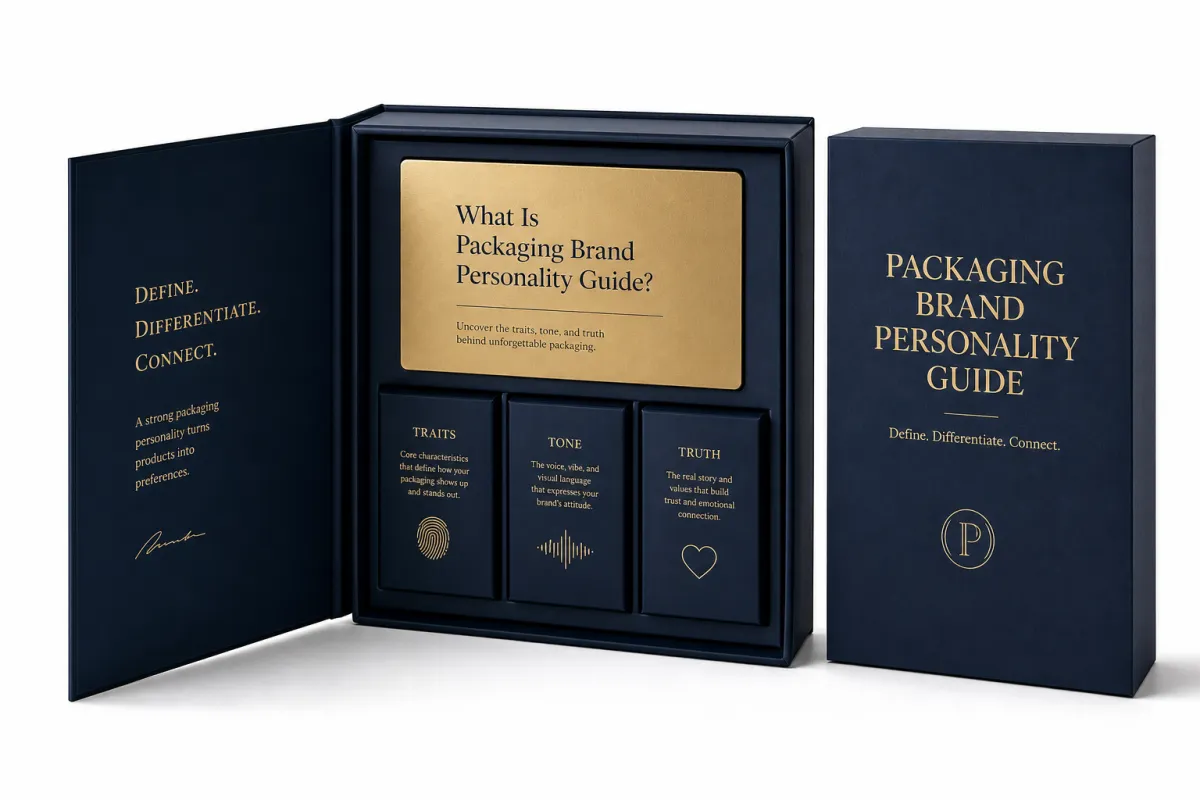
What is packaging brand personality guide in plain language? It is the set of repeatable signals that make a package feel like a specific brand instead of a random container. Those signals include box shape, board weight, coating, color system, typography, copy tone, and the order of the unboxing experience. If those pieces are inconsistent, the package feels generic. If they are aligned, the package has a point of view.
That is the real job of what is packaging brand personality guide: to answer the practical question of how packaging design does more than protect the product. A matte black rigid box with a magnetic closure sends a very different message than a kraft mailer with one-color flexo print and a folded insert. Neither is the universal answer. Each one tells a different story about price, audience, and brand promise.
The difference shows up fast on shelf and online. Shoppers may forget the product spec sheet, but they remember how the package felt in their hands and how it opened. From a packaging buyer's point of view, what is packaging brand personality guide turns that feeling into a system. It helps the brand get recognized faster, build trust with less effort, and expand across product families without wandering off-message.
It also saves money. A clear what is packaging brand personality guide keeps teams from throwing budget at the wrong finishes. If the brand should feel precise and scientific, the spend may belong in crisp print, clear typography, and a sturdy insert instead of heavy foil coverage. If the brand should feel warm and handmade, textured stock and a restrained palette may do more than a pile of decorative extras that try too hard.
A package can look polished on a screen and still feel wrong in hand if the stock, closure, and finish do not match the brand promise.
That is why I treat what is packaging brand personality guide as a decision tool, not a trend report. It connects audience expectations, channel needs, production limits, and the actual structure of the packaging. Once those parts are aligned, brand personality stops sounding abstract and starts showing up in the details customers can feel.
How the Packaging Brand Personality Guide Works in Real Packaging
What is packaging brand personality guide becomes real the second someone lifts a lid, slides out an insert, or tears open a mailer. That physical sequence matters. Packaging personality is not just visual. It is tactile, structural, and timed. A two-piece rigid box creates a slower reveal. A tuck-end carton moves fast. A mailer with a tear strip adds anticipation through sound and resistance.
The same logic applies across the whole packaging system. A brand may use retail packaging, shipping cartons, product labels, and protective outer packaging that all need to feel like they belong together. When the colors, line weights, copy tone, and finish choices stay consistent, what is packaging brand personality guide becomes a rule set that works across formats instead of a one-off mockup that only looks good in a pitch deck.
Color and typography do a lot of the heavy lifting, but they are not alone. Typography can make a package feel luxury, technical, earthy, or young. Illustration can signal handcraft, humor, or science. Photography can raise or lower the emotional temperature of the package. Copy tone can make the brand sound calm, direct, premium, or playful. Strong packaging design does not let those choices fight each other for attention.
If you need a starting point for structure options, our Custom Packaging Products page helps because it shows how format changes the feel of the finished package. One stock and one print method can still produce very different brand signals depending on whether you are building custom printed boxes, a sleeve, a mailer, or a rigid setup. That is exactly the sort of practical detail what is packaging brand personality guide is supposed to organize.
One detail that gets ignored a lot: the package does not only need to look good in a mockup. It has to survive the line, the warehouse, and the person who opens it after a long day. If the opening tab tears too early, the insert rattles, or the carton crushes in transit, the brand stops feeling premium pretty fast. Fancy dies do not save bad mechanics. I wish they did. Life would be easier.
Key Factors That Shape Packaging Brand Personality
What is packaging brand personality guide starts with audience. A luxury beauty buyer expects different cues than a wellness subscription customer, and both expect different things from industrial packaging. The same deep navy, soft-touch finish, and gold foil can feel elegant in one category and tired in another. Category context matters more than many teams want to admit.
The brand brief comes next. A useful brief should name three to five personality words, such as bold, warm, scientific, handcrafted, or eco-conscious, and then define what those words mean in production terms. If the word is "scientific," does that mean cool neutrals, sans serif type, and white SBS board with clean registration? If the word is "handcrafted," does that point to kraft texture, visible fibers, and minimal print coverage? That translation is the core of what is packaging brand personality guide.
Material choice changes the story quickly. An 18pt folding carton with aqueous coating feels different from a 24pt board with soft-touch lamination. Corrugated E-flute mailers communicate shipping practicality, while rigid boxes with wrapped paperboard signal ceremony. Even the insert changes the mood: molded pulp feels sustainable and practical, EVA foam feels protective and precise, and folded paperboard feels lighter and more cost-aware. For many brands, what is packaging brand personality guide is where those tradeoffs get settled honestly.
Operations sit underneath all of it. If the package takes too long to pack out, if it crushes in transit, if it needs specialty components that are hard to replenish, or if the print process cannot hold the same color from reorder to reorder, the personality will not survive scale. Good package branding has to work on the line, in the warehouse, and in the customer's hands. If sustainability is part of the brief, the FSC site is a solid reference point for paper sourcing language that stays grounded in actual certification claims. And yes, claims matter. Customers can spot lazy greenwashing from a mile away.
I also pay close attention to tactile contrast. A matte exterior with a slightly smoother inner print can create a nice transition in the hand. A rough kraft sleeve paired with a clean white carton inside can signal thoughtfulness without getting precious about it. The point is not to be fancy for the sake of being fancy. The point is to make the brand feel coherent.
- Audience expectation: luxury, beauty, food, wellness, and industrial categories each carry different visual and tactile codes.
- Material choice: SBS, kraft, corrugated, and rigid board each tell a different story before print even starts.
- Print and finish: spot UV, foil, embossing, and lamination should support the personality, not drown it.
- Operations: pack-out speed, storage space, and reorder consistency can make or break the final result.
What is packaging brand personality guide works best when it respects all four of those factors at the same time. Ignore one of them and the package may still look good in a mockup, but it will feel disconnected once production starts.
Step-by-Step What Is Packaging Brand Personality Guide for Brands
The cleanest way to use what is packaging brand personality guide is to treat it like a short project sequence instead of a vague creative discussion. Start with an audit. Gather current packaging, the website, customer feedback, competitor samples, and any existing brand rules. The point is to understand what the brand already says before deciding what the package should add.
Then compress the brand into a short personality statement. Keep it to three to five words, then define what each word allows and what it blocks. "Bold" may allow high contrast and a strong type system. It may block clutter and tiny decorative marks. "Calm" may allow open space and muted color. It may block loud gradients and copy that talks just to hear itself speak. That kind of exercise sounds basic, but it saves a lot of rework in what is packaging brand personality guide.
Give the team a translation layer, not just adjectives. For example, "warm" might mean a softer palette, rounded label shapes, and copy that sounds human instead of corporate. "Precise" might mean tight alignment, careful spacing, and materials that print cleanly. That is where the useful work happens. Otherwise everyone nods at the same word and means something slightly different, which is how projects drift.
- Audit the current state: look at existing boxes, labels, and shipping materials side by side.
- Define the personality: convert broad brand language into a short, practical rule set.
- Map the cues: assign colors, type, finishes, structures, and copy tone to that rule set.
- Build samples: compare paper, coating, and structural options in physical form.
- Test in context: review shelf visibility, shipping performance, and opening sequence before approving artwork.
After that, prototype early and in physical form. Screen comps can lie. A satin finish may look sleek on a monitor and feel too slippery in the hand. Embossing may seem subtle in a PDF and end up being the detail customers remember. A narrow box can look elegant in a render and still feel annoying to open. Good what is packaging brand personality guide work almost always benefits from at least one physical sample round before production approval.
Test the real use case, not only the hero shot. Put the package in a shelf mockup. Drop it into a shipping carton. Open it with gloves if the warehouse team will pack it by hand. Run transit checks where needed, and use standards such as ISTA test methods as a reference for performance expectations. That is how what is packaging brand personality guide stays connected to Product Packaging That can actually survive the supply chain.
On one launch I reviewed, the mockup looked great until we watched the pack-out line. The insert was pretty but slow. The lid looked sharp but it snagged. That whole thing had to be simplified, and the simplified version was better. Less romantic, more useful. Packaging should not need a pep talk to do its job.
Cost, Pricing, and Timeline in Packaging Brand Personality
What is packaging brand personality guide should always connect back to budget because budget shapes expression. The main cost drivers are board grade, print coverage, finishing, custom inserts, tooling, and order quantity. A simple folding carton with limited ink coverage can be efficient. A Custom Rigid Box with foil, embossing, and a formed insert will cost much more, especially at lower volumes.
For a buyer trying to plan without fantasy math, the useful question is simple: what level of personality does the product need, and where does that personality matter most? Sometimes a strong front panel and a clean insert are enough. Sometimes the entire package has to feel premium. I have seen teams overspend by adding foil, spot UV, embossing, and specialty lamination all at once, when one well-chosen finish would have done the job. That is where what is packaging brand personality guide protects margin.
These numbers are directional, not gospel. Supplier location, paper market swings, minimum order quantities, and freight can push pricing around fast. If someone gives you a suspiciously perfect quote without asking about dielines, coatings, or inserts, be careful. That quote is probably missing something.
| Packaging option | Typical unit cost | Best use | Personality signal |
|---|---|---|---|
| 18pt folding carton, 2-color print, aqueous coating | $0.18-$0.35 at 10,000 units | Retail packaging, lightweight product packaging | Clean, efficient, accessible |
| E-flute mailer, full-color print, simple insert | $0.65-$1.25 at 5,000 units | E-commerce shipments, subscription kits | Practical, branded, reliable |
| Rigid setup box with wrapped board and paper insert | $2.25-$5.50 at 3,000 units | Premium launches, gift sets, luxury goods | Refined, high-touch, deliberate |
| Rigid box with foil, emboss, and custom insert | $3.50-$8.00 at 2,000 units | Hero products, limited editions, gift programs | Distinctive, ceremonial, elevated |
Timelines deserve the same honesty. A basic concept and structure review may take 3-5 business days. Sampling often takes 7-10 business days. Production for a simple carton might run 12-18 business days after proof approval, while a rigid box with specialty finishing can move into the 20-35 business day range. Freight adds its own clock. The slowest point is usually not manufacturing, but review cycles, dieline changes, and late artwork corrections. That is another reason what is packaging brand personality guide is useful, because it keeps the team from changing direction after samples already exist.
Build a buffer into both budget and schedule. A 10-15 percent contingency is usually smarter than trying to squeeze every effect into the base quote. For brands comparing production paths, our Case Studies page helps show how different materials and finish choices changed the final look and cost of real packaging programs. In many projects, what is packaging brand personality guide is less about spending more and more about spending in the right places.
Common Mistakes in Packaging Brand Personality
The biggest mistake is copying a competitor too closely. It feels safe. It also creates confusion and weakens the brand identity you are trying to build. If the category leader uses pale neutrals and minimal typography, that does not mean your package should mirror them line for line. What is packaging brand personality guide should help a brand stand apart, not melt into a familiar shelf pattern.
Over-designing is the next trap. Too many colors, icons, badges, claims, and finishes can crowd the surface until nothing has room to breathe. The package may look busy, but the personality gets muddy. I see this a lot with startup product packaging: the team wants to communicate everything at once, and the result feels more like a brochure than a package. Strong what is packaging brand personality guide work usually improves the moment a few elements get cut.
Then there is the mismatch problem. A brand that wants to feel scientific cannot hide behind flimsy stock or sloppy registration. A brand that wants to feel earthy and sustainable should not cover itself in plastic-looking lamination. The material has to support the message. If it does not, customers notice the disconnect even if they cannot explain it. That is why what is packaging brand personality guide needs input from design and operations together.
Another mistake is approving packaging too quickly because the first sample looks "good enough." Good enough is not a personality strategy. It is a compromise with a marketing deck on top. If the linework drifts, the color shifts, or the opening motion feels awkward, the package will never quite land. Fixing those issues early is cheaper than explaining them later.
- Ignoring replenishment: a package that cannot be reproduced consistently will lose recognition quickly.
- Designing only for the hero shot: the package also has to survive shipping, stacking, and retail handling.
- Using too many effects: one strong finish is usually more memorable than five competing ones.
- Forgetting the opening sequence: the unboxing experience is part of the brand message, not a bonus feature.
What is packaging brand personality guide also falls apart when teams ignore scale. A mockup that looks beautiful at 200 units can turn messy at 20,000 if ink density, coating, or die tolerances are not handled tightly. Production reality matters more than inspiration boards. That sounds less glamorous because it is.
Expert Tips and Next Steps for Packaging Brand Personality
One of the best habits is creating a single packaging personality statement that everyone on the project can repeat. Keep it short. Maybe it is "calm, precise, and premium without being cold." Maybe it is "bright, friendly, and easy to open." The exact wording matters less than the discipline. If the phrase is clear, what is packaging brand personality guide becomes shared language instead of a design argument that resets every week.
Build a matrix for the full product line. Different SKUs can vary by color, finish, or structure, but they should still look related. Entry-level items may use simpler carton structures or fewer finishing effects. Premium items may use a rigid box, a heavier insert, or a tactile coating. The job is to keep the family coherent while giving each tier enough distinction to make pricing feel logical. That is one of the most practical uses of what is packaging brand personality guide in a growing catalog.
Do not approve a concept before you see it in context. Put the sample on a shelf next to competitors. Place it in a shipping carton. Open it on a desk. Hand it to someone who has never seen the product. Those small tests expose problems fast. They also tell you whether the package has personality or only decoration. If the team wants to compare options, the right next move is usually a sample request and a side-by-side review, not another round of mood boards. That is how what is packaging brand personality guide turns into better product packaging.
Document the final system in a spec sheet that covers color values, paper stock, coating, insert material, typography, finish notes, pack-out rules, and approval steps. Add reorder instructions if the design must stay consistent across seasons or multiple facilities. Clear documentation is boring in the best way. It preserves the package personality when the original designer is not in the room. Use one final filter: does the package still feel like the brand when it is printed, packed, shipped, and opened by a real customer? If the answer is yes, what is packaging brand personality guide has done its job.
The clean takeaway is simple: write the personality words, convert them into material and finish rules, then prove the result with one physical sample in the real pack-out flow. If the sample looks great but opens badly, the design is not done. If the sample is functional but boring, the rules are too vague. Tighten the brief, trim the extras, and keep the packaging honest.
Start with an audit, write the three to five personality words, request samples, and test one concept in the real world before scaling it. Then refine the system using the exact reality of your materials, your budget, and your channel. That is how what is packaging brand personality guide helps Custom Logo Things and every serious brand build packaging that feels unmistakably on-brand at every touchpoint.
FAQ
What is packaging brand personality in simple terms?
It is the mix of visual, tactile, and verbal cues that makes a package feel like a specific brand instead of a generic container. In practice, what is packaging brand personality guide covers structure, color, typography, materials, finishes, and the tone of the copy on the package. A strong personality helps customers recognize the brand faster and understand the product's positioning before they read every detail.
How do I build a packaging brand personality on a small budget?
Focus on a few high-impact choices, such as one strong color palette, a clear type system, and one consistent material family. Use selective finishing instead of covering every surface with premium effects, so the design feels polished without inflating unit cost. Keep the structure simple and repeatable, then invest in a thoughtful unboxing experience or insert that reinforces the brand. Even on a tighter budget, what is packaging brand personality guide can still produce a clear, memorable result.
How long does packaging brand personality development usually take?
A basic concept phase can move quickly, but sampling, revisions, and production approvals usually take the most time. The schedule depends on whether you need custom tooling, specialty materials, or multiple prototype rounds before sign-off. Build in extra time for artwork checks, physical proofs, and shipping lead times so the final package matches the intended personality. That is why what is packaging brand personality guide works better when the project calendar is realistic from the start.
Can the packaging personality change by product line?
Yes, as long as the core brand cues stay recognizable across the range so customers still see the products as part of one family. Different lines can vary by color, finish, or structure to signal price tier, use case, or season without breaking brand consistency. A good system uses shared foundations and controlled variation, which keeps the portfolio coherent while still giving each line its own voice. That flexibility is one of the strongest outcomes of what is packaging brand personality guide.
What should I include in a packaging brand personality brief?
Include the audience, the brand adjectives, the product category, the sales channel, and the budget range so the design team has clear constraints. Add reference packaging examples, material preferences, required pack-out dimensions, and any regulatory or sustainability requirements. The best briefs also define what the packaging must not feel like, because that helps prevent vague or off-brand design directions. If the brief is strong, what is packaging brand personality guide becomes much easier to execute with confidence.