Buyer Fit Snapshot
| Best fit | Packaging Cost Variance projects where brand print, material claims, artwork control, MOQ, and repeat-order consistency need to be specified before quoting. |
|---|---|
| Quote inputs | Share finished size, material target, print colors, finish, packing count, annual reorder estimate, ship-to region, and any compliance wording. |
| Proofing check | Approve dieline scale, logo placement, barcode or warning zones, color tolerance, closure strength, and carton packing before bulk production. |
| Main risk | Vague material claims, crowded artwork, missing packing details, or unclear freight terms can make a low unit price expensive after revisions. |
Fast answer: Packaging Cost Variance: Material, Print, Proofing, and Reorder Risk should be specified like a repeatable production item. The safest quote records material, print method, finish, artwork proof, packing count, and reorder notes in one written spec.
Production checks before approval
Compare the actual filled-product size with the drawing, then confirm tolerance on folds, seals, hang holes, label areas, and retail display edges. Reserve space for logos, QR codes, warning copy, and material claims before decorative graphics fill the panel.
Quote comparison points
Review material grade, print process, finish, sampling route, tooling charges, carton quantity, and freight assumptions side by side. A quote is only useful when the supplier can repeat the same color, closure quality, and packing count on the next order.
What Is Packaging Cost Variance? A Practical Buyer Guide
What is packaging cost variance? I first got a real feel for it on a carton program outside Chicago, where a buyer changed the board from 18 pt SBS to 24 pt C1S after the first quote had already been built, then asked for a front-panel foil stamp because the mockup looked a little too plain under warehouse lighting. That one round of changes added $3,840 to a 12,000-unit run, and the new total landed at $0.47 per unit instead of $0.15 on the original estimate. Nobody in the room was shocked except the spreadsheet, because that is usually how this goes: a small-looking spec change rolls through material usage, press time, finishing, and freight until the final invoice looks nothing like the first number. If you have ever watched a packaging quote move after a dieline revision, you already know that packaging cost variance is less a mystery than a record of every assumption that changed along the way.
Buyers care because what is packaging cost variance if not a direct hit to margin, forecast accuracy, and reorder planning? A $0.08 shift per unit sounds harmless when somebody says it out loud, then becomes $800 on 10,000 pieces or $8,000 on 100,000 pieces, and in a 50,000-unit launch that can erase the whole savings line from a product margin model. I have seen procurement teams compare three vendors on paper, then discover that one quote left out setup, another left out freight from Dongguan to Los Angeles, and the third quietly assumed a lower MOQ of 2,500 pieces instead of 10,000. That is not apples to apples. That is a neat-looking spreadsheet with a trap door under it, which is rude and expensive in equal measure. It is also the reason landed cost should sit beside unit price from the first round of review.
I think the biggest mistake is treating custom packaging like a fixed commodity. It is not. What is packaging cost variance in practice? It is the sum of every decision that changes board usage, labor hours, finishing steps, and shipment cost. A folding carton, a mailer, a rigid box, a label roll, and a kitted insert each carry different exposure, whether the job is running in Dallas, Ontario, or Shenzhen. Some prices move before production starts. Others move after proof approval, during a material substitution, or when a supplier quotes freight by pallet instead of by carton, which can turn a $120 truckload assumption into a $460 pallet bill very quickly. That spread is exactly why quote variance deserves the same attention as product design.
The clearest way to manage what is packaging cost variance is to treat the quote as a map, not a promise. You want to know where the fixed costs sit, where the variable costs sit, and which assumptions can move. If you are buying branded Packaging for Retail packaging, subscription boxes, or product packaging, that discipline matters more than the headline unit price, especially when the same box can price at $0.28 in Xiamen and $0.41 in Ohio because the freight model and assembly scope are different. The goal is straightforward: compare suppliers on the same spec, the same quantity, and the same delivery terms. That is the only way to get a useful comparison of unit cost, MOQ, and landed cost without a lot of guesswork.
Before the numbers start, one practical note: if you are sourcing Custom Printed Boxes, start with a product family view rather than a single SKU view. A supplier who understands package branding will usually explain tradeoffs in board grade, dieline efficiency, and finishing before the quote gets messy, and a good prepress team in Guangzhou or Monterrey will often flag a 2 mm dimension issue before it becomes a production delay. If you need a starting point, review our Custom Packaging Products and use the spec sheet as a reference point before you request pricing. That extra step gives your packaging cost variance estimate a firmer footing before sales, procurement, and operations all begin pulling on the same number.
What is packaging cost variance in a real quote?
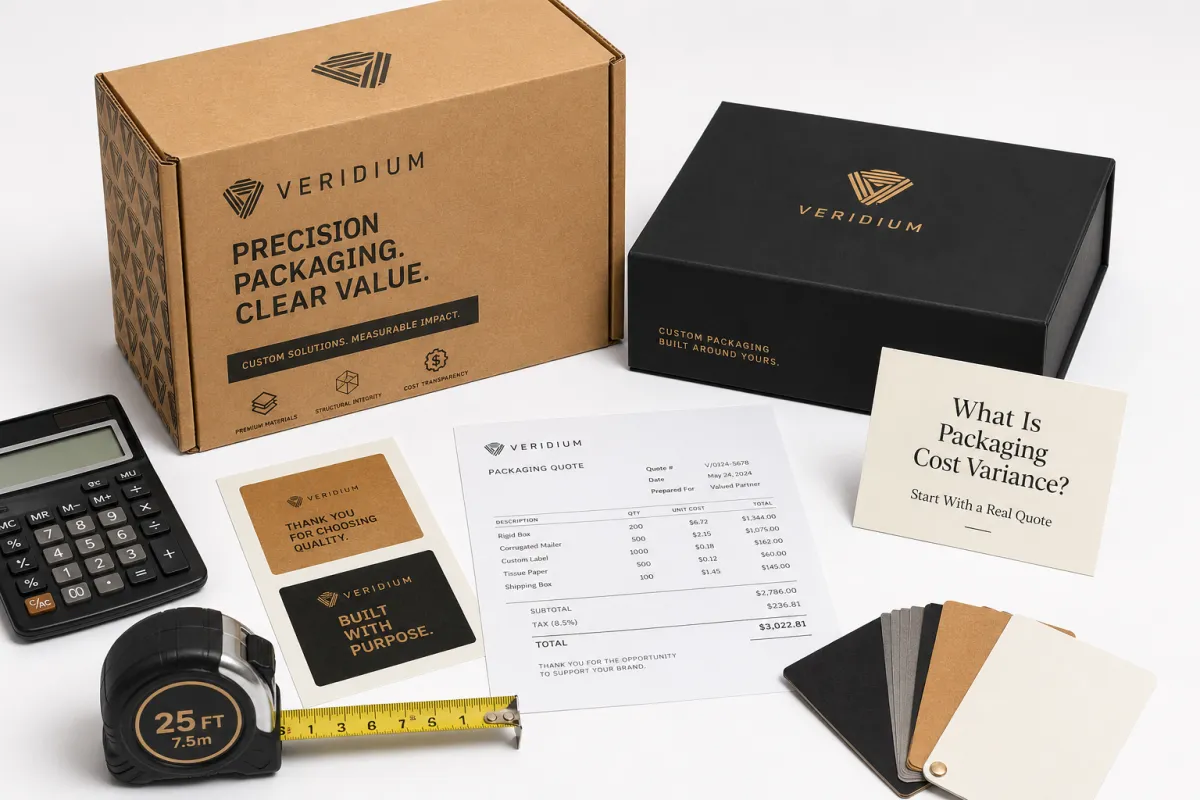
What is packaging cost variance in a real quote? It is the difference between the expected cost, the quoted cost, and the final invoiced cost after production details are locked. Those three numbers are not always the same, and they rarely drift in a neat little straight line. A buyer might expect $0.42 per unit from a first pass, get a quote at $0.47, and receive an invoice at $0.51 once freight, spoilage, a second proof round, and a partial reprint of 600 cartons are added. That spread is the variance, and it is why a quote should always be read line by line instead of waved through because the total looks "close enough" for a 5,000-piece order. In practical terms, packaging cost variance is the gap between the number in your planning model and the number that lands in accounts payable.
There are two broad buckets. Fixed costs include tooling, die cutting setup, printing plates, and sometimes a one-time proof fee that might land around $85 to $250 depending on the factory in Suzhou or New Jersey. Variable costs include board usage, ink coverage, labor, finishing, assembly, and freight. What is packaging cost variance if not the way those two buckets interact? A small change in dimensions can increase sheet waste. A richer print layout can push ink usage up by 15% or 20%. A tighter timeline can force faster freight, which can cost more than the box itself on a light run. I have seen a so-called cheap shipment cost more than the packaging because everyone forgot the pallet math until the truck was already booked, and that conversation happened after a 9:30 a.m. approval in Portland.
I sat through a supplier negotiation where a retail packaging buyer asked why a rigid box quote differed by $0.31 between two vendors. The answer was plain enough once the details were unpacked. One vendor included foam inserts, black wrap, and domestic freight to Ohio. The other priced only the outer box, assumed offshore shipping from Shenzhen, and left out the hand assembly that the brand had requested in email but never added to the final scope. That is why what is packaging cost variance starts with scope control, not price hunting. A clean scope is the easiest way to reduce quote variance before anyone signs off on production.
Here is the language I use with clients: if the spec is fuzzy, the quote is fuzzy. If the spec is precise, what is packaging cost variance becomes measurable. That is the difference between a rough estimate and a procurement tool. It also changes how you forecast landed cost, because landed cost includes the box, the freight, the packaging for shipment, and the waste rate. If your accountant wants one number, you need one clean assumption set, whether the run is 2,500 units or 25,000 units. Once those assumptions are locked, the remaining packaging price variance is usually much easier to explain.
"The cheapest quote was the most expensive order because the freight and setup showed up later." I heard that from a brand manager after a 9,000-unit launch in Atlanta, and the invoice variance ended up 11.6% above the approved budget once a second proof, revised inserts, and pallet freight from Illinois were added.
For buyers who are still mapping the territory, ISTA test methods are a useful reference for shipping performance, especially if your custom packaging must survive distribution, vibration, and drop testing on routes that go from Chicago to Phoenix or from Shenzhen to Seattle. The point is not academic. Better testing reduces rework, and rework is one of the quietest drivers of what is packaging cost variance. It is boring work, yes, but boring is better than paying to redo 8,000 boxes because the closure failed in transit on a Thursday afternoon. The same is true for carton compression, drop testing, and any distribution standard that helps your packaging estimate match the real world.
What Is Packaging Cost Variance in Custom Packaging Quotes?
In custom packaging quotes, what is packaging cost variance can be traced to three layers: estimated cost, quoted cost, and final billed cost. Estimated cost is the quick internal guess, often built from last quarter's 5,000-unit carton price or a catalog benchmark from a plant in Ohio. Quoted cost is the supplier's planned price based on the specs in hand, whether that means 350gsm C1S artboard, a 1-color inside print, or a matte lamination. Final billed cost is the number after production, freight, and any approved change order. If those layers are not separated, the buyer ends up blaming the vendor for a problem created by incomplete input, and I have watched that happen more than once on jobs that started in Denver and finished in Qingdao. That is why packaging cost variance is best treated as a process issue, not just a pricing issue.
One thing I see often is a mismatch between quote language and buyer expectations. A quote may say "ex-works" or "FOB" and the buyer reads it as delivered pricing. That difference alone can change what is packaging cost variance by hundreds of dollars. I have watched a team compare two vendors, one at $0.29 and one at $0.34, only to discover the cheaper line excluded delivery to a California fulfillment center and the more expensive line included it with a 12-business-day transit buffer. The lower quote was not lower. It was incomplete. The landed cost looked better only because the freight scope had not been checked.
Fixed costs behave differently from variable costs. Tooling, plates, and die setup usually stay flat across a run, so they sting most on low MOQ orders. Variable costs rise with unit count, print coverage, and finishing complexity, and a foil-stamped rigid box in Montreal will not carry the same labor rate as a plain tuck carton in Monterrey. That is why what is packaging cost variance is usually sharper on a 2,000-unit order than on a 50,000-unit order. The same setup fee spread across fewer units changes the unit cost curve fast, and nobody likes explaining that after approvals are already signed.
Format matters too. Folding cartons often carry a cleaner setup profile than rigid boxes, while mailers may be more sensitive to corrugated grade and flute profile. Labels can look simple, then surprise buyers with adhesive selection, liner waste, and roll direction. Inserts and kitting are another story entirely. I have seen what is packaging cost variance widen in a kitted product packaging job because one extra hand-fold step added 12 labor minutes per hundred units and a second QC check at $18 per labor hour. Twelve minutes does not sound dramatic until it is multiplied by a few thousand units and someone asks why the labor line grew teeth. That kind of quote variance is easy to miss when a spreadsheet only shows the final total.
Use a simple rule: compare like with like. If Vendor A quotes a custom printed box with aqueous coating and Vendor B quotes the same box with matte lamination, they are not quoting the same job. If Vendor A includes assembly and Vendor B does not, the gap is not just price. It is scope. That is the fastest way to see what is packaging cost variance before it reaches the invoice, and it is the same logic I use when comparing a 24 pt folding carton against a 32 ECT corrugated mailer in the same campaign. It also keeps packaging price variance from getting mistaken for a material quality issue.
| Quote Element | What It Usually Covers | Variance Risk | Example Impact |
|---|---|---|---|
| Tooling / Setup | Die, plates, press setup, prepress checks | High on low MOQ | $180 setup on 2,000 units adds $0.09 each |
| Material | SBS, corrugated, rigid board, recycled stock | Medium to high | Board upgrade can add $0.06 to $0.18 per unit |
| Finishing | Foil, embossing, coating, spot UV | High | Foil on one panel can add 8% to 14% |
| Freight | Parcel, pallet, ocean, domestic freight | Very high | Ohio delivery might be $260 or $940 depending on method |
| Assembly | Hand work, inserts, kitting, pack-out | High | One extra fold step can add $0.03 to $0.07 per unit |
That table is why I tell buyers not to compare a single headline number. What is packaging cost variance without a line-item lens? It is guesswork. A quote that looks higher at first can still produce a lower landed cost if it includes freight, proofing, and a realistic spoilage allowance. A quote that looks cheaper can become expensive once pallet fees, reshipment, and revision charges show up. I would rather see a slightly ugly, fully itemized quote than a pretty one that hides the bruises, especially if the job is shipping from a plant in Jiangsu to a warehouse in New Jersey.
I also recommend reading the quote against your internal volume plan. If your forecast says 8,000 units and the supplier priced at 20,000 MOQ, the per-unit cost may look attractive, but storage, cash flow, and obsolescence risk rise fast. That is part of what is packaging cost variance too: not only the invoice, but the cost of committing to the wrong quantity, such as 20,000 boxes when your sales team has only budgeted for a 6,500-unit launch. The right MOQ can reduce unit cost without pushing warehouse expense into the next quarter.
Product Details That Drive Packaging Cost Variance
Material choice is usually the first place buyers feel what is packaging cost variance. SBS, corrugated, rigid board, recycled stock, and specialty paper each behave differently on press and on the line. A 16 pt SBS carton with a single-color front panel will not price like a 32 ECT corrugated mailer with full-bleed print, and a recycled kraft sheet from a mill in Oregon may cost differently than a bright white sheet sourced through a distributor in Ontario. Even recycled content targets can affect the number, because some grades are easier to source in volume than others. The paper mill may call it "available," but the plant manager may call it "not this week," which is another way of saying your cost just moved. That is a simple example of packaging cost variance that comes from supply chain reality rather than design intent.
Print coverage matters just as much. A two-color box with 20% ink coverage is one thing. A four-color custom printed box with full flood coverage, soft-touch lamination, and spot UV is another. Every layer adds setup time, risk of waste, and sometimes a second pass through the press. That is a major reason what is packaging cost variance can climb after the design team approves a more ambitious packaging design without asking procurement to reprice it. I have nothing against beautiful packaging; I just like beautiful packaging that has been priced by somebody who has actually worked with a press sheet in Milwaukee or Dongguan.
Structural complexity also changes the bill. A straight tuck carton is simpler than a reverse tuck with window patching. Add inserts, partitions, or multi-piece sleeves, and labor rises. A rigid gift box with a magnetic closure is a different animal from a standard mailer. In one supplier call, I saw a kitting request add $0.11 per unit because the team needed two inserts, one tissue wrap, and a final seal label. That is what is packaging cost variance in a single sentence: more operations, more cost, and more chances for the line to slow down at 300 units per hour instead of 500.
Assembly, warehousing, and fulfillment can dominate the final number. A box at $0.24 sounds efficient until the vendor adds $0.06 for hand assembly, $0.03 for storage, and $0.09 for domestic freight. Suddenly, the packaging is still reasonable, but the total tells a different story. I think buyers should treat these services as part of product packaging, not as optional side notes. If the offer includes branded packaging support, ask for each service to be itemized separately so the quote cannot hide behind a single number and a friendly smile from a sales rep in Los Angeles. That approach usually makes packaging cost variance much easier to forecast on repeat orders.
For sustainability-sensitive projects, the material story has its own variables. FSC-certified paper can add a premium depending on supply, and compostable or recycled claims can require stricter sourcing and documentation. The FSC certification site is a useful reference if your retail packaging needs chain-of-custody clarity. In my experience, sustainability does not automatically raise what is packaging cost variance; it raises it when the spec is vague and the buyer assumes all "green" stocks are equivalent. They are not, and the invoice usually makes that painfully clear when the order ships out of a certified mill in Quebec or Finland. Clear sourcing notes reduce quote variance before the purchase order is even drafted.
Common cost drivers by format
What is packaging cost variance for folding cartons is often tied to print coverage and caliper. For mailers, it is usually board grade, flute style, and ship-to cost. For rigid boxes, labor and finishing dominate. For labels, adhesive, roll count, and web width matter more than people expect. I once watched a label quote jump by 17% because the buyer requested a wider roll width that reduced press efficiency by several hundred labels per roll on a 25,000-label order. The art department called it a "minor tweak." The production team called it a Tuesday problem with a price tag. That kind of packaging price variance is exactly why format should be named clearly in the brief.
If you want to narrow the spread early, share a complete spec sheet and ask suppliers to price the same structure, same finish, same insert count, and same shipping method. That discipline is boring. It also works. It is the fastest practical way to reduce what is packaging cost variance before production starts, whether the factory is in Illinois, Guangdong, or Mexico City. When the scope is identical, the quote variance becomes real data instead of noise.
Specifications: How Details Lock or Expand Cost Variance
Dimensions are not a small detail. They are the foundation of what is packaging cost variance. A 1/8-inch change in length can alter sheet utilization, nesting efficiency, and die layout. On a high-volume run, that can change scrap by 3% to 7%, which is enough to move the unit cost. I have seen buyers approve artwork on a "close enough" dieline, then discover the actual product needed a deeper box by 4 mm to clear a closure tab. That is not a design issue anymore. It is a pricing issue, and the invoice will not be sympathetic on a 10,000-piece order. Small dimensional shifts can ripple into a bigger landed cost than anyone expected.
Caliper, GSM, flute profile, and tolerance all deserve attention. A 350gsm C1S artboard behaves differently from 18 pt SBS. A B-flute mailer does not price the same as an E-flute mailer, because compression strength, print surface, and sheet yield all shift. If the dieline is off by even a few millimeters, the press operator may need to slow down, which raises labor cost. That is how what is packaging cost variance sneaks into a quote that looked stable on the first pass, particularly when the plant is running a 12-hour shift in Suzhou or Kansas City. It is also where unit cost and production speed start influencing each other in ways buyers can feel immediately.
Artwork readiness also matters. Files that arrive with missing dielines, low-resolution images, or unexpanded fonts create extra prepress time. A good supplier will flag this early, but not every team does. I once had a client lose a full week because a logo arrived in RGB instead of CMYK and the packaging design team had to rebuild the black plate for a 6,000-unit coffee sleeve order. That delay increased the rush freight cost later. It was not a huge line item at first. Then what is packaging cost variance showed up in the shipping bill, as it so often does when everyone assumes "we can fix it later." Prepress delays are one of the easiest ways to turn a stable quote into a moving target.
Sampling and proof approval are your best insurance policy. A physical sample can reveal a closure that binds, a window patch that misaligns, or a print panel that looks too dark under store lighting. Those errors are expensive after production starts and cheap before it starts. Good teams use sample approval to narrow what is packaging cost variance by eliminating rework, not by chasing the lowest possible quote on day one. I would rather spend an afternoon inspecting a sample at a workbench in Cleveland than spend a week arguing about why 6,000 units came back with a misfold. That is one place where a little patience can save a lot of packaging price variance later.
Sustainability specs need the same discipline. If you want recycled content, FSC sourcing, or a compostable claim, say so in writing and ask for the document set that supports it. Don't assume every supplier means the same thing by "eco-friendly." Some do not. I have seen one brand pay a 9% premium for a verified FSC chain-of-custody program, then recoup part of it because the retailer accepted the certification as part of package branding for a spring launch. That is a real tradeoff, not a marketing slogan, and it beats discovering later that the claim cannot be supported. A clear sustainability brief also helps the supplier quote the right material and avoid a late-stage change order.
The National Center for Environmental Information is not your packaging supplier, but the broader lesson from environmental reporting applies here: measurable claims beat vague claims. Use exact dimensions, exact board grade, exact finish, and exact quantity. That is how you turn what is packaging cost variance from a moving target into a controlled variable, whether your boxes are made in Northern Illinois or in the Pearl River Delta. Exact inputs are the simplest way to keep quote variance under control and avoid unnecessary rework.
Pricing & MOQ: Reading the Numbers Behind Packaging Cost Variance
Quote structure tells you more than price alone. A clean packaging quote should break out unit price, tooling, setup, freight, packaging for shipment, and any surcharge. If those numbers are bundled into one line, what is packaging cost variance becomes harder to audit. I prefer to see a quote that says, for example, $0.31/unit, $190 setup, $420 freight, and $85 for carton pack-out. That is messy on paper and powerful in practice because it shows where the cost is hiding, especially on a 5,000-piece order shipping to Nevada. It is also the fastest way to compare landed cost across plants and regions.
MOQ is where many buyers get surprised. Setup costs do not shrink much when order volume drops, so the unit cost climbs quickly on short runs. A 2,500-piece order might price at $0.48 each, while a 10,000-piece order drops to $0.29 each because the same plate, die, and proof costs are spread over more units. That is a classic example of what is packaging cost variance. The vendor is not changing the rules. The math is changing, and it usually changes in a way that makes small orders feel awkwardly expensive. In other words, the MOQ itself can be the biggest driver of packaging price variance on the whole job.
Here is a comparison I use in supplier reviews:
| Option | Unit Price | Setup / Tooling | Freight | Estimated Landed Cost |
|---|---|---|---|---|
| 2,500 folding cartons | $0.48 | $210 | $180 | $1,590 |
| 5,000 folding cartons | $0.34 | $210 | $240 | $1,150 |
| 10,000 folding cartons | $0.29 | $210 | $330 | $3,430 |
The point is not that bigger is always better. The point is that MOQ changes the cost curve. If your forecast is only 4,000 units, a 10,000-piece order may create storage costs and risk obsolete inventory if the artwork changes. So what is packaging cost variance should be measured against the real demand plan, not a theoretical per-unit ideal. I have seen teams chase lower unit pricing and then spend the next quarter staring at pallets in a warehouse in New Jersey like they are evidence in a case nobody wanted to file. The cheapest unit price is not always the best landed cost.
A useful habit is to request landed cost and reorder pricing in the same email. First-run quotes often include setup and proofing, while reorder quotes should exclude certain one-time items. If the supplier cannot explain that difference, your procurement team cannot forecast accurately. I have seen a buyer assume a reorder would match the first run, only to discover the second order still carried a plate charge because the vendor had to remake a damaged tool. That is a small sentence with a large invoice attached. It is also part of what is packaging cost variance when the first run was priced in error.
Another practical check: ask whether freight is estimated by dimensional weight, pallet count, or container load. Those models can produce very different numbers. A 6,000-unit run of lightweight retail packaging may ship cheaply by parcel if the box is compact, but a rigid box program might require pallet freight and warehouse handling from a plant in Ohio or a coastal port in California. If the vendor does not spell that out, you are not getting a complete answer to what is packaging cost variance. Freight method and packaging size should always be part of the same conversation.
If you want a sharper quote, send the exact quantity, the exact ship-to ZIP, the exact timeline, and whether the order is a first run or a repeat. Buyers who do that usually get fewer surprises. Buyers who skip it usually spend the next week chasing revisions and wondering why what is packaging cost variance looks larger than expected. I have done both paths, and only one of them keeps my blood pressure at a civilized level. Exact inputs help keep the quote variance from widening after approval.
Process & Timeline: Where Packaging Cost Variance Appears
The process path matters because every handoff can move the cost. A typical packaging workflow goes from inquiry to spec review, then quote, dieline, proof, sample, approval, production, and shipping. If one step changes, what is packaging cost variance changes with it. I like to ask buyers which step they are actually in before anyone talks about price. Too often, a team says it wants a quote but has not finalized the artwork, the quantity, or the delivery date. That is not a quote request. That is a hope with a PDF attached and a target of 12 to 15 business days that nobody has confirmed yet. A timeline that is not locked is often the first hidden cost driver.
Delays create cost pressure. Late artwork revisions can force a second prepress pass. Missed approval windows can push the job into a more expensive production slot. A material substitution can alter board price by 5% to 12% if the original stock is unavailable in Guangzhou or Toronto. Rushed freight is the most visible swing of all. I have seen a client spend $680 extra on air shipment because a sample approval sat in someone’s inbox for five days. That is not just timeline slippage. It is what is packaging cost variance in motion, and it does not care who was "out of office."
Fast timelines narrow supplier flexibility. When a buyer needs production in 12 to 15 business days from proof approval, the vendor has less room to optimize sheet use, consolidate freight, or wait for a preferred board grade. That can raise cost. The answer is not always to slow down. The answer is to lock the spec early so speed does not become a tax. That is one of the most practical ways to control what is packaging cost variance, especially when the factory is running in Dongguan and the warehouse is receiving in Atlanta. The earlier the structure is approved, the less likely you are to see quote variance from rush fees.
Communication is cheaper than change orders. Set decision dates, share launch milestones, and tell the supplier whether the order is tied to a retail reset, a trade show, or a subscription cycle. Those dates affect production sequencing. If the factory can schedule your job into a quieter window, you may keep costs down. If the job has to jump the line, you pay for the privilege. That is another place where what is packaging cost variance becomes visible only after the fact, usually when everyone is already tired and the schedule has gone sideways in the last 48 hours before launch.
I once visited a corrugated plant in Ohio where a 1.5 mm board shift moved the dieline enough to reduce nesting efficiency on a large mailer run. The operator showed me the scrap bin. It was not dramatic. It was just 7% more offcuts than the estimate, which was enough to change the quote after the fact on a 15,000-unit shipment. Small industrial changes like that are why I respect timeline discipline so much. The factory floor is where what is packaging cost variance stops being a theory and turns into paper, board, and labor.
If your program includes testing, ask for it early. ASTM D4169 and similar distribution standards can identify weak points before production scales. That testing can feel like an added cost, but it often prevents worse costs later. The same is true of sample drops, vibration checks, and compression tests. They are not glamorous. They are cheaper than a full reprint. They also make what is packaging cost variance easier to predict, which is the whole point when the shipment has to survive a truck route from Chicago to Dallas. Good testing keeps a packaging estimate grounded in real distribution conditions.
What To Do Before You Approve the Quote
Buyers usually know the price they want before they know the assumptions behind it. That is where trouble starts. If you want a quote that holds up, start with the details the factory will actually use on the floor: exact dimensions, board grade, finish, print coverage, insert count, assembly steps, ship-to location, and whether the order is a first run or a reorder. That list sounds basic, but it is the difference between a number you can budget against and a number you have to explain later. Honestly, it saves a ton of back-and-forth, and you’re gonna feel that in the schedule.
At Custom Logo Things, the value is not just a nice-looking box. It is a quote that shows where the cost lives, so what is packaging cost variance stays visible before production starts. The best suppliers I have worked with explain tradeoffs early instead of hiding them inside a tidy total and hoping nobody asks about freight, tooling, or a second proof. A clean quote is easier to trust because it can be checked against the spec sheet, the timeline, and the production method. That kind of clarity matters just as much in a plant in Los Angeles as it does in a finishing shop in Monterrey.
If you are deciding between appearance, durability, quantity, and turnaround time, ask for the tradeoff table before you sign. A soft-touch finish may lift the look of branded packaging, but it can add $0.05 to $0.09 per unit and extend approval time by 2 to 3 business days. A lighter board grade may reduce unit cost, but it may not survive a rough shipping lane. A lower MOQ may help cash flow, but it can raise the unit cost by 20% or more. That is not a sales pitch. It is the practical reality behind what is packaging cost variance. Every one of those choices leaves a mark on landed cost.
From a buyer’s perspective, the best quote is the one that can be repeated. That means exact dimensions, exact structure, exact print coverage, exact finish list, exact quantity, ship-to ZIP, and due date. If the order is a first run, say so. If it is a reorder, say so. Reorders often price differently because the tooling already exists, and that should reduce what is packaging cost variance if the supplier is tracking the job properly. If they are not tracking it properly, you eventually find out the hard way, which is a very expensive way to learn basic bookkeeping. Reorder pricing should always be checked against the original run so quote variance is not hiding in plain sight.
Here is the information I would send in one message to tighten the quote and reduce surprises:
- Exact dimensions in inches or millimeters, plus tolerance range.
- Material preference, such as SBS, corrugated, rigid board, or recycled stock.
- Print details, including color count, coverage, foil, embossing, and coatings.
- Quantity, ship-to ZIP, required delivery window, and whether the order is a first run or reorder.
- Artwork status, dieline status, and any sample or proof requirements.
That list cuts through half the confusion. It also makes what is packaging cost variance easier to explain to finance, sales, and operations. If the quote changes after those five items are fixed, you have a real variance to investigate. If the quote changes before then, you had an estimate, not a locked price, and that difference matters a lot on a 20,000-piece retail rollout. A cleaner brief also reduces the back-and-forth that tends to inflate both labor and freight.
My honest view is simple: the cheapest quote is rarely the best quote unless the scope is identical. Compare line by line, confirm assumptions in writing, and ask for landed cost, not just unit price. If you do that, what is packaging cost variance becomes manageable instead of mysterious. That is how smart buyers protect margin while still getting the custom printed boxes, product packaging, and package branding they need, whether the project is being produced in Chicago, Shenzhen, or Mexico City. In short, clean scope and clean math beat a low headline price almost every time.
FAQ
What is packaging cost variance in a custom box quote?
It is the difference between the price you expected and the price you are actually charged after setup, materials, finishing, freight, and production details are applied. In practice, what is packaging cost variance often comes from missing spec details, a lower-than-expected order volume, or a material swap that changes board usage or labor. A quote that started at $0.27 per unit can easily land at $0.33 per unit once proofing, carton pack-out, and Ohio freight are added. That spread is why a packaging quote should be reviewed as a full landed cost.
Why do two suppliers show different packaging cost variance for the same box?
Each supplier may use a different material source, production method, MOQ policy, or freight model, which changes the final landed cost. One quote may include setup or shipping while the other excludes it, so the comparison is not truly apples to apples. That is why what is packaging cost variance has to be reviewed with the full quote scope in hand, including whether the job is being run in Guangdong, Ontario, or Texas. A difference in scope often looks like a price gap until you trace the assumptions.
How can I reduce packaging cost variance before I place an order?
Lock your dimensions, artwork, finish list, and quantity before requesting quotes so vendors are pricing the same package. Ask for sample approval, landed cost, and reprint pricing so hidden changes do not show up later. That process keeps what is packaging cost variance smaller and much easier to forecast, especially if the supplier gives you a 12- to 15-business-day production window from proof approval. It also helps you catch quote variance before it becomes a change order.
Does MOQ affect packaging cost variance?
Yes, lower quantities usually increase unit cost because setup and tooling are spread over fewer pieces. Higher MOQs can reduce unit cost, but only if the volume matches your forecast and storage plan. In other words, what is packaging cost variance improves when MOQ matches demand instead of fighting it, whether you need 2,500 cartons or 25,000 cartons. The same rule applies to any packaging price variance tied to a first run or repeat order.
What details should I send to get a tighter packaging cost variance estimate?
Send exact dimensions, structure type, material preference, print coverage, finish requirements, quantity, and timeline. Include ship-to location and whether the order is a first run or a reorder, because freight and repeat setup assumptions change the quote. The more complete the brief, the smaller what is packaging cost variance usually becomes, and the more likely you are to get an accurate quote from the first pass. Clear inputs also make landed cost easier to verify.
The practical takeaway is simple: lock the spec before you lock the price. If the dimensions, materials, print process, freight method, and quantity are all the same, then what is packaging cost variance becomes a real number you can manage instead of a moving target you have to explain later. Compare quotes line by line, ask for landed cost, and make sure the factory and your team are working from the same assumptions. That is the cleanest path to protecting margin without giving up the packaging quality, print finish, or production reliability the product actually needs.

