Buyer Fit Snapshot
| Best fit | Wholesale Custom Printed Swing Tags for Brand Packaging projects where brand print, material claims, artwork control, MOQ, and repeat-order consistency need to be specified before quoting. |
|---|---|
| Quote inputs | Share finished size, material target, print colors, finish, packing count, annual reorder estimate, ship-to region, and any compliance wording. |
| Proofing check | Approve dieline scale, logo placement, barcode or warning zones, color tolerance, closure strength, and carton packing before bulk production. |
| Main risk | Vague material claims, crowded artwork, missing packing details, or unclear freight terms can make a low unit price expensive after revisions. |
Fast answer: Wholesale Custom Printed Swing Tags for Brand Packaging should be specified like a repeatable production item. The safest quote records material, print method, finish, artwork proof, packing count, and reorder notes in one written spec.
Production checks before approval
Compare the actual filled-product size with the drawing, then confirm tolerance on folds, seals, hang holes, label areas, and retail display edges. Reserve space for logos, QR codes, warning copy, and material claims before decorative graphics fill the panel.
Quote comparison points
Review material grade, print process, finish, sampling route, tooling charges, carton quantity, and freight assumptions side by side. A quote is only useful when the supplier can repeat the same color, closure quality, and packing count on the next order.
Wholesale Custom Printed Swing Tags for Brand Packaging
A shopper usually decides what a product feels like in a few seconds, and wholesale custom printed swing tags are often the first printed surface they actually study. I remember a candle line priced at $28.00 sitting untouched on a boutique shelf in SoHo until the brand moved from plain stock tags to heavier wholesale custom printed swing tags on 350gsm C1S artboard with a crisp black logo, a matte aqueous coating, and a cleaner price block; the product itself stayed exactly the same, yet the shelf reaction changed almost overnight. That still makes me grin a little, because packaging people can spend months debating Pantone numbers and then watch one small tag do half the selling.
That detail gets missed more often than it should. The tag is not an add-on, and it is not decoration for the sake of decoration. It carries the practical information a retail team needs, but it also carries the visual language of the brand, which is why stock choice, finish, and layout matter so much. In a crowded store on Oxford Street or in a 200-square-foot boutique in Melbourne, wholesale custom printed swing tags can do work that expensive displays cannot, because they sit directly on the product and speak before a sales associate has the chance. Honestly, that is why buyers notice them so quickly, even if they never say it out loud.
I have watched the same pattern repeat in factory meetings in Dongguan, client reviews in Los Angeles, and supplier negotiations in Ningbo: brands that treat wholesale custom printed swing tags as a design choice instead of a line item usually end up with stronger package branding and fewer surprises at launch. The commercial upside is easy to understand. Better first impressions. Fewer missed brand signals. A sharper shelf presence. Those gains add up quickly, and they are the kind of gains that make a finance team stop squinting at the spreadsheet for once.
And there is a very practical reason for that. A good tag reduces friction across the whole chain, from prepress to packing to store replenishment. If the barcode is clean, the hole is correctly placed, and the finish does not scuff in transit, the product moves with fewer headaches. That sounds boring, but boring is good here. Boring means the line is doing exactly what it is supposed to do.
What are wholesale custom printed swing tags?
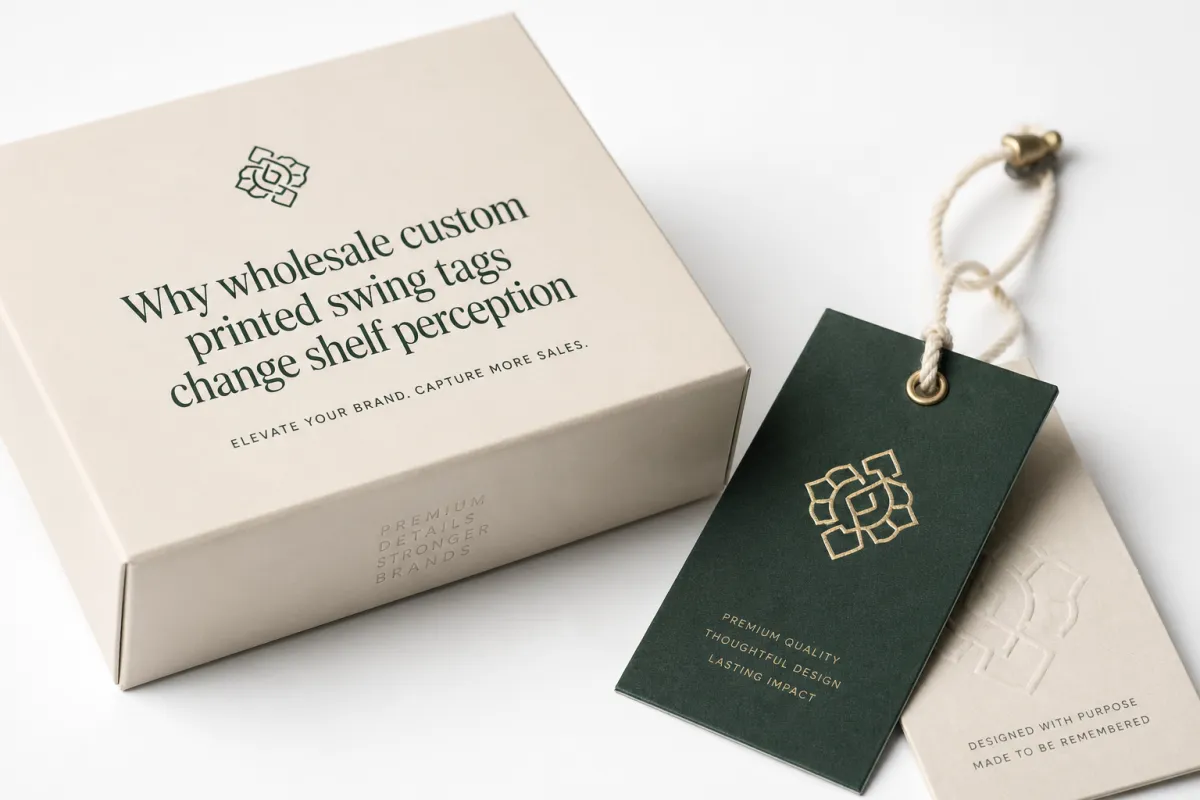
Wholesale custom printed swing tags are printed product tags designed to hang from apparel, accessories, gift sets, and retail goods, usually attached with string, twine, elastic loops, or plastic fasteners. They carry the practical details a store needs, but they also carry the visual language of the brand, which is why stock choice, finish, and layout matter so much. A well-made tag can communicate price, product story, care instructions, and quality cues in one compact piece, and that makes it one of the most efficient tools in branded packaging.
For buyers comparing custom packaging products, the tag is often the smallest item with the biggest influence on perceived value. It can be plain and functional, or it can become a tactile sales asset with soft-touch coating, foil stamping, embossing, or a custom die-cut silhouette. The goal is not to overfill the space. The goal is to make the tag feel like it belongs to the product, the shelf, and the wider packaging system all at once. If the tag looks borrowed from another brand, people notice. They might not say why, but they feel it.
In production terms, the structure is simple enough: artwork goes through prepress, the board gets printed, the sheets are cut, the holes are punched or drilled, and the finishing gets applied last if the build calls for it. The details are where the quality lives. A clean score line on a folded tag, a hole that does not split under string tension, and ink density that stays even across a large run all matter more than a fancy mockup on a screen.
Why wholesale custom printed swing tags change shelf perception
During one showroom visit in Shoreditch, a buyer picked up two nearly identical shirts. One carried a thin white tag with a generic font; the other used wholesale custom printed swing tags on 350gsm artboard with a soft-touch coat and a subtle silver foil logo. She did not say, "I like the packaging." She said, "The second one belongs in my store." That line carries real weight, because buyers are usually too busy to hand out compliments unless something genuinely changes the product's position in their mind.
Shelf perception gets undervalued because people assume quality is judged only through stitching, fabric, or formula. It is not. It is judged through cues, and wholesale custom printed swing tags are among the fastest cues a shopper sees. They signal whether a brand pays attention to detail, whether the asking price makes sense, and whether the product belongs on a discount rack or a premium display. I have seen a tag do what a whole marketing deck could not, which is slightly annoying for anyone who spent three weeks polishing that deck, especially when the printer in Guangzhou delivered the tags 48 hours before the line review.
The practical side matters just as much. Wholesale custom printed swing tags can carry barcode information, SKU logic, care notes, and brief brand copy without crowding the main product packaging. That helps brands balancing product packaging, retail packaging, and e-commerce fulfillment from a warehouse in Dallas to a pop-up in Toronto. I have seen teams use the tag to keep the carton cleaner while still giving store staff everything they need at a glance. That matters on the receiving dock too, where nobody wants to decode a packaging puzzle before coffee at 7:30 a.m.
The best versions use restraint. A tag that tries to say everything usually says nothing clearly. The smarter move is to let wholesale custom printed swing tags act like a short, confident statement: logo, product name, material, size, barcode, and one line that feels human. A sharp type system and a stock with enough body can do more than a long paragraph of copy. If the tag feels like it is shouting, the product feels cheaper. If it feels like it knows what it is doing, the whole shelf looks calmer.
On a factory floor in Shenzhen, I watched a production manager reject a batch because the tag board was only 280gsm and too light for a heavy knit cardigan. The tags bent during packing, and the brand would have shipped 8,000 units with a tired-looking presentation. That is the quiet value of wholesale custom printed swing tags: they defend the perceived value of the item before a customer ever handles it. And yes, watching a pallet of nearly-finished goods get delayed because a paperboard sample folded like a cheap postcard is one of those moments that makes everyone stare at the floor for a second.
"We changed nothing about the garment, only the tag, and the shelf response improved immediately." That was a buyer's line to me after a store test in Chicago, and it still sums up why wholesale custom printed swing tags deserve budget.
For brands planning a launch, the upside can be measured. Better tag stock can reduce shelf damage, improve perceived price, and support package branding across multiple SKUs. Used well, wholesale custom printed swing tags become part of the brand system instead of an afterthought added at the end of production. I think that is the real dividing line between packaging that looks assembled and packaging that looks considered, especially when a retailer is deciding between a $22 T-shirt and a $48 one.
There is also a trust angle that does not get discussed enough. A tag that feels flimsy, smudged, or inconsistent makes shoppers wonder whether the product itself was handled the same way. A sturdy tag, printed cleanly and trimmed properly, says the opposite. It tells the customer that somebody cared enough to check the details twice, maybe three times. That matters more than people want to admit, even if they are pretending to shop quickly.
Wholesale custom printed swing tags: materials, shapes, and finishes
Material choice does most of the heavy lifting. For wholesale custom printed swing tags, coated paper performs well when the brand needs rich image reproduction and crisp typography. Uncoated stock gives a more tactile, less polished feel, which suits craft-led labels and some luxury goods. Kraft board signals earthiness and restraint. Textured board adds depth without relying on ink tricks. Rigid materials raise the perceived value again, especially for gift packaging and premium accessories. I have a soft spot for heavier board because 350gsm C1S artboard feels honest in the hand, not flimsy and apologetic.
I have seen buyers choose the cheapest stock first and then spend more trying to make the design look premium. That rarely works out well. A better path is to start with the brand promise and choose the substrate that supports it. If the product is minimalist apparel, wholesale custom printed swing tags on 350gsm matte coated board can keep the layout crisp. If the line leans handmade or natural, a 400gsm kraft build from a mill in Zhejiang may fit better. The stock should make the design believable, not force it to pretend it is something else.
Shape matters more than many teams expect. Standard rectangles are efficient, easy to stack, and dependable for large wholesale custom printed swing tags runs of 5,000 to 20,000 pieces. Die-cut silhouettes can add personality, especially for cosmetics, toys, or artisan food packaging. Folded tags create room for care instructions, origin stories, or multi-language content. Multi-panel formats help when the retailer needs more data on one piece without cluttering the front. I have watched a design team fall in love with a scalloped edge only to realize the warehouse hated the irregular stack height, which, frankly, is a very warehouse reaction.
Finishes decide how loudly the tag speaks. Matte feels calm and modern. Gloss adds contrast and a brighter shelf flash. Soft-touch brings a smooth, almost velvety feel that often reads as premium the moment someone picks up the product. Foil accents catch attention fast, especially in gold or silver on a dark navy base. Spot UV guides the eye to a logo or emblem. Embossing and debossing create physical depth, which is useful when the brand wants tactile cues rather than visual noise. All of these options can work for wholesale custom printed swing tags, but they do not all belong in every category. A beauty brand can get away with a little shine; a heritage leather label might look silly if the tag sparkles like a disco flyer.
At a supplier meeting in Hong Kong, I once watched a cosmetics brand compare three tag samples side by side: plain matte, soft-touch with foil, and embossed kraft. The marketing team kept reaching for the embossed sample because it felt artisanal. The sales team kept choosing the soft-touch version because it read cleaner under retail lighting at 4000K. That tension is normal. Wholesale custom printed swing tags sit at the meeting point of aesthetics, production cost, and shelf performance, so the right choice depends on what needs to win. Half the job is knowing which department is actually buying the story.
If sustainability is part of the brief, do not stop at the word "eco." Ask what the paper actually is, whether the board carries FSC certification, and whether the finish still fits the brand story. The FSC site is a useful reference point for understanding certified sourcing, including chain-of-custody requirements for mills in Guangdong and Fujian. I also recommend checking the guidance and resources from Packaging School when teams need a common language for materials and print quality. That is usually less glamorous than a mood board, but much more useful when production starts asking real questions.
For brands comparing options, wholesale custom printed swing tags usually fall into three practical tiers:
| Build | Typical Quantity | Example Unit Price | Best Fit | Notes |
|---|---|---|---|---|
| Economy matte paper | 1,000-5,000 | $0.15 per unit for 5,000 pieces | Basic retail launch, high-volume apparel | Clean print, limited finishing, low setup burden |
| Mid-tier coated board with soft-touch | 3,000-10,000 | $0.21-$0.34 | Fashion, skincare, lifestyle products | Better tactile feel, stronger shelf presence |
| Premium rigid stock with foil or embossing | 1,000-5,000 | $0.48-$0.82 | Gift packaging, luxury accessories, limited editions | Higher setup and finishing cost, stronger perception lift |
Those figures are working benchmarks, not promises. Even so, they show the broad shape of the market. The more custom the shape, finish, or die-cut, the more wholesale custom printed swing tags will move into higher setup territory, especially if the factory is handling production in Dongguan or Qingdao during a busy October retail window. The more standard the construction, the easier it is to keep cost controlled while preserving a polished result. That is one of those boring truths that saves brands money, which is usually why it gets ignored until the second quote arrives.
Specifications that keep swing tags consistent
The quickest way to avoid rework is to lock the spec sheet early. For wholesale custom printed swing tags, that means size, paper weight, print side, hole placement, string type, edge shape, and any finishing layers. If a brand changes its mind after proofs are issued, the schedule slips. That sounds obvious. In practice, it happens constantly because marketing, merchandising, and operations each assume someone else already approved the details. I have sat in those meetings in Singapore and Sydney, and the silence after someone asks "who signed off on this?" is louder than a forklift.
Here is the checklist I use with teams before a quote goes out:
- Dimensions: exact width and height, including any folded format.
- Stock weight: for example, 300gsm, 350gsm C1S artboard, or a rigid board if the product needs more stiffness.
- Print side: one-sided or two-sided, with any flood color specified clearly.
- Hole placement: top center, left corner, or custom position tied to the product shape.
- Attachment: string, elastic loop, twine, or plastic fastener.
- Finish: matte, gloss, soft-touch, foil, spot UV, emboss, or deboss.
- Data content: barcode, SKU, care copy, origin statement, and legal text.
Bleed and safe zone are not glamorous, but they matter. A tag design with text too close to the trim can look fine on screen and fail once cut. I have seen a 2mm shift wipe out a carefully placed barcode. For wholesale custom printed swing tags, that is the difference between smooth retail intake and a pallet of questions from the warehouse team in Rotterdam. Nobody enjoys explaining to fulfillment why the barcode is half a millimeter into the danger zone.
Color mode is another place where good intentions can miss the mark. Designs built in RGB often print differently than expected because production works in CMYK. High-resolution files help, too; I prefer 300 dpi for raster elements and vector artwork for logos whenever possible. Those numbers are not decoration. They protect legibility, which is critical when wholesale custom printed swing tags need to carry small text, barcodes, or product codes. If the type looks fuzzy, the whole thing starts to feel cheaper than it should.
Durability depends on more than ink. Will the tag survive bundling, shipping, and hang time on the rack for 21 days? Will it hold up if a shopper bends it? Will the surface scuff against other items in transit? Brands selling through multiple channels should also ask how the tags perform under parcel stress, especially if the same wholesale custom printed swing tags will be used for direct-to-consumer shipping and store display. For transit testing, many teams look to ISTA 3A or 2A protocols because they offer a practical framework for handling and drop conditions.
A proofing checklist saves money. I recommend a line-by-line review of spelling, logo placement, barcode readability, hole position, color intent, and final trim. For multi-SKU rollouts, one missed digit can become a warehouse headache. That is not a design issue. That is an operations issue with a design origin. Wholesale custom printed swing tags should be checked with the same seriousness as a carton proof or a label sign-off. If the tag is wrong, the mistake does not stay small for long.
One of the better client habits I have seen is the "three-person proof." A designer checks the layout. An operations lead checks data fields. A sales lead checks the retail story. That approach adds a day to approval and can save a week of corrections. For wholesale custom printed swing tags, that trade is usually worth it. I would take one extra day over one very expensive reprint any week, especially if the job is shipping out of a plant near Suzhou.
There is a tiny but real lesson in all this: the brands that slow down before production usually move faster overall. They do not lose time fixing mistakes, chasing reprints, or apologizing to retailers. That discipline is not glamorous, and nobody puts it in a pitch deck, but it is a quiet advantage.
Wholesale custom printed swing tags pricing and MOQ explained
Pricing is driven by five main variables: quantity, material choice, print coverage, finishing complexity, and die-cut tooling. If a brand wants wholesale custom printed swing tags in a standard rectangle with one-color print, the setup stays simple. If the brief includes a custom silhouette, foil blocking, embossing, and a two-sided layout, the cost rises quickly because the press time, tooling, and finishing steps all expand. That is the point where everyone's "simple tag" suddenly becomes a more expensive conversation, usually after the sample from a factory in Shenzhen arrives with a satin ribbon attachment nobody requested.
MOQ means minimum order quantity, and it matters because it affects both price and production efficiency. A mill or printer can produce wholesale custom printed swing tags more cheaply at higher volumes because setup cost gets spread across more units. That is why a 10,000-piece run often has a better unit price than a 1,000-piece order. Still, small runs can make sense for launches, seasonal drops, or limited editions where inventory risk is more expensive than a slightly higher unit cost. I have watched brands pay a little more per tag just to avoid being stuck with boxes of leftovers in August in a New Jersey warehouse.
I have negotiated enough supplier quotes to know that the lowest price is not always the best decision. A brand saving two cents per tag can lose far more if the stock feels flimsy or the finish does not support the line. Wholesale custom printed swing tags should be priced against the value of the product they sit on. A $0.24 tag on a $6 accessory is one conversation. A $0.24 tag on a $120 jacket is another. Same material, very different expectations, and both can be produced with 350gsm artboard and a 4mm punched hole if the spec is set correctly.
Here is a practical comparison that buyers often find useful:
| Option | MOQ | Unit Cost | Lead Time | Commercial Use |
|---|---|---|---|---|
| Standard bulk tag | 1,000 | $0.20-$0.28 | 10-12 business days after proof approval | Fast-moving retail launches |
| Mid-range branded tag | 3,000 | $0.15-$0.22 | 12-15 business days after proof approval | Core range, repeat orders, wider SKU sets |
| Premium finished tag | 5,000 | $0.34-$0.65 | 14-20 business days after proof approval | Luxury packaging, gift sets, and seasonal campaigns |
Those numbers are realistic for planning, though exact pricing always depends on the print file and the factory schedule. A rush order, a rare paper stock from Haining, or a custom die can alter the final quote. That is true for wholesale custom printed swing tags just as it is for Custom Printed Boxes or other custom packaging products. The quote is a snapshot, not a promise until the specs are final. I know that can be irritating, but production is not a magic trick, even if clients sometimes wish it were.
If your team is comparing budgets, think in terms of brand impact rather than only unit cost. Economy builds support basic retail packaging. Mid-tier builds suit most branded packaging programs. Premium builds make sense when the tag is part of the selling story, not just the compliance story. Wholesale custom printed swing tags can occupy any of those tiers, but the wrong tier for the product will feel off the moment a buyer touches it. People notice that mismatch faster than they can explain it, especially in a store with bright LED lighting and a 30-minute merchandising reset.
I once sat through a negotiation where the buyer wanted a premium finish and a budget-level unit price. The supplier explained, patiently, that the math did not work. He was right. The brand eventually trimmed the foil coverage from 70% of the face to 20%, simplified the die-cut, and got a result that still looked expensive without destroying margin. That is often the real art of wholesale custom printed swing tags: not choosing the loudest option, but choosing the version that protects both brand and margin. A little restraint can save a lot of pain later.
There is another angle here that gets overlooked: reorders. A slightly cheaper first run is not a win if the second run cannot match it. Matching paper shade, finish, and cut quality across batches matters, especially for brands with seasonal continuity. I have seen retailers reject a reprint because the new batch looked "almost right," which is usually code for "not good enough on the shelf."
Process and timeline for swing tag production
The order flow stays straightforward when the information is complete. It usually moves from inquiry to quote, then artwork review, proof approval, production, finishing, and shipping. The entire process for wholesale custom printed swing tags moves faster when the buyer arrives with exact dimensions, quantity, stock preference, finish choice, and print-ready files. The slower path is familiar too: vague brief, missing barcode, artwork still in review, then a rush request on the back end. I have seen that movie too many times, and the ending is never surprising, whether the factory is in Guangzhou or a regional print shop in Manchester.
Lead times vary, but a common range for wholesale custom printed swing tags is 12-15 business days after proof approval for standard runs, with shipping added on top. Simpler orders tend to sit at the lower end of that range. Premium finishes, special cutting, or busy production windows move the timeline upward. If a team says "we need it fast," I ask one question first: fast compared with what, and for how many units? That usually clears the fog better than ten minutes of vague urgency.
The fastest quotes come from complete information. I want to know the tag size in millimeters, the substrate, the finish, the artwork format, the number of versions, and the target delivery date. If the product needs a barcode or care instructions, those details should be supplied up front. Wholesale custom printed swing tags are far easier to price accurately when the supplier does not have to guess. Guessing is what leads to awkward follow-up emails that start with "just one quick clarification" and end an hour later after someone finds the missing SKU sheet.
Rush orders are possible, but they usually require trade-offs. Sometimes the brand can keep the same design and move to a standard shape. Sometimes the finish needs to be simplified. Sometimes the delivery date can be met only if artwork is final within hours, not days. The honest answer is that wholesale custom printed swing tags are not difficult to produce; they are difficult to produce quickly if the brief is still changing. Production floors dislike indecision almost as much as they dislike missing files.
Sample requests help, especially for new brands or new materials. I have seen a client approve a soft-touch stock only after handling a physical sample because the on-screen image made it look almost rubbery. The sample told the truth. That is why I prefer a proof plus a physical reference whenever possible for wholesale custom printed swing tags, especially on premium packaging or brand launches where the tactile result matters as much as the visual one. Screens can lie politely; paper tells the truth immediately.
Clear communication cuts delays more effectively than pressure does. The teams that get their wholesale custom printed swing tags on time usually do three things well: they answer questions quickly, they consolidate feedback from stakeholders, and they approve proofs without dragging out minor preferences that do not affect the selling point. Small details matter. So does decisiveness. A brand does not need to agonize over 14 shades of near-white when the real question is whether the tag works in store at 9:00 a.m. on launch day.
For product managers working across branded packaging programs, the tag schedule should sit beside carton, label, and insert timelines. If the carton is ready but the tag is late, the launch still slips. I have seen that happen with cosmetics, apparel, and gift packaging in Austin and Amsterdam. The tag is small, yes, but wholesale custom printed swing tags still affect the final handoff to retail. Small pieces can create surprisingly large headaches when they are missing.
A practical rule I use: if the launch date is fixed, the tag spec should be frozen first, not last. That sounds backward to some teams, but it prevents the most common scramble. Once the paper, finish, and data fields are locked, everything else gets easier.
Why buyers choose our swing tag programs
Buyers usually come to us for one simple reason: they want reliable print quality without a lot of back-and-forth. That means consistent color, clean cutting, accurate hole placement, and quotes that do not drift every time a detail is clarified. Wholesale custom printed swing tags should feel controlled from the first email to the final carton. Our job is to make that process predictable, which is more valuable than it sounds if you've ever chased three different answers to one simple file question from three time zones.
In my experience, the biggest value is not only production. It is guidance. Some teams know exactly what they want. Others know the product but not the right paper, finish, or attachment. We help sort that out quickly so the tag fits the brand and the budget. That is especially useful for brands ordering wholesale custom printed swing tags alongside Custom Labels & Tags, because the materials and finishes need to speak the same visual language. If one piece looks premium and the other looks like it was pulled from a bargain bin, the whole set feels off.
We also pay attention to the commercial details buyers care about but rarely advertise. Can the order be split across SKUs? Is the turnaround realistic? Will the proof clearly show barcode placement? Can the finish work with the rest of the packaging design? These are the questions that protect a launch. For many teams, our Wholesale Programs make that easier because they need a repeatable path for replenishment, not a one-off transaction. Reorders should feel boring in the best possible way, especially when the first shipment came from a plant in Dongguan and the second needs to match it exactly.
One fashion client told me the real reason they stayed was not the lowest unit cost. It was the fact that the tags arrived matching the first approved proof, then matched again on the reprint three months later. Consistency matters more than people admit. Wholesale custom printed swing tags are part of the product's face, and a brand cannot afford a different face every season. If customers notice that the tag quality shifts around, they start wondering what else changed.
I also like that our process keeps packaging conversations connected. A tag does not live alone; it sits next to cartons, sleeves, inserts, and mailers. When the rest of the branded packaging is aligned, the product looks more intentional, and the buying decision feels easier. That is especially true for lines that also use Custom Packaging Products across multiple retail channels. The whole system should feel like one family, not a set of cousins who only meet at Christmas in a warehouse in Kent.
Here is the honest part. Not every client needs the same level of finish, and not every launch needs a premium tag. Sometimes a clean, well-printed matte build is the right answer. Sometimes a textured stock creates better trust than a glossy one. The point is not to oversell the tag. The point is to choose wholesale custom printed swing tags that help the product sell and the operation run without friction. I think good packaging advice should save money as often as it spends it.
That balance is why buyers come back. They want a supplier who understands that wholesale custom printed swing tags are part production item, part marketing asset, and part logistics problem. When all three are handled well, the result looks simple. Simple is usually the hardest thing to make, which is why people who make it look easy tend to get called back. And, honestly, that is the kind of trust that takes years to earn and one sloppy reprint to lose.
Next steps for ordering
If you are ready to move, start with the essentials: dimensions, quantity, stock preference, finish, logo files, barcode needs, and any care copy or legal text. That shortlist is enough to get a useful quote for wholesale custom printed swing tags without wasting a week on revisions. If you have two or three material options in mind, ask for all of them. Side-by-side pricing makes the decision clearer than a single number ever will. I have never met a brand team that regretted having one more comparison sheet, especially when one sample is 350gsm C1S artboard and another is 400gsm kraft.
Before you approve anything, check spelling, logo placement, color intent, and hole position. Then check them again. I say that because wholesale custom printed swing tags tend to hide small errors until the sample arrives, and by then the mistake is much more expensive. A good proof should answer every practical question the retail floor will ask. If it does not, keep pushing until it does, even if the final approval takes one extra day in London or Milan.
For launch planning, compare lead times against your carton, label, and fulfillment schedule. If the tag is late, the launch is late. If the tag is early but the artwork is still changing, production will still stall. The cleanest path is to lock the final specs, then move quickly to proof approval and production. That is the rhythm that keeps wholesale custom printed swing tags moving without stress. It sounds almost too simple, which is usually a clue that someone in the room has not been involved in a real production schedule yet.
My final recommendation is simple. Ask for a quote, request two or three build options, and choose the version that fits the product story, the shelf environment, and the budget. Wholesale custom printed swing tags are small, but they influence value perception more than many larger packaging items. Use that to your advantage. A smart tag can make a product feel like it belongs exactly where you placed it, whether that shelf is in Brooklyn, Berlin, or Brisbane.
If you want a broader packaging refresh, pair the tag order with a review of your other branded packaging assets so the look stays consistent from shelf to shipment. The same thinking applies whether you are adjusting Custom Printed Boxes, updating inserts, or refining a new label system. Good package branding works as a set, not as isolated pieces. And if you are comparing the next order across several lines, our wholesale custom printed swing tags, Custom Labels & Tags, and Custom Packaging Products pages are a practical place to start.
For brands that want a fast first step, send the spec sheet, compare lead times, and confirm the best wholesale custom printed swing tags build for the launch. That single move usually turns a vague packaging idea into a real production plan, which is a much better place to be than guessing under pressure. If you keep the spec tight and the approvals clean, the tags will do their job without drama, and that is exactly how it should be.
FAQ
How many wholesale custom printed swing tags do I need to order?
Start with the number of units in the current production run, then add a buffer for samples, rework, and future replenishment. For seasonal or limited-edition products, a smaller MOQ can reduce inventory risk while still keeping the unit price workable. If the same tag will be used across multiple SKUs, ordering more at once often lowers cost per tag. I usually tell clients to think one step beyond the current launch so they are not scrambling for a reprint after the first sell-through in week six.
What affects the price of custom printed swing tags in bulk?
Material choice, finish complexity, size, shape, and print coverage are the biggest pricing variables. Higher quantities usually reduce unit cost, while custom die-cuts and premium finishes raise setup or production expense. Artwork readiness can also affect price if extra prepress or proofing work is required. If the files are a mess, the quote usually reflects that mess, which feels rude but is perfectly fair when the printer in Shenzhen has to rebuild the layout from scratch.
How long does production usually take for wholesale custom printed swing tags?
Lead time depends on quantity, finishing, and proof approval speed, but the full process usually includes quoting, artwork review, production, and shipping. Simple orders move faster when files are print-ready and specs are confirmed early. For standard builds, 12-15 business days after proof approval is a realistic planning window, and rush timelines are possible when capacity and finish choices allow it. If the project needs a hard deadline, tell the supplier early rather than hoping the calendar will cooperate.
Can I order wholesale custom printed swing tags with my own artwork?
Yes, provided the files meet print requirements such as resolution, bleed, and color setup. Most buyers submit vector logos, layout files, or print-ready PDFs for the fastest approval. A proof stage helps verify that text, codes, and placement are correct before production. I always recommend checking the artwork in print scale too, because a design can look charming on a laptop and too tiny once it hits 90mm by 50mm on paper.
What should I check before approving custom printed swing tags for retail use?
Confirm spelling, logo placement, barcode readability, and any legal or care information. Check that the size and finish fit the product category and the intended shelf presentation. Review color and hole position on the proof so the finished tag matches the retail application. If you can, hold the sample under the same lighting the store uses, because fluorescent lights in a 3200K fitting room have a funny way of exposing every design assumption.
What is the safest way to keep wholesale custom printed swing tags consistent across reorders?
Keep a locked master spec sheet with the approved stock, finish, die line, hole size, and barcode data, then reuse the same print files for every reorder. Ask the supplier to keep a physical sample from the approved run if that is possible, because paper shade and coating feel can drift just enough to matter over time. The brands that manage this well are the ones that treat the tag like a production standard, not a last-minute accessory.