Buyer Fit Snapshot
| Best fit | Recycled Fiber Corrugated Board projects where brand print, material claims, artwork control, MOQ, and repeat-order consistency need to be specified before quoting. |
|---|---|
| Quote inputs | Share finished size, material target, print colors, finish, packing count, annual reorder estimate, ship-to region, and any compliance wording. |
| Proofing check | Approve dieline scale, logo placement, barcode or warning zones, color tolerance, closure strength, and carton packing before bulk production. |
| Main risk | Vague material claims, crowded artwork, missing packing details, or unclear freight terms can make a low unit price expensive after revisions. |
Fast answer: Recycled Fiber Corrugated Board: Quote Scope, Sample Proof, MOQ, and Lead Time should be specified like a repeatable production item. The safest quote records material, print method, finish, artwork proof, packing count, and reorder notes in one written spec.
Production checks before approval
Compare the actual filled-product size with the drawing, then confirm tolerance on folds, seals, hang holes, label areas, and retail display edges. Reserve space for logos, QR codes, warning copy, and material claims before decorative graphics fill the panel.
Quote comparison points
Review material grade, print process, finish, sampling route, tooling charges, carton quantity, and freight assumptions side by side. A quote is only useful when the supplier can repeat the same color, closure quality, and packing count on the next order.
If a box lands in a warehouse with the corners still square, the print still readable, and the product inside still intact, nobody starts applauding the fibers. They care about one thing: did it hold up? That is the practical answer to what is recycled fiber corrugated board. It is corrugated packaging made from recovered paper fibers that still performs when the grade, flute, and construction are chosen with some actual thought.
The word recycled makes some buyers flinch. They hear weak, cheap, second-rate. That reaction is lazy. Packaging performance comes from the board spec, not from a green label slapped on the carton and called a day. A well-made sheet with recycled fibers can handle stacking, vibration, retail display, and print without drama. A bad sheet can fail while looking very proud of its sustainability story. What is recycled fiber corrugated board? Not a slogan. A material system. Details matter.
For brands and operations teams, the real question is not whether recycled content sounds nice in a deck. It is whether the carton protects the product, keeps costs under control, and supports the brand without creating waste. If you are ordering Custom Shipping Boxes, that is the level of thinking that keeps money in the bank. Pretty boxes that collapse in transit are just expensive disappointment with better lighting.
Recycled content is a material choice, not a free pass. If the board grade is wrong, the box will fail with impressive confidence.
What Is Recycled Fiber Corrugated Board? Start Here
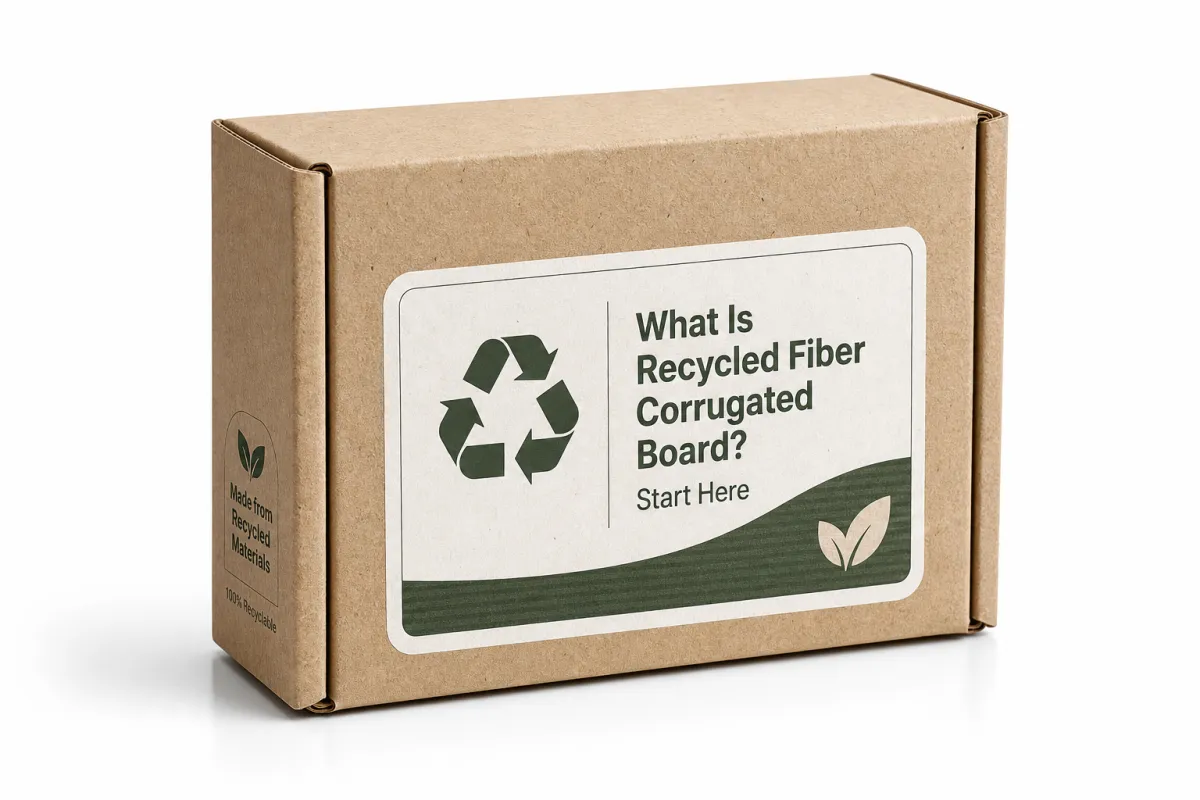
What is recycled fiber corrugated board? Plainly, it is corrugated sheet material made with recovered paper fibers in one or more layers, usually the linerboard, the medium, or both. Corrugated board is the sandwich: flat liners on the outside and a fluted middle layer that gives the box strength and cushioning. Recycled fiber can show up in any part of that structure depending on the grade and the supplier's mix. Recycled content is not an all-or-nothing label. It is a range, and that range has consequences.
One thing buyers miss all the time: recycled does not automatically mean weak, and virgin does not automatically mean better. A recycled-fiber sheet with the right flute geometry and enough compression strength can beat a lighter virgin-fiber board chosen by habit instead of testing. What is recycled fiber corrugated board really about? Balancing fiber source, board construction, and the demands of the shipment. That is the whole game.
Three terms get mixed up constantly:
- Recycled content: how much of the material came from recovered fibers.
- Recyclable: whether the material can be collected and processed again after use.
- Recycled fiber: the actual recovered fiber used in manufacture.
Those are not the same thing. Treating them like they are is how sales calls go sideways fast. A board can be recyclable without carrying much recycled content. A board can contain recycled fiber and still fail if the structure is wrong. If you want what is recycled fiber corrugated board to mean something useful, ask for the spec, not the slogan. Grade, ECT, burst strength, flute type, and board caliper tell you more than a green icon ever will.
In practice, buyers choose this material for routine shipping, e-commerce cartons, internal distribution, subscription packaging, and other jobs where the box needs to be reliable, not heroic. It is often a smart Fit for Brands trying to reduce material intensity without turning packaging into a fragile science project. If your product is heavy, sharp-edged, or likely to sit in a damp warehouse for weeks, the answer changes quickly. That is not a flaw in what is recycled fiber corrugated board. That is physics doing its job.
Another distinction matters: the board can be made with different recycled fiber percentages, and the percentage alone does not tell the full story. Fiber length, how many times the pulp has been recycled, how much contamination was removed, and how the sheet was formed all affect performance. Two sheets with the same recycled claim can behave very differently in compression and print quality. What is recycled fiber corrugated board is not one product. It is a family of constructions.
How Recycled Fiber Corrugated Board Works
The structure is simple enough to explain without a whiteboard. Outer liners carry print and surface durability. The middle flute creates the air gap that gives the box stiffness and cushion. Recycled fibers can be used in the liners, the medium, or both, depending on the grade. What is recycled fiber corrugated board at the structural level? A load-bearing sheet built from paper layers that work together under compression, vibration, and handling abuse.
The manufacturing flow starts with recovered paper sorting. Old corrugated containers, mixed paper, and other recovered streams are collected, then pulped in water. From there, the pulp is cleaned, screened, and refined to remove contaminants and prepare the fibers for sheet formation. After that, the paper machine forms the liner or medium, dries it, and converts it into corrugated board. If the board is intended for stronger recycled-content claims, the supplier may also track chain-of-custody documentation, such as FSC Recycled where applicable. That does not make the box magical. It just makes the paperwork cleaner.
Adhesive and moisture control matter more than most people realize. The fluted medium is glued to the liners, and the bond has to survive shipment, storage, and temperature swings. Recycled fibers can behave differently from virgin fibers because their history is longer. They have already been through one or more cycles, so fiber length and bonding behavior may be a little less forgiving. That is why the same board caliper can feel different from supplier to supplier. What is recycled fiber corrugated board in real production? A material that depends on glue line integrity, humidity, and compression resistance as much as on the recycled claim.
Performance is usually checked with tests people can actually interpret. Edge Crush Test, or ECT, helps estimate stacking strength. Burst strength measures resistance to rupture. Compression testing, including methods covered by ASTM standards such as ASTM D642, looks at how cartons behave under load. Shipping validation often includes carrier-style testing and vibration checks. If a board is only "good" because someone liked the sample color, that is not engineering. That is wishful thinking wearing a purchase order. For shipping performance references, the procedures described by ISTA are a useful benchmark.
Where does what is recycled fiber corrugated board work well? Standard e-commerce orders, retail replenishment, secondary packaging, simple die-cuts, and non-premium printed shippers are all good use cases. Where does it get risky? Long storage in humid conditions, very heavy SKUs, fragile goods with concentrated load points, and supply chains that punish weak corners. The board is not the problem. The mismatch is.
What Is Recycled Fiber Corrugated Board: Cost and Pricing Factors
If you want a buyer-friendly answer to what is recycled fiber corrugated board from a cost angle, here it is: it can be economical, but only if the spec matches the job. Material price is just one piece of total cost. A cheaper sheet that fails in transit is not cheap. It is a future replacement shipment waiting to happen. I see that mistake constantly. People chase unit price and ignore damage rate. That is a very expensive hobby.
The main pricing drivers are straightforward. Fiber quality and recycled content affect raw material cost. Board grade and flute type affect strength and caliper. Print coverage changes ink, plate, and setup cost. Custom die-cutting adds tooling and setup time. Order volume matters because short runs spread fixed costs across fewer units. If you need what is recycled fiber corrugated board to carry heavy graphics or tight tolerances, expect the price to move accordingly. Nobody gets premium performance for free. If someone says otherwise, check the fine print and the actual sample.
| Option | Typical Use | Typical Unit Cost | Strength / Tradeoff |
|---|---|---|---|
| Recycled single-wall corrugated board, standard print | E-commerce cartons, light to moderate product weight | $0.42-$0.78 at 1,000-5,000 units | Good value if the product is not overloaded; may need stronger ECT for stack-heavy lanes |
| Recycled double-wall corrugated board | Heavier items, longer transit, better stacking | $0.88-$1.65 at 1,000-5,000 units | More protection, more board, more freight; useful when damage is costly |
| Virgin-fiber premium board | High cosmetic needs or tighter moisture control | $0.55-$1.25 at 1,000-5,000 units | Can improve appearance or consistency, but not always the smartest value |
| Recycled board with complex die-cut and heavy print | Retail-ready or branded shipping boxes | $0.70-$1.80 at 1,000-5,000 units | Brand-friendly, but setup and finishing can dominate the cost if volumes are low |
The ranges above are directional, not promises carved into stone. Box size, flute profile, board caliper, print coverage, and freight distance all push the final number around. Still, they are useful because they show the basic truth: what is recycled fiber corrugated board is often a strong value when the spec is honest. The cheapest board is not always the least expensive package. If it needs replacement shipments, customer service time, or chargebacks, the math changes quickly.
Freight and warehousing also matter. Overbuilt boxes take up more pallet space, weigh more, and cost more to move. A board that is too heavy can quietly raise landed cost even if the carton quote looks fine. A lot of buyers focus on carton quote only, then get surprised when shipping and storage eat the savings. That is why the spec should be tied to product weight, distribution lane, and stack height. What is recycled fiber corrugated board worth if it lowers total waste and avoids unnecessary board thickness? Quite a lot.
There are hidden costs too. If the board is under-specified, damage rates go up. If the printing is wrong, you may have to scrap or rework inventory. If a sustainability claim cannot be supported by the actual fiber mix, compliance teams get nervous and legal teams get involved, which is never a fun part of the day. A better approach is to pay for the strength you need and stop there. Over-specifying corrugated is just burning cash with extra steps.
If your product is already priced tightly, think about the box as part of the margin, not an accessory. That is why many brands start by comparing a few construction options rather than guessing. A quick conversation around Custom Shipping Boxes can reveal whether a lighter recycled spec, a stronger double-wall option, or a different flute profile will give you the best balance of cost and protection. What is recycled fiber corrugated board good for in that discussion? It is the baseline material that can be tuned, not a fixed answer.
Recycled Fiber Corrugated Board Process and Timeline
The usual path from idea to delivered cartons is more orderly than people expect. First, define the use case: product weight, dimensions, fragility, and shipping method. Then review material options and confirm the board grade. Next comes sampling, where the supplier makes a prototype or mockup so fit, stacking, and print can be checked before production. Finally, the approved spec moves to manufacturing and delivery. If you understand what is recycled fiber corrugated board, you can make this process boring. Boring is good. Boring means fewer surprises.
Sampling is not a ceremonial step. It is the cheapest place to find problems. A prototype box can show whether the dimensions are right, whether the product shifts inside, whether the closure tabs are strong enough, and whether the print looks muddy on a recycled liner. For branded shippers, mockups also help verify logo placement and panel balance. I would rather hear "the sample needs one tweak" than "the whole shipment crushed on the way out." That second sentence gets expensive fast.
Timeline depends on complexity. Simple stock-size recycled corrugated orders can move quickly if the board is available. Custom jobs take longer because you are dealing with dimensions, tooling, print setup, and the supplier's production schedule. A plain run may be ready in a matter of days after approval, while a custom recycled fiber corrugated board project often needs extra time for sampling and signoff. If artwork is missing or measurements are fuzzy, the schedule slips. Miraculously, cardboard does not improve when the brief is vague.
Bottlenecks usually come from the buyer side, not the mill. Missing load data. Late artwork. No stack-height target. Unclear finish requirements. Or the classic move: approving a sample without testing actual pack-out conditions. What is recycled fiber corrugated board supposed to protect if nobody tested it under real use? Not much. A good supplier can help, but they cannot guess your shipping lane. They are not mind readers.
For documentation and testing habits, keep one eye on shipping standards and one eye on your own environment. EPA recycling guidance is useful if your team needs a plain explanation of recovery and recycling basics, while ISTA procedures help frame transport testing. A practical buyer does both: they ask for the material spec and they check how the box behaves in the real lane. That is the difference between a packaging plan and a guess.
Key Factors That Affect Performance
Three forces shape the answer to what is recycled fiber corrugated board in actual use: load, crush, and humidity. Load is the obvious one. If the carton carries a heavy product, the board needs enough compression strength to support stacking without bowing. Crush matters because corners and edges take the punishment during transit and palletization. Humidity is the quiet troublemaker. Recycled fibers can lose stiffness faster in damp conditions, which is why storage environment deserves more attention than it usually gets.
Flute selection changes the whole feel of the box. Single-wall construction is common for lighter and medium-duty shipments. Double-wall adds more strength and better stacking tolerance, but it also adds weight and cost. Different flute profiles change cushioning, board thickness, and print surface behavior. A smaller flute can improve print detail; a larger flute can help with cushioning. What is recycled fiber corrugated board supposed to do for the package? Protect the product first, then support the branding, not the other way around.
Product weight and transit distance should steer the spec. A compact, light accessory shipped locally may be fine in a recycled single-wall carton. A heavier item traveling through multiple handoffs may need a stronger board or a different closure design. Storage time matters too. If cartons sit for long periods before use, especially in changing humidity, the margin for error shrinks. That is why buyers who ship year-round should test more than the first sample. What is recycled fiber corrugated board under summer humidity is not the same as the same board in a dry warehouse.
Print and finishing can change the picture as well. Heavy ink coverage may affect drying and appearance, especially on rough recycled liners. Coatings, laminations, and intricate die-cuts can add cost and alter how the sheet converts on the line. If the design has tight folds or aggressive scores, make sure the board grade can tolerate them. I have seen beautiful packaging fail because someone designed for the render instead of the material. The render does not ship.
Sustainability tradeoffs should stay honest. Recycled content can reduce demand for virgin fiber, but the best choice still has to lower total waste. A box that uses less board, fits the product better, and survives transit is often more sustainable than a heavier carton with a better-sounding claim. What is recycled fiber corrugated board worth if it saves material and still protects the goods? A lot. Not if it creates damage, returns, or extra inserts to compensate for a bad spec.
If you want the material to perform consistently, ask about the supply chain too. Does the supplier test incoming recycled pulp? Do they track caliper consistency? Can they show compression data for the exact grade you are considering? Those questions sound technical because they are technical. They also matter. Packaging is one of those rare categories where a few precise questions can save a lot of money later.
Common Mistakes When Specifying Recycled Fiber Corrugated Board
The first mistake is the obvious one: choosing by recycled content alone. What is recycled fiber corrugated board worth if it has a high recycled claim but the corners collapse after a light stack? Not much. Buyers do this because the recycled number feels like a simple proxy for sustainability and quality. It is not. Strength specs tell you more than a percentage ever will.
The second mistake is overbuilding the box because the team wants to feel safe. "Make it stronger" sounds responsible until the freight bill shows up and warehouse space gets eaten by excess board. Over-specifying corrugated is common, especially when nobody wants to be blamed for damage. Safe is not the same as smart. The goal is to choose the lightest viable board that still protects the product. What is recycled fiber corrugated board supposed to do? Exactly enough, not everything a nervous buyer can imagine.
The third mistake is ignoring humidity and storage conditions. Recycled fibers are not paper superheroes. They can lose performance if cartons sit in a damp loading area or travel through wet climates without enough margin. If your supply chain includes long storage, seasonal moisture swings, or non-climate-controlled warehouses, test for it. The box that looked fine in the sample room may behave differently after a week in the real environment. Weird how physics keeps showing up.
The fourth mistake is approving a sample that never saw real pack-out conditions. A carton can look great empty and still fail once the product, inserts, and sealing method are in place. Test the actual fill, stack height, carrier handling, and tape or closure method. If the product shifts, the box has to work harder. What is recycled fiber corrugated board for if not real shipping? A showroom sample is nice. A passing transit test is better.
The fifth mistake is assuming one grade fits every product. That is the fastest way to build a pile of avoidable problems. A lightweight cosmetic item, a dense hardware kit, and a fragile glass product do not need the same carton just because they all live in boxes. Use the product weight, fragility, and route to guide the choice. If you need broader packaging options, it can help to compare formats such as custom mailer boxes alongside other box styles instead of forcing one structure to do every job.
There is also a paperwork mistake that shows up more often than it should. Teams say they want recycled content, but they never ask for documentation. Then they need a sustainability report, and suddenly everyone is hunting through old approvals like it is an archeological dig. If recycled claims matter to your brand, ask for the documentation before the order is placed. What is recycled fiber corrugated board if you cannot prove what was ordered? It is a claim without a file, which is not helpful to anyone.
The cheapest board on paper can be the most expensive board in practice. Damage, rework, and complaints are not free just because they show up later.
Expert Tips and Next Steps for Recycled Fiber Corrugated Board
Start with the product, not the carton. That sounds obvious, but people skip it constantly. Gather product weight, dimensions, fragility, stack height, ship method, and storage conditions before you ask for quotes. Once those facts are clear, what is recycled fiber corrugated board becomes a specification conversation instead of a guessing game. The more precise the brief, the fewer revisions later.
Ask suppliers for strength data, recycled content details, and an explanation of how their board system is built. If they can explain liner choice, flute profile, and ECT in plain language, that is a good sign. If they only talk about "eco-friendly cardboard," keep asking questions. A decent supplier should be able to tell you whether the material is appropriate for your lane and what tests they recommend. That kind of clarity is part of the value. What is recycled fiber corrugated board should never feel mysterious once the spec is on the table.
For a new product or a new shipping lane, pilot one order before scaling up. Test real shipments, not a theory on a spreadsheet. Track damage rate, fit, printing quality, and handling feedback from the warehouse. If the board passes, move forward. If it fails, change the spec before ordering at scale. I know, testing sounds slower than guessing. Guess what is slower than testing? Replacing broken product.
Use a simple comparison checklist:
- Cost per box: compare the carton price and the freight impact.
- Damage rate: measure what happens in actual transit.
- Lead time: include sample approval and production, not just factory time.
- Print quality: check brand clarity on recycled liners.
- Documentation: confirm recycled content and any chain-of-custody claims.
That list keeps the conversation grounded. It also stops the common mistake of buying the prettiest sample and hoping it survives. What is recycled fiber corrugated board supposed to deliver? Protection, cost control, and a story the brand can stand behind. If one of those three is missing, the spec is incomplete.
My practical rule is simple: request two board options, test them against the actual shipment, and then lock the version that protects both product and budget. One option should be the conservative spec. The other should be the lighter or more cost-efficient candidate. If both pass, choose the cheaper one that still keeps the product safe. If one fails, you have your answer without a long debate. That is how you keep packaging decisions from turning into committee theater.
So if someone asks you again what is recycled fiber corrugated board, the honest answer is this: it is a corrugated material built from recovered paper fibers that can be strong, printable, and cost-effective when the grade is matched to the shipment. It is not automatically good, and it is not automatically weak. The result depends on the spec, the test data, and the real shipping conditions. Get those right, and recycled fiber corrugated board is one of the most practical options on the table. Ignore them, and you are just buying a story with a box around it.
Pick the spec based on the product, confirm the data, and test it in the lane it will actually travel. That is the cleanest takeaway here, and honestly the only one that keeps packaging from turning into a guessing game with invoices.
What is recycled fiber corrugated board used for in shipping?
It is commonly used for e-commerce cartons, retail shipping boxes, mailer shippers, and transit packaging. It works best for moderate loads, standard distribution, and jobs that need a balance of cost, protection, and sustainability. If the product is unusually heavy or fragile, the board grade and flute construction should be tested first.
Is recycled fiber corrugated board strong enough for heavy products?
Sometimes, yes, but only if the board grade, flute type, wall construction, and storage conditions are right. Heavy products often need a tested spec with documented edge crush and compression performance. Recycled content alone does not tell you whether a carton will survive a stack or a rough lane.
How does recycled fiber corrugated board compare on price?
It can be cheaper than premium virgin-fiber options, especially on standard runs and higher volumes. The real cost depends on box size, print complexity, board strength, freight weight, and how much waste the spec avoids. A lower unit price is not a win if the cartons fail and trigger replacements.
How long does it take to source recycled fiber corrugated board?
Stock sizes can move quickly, while custom jobs take longer because samples, tooling, and approval steps add time. Lead time depends on supplier capacity, board availability, artwork readiness, and how quickly the spec gets signed off. If you need a custom structure, plan for sampling instead of assuming a one-step order.
What should I ask before ordering recycled fiber corrugated board?
Ask for edge crush, burst strength, board grade, recycled content details, and whether the board fits your shipping conditions. Also ask about sample timing, minimum order quantities, and the kind of testing they recommend before full production. If the supplier cannot answer those questions clearly, keep looking.