Buyer Fit Snapshot
| Best fit | Sustainable Packaging Design projects where brand print, material claims, artwork control, MOQ, and repeat-order consistency need to be specified before quoting. |
|---|---|
| Quote inputs | Share finished size, material target, print colors, finish, packing count, annual reorder estimate, ship-to region, and any compliance wording. |
| Proofing check | Approve dieline scale, logo placement, barcode or warning zones, color tolerance, closure strength, and carton packing before bulk production. |
| Main risk | Vague material claims, crowded artwork, missing packing details, or unclear freight terms can make a low unit price expensive after revisions. |
Fast answer: Sustainable Packaging Design: Spec Review should be specified like a repeatable production item. The safest quote records material, print method, finish, artwork proof, packing count, and reorder notes in one written spec.
Production checks before approval
Compare the actual filled-product size with the drawing, then confirm tolerance on folds, seals, hang holes, label areas, and retail display edges. Reserve space for logos, QR codes, warning copy, and material claims before decorative graphics fill the panel.
Quote comparison points
Review material grade, print process, finish, sampling route, tooling charges, carton quantity, and freight assumptions side by side. A quote is only useful when the supplier can repeat the same color, closure quality, and packing count on the next order.
What Is Sustainable Packaging Design? A Business Guide
What is sustainable packaging design? I still remember a premium candle launch in Los Angeles where the outer rigid box, PET foam tray, and metallized wrap weighed 214 grams while the candle itself weighed 180 grams. I stared at the freight quote for that program like it had insulted my family. The packaging cost landed at $4.20 on an $18 product, and the carton footprint was 12.5 by 12.5 by 9.0 inches. That mismatch is the clearest answer I know: sustainable packaging design is packaging that reduces environmental impact across the full life cycle, not packaging that borrows eco language and hopes nobody checks the math. It is also where life cycle assessment stops being a boardroom phrase and starts being a useful tool.
On the plant floor in Dongguan, I have watched the same principle play out in less glamorous ways. One carton redesign shaved 11 grams off a 72-gram pack, reduced a master shipper from 24 units to 18, and pulled breakage from 3.8% to under 1% after the corrugate structure changed. Those are not abstract wins. They show up in material spend, freight, labor, returns, and the very unglamorous spreadsheet tabs finance reviews every Monday at 8:30 a.m. They also show up in carbon calculations, which is why the conversation belongs in operations as much as in marketing.
Brands selling branded packaging, retail packaging, or Custom Printed Boxes keep running into the same stubborn question. What is sustainable packaging design if the carton fails a 36-inch drop, arrives crushed in Chicago in February, or disappears into mixed waste because of a glossy film nobody can separate? The point of the discipline is blunt: make the package lighter, smarter, and easier to recover without wrecking the product or making the shelf presentation feel cheap. In practice, that often means right-sized packaging rather than a bigger box with nicer copy.
I see teams get trapped by green language more often than they admit. They call a kraft-look carton “sustainable” while it still carries a PET window, acrylic lamination, and a magnet closure that local recycling systems in Toronto and Manchester reject. I have sat through meetings where everyone nodded at the word “eco” and then quietly ignored the fact that the package was basically a recycling headache in a tuxedo. Sustainable packaging design should be measured by grams saved, freight weight reduced, recovery access improved, and compliance risk lowered. Otherwise it is just branding with a cleaner accent. Circular packaging only earns the label when the system around it can actually move material back into use.
The tension is real, and that is why the topic keeps surfacing on serious projects. What is sustainable packaging design if the box cannot protect glass, survive humidity in a warehouse near Savannah, Georgia, and still look sharp on a retail shelf with a foil-stamped logo? The strongest answer balances three demands at once: protection, efficiency, and brand presence. Miss one of them and the whole thing starts wobbling.
What is sustainable packaging design?
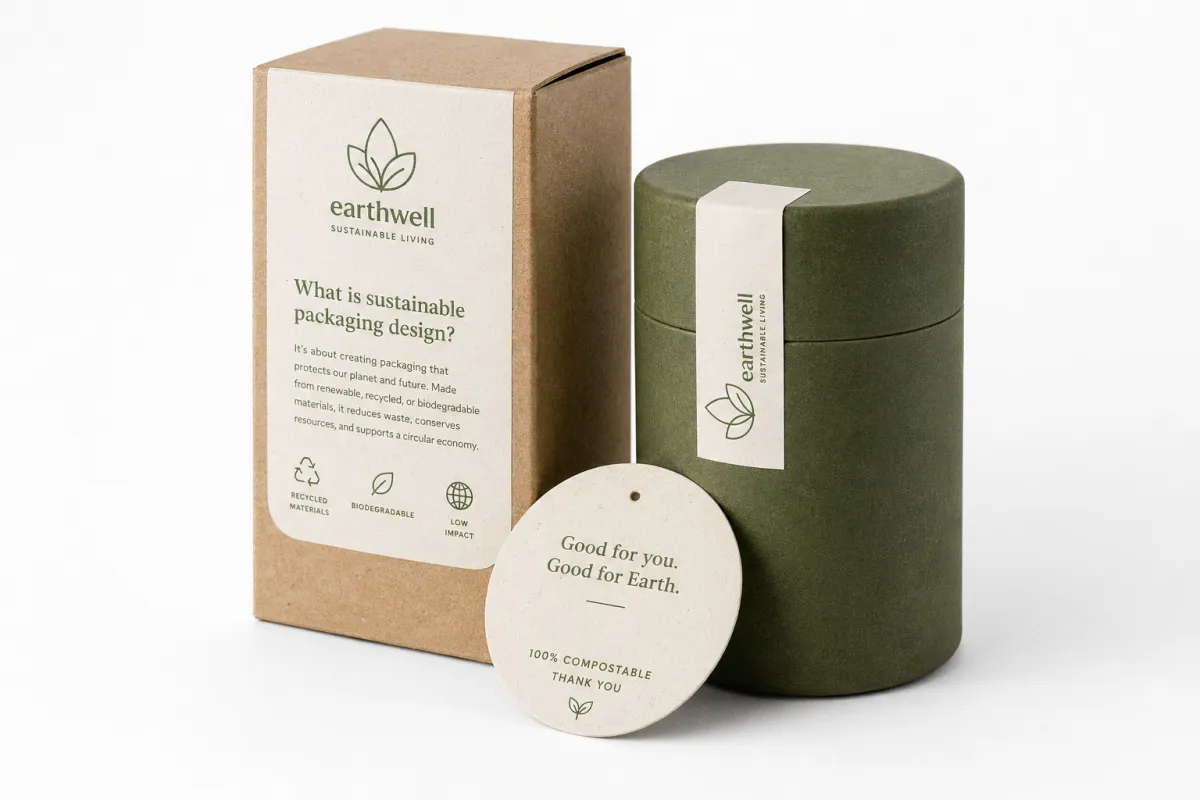
What is sustainable packaging design? In plain business terms, it is packaging designed to reduce environmental impact across sourcing, manufacturing, shipping, use, and end-of-life. The board grade, ink coverage, adhesive pattern, pallet count, and disposal path all matter. I have seen a client save more carbon by removing 6 mm of excess headspace than by switching to a pricier eco-marketed board from a mill in Wisconsin, which is why I treat the whole system as the brief instead of obsessing over a single green-sounding material choice.
At a supplier meeting in Shenzhen, a brand owner pointed at a handsome folding carton and said, “This feels premium, so it must be sustainable.” The carton used 350gsm C1S artboard, aqueous coating, hot foil, and a 40 mm window patch. What is sustainable packaging design in that moment? It is the version that still feels premium after you remove 14 grams of unnecessary material and keep the structure strong enough to pass a 1-meter transit test. I remember thinking, very politely, that “feels premium” is not a measurement system.
I often explain the answer with a blunt comparison: a pack that looks green is not the same as a pack that performs sustainably. One relies on surface cues; the other rests on measurable outcomes such as less waste, better recovery, lower damage rates, and smarter material choices. If you cannot point to a number, you probably do not yet have a sustainability strategy, only a mood and a board mockup from last Tuesday.
“We thought the fancy insert was the upgrade, but the freight cube told us a different story.” That came from a beauty brand buyer in New Jersey after we cut 19% of void space and replaced a two-piece tray with molded fiber sourced from Huizhou. Sustainable packaging design often looks that ordinary: fewer parts, fewer grams, fewer surprises. There is no magic ribbon to tie around it, which is probably why it works.
There is a business case here, and it is hard to ignore. What is sustainable packaging design if not a way to lower material use, freight weight, damage rates, and compliance risk while protecting the brand experience? On one beverage program shipped through Rotterdam, trimming the shipper weight by 8% saved enough pallet cost to offset the slightly higher board price from €0.09 to €0.12 per unit. That trade-off only made sense once we looked at total landed cost instead of sticker price, which is usually where the real story hides.
- Less material: right-sized cartons, thinner calipers, and fewer inserts can cut grams immediately.
- Better recovery: FSC-certified paperboard, recyclable corrugate, or mono-material structures improve the odds that customers dispose of them correctly.
- Stronger protection: a package that prevents returns usually beats a “green” package that fails in transit.
Sustainable packaging design also means being honest about limits. Not every bio-based film belongs on every product, and not every compostable label makes sense if the market has no industrial composting access in Melbourne, Austin, or Madrid. I have watched brands spend two weeks on claim language when the better move was a simpler fiber-based structure and a clearer recycling message printed in 7-point type. That is the sort of thing that can make a room go quiet, but only because the simpler answer is usually the right one. A clean answer is not glamorous, but it is usually the one that survives procurement, legal review, and real life.
How does sustainable packaging design work in practice?
In the factory, sustainable packaging design starts from the inside out. I ask for product dimensions, fill weight, shipping lane, retail display requirements, and end-of-life target before anyone sketches a sleeve or tray. If a lotion bottle has a 58 mm neck, travels from Vietnam to California, and sits in humid distribution centers for 14 days, the board grade, glue line, and closure choice all change with it. There is nothing glamorous about that, but packaging rarely rewards glamour.
The best teams follow a sequence that resists unnecessary detours. Reduce material first. Then choose recycled or recyclable substrates. Only after that do reuse or refill models deserve attention, and only if the system can support them. Sustainable packaging design without that order usually becomes a more expensive version of the same waste pattern, only wrapped in better copy and a nicer render. It is also where circular packaging stops sounding aspirational and starts becoming operational.
Testing is where theory gets exposed. I have seen a beautiful carton fail vibration testing because the corner score was too deep, and I have seen a molded fiber insert pass drop tests while using 22% less material than the foam it replaced. What is sustainable packaging design if it never faces a warehouse pallet in Dallas or a courier belt in Berlin? In my view, it is just a presentation deck with nicer rendering, and I have had enough of those to last several fiscal quarters.
The process is collaborative in a way outsiders often miss. Packaging engineers, converters, printers, co-packers, logistics partners, and sustainability leads all shape the outcome, and one late change can erase a week of savings. I once watched a co-packer in Ohio reject a clever insert because it added 18 seconds to the fill line, which would have cost more in labor than the redesign saved in board. That was a very expensive lesson in seconds, and the stopwatch was less forgiving than anyone in the room.
If you want a reference point, I often send teams to the Sustainable Packaging Coalition at Packaging.org and transit testing guidance from the International Safe Transit Association. What is sustainable packaging design on paper and what is sustainable packaging design in the real world are often different animals, and those resources help close the gap with standards, specs, and test protocols that actually survive procurement.
- Measure the product: actual dimensions, tolerances, and fill weight beat catalog estimates every time.
- Model the journey: pallet height, vibration, temperature swings, and retail handling all matter.
- Prototype early: a 3D mockup or die-line sample reveals weak spots before tooling costs appear.
- Test for the route: ISTA 3A, ASTM D4169, or a custom transit profile should match the shipment.
Key factors that separate good packaging from greenwashing
Material selection is where sustainable packaging design gets serious. Corrugated board, molded fiber, paperboard, mono-material plastic, and some bio-based options can all fit into a smart system, but none of them wins by default. I choose by product type, recovery path, and line compatibility, because a better substrate that jams on the filler in Monterrey is not better at all. I have learned, usually the hard way, that the machine does not care about the slide deck.
Right-sizing creates bigger gains than most people expect. I worked on a supplement carton that trimmed only 4 mm from each side, yet the case pack improved by 12%, the shipper cube dropped by 9%, and freight per unit fell enough to justify the design work. What is sustainable packaging design if not a series of small dimensional wins that stack up? In packaging, millimeters are not trivial. They are the difference between a tidy pallet and a freight bill that makes everyone sigh in the review meeting.
Inks, coatings, adhesives, and laminations are where greenwashing tends to hide. A recyclable paperboard carton with a soft-touch film and UV varnish can turn into a mixed-material headache even if the board itself is FSC-certified. I have seen brands spend money on recycled content, then erase the benefit with a high-gloss laminate and a decorative foil stack from a converter in Guangdong. The package looks refined, but the recovery story becomes muddy fast. It is a little like buying a water bottle and then gluing a brick to it.
End-of-life reality matters more than labels. A curbside recyclable claim means little if the customer’s municipality does not accept that format, and compostable claims can mislead if industrial composting is unavailable in the region. What is sustainable packaging design in practical terms? It is honest about the recovery system, the local infrastructure, and the habits of the people actually throwing the package away in Seattle, Dublin, or Kuala Lumpur. That honesty is less flashy than a certification badge, but it saves a lot more grief.
Brand experience still counts, which is where some teams oversimplify the conversation. Customers want product packaging that opens cleanly, protects the item, and communicates quality without wasteful extras. A stripped-down box that feels cheap can hurt repeat purchase, while a thoughtful structure with 1-color flexo, a matte aqueous coat, and a clean fit can feel premium and responsible at the same time. That balance is the trick, and yes, it is annoying that the trick is rarely the cheapest option at first glance.
- Beware of cosmetic green cues: kraft color alone proves nothing.
- Check recovery access: the package should fit the real recycling or composting path in the buyer’s market.
- Watch mixed materials: small windows, laminations, and decorative wraps often create the biggest disposal problems.
Sustainable packaging design also depends on claim discipline. If you say “recyclable,” you should know where, how, and under what conditions. If you say “FSC-certified,” you should be able to show the chain-of-custody paperwork. I have sat in meetings where a $0.03 claim mistake turned into a legal review that cost far more than the packaging itself. That kind of cost is invisible right up until it is very, very visible.
What sustainable packaging design costs and where the money goes
What does sustainable packaging design cost? The honest answer depends on material, print complexity, minimum order quantities, tooling, testing, freight, and lead time. A plain folding carton at 5,000 pieces can land very differently from a Custom Rigid Box with specialty inserts, because one uses standard tooling and the other needs custom setups, sampling, and more handwork. Packaging budgets love to pretend those are minor details until the invoices arrive, usually with three separate line items from three different vendors.
I prefer comparing unit price with total landed cost. That matters because the cheapest material is not always the least expensive option once you factor in damage, pallet efficiency, and reorders. I once reviewed two options for a skincare line near Toronto: the low-cost pack was $0.11 per unit, but it drove a 2.9% breakage rate; the better-designed pack was $0.18 per unit, yet it saved more in replacements, freight, and customer service credits than the material premium cost. Honestly, I think that kind of math should be taught before anyone is allowed near a sourcing spreadsheet.
Sustainable packaging design can also save money by eliminating unnecessary finishes. A foil accent, emboss, soft-touch film, and magnetic closure can all be defensible on the right brand, but they should earn their place. If the finish adds no recovery value and no sales lift, I question it hard. Sometimes I question it so hard the room starts shuffling papers and checking the clock at 4:12 p.m.
“Remove the window patch and we can hit the price target.” That was a supplier negotiation on a 10,000-unit run in Ho Chi Minh City, and it saved $0.06 per unit overnight. What is sustainable packaging design in a purchasing meeting? Often it is saying no to one decorative layer and yes to a simpler production path. Not thrilling, but very effective.
| Option | Typical use | Approx. unit cost at 5,000 pcs | Lead time | Recovery note |
|---|---|---|---|---|
| Corrugated E-flute | E-commerce mailer, shipper box | $0.18-$0.32 | 10-14 business days | Widely recyclable in most curbside systems |
| 350gsm FSC folding carton | Retail packaging, sleeves, cartons | $0.10-$0.24 | 12-15 business days | Good recovery when coatings stay simple |
| Molded fiber insert | Protective tray, inner cradle | $0.14-$0.28 | 15-20 business days | Strong option where fiber recovery is available |
| Mono-material rPET clamshell | Display pack, product protection | $0.22-$0.46 | 20-30 business days | Depends heavily on local collection and sorting |
These ranges are illustrative, not universal. Resin markets, freight lanes, print coverage, and tooling shape the final number fast.
What is sustainable packaging design if the budget is tight? Start with the highest-volume SKU, not the entire line. On a 60,000-unit beverage program, we saved $0.03 per unit by reducing board caliper and reworking the tuck-in flap, which translated into $1,800 of direct savings before freight. That kind of move is easier to defend than a brand-wide redesign based on aesthetics alone, especially when the CFO wants a payback period under one quarter.
If you are comparing Custom Packaging Products, ask for the board spec, coating, die-line, and MOQ in writing. I would also ask for sample photos under warehouse lighting, because a pack that looks great in a studio can read very differently under 4,000K LEDs on a retail floor in Dallas or Amsterdam. What is sustainable packaging design if the final piece fails the lighting test or the cost model? It is a good-looking concept with a weak business case.
Step-by-step process and timeline for a package redesign
The first step is always a packaging audit. Measure current material use, failure points, shipping costs, return reasons, and where waste appears in the customer journey. What is sustainable packaging design without that baseline? It turns into guesswork. I like to pull three months of damage data, line it up against SKU volume, and identify the package creating the most waste per dollar of revenue. Numbers can be irritating, but they are also useful, which is more than I can say for most “gut feel” debates.
Then define targets. I ask teams to set numbers for cost, protection, recyclability, recycled content, and shelf impact before concept work starts. A target like “reduce ship weight by 8%” is far more useful than “make it greener.” What is sustainable packaging design if the goal cannot be measured? You cannot improve what you refuse to quantify, and you definitely cannot defend it in a review meeting with six stakeholders and one very concerned buyer.
After that, short-list materials and suppliers. Get side-by-side samples, not just marketing sheets, and review the actual construction. I have seen a folded carton with 30% recycled content lose to a cleaner 100% virgin board option because the former warped under humidity in Singapore and the latter held registration perfectly. That is the kind of trade-off no brochure will explain for you, which is why I never trust a brochure to do a production manager’s job.
Prototyping and testing should use real product fills, real warehouse conditions, and real transit scenarios. If you can, run ISTA or ASTM-based testing alongside shelf checks and assembly-line trials. A simple cosmetic change can move quickly, but a structural shift, a new insert, or a new closure can require 6-10 weeks once sampling, approvals, and transit testing are all included. The schedule looks much friendlier on a whiteboard than it does in procurement.
- Audit: capture weight, dimensions, damage rate, and current packaging spend.
- Set targets: choose one primary goal and two secondary goals, such as cost plus recyclability.
- Prototype: review die-lines, mockups, and printed samples before tooling.
- Test: validate in drop, vibration, and warehouse trials with real filled product.
- Launch: lock specs, document claims, and brief logistics and customer service teams.
Timeline matters, and sequencing matters too. A cosmetic refresh can reach proof approval in 12-15 business days if the structure stays the same and the printer already has approved substrates in Shenzhen or Lahore. A deeper redesign with new tooling, a molded fiber insert, and compliance review can stretch into several months. Sustainable packaging design in project management terms is the ability to change one variable at a time and still keep the launch date intact. That sounds simple until three departments decide to tweak one more thing at 5:40 p.m.
I also schedule the packaging review before marketing finalizes artwork. That sounds obvious, yet I have watched teams lock a four-color flood coat and a full-coverage foil pattern before the structural change was approved. Once that happens, the cost of the redesign rises by 15% to 20% because every panel needs a second pass. Small timing mistakes become expensive quickly, which is a polite way of saying they become annoying and expensive.
What is sustainable packaging design for your first redesign?
For the first project, start with one high-volume SKU. That gives you clean data, a meaningful savings base, and a lower-risk place to learn. What is sustainable packaging design for a first redesign? It is usually not a total brand overhaul; it is one package, one problem, and one measurable win. I have seen teams save more by fixing a single oversized mailer than by debating a whole portfolio for six months. In fact, that kind of focus often reveals the real bottleneck faster than any workshop could.
Use a scorecard. Balance cost, carbon, protection, customer experience, and recovery instead of chasing one metric at the expense of the others. I like scoring each option on a 1-to-5 scale, then adding hard numbers like unit cost, grams saved, and defect rate. What is sustainable packaging design without a scorecard? It becomes a preference contest, and those usually reward whoever speaks the loudest. That is not strategy; that is volume.
Ask suppliers for side-by-side samples and production specs so you compare real options, not sales language. I always want board caliper, print method, adhesive type, coating, MOQ, lead time, and transit-test results in the same folder. One client saved two weeks simply because we requested a digital proof and a physical sample at the same time instead of waiting for a second round of revisions from a converter in Kunshan. I wish every project moved that cleanly, but packaging enjoys its little surprises.
Run a small pilot before you roll the redesign across the full line. Collect warehouse feedback, damage data, customer reactions, and returns for at least one shipping cycle, ideally 10 to 14 days. What is sustainable packaging design if it is not proven in the field? It remains a nice concept until real orders tell you otherwise. Once the pilot clears, you can scale with much more confidence, and everyone in operations gets to breathe again.
- Start narrow: one SKU, one carton style, one measured goal.
- Document claims: if you mention recycled content or FSC, keep the proof on file.
- Check shelf impact: branded packaging still has to sell in 3 seconds or less.
- Review the whole chain: sourcing, conversion, logistics, and end-of-life all belong in the same discussion.
What is sustainable packaging design, after all, for a brand that needs both performance and credibility? It is a disciplined way to cut waste, protect the product, and preserve the look and feel customers expect. I have seen it work on Custom Printed Boxes for cosmetics, on retail packaging for snacks, and on product packaging for hardware that had to survive a rough route through distribution from Mexico City to Phoenix. The details change. The principle does not. That is the part I keep coming back to whenever someone asks for a shortcut.
What is sustainable packaging design for e-commerce brands?
For e-commerce, sustainable packaging design usually means right-sizing the box, reducing void fill, and choosing materials that hold up in shipping while using less material overall. On a 2,000-order monthly run, shaving even 1 ounce from the shipper can lower freight spend and cut damage at the same time, especially on routes that move through last-mile hubs in Atlanta or Newark.
How do I know if my sustainable packaging design is actually working?
Measure it against clear metrics such as material weight, damage rate, shipping cost, and recyclability or recovery compatibility. I prefer comparing before-and-after results on real orders, because sample prototypes often look better than production runs with actual warehouse handling in 85-degree summer conditions and 60% humidity.
Is sustainable packaging design always more expensive?
Not always. Some changes cost more per unit upfront, but they can reduce freight, breakage, and waste-related costs enough to improve total landed cost. What is sustainable packaging design worth if it saves $0.03 on materials but adds $0.10 in replacements? Not much, and nobody likes that answer until the invoice arrives.
How long does a sustainable packaging redesign usually take?
A simple change can take a few weeks if the structure stays similar and suppliers already have the right materials. A deeper redesign with new tooling, testing, and approvals can take several months, especially if you need transit validation, revised artwork, and production slots at a converter in Guangdong or Ohio.
Which materials are best for sustainable packaging design?
There is no universal winner. Corrugated board, molded fiber, paperboard, and mono-material options often work well depending on the product and the market’s recovery system. What is sustainable packaging design depends on the product, the route, and the local disposal reality, not just the material label.
The shortest path is also the least theatrical: start with one SKU, measure the current pack honestly, cut the waste that is easiest to prove, and test the redesign before artwork is locked. Do that, and the keyword question turns into a practical method instead of a slogan.


