Buyer Fit Snapshot
| Best fit | Wholesale Biodegradable Warning Stickers for Packaging projects where brand print, material claims, artwork control, MOQ, and repeat-order consistency need to be specified before quoting. |
|---|---|
| Quote inputs | Share finished size, material target, print colors, finish, packing count, annual reorder estimate, ship-to region, and any compliance wording. |
| Proofing check | Approve dieline scale, logo placement, barcode or warning zones, color tolerance, closure strength, and carton packing before bulk production. |
| Main risk | Vague material claims, crowded artwork, missing packing details, or unclear freight terms can make a low unit price expensive after revisions. |
Fast answer: Wholesale Biodegradable Warning Stickers for Packaging should be specified like a repeatable production item. The safest quote records material, print method, finish, artwork proof, packing count, and reorder notes in one written spec.
Production checks before approval
Compare the actual filled-product size with the drawing, then confirm tolerance on folds, seals, hang holes, label areas, and retail display edges. Reserve space for logos, QR codes, warning copy, and material claims before decorative graphics fill the panel.
Quote comparison points
Review material grade, print process, finish, sampling route, tooling charges, carton quantity, and freight assumptions side by side. A quote is only useful when the supplier can repeat the same color, closure quality, and packing count on the next order.
Wholesale biodegradable warning stickers are easy to ignore until one is missing and a carton ends up on the wrong conveyor, the wrong pallet, or the wrong side of a customer complaint. That tiny square of print can decide whether a shipment arrives intact or turns into a return, a reshipment, and a long conversation about preventable loss. For packaging teams shipping glass jars, chilled products, compostable pouches, or anything fragile enough to punish rough handling, wholesale biodegradable warning stickers carry more weight than their size suggests. They signal risk, guide handlers, and support lower-impact packaging choices without adding more plastic into the mix.
The math is hard to dismiss. A warning label may cost only a few cents. A single damaged outbound order can cost hundreds once labor, replacement product, freight, and customer service time are counted. I have seen that gap widen in a warehouse audit where one mislabeled pallet created three separate downstream corrections. The label itself was trivial; the failure around it was not. That is why wholesale biodegradable warning stickers have moved from a nice extra to a practical control for brands that want cleaner packaging and fewer avoidable mistakes.
Buyers comparing bulk label programs usually end up weighing three things at once: speed on the line, legibility on the box, and the material story behind the sticker. A good supplier should match the adhesive to the substrate, the format to the workflow, and the finish to the environment without turning a reorder into a design debate. If your packaging program extends beyond warnings, it helps to keep related print components connected through Custom Labels & Tags and to align replenishment planning through Wholesale Programs.
Wholesale biodegradable warning stickers: the small label that prevents bigger losses
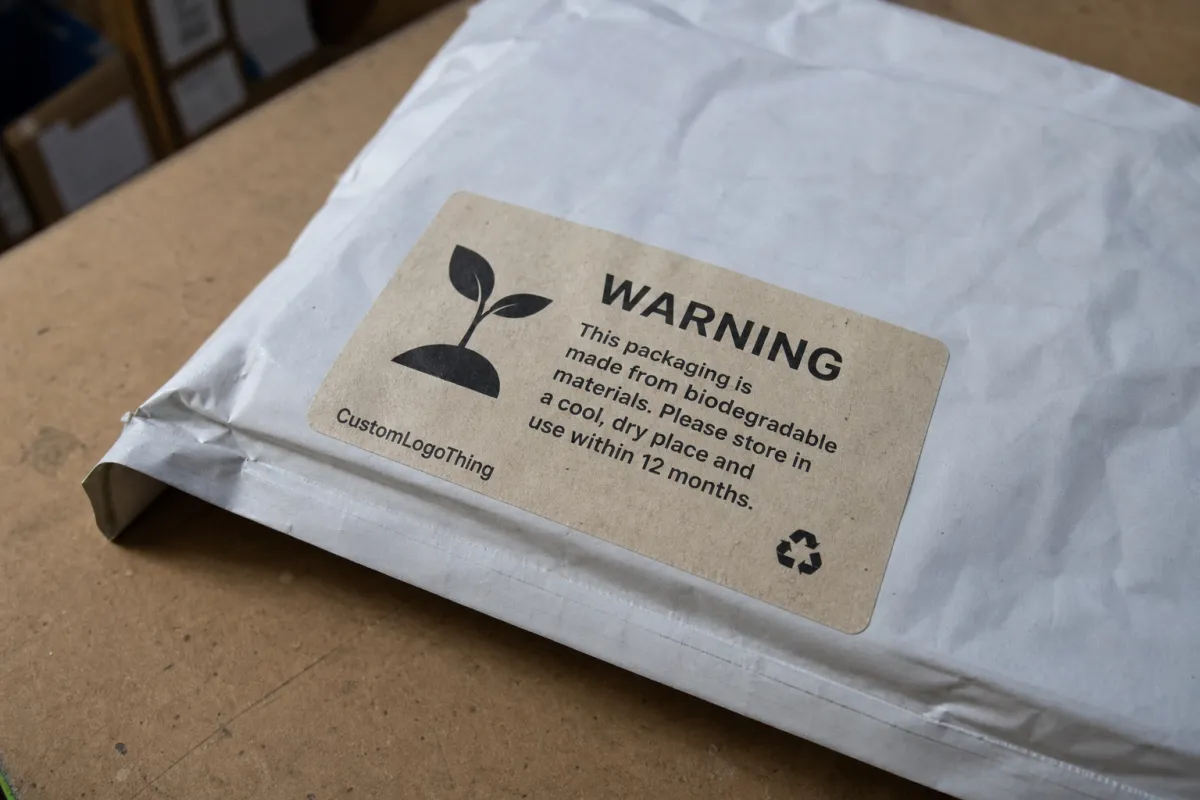
Wholesale biodegradable warning stickers do their best work before the customer ever touches the parcel. On the packing floor, they tell people what the box needs: fragile, keep dry, this side up, temperature sensitive, tamper evident, or compostable-product handling only. A short instruction can stop a carton from being dragged through a wet dock, crushed in a poor stack pattern, or tossed into a mixed pallet where it does not belong. The job is not glamorous. It is closer to traffic control than branding, and that is exactly the point.
Picture a few ordinary but expensive situations. A glass candle brand ships into retail distribution and needs wholesale biodegradable warning stickers that still pop against kraft board. A frozen meal producer needs a warning that survives condensation without curling. A skincare company wants packaging that looks clean and responsible, yet still has to mark fragile product and prevent crush damage during transit. Printing the message on the carton helps, but it often fails once the box is folded, taped, wrapped, and stacked beside fifty others that look almost identical.
That is the point where the label earns its keep. Wholesale biodegradable warning stickers help reduce rework, returns, and customer confusion while keeping packaging aligned with lower-impact material choices. They do not replace packaging design, drop testing, or common sense in a warehouse. They do make the handling rules visible at the exact moment a rushed worker needs them. A label that costs $0.03 and saves a damaged case is doing real financial work, not decorative work.
The sustainability argument matters too, but only if it is honest. Many brands have already switched to recycled board, reduced virgin plastic, or changed how they source outer packaging. A warning label should not drag that progress backward. Wholesale biodegradable warning stickers let teams preserve the handling message while removing unnecessary plastic from the system. That is useful for companies reporting on material reduction, packaging waste, and recyclability, especially when procurement and sustainability teams are both watching the same data.
There is a reason the bulk math still favors this category. A larger label order may shave only a fraction of a cent off each unit, but those savings compound across thousands of cartons. One preventable mistake can erase the benefit of an entire quarter's worth of label savings. Procurement people know this instinctively. Total cost of ownership tells a different story than the headline unit price, and wholesale biodegradable warning stickers usually win that comparison when they prevent even a small amount of damage.
"A warning label should shorten a decision, not add one."
For packaging buyers, that means the specification has to be plain enough to run fast, durable enough to survive the trip, and readable enough to work with mixed crews and shifting shifts. Wholesale biodegradable warning stickers are strongest when they make the right action obvious in a second or less.
Wholesale biodegradable warning stickers by use case and format
The right wholesale biodegradable warning stickers depend on the job. A fragile label for a retail carton of cosmetics is not the same thing as a warning label for palletized chilled food, and neither one should be specified like a compostable pouch notice. Size, message, material, and adhesive all move with the use case. Teams that treat every warning sticker as interchangeable usually discover the mistake on the dock, not in the quote.
The most common messages are familiar for a reason: fragile, this side up, keep dry, temperature sensitive, tamper evident, and handling notes for compostable products. Those phrases work because they are fast to read. Nobody on a packing line has time for a paragraph. A bold icon and three to five words are usually enough. For wholesale biodegradable warning stickers, clarity matters more than ornament. The whole point is to be understood without stopping the flow.
Most buyers end up choosing between three formats. Rolls fit high-volume packing lines where labels need to dispense quickly and repeatedly. Sheets make more sense for office fulfillment, small teams, or low-volume hand application. Custom cut shapes are useful for retail programs that want a more polished presentation or a warning shape that mirrors the product line. Each format comes with a tradeoff. Rolls are fast. Sheets are flexible. Custom cuts look sharper and often cost more to set up.
These labels show up on mailer boxes, corrugated cartons, jars, pouch packs, envelope packs, shrink-wrapped bundles, and outer shipping cases. In many sustainable packaging systems, wholesale biodegradable warning stickers sit on recycled board or kraft stock with little visual contrast. That is where legibility becomes a practical issue instead of a design preference. If the warning disappears into the substrate, the sticker is just taking up space.
Size should follow the reading distance. A 2 x 3 inch label can work on a small parcel or carton panel. A 3 x 5 inch label often suits pallet cases or cold-chain packs where the message needs to be understood from several feet away. The worker applying it should not need to pause and squint. Good wholesale biodegradable warning stickers disappear into the workflow because they are easy to read the first time.
Icons help too. A wine-glass fragility symbol, an umbrella for keep dry, or arrows for this side up can cut across language barriers in mixed crews and seasonal labor pools. That matters in warehouses where contractors, multilingual teams, and outsourced fulfillment all touch the same shipment. A good layout keeps the art simple and bold. It should guide the hand, not compete for attention like a poster on a wall.
Buyers often compare the available formats like this:
| Format | Best for | Typical strength | Typical tradeoff |
|---|---|---|---|
| Roll labels | High-volume packing lines | Fast application, easy dispensing | Less convenient for office use |
| Sheet labels | Manual fulfillment and low-to-mid volume | Flexible, easy to store | Slower than rolls on busy lines |
| Custom cut shapes | Retail-ready presentation and branded programs | Distinct visual impact | Higher setup and die cost |
Wholesale biodegradable warning stickers work best when the format matches the pace of the operation. The wrong choice creates friction every day. The right choice becomes invisible because the process just works.
Material specs, adhesion, and print details buyers should verify
Material choice decides whether wholesale biodegradable warning stickers perform or disappoint. A supplier may describe the face stock as biodegradable, but that label means very little if the adhesive fails on recycled board or the liner fights the dispensing setup. Buyers should ask for the actual construction, not just the marketing version. In procurement terms, that means confirming face stock, adhesive, liner, finish, thickness, and expected use conditions before the order is approved.
Start with the substrate. A biodegradable paper face stock is often the most practical choice for warning labels, especially when the text has to stay crisp and the design needs strong contrast on brown kraft cartons. Some buyers prefer compostable face stocks or FSC-certified paper when sourcing documentation matters. FSC, however, speaks to fiber origin and responsible forestry, not to biodegradability on its own. If the supplier uses the word compostable, ask what standard it meets, what part of the label was tested, and under which conditions. For sourcing context, the FSC certification standards are a useful reference when paper origin affects the buying decision.
Adhesive choice can matter just as much as the paper itself. A permanent adhesive suits most corrugated cartons and outer shipping cases. A removable adhesive may be better for returnable packaging or temporary handling notices. A freezer-grade or cold-chain adhesive is essential when the product will meet refrigeration, condensation, or sub-zero storage. Skip that check and even strong wholesale biodegradable warning stickers can start to curl, lift, or fail after a temperature swing.
Print method matters in bulk programs too. Flexographic print is common for large roll runs with repeating warning messages. Digital print helps with variable data, shorter runs, or several versions of the same warning copy. One-color black on white or black on kraft is usually enough. Red and orange can add urgency, yet contrast matters more than decoration. A label that looks polished but reads poorly is bad value.
In one plant visit last spring, I watched a perfectly proofed label peel at the corners after twenty minutes in a chilled staging room. The problem was not the artwork. It was the adhesive, which had been specified for ambient cartons and not the cold surface it actually met. That is a common failure pattern, and it is why sample testing matters more than a polished PDF.
What to verify before approval
Before approving wholesale biodegradable warning stickers, buyers should confirm a few technical details that can change how the labels behave in production:
- Finish: matte or uncoated surfaces usually improve writeability and readability.
- Thickness: enough stiffness to dispense cleanly, but not so much that it bridges on curved cartons.
- Roll direction: critical for label applicators and fast hand placement.
- Core size: often 1 inch or 3 inches, depending on the dispensing setup.
- Temperature range: confirm whether the label must hold in chilled, frozen, or ambient conditions.
- Surface compatibility: test on corrugated, recycled cardboard, coated cartons, pouches, and slightly textured board.
The substrate tells its own story. A label that clings perfectly to a coated carton may fail on recycled board with more fiber lift. A warning sticker that behaves on a flat mailer may act differently on a curved jar carton or a pouch with condensation on it. Sample testing is not a luxury here. A small run on your own packaging is more useful than a spec sheet that never touches the warehouse.
Legibility deserves the same attention. Type size needs to be large enough for a dock worker to read at a glance, and the icon should stay clean even when the label is printed in one color. Dark kraft needs high contrast. Long copy needs editing. Wholesale biodegradable warning stickers usually fail when they try to say too much. The good ones say the right thing in the fewest words possible.
Compliance context matters as well. If the shipment is fragile, high-value, or especially sensitive to handling, buyers may want label selection paired with packaging performance testing guided by ISTA test methods. Labels do not replace shipment testing. They should survive the same handling realities the pack-out already faces. That is especially true for wholesale biodegradable warning stickers used on chilled goods, breakables, or cartons that move through several hands before delivery.
One last point deserves a blunt answer: a sticker is only biodegradable if the full construction supports that claim. Paper face stock on its own does not mean much if the adhesive or liner introduces a different disposal profile. Ask for the actual build, request documentation, and compare the supplier's wording against your sustainability requirements. That discipline keeps wholesale biodegradable warning stickers from turning into a vague promise instead of a verifiable packaging choice.
Cost, pricing, and MOQ for wholesale orders
Price is where many teams begin, though it should not be where they finish. For wholesale biodegradable warning stickers, unit cost depends on quantity, size, face stock, adhesive, print complexity, and whether the labels are rolled or sheeted. A simple one-color warning label in bulk can be economical. A custom shape with several colors and a specialty adhesive will cost more. That follows normal print economics: more setup, more labor, less production efficiency.
As a rough range, many wholesale warning label programs land around $0.02-$0.08 per unit at higher volumes, while smaller orders or more complex builds can sit around $0.08-$0.20 per unit. Those numbers move with artwork coverage, finish, and the material selected. A buyer comparing quotes on wholesale biodegradable warning stickers should assume the lowest headline number may leave out setup, proofing, freight, or specialty finishing. The real number is the landed cost.
MOQ usually follows the production method. If a supplier is printing a standard warning design on a common roll format, the minimum may stay relatively low. If the job needs a Custom Die Cut, several print colors, or a specialty biodegradable construction, the MOQ rises because the supplier has to spread setup costs across enough labels to make the run efficient. That is not a penalty. It is how the press gets paid.
Smart buyers compare quotes only after they have matched the spec line by line. Same dimensions. Same face stock. Same adhesive. Same quantity. Same roll or sheet format. Same delivery terms. Otherwise, one quote may look cheaper simply because it is not the same product. That mistake comes up often with wholesale biodegradable warning stickers, and it creates false savings that disappear the moment the labels hit the floor.
It helps to break the cost stack into pieces:
- Setup or plate fees: often tied to print method and custom artwork.
- Material cost: varies by paper stock, compostable construction, and liner choice.
- Printing: one-color jobs are usually cheaper than full-color or multi-version orders.
- Finishing: die cutting, varnish, roll slitting, and packaging all add labor.
- Freight: weight and carton count matter more than buyers expect.
Some projects justify a larger order because the unit price drop is meaningful. Others need a lower MOQ because the warning copy may still change or the packaging line has not stabilized yet. The goal is not to buy the biggest volume available. The goal is to match inventory to usage so wholesale biodegradable warning stickers are not sitting in storage while the spec changes.
| Order type | Typical MOQ | Indicative unit price | Best fit |
|---|---|---|---|
| Stock-style warning labels | 1,000-2,500 pieces | $0.05-$0.12 | Fast replenishment and simple messaging |
| Custom roll labels | 5,000-10,000 pieces | $0.02-$0.08 | Higher-volume fulfillment lines |
| Custom sheet labels | 250-1,000 sheets | $0.06-$0.15 | Manual packing and lower-volume teams |
| Specialty shape or multi-color run | 10,000+ pieces | $0.04-$0.18 | Retail-facing presentation or unique specs |
That table is not a quote. It is a practical frame for procurement discussions. If one supplier offers wholesale biodegradable warning stickers at a lower unit price but demands a much larger MOQ, the storage burden and cash flow hit may wipe out the savings. The strongest procurement choice usually balances unit cost, inventory risk, and reorder frequency instead of chasing the lowest number in isolation.
Put plainly, the right wholesale run is the one your operation can actually use. A label that saves two cents but forces six months of storage is not automatically the better buy. Packaging buyers know this from experience. The best deals reduce friction instead of creating a new kind of headache.
Production steps, process, and timeline from proof to ship date
The production path for wholesale biodegradable warning stickers is usually straightforward, yet small delays can pile up fast if the brief is incomplete. Most jobs move through the same stages: artwork intake, material recommendation, proof creation, approval, production, finishing, packing, and dispatch. Each step serves a purpose. The more accurate the buyer's information, the less time the order spends in limbo.
Artwork intake is where many projects slow down first. Low-resolution files, fuzzy icons, vague dimensions, or long warning copy all make proofing harder than it needs to be. A clean brief should include size, quantity, intended surface, adhesive needs, print colors, and any sustainability requirement tied to the label construction. For wholesale biodegradable warning stickers, the supplier should know whether the labels are going on corrugated board, kraft mailers, chilled cartons, or a slightly textured pouch.
The proof comes next. This is the moment to check bleed, trim, icon size, contrast, and copy accuracy. If the label needs a specific Pantone target, confirm it here. A common failure point is approving a proof too quickly and then realizing the wording needs a tweak after production has already started. That kind of change can push the job back by days, sometimes more.
A realistic timeline for first-time custom wholesale biodegradable warning stickers is often 12-15 business days from proof approval, depending on the material and the finishing method. Repeat runs can move faster, especially if the artwork has not changed and the supplier already has the die or print setup on file. Rush work is possible in some cases, and rush pricing should be expected. Speed always costs something.
If the labels are intended for cold-chain use or for cartons that will sit in a humid staging area, build a little extra time into the schedule. That testing window is usually cheaper than discovering an adhesion problem after the shipment is already packed. I have seen a three-day rush turn into a two-week correction because no one tested the label on the real carton surface first.
What should be checked before approval?
Before the order enters production, buyers should confirm a few checkpoints:
- Dimensions: the label fits the carton panel and leaves enough margin from folds or seams.
- Bleed and trim: no important copy sits too close to the edge.
- Readability: the warning text is legible at the intended distance.
- Material fit: the face stock and adhesive match the application surface and storage conditions.
- Quantity: the order count includes reasonable overage for line use and spoilage.
The checklist is simple because it has to be. Simple errors create expensive noise downstream. A wrong dimension can stop a line, waste a proof cycle, or force manual work that nobody planned for. The same logic applies to wholesale biodegradable warning stickers: if they are meant for a specific panel size or dispenser setup, the proof has to reflect that reality, not a best-guess version of it.
After approval, production moves through print, cut, inspection, packing, and shipping. If the job uses rolls, the supplier should confirm core size and winding direction. If it uses sheets, pack count and carton dimensions matter more. Buyers managing launches, replenishment, or seasonal spikes should ask how the labels will be packed and how many cartons to expect. That is how receiving stays predictable and warehouse space does not get swallowed by surprise inventory.
For unusual applications, a sample before the full run is often worth the time. That is especially true for wholesale biodegradable warning stickers going onto cold-chain cartons, rough recycled board, or packaging that passes through multiple handling stages. A sample can expose adhesive problems or contrast issues before they become expensive problems at scale.
In short, the schedule is only as good as the brief. Clear artwork, clear specs, and fast proof review are what keep wholesale biodegradable warning stickers on time and out of the delay pile.
Why buyers switch to our wholesale biodegradable warning stickers
Packaging buyers rarely switch suppliers because they are chasing novelty. They switch because the old arrangement was slow, inconsistent, or hard to trust. That is the real appeal of wholesale biodegradable warning stickers from Custom Logo Things: consistent print quality, dependable adhesion, material options that fit sustainability targets, and quotes that do not take days to arrive. In packaging, reliability is often more valuable than cleverness.
A packaging-focused supplier usually asks better questions. A general print shop may be able to make a sticker. A supplier who understands shipping and fulfillment is more likely to ask how fast the line moves, what the label is sticking to, whether the carton will be refrigerated, and how far away the warning has to be read. Those details separate a nice-looking label from one of the more useful wholesale biodegradable warning stickers in the workflow.
Quality control matters more in bulk runs than many buyers expect. A small order can hide a weak adhesive or a slightly off die cut. A larger run exposes those problems quickly. That is why consistency checks should cover color alignment, cut accuracy, roll tension, and adhesive integrity. If the label feeds unevenly or lifts on recycled board, the whole packing line feels it. Reliable wholesale biodegradable warning stickers should dispense cleanly and stick the same way from first label to last.
Supply stability is another reason teams stay with one vendor. Packaging operations care more about repeatability than novelty. If a label spec works in March, it should work the same way on the next reorder. That stability matters for seasonal demand, e-commerce replenishment, and contract packaging. It also helps when warning labels are ordered as part of a broader packaging schedule instead of as a panic buy after a problem surfaces.
Reporting matters too. Many brands now track packaging reduction, recycled content, and responsible sourcing. Biodegradable or FSC-aligned warning labels can support that story without weakening handling communication. The trick is to document the material honestly and Choose the Right label for the actual use case. Wholesale biodegradable warning stickers are strongest when the sustainability claim and the operational performance both survive scrutiny.
Service matters in procurement because procurement never ends at the product page. Fast answers, clean proofs, realistic lead times, and clear minimums save time. That becomes even more valuable on repeat orders, where the team is not experimenting with a new design but simply replenishing a proven SKU. A supplier that treats wholesale biodegradable warning stickers as a packaging system component rather than a throwaway printed item is usually easier to work with over the long run.
There is also a quiet operational benefit: once the label spec is locked, ordering becomes easier to forecast. Finance likes that. Operations likes that. The warehouse likes that. Fewer surprises. Fewer emergency buys. Fewer compromises. It is not flashy, but it is the kind of value that shows up in the monthly numbers.
Next steps: request samples, compare specs, and place the order
If you are ready to buy wholesale biodegradable warning stickers, start with samples in the exact size, material, and adhesive you plan to use. A label can look perfect in a proof and still behave differently on your own carton stock. Sample testing is worth the extra day or two. Check adhesion on the real surface, read the copy at arm's length, and see whether the label still looks clean after handling.
Send the supplier the full brief up front. Quantity, dimensions, artwork, surface type, storage conditions, and any sustainability requirement should all be in one message. That makes the quote more accurate and cuts down on back-and-forth. For wholesale biodegradable warning stickers, clarity at the quoting stage usually saves more time than later revisions can recover.
- Compare at least two material options side by side, especially if you are deciding between paper stock and a more specialized compostable construction.
- Ask for the landed price, not just the unit price, so setup, proofing, and freight are visible.
- Confirm the MOQ and lead time against your reorder cycle and storage space.
- Verify whether your message needs a one-color warning or a color-coded system for different products.
- Lock the spec before the first production run so repeat orders stay consistent.
If your operation handles multiple SKUs, standardizing label sizes can make a real difference. One or two common formats are easier to store, easier to reorder, and easier to train on. That is especially helpful for wholesale biodegradable warning stickers used across several packaging lines or seasonal product ranges. Standardization saves time every time someone reaches for a label.
Before placing the order, think through receiving, storage, and deployment. A strong quote is not enough if the team does not have the right reel orientation, enough shelf space, or a clear reorder point. Those operational details matter as much as print quality. They always have.
Wholesale biodegradable warning stickers are a small purchase with a large operational footprint. The practical path is simple: print one sample on the real carton, test it in the temperature and humidity your shipment will actually face, compare the landed cost line by line, and approve the spec only after the adhesive, roll direction, and label size all match the workflow. That sequence prevents most expensive surprises and keeps the next reorder easy to repeat.
Frequently Asked Questions
What makes wholesale biodegradable warning stickers biodegradable in real use?
Look for a paper or compostable facestock paired with a liner and adhesive that are documented by the supplier, not just described loosely in sales copy. Ask for material specifications and test conditions so you know how the label performs on real packaging surfaces. The best wholesale biodegradable warning stickers are backed by clear construction details, not vague claims.
Are wholesale biodegradable warning stickers suitable for cold-chain packaging?
They can be, but only if the adhesive is rated for refrigerated or freezer conditions. Test the label on the exact carton or pouch you use, because condensation and texture can change performance. For chilled or frozen goods, a sample run is a smart move before you commit to a full order of wholesale biodegradable warning stickers.
What is a typical MOQ for biodegradable warning stickers wholesale?
MOQ depends on size, print setup, material, and whether the order is rolled or sheeted. Custom shapes and multi-color print usually require a higher minimum than standard stock formats. The best quote usually balances MOQ against unit price, storage space, and how often you reorder, especially for wholesale biodegradable warning stickers that need repeat buying.
How do I compare pricing on wholesale biodegradable warning stickers fairly?
Match the same dimensions, material, adhesive, print color count, and finishing method across every quote. Check whether the price includes setup, proofing, packaging, and shipping, because those costs can change the real total. Compare unit cost only after you confirm the same spec; otherwise the cheapest quote may be a different product. That rule is especially useful for wholesale biodegradable warning stickers.
Can you customize the warning text, icons, and language on these stickers?
Yes, most wholesale runs can be customized with your warning text, handling icons, brand colors, and multilingual copy. Keep the message short so it remains readable at a glance on fast-moving packing lines. Provide artwork and any compliance language early so the proof stage does not delay production. Customizing wholesale biodegradable warning stickers is usually straightforward when the brief is complete.

