Buyer Fit Snapshot
| Best fit | packaging buyers who need clearer specs, stronger internal paths, and repeatable quote decisions where brand print, material, artwork control, and repeat-order consistency matter. |
|---|---|
| Quote inputs | Share finished size, material target, print colors, finish, packing count, annual reorder estimate, and delivery region. |
| Proofing check | Approve dieline scale, logo placement, barcode or warning zones, color tolerance, and any recyclable or compostable wording before bulk production. |
| Main risk | Vague material claims, crowded artwork, or missing packing details can create delays even when the unit price looks attractive. |
Fast answer: Wholesale Box Dividers for Glassware: Specs and Pricing should be specified like a repeatable production item. The safest quote includes material, print method, finish, artwork proof, carton packing, and reorder notes in one written spec.
What to confirm before approving the packaging proof
Check the product dimensions against the actual filled item, not only the sales mockup. Ask for tolerance on folds, seals, hang holes, label areas, and retail display edges. If the package carries a logo, QR code, warning copy, or legal claim, reserve that space before decorative graphics fill the panel.
How to compare quotes without losing quality
Compare board or film grade, print process, finish, sampling route, tooling charges, carton quantity, and freight assumptions side by side. A lower quote is only useful if the supplier can repeat the same color, closure quality, and packing count on the next order.
Wholesale Box Dividers for Glassware: Specs and Pricing Wholesale box dividers for glassware are the unglamorous part that keeps a shipment from arriving as a noise complaint. A 24-count stemware order only ships cleanly if the carton interior, divider cell size, and pack pattern actually match the product. Give the glasses too much room and the box turns into a moving target. Glass always loses that fight.
Why Glassware Breakage Usually Starts in the Carton
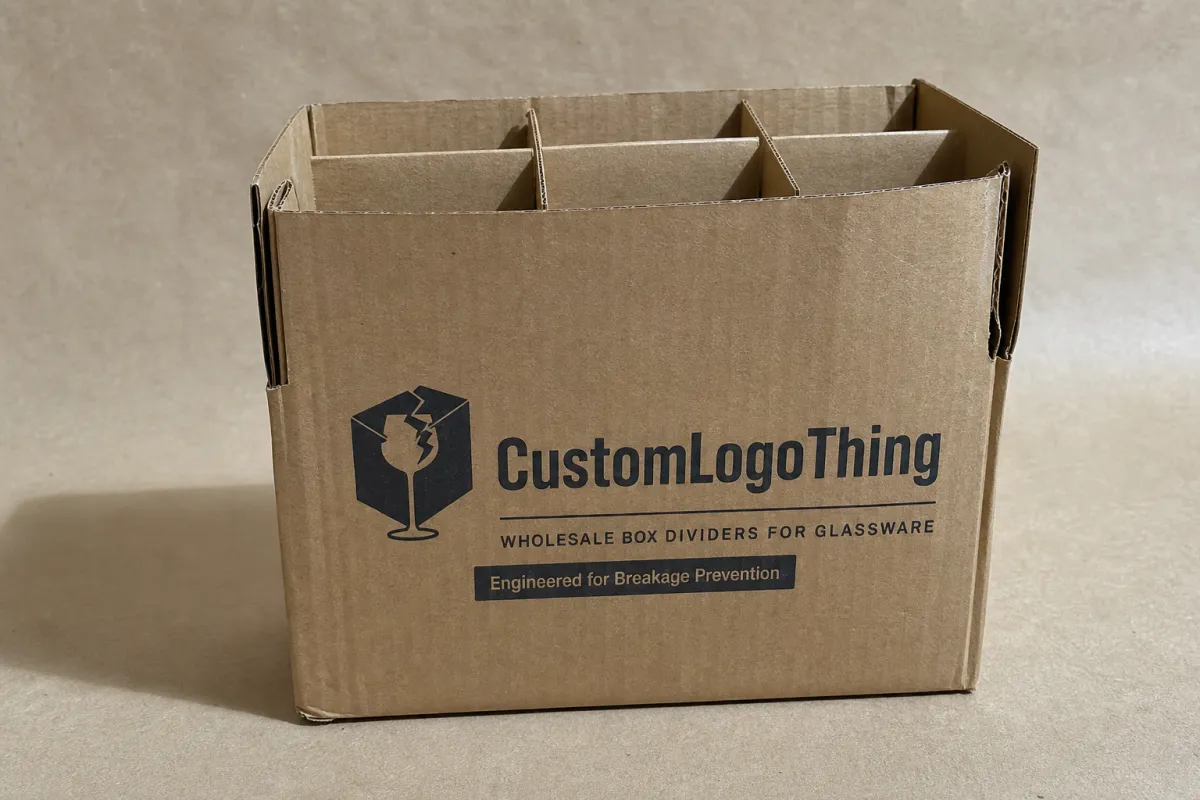
Open a damaged shipment and the cause is usually painfully ordinary. The product was fine. The route was normal. The carton just let the load move around too much. That is why wholesale box dividers for glassware matter so much: they isolate each piece before vibration, drop shock, and compression start attacking the rims and bases.
Packaging buyers often blame the glass first because it is easier. Usually wrong, though. A stemware order can fail because the carton leaves a little side-to-side motion, because the divider sits too low, or because the packer had to force the set into a box that only looked close on paper. The shipper survives. The product pays for it every mile after that.
The real cost shows up after the label is printed. Replacement product costs money. Repacking costs money. Freight on the resend costs money. Customer service time costs money. Then there is the part nobody wants to say out loud: once a buyer sees repeated breakage, the packaging spec stops getting trusted. One busted case can erase the savings from a cheaper insert.
Breakage is rarely one huge failure. It is usually a small fit problem repeated across hundreds of cartons.
Box dividers are not decoration. They standardize pack speed and make the same carton behave the same way across shifts, facilities, and co-packers. That matters for barware, wine glasses, tumblers, and specialty glass in volume. A pack that works only when your best operator handles it is not a process. It is a gamble with a label printer.
The job is to match the divider to the actual shipping reality: glass dimensions, carton interior, lane length, carrier network, and pack pattern. Parcel shipments take different abuse than palletized freight. Regional distribution needs different tolerance than national e-commerce. The goal is not the heaviest board on the market. The goal is a repeatable pack-out that keeps fragile glass moving without turning into an incident report.
Wholesale Box Dividers for Glassware: What They Are and How They Work
Wholesale box dividers for glassware are interlocking inserts that create separate cells inside a shipping carton. Each glass gets its own slot, so one piece cannot slam into the next during transit. That separation is the whole point. Contact, spacing, and movement get controlled before the carton leaves the dock.
The common formats are plain corrugated partitions, cross-style inserts, chipboard dividers, and custom die-cut layouts. Cross partitions show up everywhere for standard drinkware counts because they assemble fast and create consistent cells. Slotted corrugated partitions add stiffness and hold up better in rough lanes. Chipboard can work for lighter, lower-risk applications, but it gives you less crush resistance. Custom die-cut layouts make sense when the shape is unusual, like oversized cocktail glasses, narrow-stem flutes, or barware with a delicate rim profile.
What makes a divider work is not just the material. It is the relationship between cell size, divider height, and the glass itself. A good fit holds the glass upright without pinching it. Too tight, and packing gets annoying and the rim takes stress. Too loose, and the glass rattles in the compartment every time the carton gets touched. There is a narrow range where the pack stays secure and easy to assemble. That is the range worth paying for.
Different glass types need different structures:
- Stemware usually needs more vertical clearance and tighter side control to protect the stem and bowl.
- Tumblers benefit from snug cell walls and bottom support because they carry more weight at the base.
- Wine glasses need room for the bowl without giving the rim space to knock around.
- Cocktail glasses often need extra attention at the top edge because the shape is less forgiving.
- Specialty barware may need custom cell widths if the geometry changes from one SKU to the next.
Good divider design also protects labor. If packers have to fight the insert, turn glasses sideways to make them fit, or keep reworking cartons that will not close, the structure is wrong or the dimensions are off. The best insert disappears into the workflow. It loads fast, closes cleanly, and ships the same way every time.
For buyers comparing options, the right question is not “What divider is strongest?” The better question is “What divider protects this product in this lane at the lowest total cost?” A medium-weight corrugated partition can beat a heavier one if it packs faster and cuts waste. Custom can be worth it when the glass shape is awkward and expensive. There is no prize for overbuilding a carton and paying for the extra freight every week.
Specifications That Matter: Size, Board Grade, and Cell Count
Before you Request a Quote, lock down the dimensions that actually drive the design. Internal carton size matters more than outer box size. Glass height, top diameter, base diameter, and the widest point on the bowl all affect the divider layout. Skip one measurement and the supplier is guessing. Guessing is how you end up with a divider that looks fine in a spreadsheet and useless in production.
Here is the spec list that should be on every request:
- Carton internal dimensions in inches or millimeters.
- Glass height, plus the widest and narrowest diameter points.
- Pack count per carton, such as 6, 12, or 24.
- Divider format, including cross partition, slotted board, or custom die-cut.
- Board preference, such as corrugated, chipboard, or heavy-duty partition stock.
- Shipping method, including parcel, LTL, or mixed distribution.
- Assembly style, meaning flat-packed components or pre-assembled sets.
Board grade changes the whole equation. Lightweight board can be a smart choice for short lanes or lower-risk drinkware, especially if freight is tight and the carton already fits well. Heavier corrugated, like a stronger ECT-rated board or double-wall construction, makes more sense for long shipping distances, palletized freight, or high-value glass. Extra stiffness helps with crush resistance and keeps the divider from collapsing when cartons stack.
Cell count matters too. More cells usually mean better isolation, but they also increase pack time, carton weight, and sometimes material cost. Fewer, larger cells can handle oversized drinkware, but only if they still control movement. If the cell is too generous, the product becomes its own impact load. A divider does not protect glass by being roomy. It protects glass by being precise.
Clearance is another detail buyers miss. You need enough space for fast loading and safe closure, but not so much room that the glass can tip, slide, or bounce. In practice, the target is usually a tight fit with some assembly tolerance, not a loose fit held together by hope. A carton should close without forcing the contents and without making the operator compress fragile product into place.
Compatibility gets overlooked constantly. Divider height has to work with the outer shipper and any pads, corner supports, or molded inserts in the pack. Flute direction matters. Stack height matters. So does whether the carton is hand-packed at one facility or kitted by a co-packer somewhere else. A spec that runs well in a test pack can still fail if it does not fit the real line.
If a shipment needs formal validation, ask about test methods such as ISTA procedures or relevant ASTM packaging tests. For higher-risk shipments, a simple drop test is not enough. Glassware that moves through parcel networks can benefit from a more realistic distribution simulation. If the supply chain needs responsibly sourced fiber, ask for FSC documentation and check the supplier against the standards at FSC.
Practical spec ranges buyers can use
For common drinkware programs, divider cells often fall into these practical ranges:
- Stemware: cells around 2.5 to 3.75 inches wide, depending on bowl and stem shape.
- Tumblers: cells around 3 to 4.5 inches wide, with stronger bottom support.
- Mixed sets: custom cell grids that combine narrow and wider compartments in one carton.
- Heavy barware: thicker board and tighter compartment control, especially for parcel shipping.
These are starting points, not a universal rule. A thick-walled pint glass and a thin-rimmed coupe need very different treatment even if their overall heights look similar. That is why a decent supplier asks for product samples or detailed drawings before quoting. If they do not ask, they are probably planning to sell you something “close enough.” Close enough is not a packaging strategy.
Cost, Pricing, MOQ, and Unit Cost Drivers
Pricing for wholesale box dividers for glassware comes down to a small set of variables, and none of them are mysterious. Material grade, divider complexity, cell count, custom sizing, print, and order volume do most of the work. A simple stock partition in a common size costs far less than a custom layout built for a fragile, odd-shaped glass line. More structure usually means more cost. Normal. Not shocking.
MOQ follows the same logic. Stock or commonly used sizes may be available in lower quantities because the setup burden is already spread across existing production. Custom work usually needs a higher minimum order because the manufacturer has to justify tooling, setup, and waste from the first run. If you only need a small pilot, ask for a sample batch or a limited production run before committing to a full wholesale order.
Here is a practical pricing snapshot for typical packaging-only cost, assuming standard print-free production and common carton-friendly formats. These are not universal quotes; they are useful buying ranges.
| Divider option | Best for | Typical MOQ | Common unit price range | Notes |
|---|---|---|---|---|
| Chipboard partitions | Lightweight tumblers, lower-risk lanes | 500 to 1,500 units | $0.10 to $0.22 | Lower cost, less crush resistance |
| Standard corrugated cross dividers | Most glassware packs, mixed distribution | 1,000 to 3,000 units | $0.16 to $0.34 | Good balance of speed and protection |
| Heavy-duty slotted partitions | Longer shipping lanes, higher-value glass | 1,500 to 5,000 units | $0.24 to $0.48 | Better stiffness, higher material cost |
| Custom die-cut divider sets | Odd shapes, premium stemware, specialty barware | 3,000 to 10,000 units | $0.30 to $0.75 | More setup, more fit control |
Those numbers move up or down based on carton size, board spec, and order volume. A small divider with a simple fold pattern can be very economical. A large insert with multiple cell depths, heavier board, or a precise fit around delicate rims will cost more. Freight matters too, especially if the divider ships flat in bulk or if the supplier quotes delivered pricing instead of ex-factory pricing.
Unit cost is not the only cost that matters. A divider that saves $0.04 per unit but slows packing by 8 seconds can erase the savings immediately. Multiply that across thousands of cartons and the “cheap” option starts looking expensive. The lowest quote is often the one that makes the whole operation cost more.
Buyers should also watch for pricing traps:
- Over-specifying board strength for a lane that does not need it.
- Choosing the wrong cell count and forcing packers to slow down.
- Ordering a divider that barely fits and creates rework on the line.
- Comparing quotes with different inputs, which makes the numbers meaningless.
If you want a fair quote, send the same data every time: carton internal dimensions, glass dimensions, pack count, material preference, and shipping destination. Anything less turns pricing into a guessing contest. No one needs that in packaging.
Process and Timeline: From Spec Sheet to Production
A clean ordering process saves time and avoids expensive revisions. The usual sequence is straightforward: sizing review, divider recommendation, sample or dieline approval, production scheduling, manufacturing, quality check, and shipment. Better input means fewer rounds before you get to a usable spec.
Missing dimensions cause the most delays. So do blurry photos, unclear pack counts, and last-minute changes after the quote is approved. If a buyer sends only a product name and expects the supplier to infer the rest, the timeline stretches. Glassware is too sensitive for vague specs. The divider has to work in the box, not in the imagination.
Standard jobs move faster than custom jobs. A common cross divider in an established carton size can move quickly because the structure is already known and the setup is simpler. Custom divider work adds time for fit confirmation, structural review, and manufacturing setup. That does not mean custom is slow by default. It means custom needs an actual process instead of a shrug.
Typical production cadence
- Day 1 to 2: Collect measurements, carton size, and product photos.
- Day 2 to 4: Review structure, confirm layout, and issue pricing.
- Day 4 to 7: Approve sample or dieline if the job is custom.
- Day 7 to 15: Schedule production for standard runs.
- Day 12 to 20+: Manufacture, inspect, and ship custom divider orders, depending on complexity and volume.
Those ranges are typical, not guaranteed. A small stock order may finish faster. A large custom program may take longer, especially if it needs multiple sample rounds. If the supplier is honest, they will say where the risk sits: design, production, or freight.
You can save time without cutting corners by sending a complete starter pack. Include a photo of the glassware, a carton drawing or sample carton dimensions, the desired pack count, and any known shipping lane concerns. If the product goes through parcel carriers, say so. If it ships palletized, say that too. The shipping method changes what kind of divider is worth building.
For higher-risk programs, a supplier should be willing to talk about test conditions, not just raw size. That may include compression tolerance, drop orientation, and whether the pack should be checked under ISTA-style distribution logic. The point is simple: a divider must survive the route, not just survive a nice-looking sample pack on a table.
If the buyer understands the process, the job gets easier. If the supplier understands the glass and the lane, the job gets better. That is the whole game.
Why Choose Us for Glassware Divider Orders
For buyers sourcing wholesale box dividers for glassware, the right supplier should be judged on outcome, not fluff. You want fewer damaged shipments, cleaner packing, and a divider that matches the real carton line. That sounds obvious until you see how many quotes ignore the actual glass dimensions and just price a generic insert.
A good partner asks the annoying questions early. What is the exact carton interior? How tall is the glass at the tallest point? Does the rim need extra clearance? Is the shipment going parcel, LTL, or through a warehouse that repacks cartons by hand? Those questions slow the first call down a little, then save a lot of money later. The supplier who skips them is usually the one who gets to explain the breakage later.
Our Wholesale Programs are built for repeat ordering, which matters more than people admit. One decent prototype is easy. Ten stable reorders across multiple shifts is the real test. Buyers need consistent material, repeatable sizing, and production that does not drift from order to order. If the first batch works and the second batch does not, the “savings” were fake from the start.
Here is what a serious divider supplier should check before full production:
- Dimensional accuracy against the glass and carton spec.
- Fit validation with a sample pack, not just a drawing.
- Assembly check to make sure the insert loads quickly on the line.
- Stack performance if cartons will be palletized or boxed in bulk.
- Material review to match board strength with the shipping lane.
That quality control step filters out bad packaging fast. Dimensional checks catch the obvious failures. Fit validation catches the embarrassing ones. Packing structure review catches the cases where the divider technically fits but slows the line to a crawl. Those are not the same problem, and they should not be treated like they are.
There is also a logistics side to the decision. A supplier should help the buyer match the divider to the shipping method, not just sell a box insert and disappear. Parcel networks punish weak fit more aggressively than local freight. Palletized shipping can forgive some handling but adds compression risk. Mixed network orders need a structure that tolerates both. The best design respects the route, the product, and the people packing it.
For sustainability-minded buyers, fiber sourcing matters too. Ask for FSC-certified board if your procurement team requires it, and do not assume every “eco” claim is backed by documentation. A real paperboard spec should support both performance and sourcing requirements. Cheap material with vague paperwork is not a clean purchase. It is a future problem wearing a nicer label.
Next Steps: What to Send Before You Request a Quote
If you want a useful quote on wholesale box dividers for glassware, send the actual data up front. Not a guess. Not “standard size.” The real numbers. Better input means fewer revisions, and fewer revisions means the order moves from idea to production without dragging everyone through avoidable back-and-forth.
Send these items first:
- Glassware dimensions, including height and widest diameter.
- Carton internal dimensions, not just the outer box size.
- Desired pack count per carton.
- Shipping method, such as parcel, LTL, retail fulfillment, or distribution.
- Product photos from the side and top, plus any sample pack pattern.
- Material preference if you already have one in mind.
If you have a sample carton, ship it. If you have an existing divider that failed, send that too. A worn-out sample tells a supplier more than a perfect spec sheet ever will, because it shows where the real failure happened. Maybe the cell was too loose. Maybe the top edge needed more support. Maybe the carton was oversized and the packer had to compensate with tape and luck. There is always a reason.
From there, the order path is simple:
- Request a quote with full dimensions.
- Review the recommended divider structure.
- Approve a sample or dieline if the design is custom.
- Confirm MOQ, pricing, and timeline.
- Release production once the fit is locked.
That sequence keeps the project moving and reduces rework. The biggest mistake buyers make is changing the spec after approval because someone notices a new carton size or a different glass variant late in the process. That usually costs time and money, and not a little of either. Lock the dimensions before the volume order. It is cheaper that way. Shocking, I know.
The practical takeaway is simple: start with the carton interior, the glass dimensions, the pack count, and the shipping lane. Those four inputs decide most of the divider design, pricing, and breakage risk. If those numbers are clear, wholesale box dividers for glassware stop being a guess and start doing the job they were supposed to do all along.
FAQ
What carton sizes work best with wholesale box dividers for glassware?
The best carton size is the one that matches the glass dimensions with as little dead space as possible. Measure the internal carton size, not the outside box dimensions, before choosing the divider. If the carton is too large, the glasses can still move even with inserts. If it is too small, loading gets slow and the packer starts forcing the product, which defeats the whole point.
Can wholesale box dividers for glassware be customized for stemware and tumblers?
Yes. The divider layout should change with the product shape, rim fragility, and base diameter. Stemware usually needs more vertical clearance and tighter side control than tumblers. Custom layouts are worth the extra setup when the shape is unusual or when breakage costs are high enough to justify a better fit.
What material is usually used for wholesale box dividers for glassware?
Corrugated board is the most common choice because it balances stiffness, cost, and easy assembly. Heavier board grades are better for longer shipping lanes or more fragile products. Chipboard or lighter partitions can work for lower-risk packing, but only if the carton fit is tight and the route is not overly rough.
How do MOQ and pricing change for wholesale box dividers for glassware?
MOQ usually rises when the divider is custom-sized or has a complex cell pattern. Unit cost drops as volume rises, but freight and packing labor still matter. Always ask for pricing based on the same carton size and glass dimensions so the quotes are actually comparable. Otherwise you are just comparing different assumptions.
How long does production usually take for wholesale box dividers for glassware?
Standard options move faster than custom sizes because custom jobs need approval and setup. Lead time depends on sample approval, order volume, and current production load. The fastest way to avoid delay is to send exact dimensions and a clear pack pattern at the start, so the supplier is not rebuilding the spec from scratch.


